Best Coolants That Keep Engines Running Smoothly
Choose a coolant that matches your vehicle’s chemistry and service needs. PEAK OET Orange uses OAT formula, lasts up to 15 years or 400,000 miles with a full flush, and protects down to -34°F. Zerex Dex-Cool offers OAT-based, 50/50 pre-mixed protection for up to 150,000 miles. Mopar’s 10-year coolant meets Type 3 specs and resists boil-over to 265°F. Proper formulation prevents deposits, corrosion, and thermal breakdown-keeping your engine running smoothly. You’ll discover which specific coolants outperform others based on chemistry and application.
We are supported by our audience. When you purchase through links on our site, we may earn an affiliate commission, at no extra cost for you. Learn more. Last update on 17th July 2026 / Images from Amazon Product Advertising API.
Notable Insights
- OAT-based coolants like PEAK OET Orange offer long-term protection up to 15 years or 400,000 miles with proper maintenance.
- HOAT coolants combine fast-acting silicates with organic acids for superior aluminum protection in modern engines.
- Pre-diluted 50/50 coolants ensure optimal freeze and boil-over protection without mixing errors.
- POAT formulations, such as PEAK Blue, are ideal for Asian vehicles needing high-temperature aluminum protection.
- Coolants with denatonium benzoate reduce risk of accidental ingestion while maintaining engine performance and durability.
PEAK OET Orange Antifreeze/Coolant 1 Gal

If you drive a North American vehicle like a Ford, GM, or Chrysler, the PEAK OET Orange Antifreeze/Coolant is your best defense against long-term engine wear. I rely on its organic acid technology (OAT) formula to prevent rust and corrosion. It’s prediluted 50/50, so I use it straight from the 1-gallon container-no mixing needed. This coolant protects up to 400,000 miles or 15 years when I do a complete flush and fill. It’s compatible with other extended life coolants, giving me flexibility. Denatonium Benzoate adds a bitter taste to deter accidental ingestion.
Best For: Drivers of North American vehicles like Ford, GM, and Chrysler seeking long-lasting, hassle-free engine protection with a ready-to-use, extended-life antifreeze/coolant.
Pros:
- Organic acid technology (OAT) formula provides superior rust and corrosion protection for up to 400,000 miles or 15 years
- 50/50 prediluted mixture is ready to use straight from the container, ideal for quick top-offs and complete flushes
- Compatible with other extended life coolants and includes a bittering agent to deter accidental ingestion
Cons:
- Designed primarily for North American vehicles, making it less ideal for import or European models
- Orange OAT coolant may require system flushing if switching from a different coolant type to avoid contamination
- Slightly higher price point compared to conventional antifreeze/coolants
Zerex Dex-Cool 50/50 Ready-to-Use Antifreeze Coolant 1 Gallon
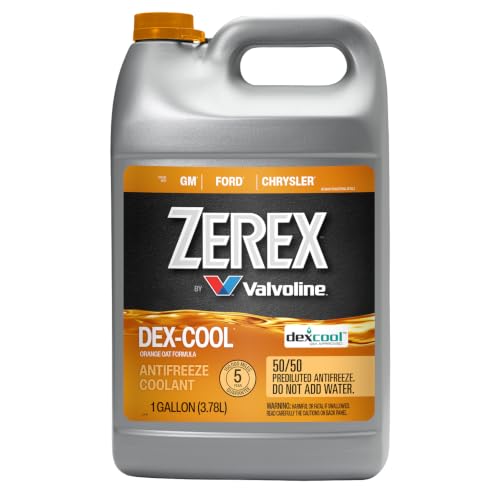
Zerex Dex-Cool 50/50 Ready-to-Use Antifreeze Coolant is my top pick for drivers seeking reliable, long-term engine protection without the hassle of mixing concentrate. It provides freeze protection down to -34°F and prevents boil-over up to 265°F. The organic acid technology delivers lasting defense against rust, scale, and corrosion. It’s safe for all cooling system metals, especially aluminum. Pre-mixed with deionized water in a 50/50 ratio, this orange formula is Dex-Cool compatible. It contains additives that protect gaskets, hoses, and plastics. I rely on its 5-year or 150,000-mile warranty for extended service life.
Best For: Drivers seeking a reliable, ready-to-use antifreeze coolant that delivers long-term protection for modern engines, especially those with aluminum components.
Pros:
- Offers excellent freeze and boil-over protection with a wide temperature range from -34°F to 265°F
- Pre-mixed 50/50 formula with deionized water for immediate use and optimized compatibility with Dex-Cool systems
- Backed by a 5-year or 150,000-mile warranty, ensuring extended service life and durability
Cons:
- Orange color may cause confusion if mixed with non-compatible coolants, risking potential system damage
- Contains denatonium benzoate, which while safe, may raise concerns for environmentally sensitive users
- Slightly higher price point compared to some conventional coolants due to extended-life formulation
PEAK OET Blue Antifreeze for Asian Vehicles
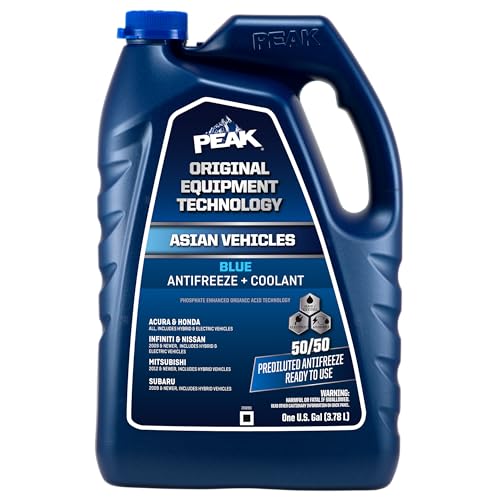
I rely on PEAK OET Blue Antifreeze when maintaining Asian vehicles that demand a phosphate-enhanced organic acid technology (POAT) coolant, especially because it’s engineered specifically for brands like Honda, Acura, Nissan, and Subaru. This 1-gallon, 50/50 prediluted coolant is ready to use-no mixing required. It protects against rust and corrosion using advanced POAT chemistry. I appreciate the included Denatonium Benzoate, a bittering agent that discourages accidental ingestion. When I perform a full flush and fill, I trust it delivers up to 150,000 miles or 5 years of guaranteed protection. It’s fully compatible with other extended life coolants, making maintenance simple and safe.
Best For: Drivers of Asian vehicles like Honda, Acura, Nissan, and Subaru requiring a phosphate-enhanced organic acid technology (POAT) coolant.
Pros:
- Specifically formulated for Asian vehicles requiring blue POAT coolant, ensuring optimal compatibility
- 50/50 prediluted, ready-to-use formula with no mixing required for convenient maintenance
- Provides up to 150,000 miles or 5 years of guaranteed protection when used in a full flush and fill
Cons:
- Limited to vehicles requiring POAT formulation, reducing universal applicability
- Contains bittering agent that, while safe, may complicate emergency topping off if unfamiliar
- Not ideal for non-Asian vehicle brands or those requiring different coolant chemistries
Mopar 10 Year/150,000 Mile Coolant 50/50 Premixed
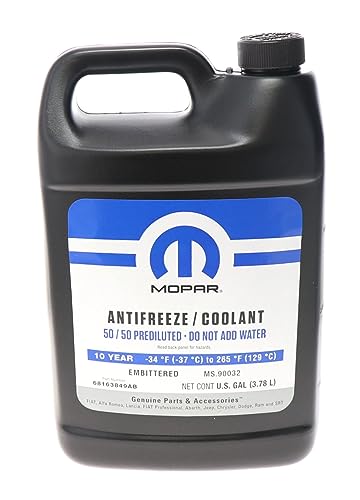
Mopar 10 Year/150,000 Mile Coolant 50/50 Premixed is the best choice for owners of Chrysler, Dodge, Jeep, Ram, Fiat, and Alfa Romeo vehicles manufactured from 2013 through 2021. I rely on this coolant because it’s pre-mixed 50/50, so I don’t need to dilute it. It has a freeze point of -34°F and a boil point of 265°F, protecting my engine in extreme conditions. It meets ASTM D3306 Type 3 standards and lasts up to 10 years or 150,000 miles. The embittered formula helps prevent accidental ingestion. One gallon weighs 9.24 lbs and fits easily in my trunk for top-offs.
Best For: Owners of Chrysler, Dodge, Jeep, Ram, Fiat, and Alfa Romeo vehicles from 2013–2021 seeking long-life, pre-mixed coolant that offers reliable protection without the need for dilution.
Pros:
- Pre-mixed 50/50 formula eliminates the need for dilution, making it convenient and ready to use
- Long service life of up to 10 years or 150,000 miles reduces maintenance frequency
- Meets ASTM D3306 Type 3 standards with a wide temperature range (freeze point -34°F, boil point 265°F) for reliable performance
Cons:
- Limited to specific Mopar and affiliated brand vehicles, reducing universal applicability
- Slightly higher weight (9.24 lbs) may be cumbersome for some users during handling
- Embittered formula, while safety-focused, does not address potential environmental concerns with disposal
PEAK Antifreeze & Coolant 1 Gal

This coolant stands out for drivers who demand long-term protection without frequent replacements. I rely on PEAK Global Lifetime Concentrate-it’s a 1-gallon ethylene glycol-based formula with Organic Acid Technology (OAT) that protects all metals in my engine’s cooling system. It’s non-abrasive, contains Denatonium Benzoate to deter ingestion, and mixes safely with any coolant type. The amber color won’t disrupt existing coolants. I use it in all my vehicles-American, Asian, European, light or heavy-duty-regardless of age. When mixed 50/50 with water, it delivers lifelong corrosion and rust protection, provided I maintain it properly.
Best For: Drivers seeking a long-lasting, universal antifreeze and coolant that provides lifetime protection across all vehicle types and brands when properly maintained.
Pros:
- Features Organic Acid Technology (OAT) for extended protection against rust and corrosion in all metals
- Compatible with all antifreeze types and safe for use in American, Asian, and European vehicles of any model or year
- Ethylene glycol-based concentrate with a bittering agent to discourage accidental ingestion
Cons:
- Must be mixed 50/50 with water for optimal performance, requiring additional preparation
- Concentrate format means it cannot be used directly from the jug without dilution
- Lifetime protection claim is contingent on proper maintenance, which may not be clear to all users
Honda Genuine Antifreeze/Coolant Type 2 (1 Gallon)

Honda Genuine Antifreeze/Coolant Type 2 (1 Gallon) is the best choice for Honda owners who demand factory-matched protection and long-term reliability. It’s pre-mixed at a 50/50 ratio, so you can use it straight from the container-no dilution needed. The coolant uses ethylene glycol for thermal stability and includes denatonium benzoate to discourage accidental ingestion. It’s specifically engineered for Honda systems requiring Type 2 (Long-Life Blue) coolant. I trust it to prevent freezing and boil-over in extreme temperatures. It guards against corrosion in both metal and non-metal parts. Change intervals stretch up to 5 years or 60,000 miles under normal conditions.
Best For: Honda owners seeking factory-specified, long-life coolant with hassle-free, pre-diluted protection.
Pros:
- Pre-mixed 50/50 ratio for immediate use without dilution
- Formulated to meet Honda’s Type 2 (Long-Life Blue) specifications for optimal compatibility
- Provides up to 5 years or 60,000 miles of protection against freeze, boil-over, and corrosion
Cons:
- Higher cost compared to non-OEM or universal coolants
- Limited to Honda vehicles requiring Type 2 coolant, reducing versatility
- Contains ethylene glycol, which is toxic if ingested despite bittering agent
PEAK OET Antifreeze/Coolant for Asian Vehicles

If you own an Asian-made vehicle like a Toyota, Lexus, or Scion that requires a phosphate-enhanced organic acid technology (POAT) coolant, PEAK OET Extended Life Red/Pink 50/50 antifreeze/coolant is the best choice. I rely on its pre-mixed 50/50 formula for immediate use-no dilution needed. It contains POAT for superior corrosion protection and includes Denatonium Benzoate to deter accidental ingestion. I’ve seen it protect aluminum, steel, and rubber components up to 150,000 miles or 5 years after a complete flush and fill. It’s fully compatible with other extended life coolants.
Best For: Drivers of Asian vehicles like Toyota, Lexus, and Scion that require a phosphate-enhanced organic acid technology (POAT) coolant.
Pros:
- Pre-mixed 50/50 formulation for immediate use without dilution
- Provides up to 150,000 miles or 5 years of protection after a complete flush and fill
- Contains Denatonium Benzoate to help prevent accidental ingestion
Cons:
- Specifically designed for Asian vehicles, limiting use in non-compatible engines
- Red/Pink POAT formula may not be suitable for vehicles requiring other coolant types
- Potential compatibility issues if mixed with non-extended life or conventional coolants
PEAK OET Pink Antifreeze/Coolant 1 Gal

For drivers of European vehicles requiring a reliable, long-lasting coolant, PEAK OET Pink Antifreeze/Coolant 1 Gal stands out as a top-tier choice. I use this 1-gallon, 50/50 prediluted formula because it’s ready to pour-no mixing needed. It’s based on silicate-free Organic Acid Technology (OAT), colored pink for easy identification. This coolant protects against rust and corrosion, safeguarding metals in the cooling system. I rely on its Denatonium Benzoate additive, which deters accidental ingestion. It’s compatible with Audi, Fiat, Saab, and other European models needing pink OAT. When I do a full flush and fill, I expect up to 150,000 miles or 5 years of protection.
Best For: Drivers of European vehicles such as Audi, Fiat, and Saab that require a silicate-free, pink OAT antifreeze/coolant for long-term engine protection.
Pros:
- Ready-to-use 50/50 prediluted formulation eliminates the need for mixing
- Provides extended life protection up to 150,000 miles or 5 years when installed properly
- Silicate-free OAT formula prevents rust and corrosion while being compatible with various coolants
Cons:
- Specifically designed for certain European vehicles, limiting use in other models
- Pink color aids identification but may cause confusion if mixed with other coolants
- Bittering agent, while safe, is a reminder of toxicity and requires careful handling around pets and children
Zerex Blue Antifreeze/Coolant 1 GA

This coolant stands out for owners of Asian-made vehicles that demand a silicate-free, blue-formulated HOAT coolant, especially when maintaining long-term engine health is non-negotiable. I rely on Zerex Blue because it’s engineered specifically for Honda, Nissan, KIA, Hyundai, and similar brands requiring blue HOAT fluid. Its silicate-, phosphate-, and borate-free formula prevents deposit buildup in sensitive cooling systems. I appreciate the pre-diluted 50/50 mix-no guesswork, just direct fill. It protects up to 5 years or 150,000 miles. The coolant meets MS 591-08, JIS K 2234, and ASTM D3306 standards, ensuring OEM-level performance.
Best For: Drivers of Asian-made vehicles like Honda, Nissan, KIA, and Hyundai that require a blue, silicate-free HOAT coolant for long-term engine protection.
Pros:
- Specifically formulated for Asian vehicles requiring blue HOAT coolant, ensuring optimal compatibility
- Pre-diluted 50/50 ready-to-use mix eliminates the need for mixing and reduces user error
- Long-life protection up to 5 years or 150,000 miles with rust, corrosion, and deposit inhibition
Cons:
- Limited to vehicles requiring blue HOAT coolant, not suitable for all makes or coolant types
- Contains denatonium benzoate, which may be a concern for users avoiding bittering agents
- Higher cost compared to universal or generic coolants due to specialized formulation
Zerex G40 Phosphate and Nitrite Free Concentrate Antifreeze/Coolant 1 GA
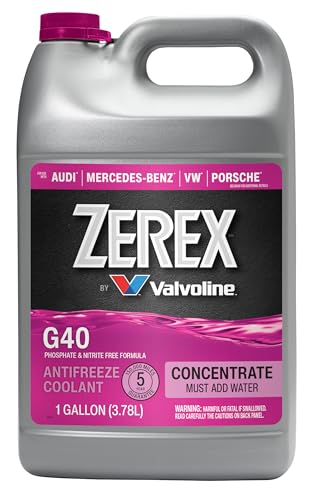
I rely on Zerex G40 Phosphate and Nitrite Free Concentrate Antifreeze/Coolant when maximum protection without harmful additives is non-negotiable. Its Si-organic acid technology prevents corrosion and rust, safeguarding all metals, especially aluminum. It contains no phosphates or nitrites, reducing scaling and deposits. I dilute the violet concentrate with water at 50/50, 60/40, or 70/30 ratios. At 50/50, it protects from -34°F to 265°F; 60/40 reaches -62°F to 270°F. It includes 30–50 ppm denatonium benzoate to deter ingestion. I trust its 5-year, 150,000-mile warranty against freeze-ups or boil-overs.
Best For: Drivers seeking long-lasting, phosphate- and nitrite-free coolant with superior corrosion protection for modern engines, especially those with aluminum components.
Pros:
- Utilizes Si-organic acid technology to effectively prevent corrosion and rust in all cooling system metals, including aluminum
- Contains no phosphates or nitrites, minimizing scaling and deposit buildup in the cooling system
- Backed by a 5-year or 150,000-mile warranty and offers flexible freeze/boil protection with adjustable mix ratios
Cons:
- Requires careful mixing with water, which may be inconvenient for users seeking pre-diluted coolants
- Violet dye may stain surfaces or skin during handling, requiring extra caution during installation
- Bittering agent, while safe, indicates potential toxicity requiring secure storage away from children and pets
Factors to Consider When Choosing the Best Coolant
You need to check your vehicle’s coolant compatibility requirements before choosing a product-using the wrong type can damage aluminum components or plastics in the cooling system. Consider the coolant formulation type, like OAT, IAT, or HOAT, since each offers different protection levels and works with specific engine materials and service life expectancies, typically ranging from 30,000 to over 150,000 miles. Also, decide between ready-to-use and concentrate coolants, as pre-mixed versions save time while concentrates can reduce costs if you properly dilute them with distilled water.
Compatibility Requirements
Choosing the right coolant starts with understanding chemical compatibility, as using the wrong type can lead to serious engine damage. You must match your coolant to your vehicle’s required formulation-OAT, HOAT, or POAT-because each protects specific engine materials. Manufacturers design these coolants to work with particular metal compositions, especially aluminum, and under defined temperature ranges. Using an incompatible type can cause gel formation, reducing heat transfer and increasing corrosion risk. This may result in cooling system failure. Never rely on color to determine compatibility; different chemistries can share the same hue. Instead, check for certifications like ASTM D3306 or JIS K 2234, which confirm proper corrosion inhibition, chemical stability, and long-term protection. Always verify the coolant meets your engine maker’s exact specifications. Mixing types risks damage.
Coolant Formulation Type
Organic Acid Technology (OAT) coolants deliver extended service life by forming a thin, stable layer on metal surfaces, preventing corrosion without relying on silicates. They’re silicate-free and ideal for modern engines needing long-term protection. Hybrid Organic Acid Technology (HOAT) blends OAT with small amounts of silicates for fast-acting defense, especially on aluminum parts. This mix offers quick protection while maintaining extended performance. Phosphate-Enhanced Organic Acid Technology (POAT) uses phosphates to shield aluminum and metals in high-temperature engines, common in many Asian and European vehicles. In contrast, Inorganic Additive Technology (IAT) depends on silicates and phosphates for immediate protection but depletes faster, requiring more frequent changes. All types may include denatonium benzoate at 30–50 ppm, a bittering agent that helps prevent accidental ingestion.
Service Life Expectancy
While coolant longevity varies widely across formulations, service life expectancy is a critical factor in maintaining engine reliability and minimizing maintenance costs. You’ll find options lasting 5 years or 60,000 miles up to 15 years or 400,000 miles, depending on formulation. Extended-life coolants typically protect for 5 years or 150,000 miles, preventing rust, corrosion, and boil-over. Some deliver lifetime protection when you perform a complete flush and fill, as long as you follow up with regular inspections. Chemical makeup matters-OAT and HOAT technologies resist breakdown better than older formulas. These advanced coolants maintain integrity under stress because their organic acids form protective layers on metal surfaces. Pre-diluted 50/50 mixes offer stable performance; the balanced glycol-to-water ratio prevents degradation across operating conditions. Matching coolant life to your driving habits makes maintenance easier and engine protection more predictable.
Temperature Protection Range
Coolant doesn’t just manage heat-it protects your engine across extreme temperatures, a role that becomes more demanding as service intervals stretch. You need a coolant that prevents freezing in winter and boil-over in summer. Most coolants, mixed 50/50 with water, guard against freezing down to -34°F (-37°C) and raise the boiling point to about 265°F (129°C). Adjusting the mix increases protection-higher glycol concentrations can lower freeze points to -84°F (-64°C). Ethylene glycol-based formulas stay fluid in severe cold and resist vapor lock under heavy loads. But if you dilute the mix too much, you weaken both freeze and boil protection, risking engine damage. Long-life coolants hold their performance over time, as long as you maintain the right dilution and follow service guidelines. Your engine relies on this balance to survive temperature extremes without failure.
Ready-To-Use Vs Concentrate
How do you decide between convenience and control?
You want reliable engine protection without guesswork-choose ready-to-use coolant. It comes pre-mixed at a 50/50 ratio of antifreeze to water, ensuring freeze protection down to -34°F and boil-over resistance up to 265°F. No measuring or dilution is needed, minimizing human error. This is ideal for quick top-offs or routine maintenance.
But you need maximum flexibility in extreme climates-use concentrate. You mix it with clean water at ratios like 50/50, 60/40, or 70/30 based on temperature demands. A 70/30 blend can deliver freeze protection as low as -84°F.
Yet improper mixing risks poor corrosion control or freezing. Get it wrong, and your engine pays the price. Choose carefully-your climate and precision determine the best path.
Frequently Asked Questions
Can I Mix Different Colored Coolants?
No, you can’t mix different colored coolants safely. Colors indicate specific chemical formulations, and mixing them risks gelling or sludge. Incompatible coolants like OAT and IAT react poorly, reducing heat transfer and corrosion protection. Always drain and flush the system before switching types. Use only the coolant specified by your vehicle’s manufacturer. Mixing types might seem convenient, but it compromises engine longevity and cooling efficiency-like diluting medicine with an unknown substance.
How Often Should I Change My Coolant?
You should change your coolant every 30,000 to 50,000 miles or every 2 to 5 years. Always follow your vehicle manufacturer’s recommendation-older models need changes more often. Coolant degrades over time, losing pH balance and corrosion inhibitors. Neglecting it risks overheating and internal engine damage. Check it regularly; if it’s cloudy or contaminated, flush and replace it immediately.
Is Distilled Water Better Than Tap Water for Mixing?
Yes, you should use distilled water instead of tap water when mixing coolant. Tap water contains minerals and impurities that can form deposits and corrode engine components. Distilled water has had these contaminants removed, ensuring a consistent 50/50 mix. This improves heat transfer efficiency and prevents scale buildup in the radiator and coolant passages, protecting your engine’s longevity and maintaining ideal operating temperature over time.
Does Coolant Expire if Unopened?
Yes, coolant can expire even if unopened. Manufacturers typically stamp a shelf life of 2 to 5 years on bottles. Over time, chemical stabilizers degrade, reducing corrosion inhibition. Unopened bottles stored in extreme temperatures fail faster. The ethylene glycol base stays stable, but additives break down. Always check the production date and inspect for cloudiness or separation before use. Expired coolant risks engine damage.
Can Old Coolant Cause Overheating?
Yes, old coolant can cause overheating. You’re risking engine damage when degraded fluid loses its thermal stability. Over time, coolant breaks down, reducing its ability to transfer heat-its boiling point drops below the standard 223°F (106°C) for 50/50 mixtures. Corrosion inhibitors fade, letting rust and scale clog passages. That restricts flow and insulates hot spots. You need effective heat dissipation, not sediment buildup. Replace coolant every 2–5 years to maintain efficiency.