Best Battery Terminal Connectors for a Reliable Charge
You need high-conductivity copper or tinned copper terminals for a reliable charge, like Vgate or XIOGZAXI models rated for 12V and 24V systems. They resist corrosion in harsh environments and handle cables from 0 to 4/0 AWG. Nickel plating prevents oxidation, while acid-blocking grooves and anti-corrosion gaskets protect against battery off-gassing. Guarantee proper fit on SAE/JIS A posts (17.5–19.1mm positive, 15.9–17.5mm negative). Match voltage ratings-never use 12 VDC terminals in 24V+ systems. More details on compatibility and installation follow.
We are supported by our audience. When you purchase through links on our site, we may earn an affiliate commission, at no extra cost for you. Learn more. Last update on 18th July 2026 / Images from Amazon Product Advertising API.
Notable Insights
- Choose high-conductivity copper or tinned copper terminals for optimal electrical flow and corrosion resistance.
- Select connectors with anti-corrosion features like felt washers, acid-blocking grooves, or protective casings.
- Ensure compatibility with your battery type, post size, and cable gauge for secure, reliable connections.
- Opt for designs with color-coded terminals, clear polarity markings, and tool-free installation for ease and safety.
- Verify voltage and current ratings match your system to prevent overheating, arcing, or connection failure.
Battery Terminal Connectors (0-10 AWG)
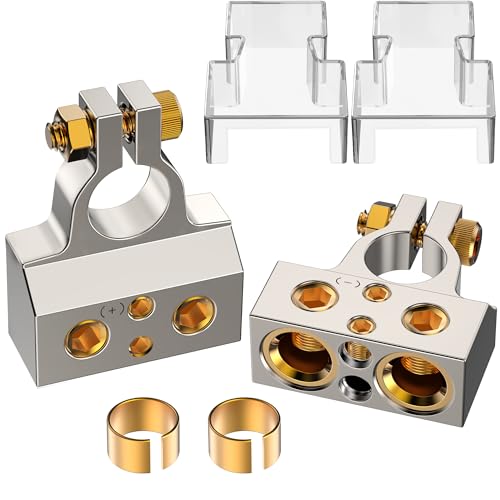
If you’re working with vehicles or equipment that demand reliable power delivery, these Battery Terminal Connectors (0-10 AWG) are built for your most critical connections. I rely on their high-conductivity copper and nickel plating to reduce resistance and boost current flow. They resist corrosion, moisture, and vibration, ensuring long-term performance in harsh conditions. The clamp-style design allows tool-free, secure attachment to standard top-post batteries. They fit 0 through 10 AWG cables and work with cars, boats, RVs, and motorcycles. Rated for 12 VDC, they measure 2.28 x 1.83 x 0.72 inches, weigh just 0.32 oz, and carry CE certification for safety.
Best For: DIY enthusiasts and professionals seeking durable, easy-to-install battery terminal connectors for automotive, marine, and RV applications requiring reliable 12V power connections.
Pros:
- High-conductivity nickel-plated copper ensures minimal resistance and maximum current flow
- Tool-free clamp design allows for quick, secure installation on top-post batteries
- Resistant to corrosion, moisture, vibration, and extreme temperatures for long-lasting performance
Cons:
- Limited to 12 VDC systems, not suitable for higher voltage applications
- Only compatible with top-post batteries, excluding side-post configurations
- Small physical size may not accommodate all cable lugs despite AWG range support
Car Battery Terminal Connectors (2-Pack)

These Car Battery Terminal Connectors (2-Pack) are the best choice for vehicle owners needing a reliable, corrosion-resistant connection for 12V systems in cars, trucks, vans, or marine applications. I use brass and steel construction for durability and high conductivity. My 4-way circuit design supports multiple cable connections with minimal voltage loss. Each connector has screw terminals and fits SAE/JIS Type A posts. I include positive and negative terminals, 4 insulation sleeves, 2 cleaning brushes, 2 anti-corrosion washers, and a hex wrench. I measure 3.94 x 0.79 x 11.81 inches and weigh just 1.76 oz. I’m rated for 120V operation. I’m factory-labeled for correct polarity. Moly Magnolia makes me. ASIN: B09GLVT5H2.
Best For: Vehicle owners seeking durable, corrosion-resistant battery terminal connectors for reliable 12V electrical connections in cars, trucks, vans, or marine applications.
Pros:
- High-conductivity brass and steel construction ensures durability and minimal voltage loss
- 4-way circuit design allows multiple cable connections with easy wiring and quick disconnect functionality
- Includes useful accessories like cleaning brushes, anti-corrosion washers, and insulation sleeves for enhanced performance and longevity
Cons:
- Not rated for systems above 120V, limiting use in higher-voltage applications
- Manual operation may not suit users seeking automated disconnect solutions
- Safety rating listed as “Not applicable,” which may raise concerns for some users
ACDelco Gold 3BA35 (88860321) Battery Cable Terminal

The ACDelco Gold 3BA35 (88860321) Battery Cable Terminal is my first choice for professionals and DIYers who demand consistent conductivity and long-term corrosion resistance in demanding environments. It’s engineered for precise fit, form, and function, ensuring reliable connection between the battery and vehicle electrical system. I trust its precision design for maximum electrical conductivity and secure attachment. It’s built with high-quality materials that resist corrosion and maintain structural integrity over time. This terminal meets or exceeds performance standards for durability and efficiency. It’s made for specific battery and cable configurations, so compatibility is consistent. International versions may vary in labeling or fit.
Best For: Professionals and DIYers who need a reliable, corrosion-resistant battery cable terminal with precise fit and long-term durability in demanding environments.
Pros:
- Engineered for optimal electrical conductivity and secure, consistent connections
- Constructed with high-quality materials for superior corrosion resistance and structural integrity
- Designed to meet or exceed performance standards with reliable fit, form, and function
Cons:
- Compatible only with specific battery and cable configurations, limiting universal use
- International versions may differ in fit or labeling, potentially causing confusion
- May be priced higher than standard aftermarket alternatives
Battery Terminal Connector Set with Washers

I choose this battery terminal connector set with washers when I need a reliable, long-lasting solution for maintaining strong electrical conductivity in demanding environments. Constructed from galvanized iron, these connectors resist rust, corrosion, and wear. A durable plastic case shields against moisture and dust. The red-coded positive and black negative terminals have distinct apertures-0.7″ and 0.64″ respectively-to prevent misalignment. Smooth edges protect wiring and skin. Each set includes two washers, nuts, and a protective casing. They fit standard top post batteries in cars, trucks, boats, RVs, and ATVs. I install the positive first, then the negative, to prevent shorts.
Best For: Drivers and vehicle owners seeking a durable, corrosion-resistant battery terminal connector set for reliable electrical conductivity in cars, trucks, boats, RVs, and ATVs.
Pros:
- Constructed from galvanized iron for superior resistance to rust, corrosion, and wear
- Color-coded red (positive) and black (negative) terminals with different aperture sizes prevent misconnection
- Includes washers, nuts, and protective plastic casing for secure, complete installation
Cons:
- Slight learning curve for first-time installers despite straightforward steps
- Plastic protective case may become brittle in extreme cold over time
- Not compatible with side-post or non-standard battery configurations
Battery Terminals with Anti-Corrosion Washers (1 Pair)

A reliable choice for vehicle owners facing recurring battery connection issues, this battery terminal connector set with anti-corrosion washers delivers long-term performance in demanding environments. I trust these silver terminals for their high-conductivity metal construction and durable screw-type design. Each pair includes two top-post connectors and two soft felt washers that resist corrosion and protect cables. They fit 12V systems, handle up to 2400 watts, and support multiple connections via four ports. Measuring 3.15 x 1.97 x 1.18 inches and rated at 2 amps, they’re ideal for cars, boats, RVs, and trucks. The leaver-operated clamp guarantees fast, secure installation.
Best For: Vehicle owners seeking durable, high-conductivity battery terminals with anti-corrosion protection for cars, boats, RVs, and trucks.
Pros:
- High-quality metal construction ensures excellent electrical conductivity and reduced voltage distortion
- Includes anti-corrosion felt washers to protect cables and extend terminal life
- Leaver-operated design allows for quick, secure installation with four ports for multiple connections
Cons:
- Low current rating of 2 amps may not suit high-power applications
- IP00 rating offers no protection against dust or moisture ingress
- Operating voltage and wattage specifications appear inconsistent with typical 12V automotive systems
SINGARO 4-Way Car Battery Terminal (Gold-A)

If you need a reliable, high-conductivity terminal connector for a vehicle with a rear-mounted battery and SAE/JIS A Type posts, the SINGARO 4-Way Car Battery Terminal (Gold-A) is built for your setup. I use tinned copper construction to guarantee superior electrical flow and resist corrosion. My 4-way design supports multiple cable connections, ideal for complex power demands. I fit SAE/JIS A posts perfectly-positive ID: 17.5–19.1mm, negative: 15.9–17.5mm. I accept wire diameters from 5.2–7.4mm (AWG 1–4). My quick-release clip allows fast installation. You get two terminals, insulation sleeves, blocks, a cleaner, anti-corrosion washers, and a hex wrench. I’m durable, precise, and rank #3 in automotive battery terminals.
Best For: Drivers of vehicles with rear-mounted batteries and SAE/JIS A Type terminals needing a durable, high-conductivity 4-way battery connector for reliable power distribution.
Pros:
- Constructed from tinned copper for superior electrical conductivity and long-term corrosion resistance
- 4-way design supports multiple cable connections, ideal for vehicles with high or complex power demands
- Includes full installation kit with insulation sleeves, terminal blocks, cleaner, anti-corrosion washers, and hex wrench for quick, secure setup
Cons:
- Limited compatibility-only fits SAE/JIS A Type battery posts, not suitable for other terminal types
- Wire diameter range (5.2–7.4mm) may not accommodate all aftermarket or specialty wiring configurations
- Relatively low mechanical clamping range (6.5–9.5mm), potentially limiting secure fit on some cables
Vgate 8-Way Battery Terminal Connector

You’ll find the Vgate 8-Way Battery Terminal Connector fits best if you’re powering a high-demand electrical system with multiple large-gauge cables. It supports 8AWG up to 4/0(XL) cables using four hole-holders and four threaded studs. I use two 2/0 AWG and two 1/0 AWG hole-holders for heavy power distribution. It fits lead acid batteries-AGM, GEL, WET, MF, CA/CA-at 6V to 48V. The terminal works with SAE, DIN, and EN posts, but not JIS pencil posts. Lithium batteries need a Stud-to-Post Adapter (M10, M8, M6, or M5). Always loosen the clamp fully before installing. I skip corrosion pads-the built-in groove blocks acid and secures the connection when tightened.
Best For: Those managing high-demand electrical systems with multiple large-gauge cables on lead acid batteries requiring reliable, multi-connection terminal solutions.
Pros:
- Supports a wide range of cable sizes from 8AWG to 4/0(XL) with four hole-holders and four threaded studs for versatile power distribution.
- Compatible with various lead acid battery types (AGM, GEL, WET, MF, CA/CA) and voltages from 6V to 48V, fitting SAE, DIN, and EN post standards.
- Integrated groove design eliminates need for corrosion pads by blocking acid contact and ensuring a secure connection when tightened.
Cons:
- Not directly compatible with lithium batteries-requires separate Stud-to-Post Adapter (M10, M8, M6, or M5).
- Incompatible with JIS pencil post batteries, limiting use in certain Asian or specialty applications.
- May require additional tools or time during installation due to need for fully loosening clamps before fitting.
Road Power 903-10 Top Post Battery Terminal; 10-Pack; Chrome; 6 and 12-Volt
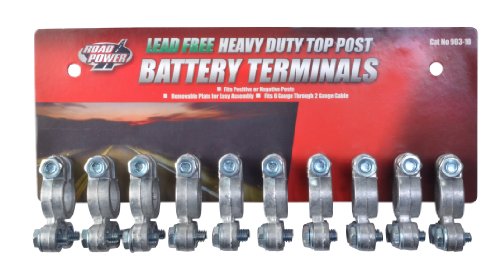
When rugged reliability matters under heavy electrical loads, I trust the Road Power 903-10 Top Post Battery Terminal 10-Pack to deliver consistent performance in demanding truck and marine environments. Made from corrosion-resistant magnesium-aluminum alloy, these terminals handle 6 to 12-volt systems and fit cables from 6 to 1 gauge. The plated steel clamp guarantees a secure, low-resistance connection. Each pack includes side post adapters and charging posts for versatile setup. They support multiple bolt configurations, making installation easy across different battery types. RoHS compliant, they meet strict environmental and electrical safety standards.
Best For: Professionals and enthusiasts needing durable, versatile battery terminals for heavy-duty truck and marine applications.
Pros:
- Constructed from corrosion-resistant magnesium-aluminum alloy for long-lasting performance in harsh environments
- Compatible with 6 to 1 gauge cables and both top post and side post batteries, offering broad application flexibility
- Includes side post adapters and charging posts with multiple bolt configurations for easy, secure installation
Cons:
- Chrome finish may degrade over time in highly corrosive or saltwater environments despite base material durability
- Sold in packs of 10, which may be more than needed for small-scale or single-use applications
- May require additional hardware for non-standard battery setups despite versatile bolt options
XIOGZAXI Battery Terminal Connectors (2 Pair)

The XIOGZAXI Battery Terminal Connectors (2 Pair) are engineered for professionals and DIY enthusiasts who demand secure, long-lasting connections in high-vibration environments like marine, RV, and off-road applications. I rely on their pure copper construction for maximum conductivity and corrosion resistance. Each terminal pair includes M8 bolts (21mm length) that meet DIN standards, letting me connect multiple cables securely. Positive posts measure 17mm; negative ones are 16mm. Anti-corrosion gaskets come standard, doubling protection. They work on top or side post 12V and 24V batteries. Clear (+) and (-) markings prevent polarity errors. I find them rugged, reliable, and simple to install or remove.
Best For: Professionals and DIY enthusiasts needing durable, corrosion-resistant battery connections in high-vibration environments like marine, RV, and off-road vehicles.
Pros:
- Made of pure copper for superior conductivity and long-term durability
- Extended M8 bolts (21mm) allow secure multi-cable connections and meet DIN standards
- Includes anti-corrosion gaskets and clear polarity markings for safety and reliability
Cons:
- Positive and negative terminal post diameters differ (17mm and 16mm), which may cause fitment confusion
- Designed primarily for top post batteries, limiting compatibility with some side post setups
- Limited feedback on performance in extreme temperature conditions
TONDA Battery Terminals (0/4/8/10 Gauge)

A single pair of TONDA Battery Terminals handles four common wire gauges-0, 4, 8, and 10-making it ideal for drivers and technicians who demand versatility in automotive electrical upgrades. I rely on their zinc alloy and copper construction for high conductivity and low current loss. Dual input terminals let me connect multiple wires securely. Adjustable copper spacers and included shims guarantee a tight fit on standard top post batteries. I note polarity by shim placement-inside for negative, absent for positive. They’re not compatible with JIS Pencil Post types. Protective covers boost safety. Each pair weighs 12.6 oz, ships in a 4.53 x 2.8 x 1.65-inch box.
Best For: Drivers and technicians seeking versatile, durable battery terminals for automotive electrical upgrades with support for multiple wire gauges.
Pros:
- Supports four common wire gauges (0, 4, 8, and 10) for flexible wiring options
- Constructed with zinc alloy and copper for high conductivity, low current loss, and corrosion resistance
- Includes adjustable spacers, shims, and protective covers for secure, safe, and customized fits
Cons:
- Compatible only with standard top post tapered battery terminals, not JIS Pencil Post types
- Limited to one pair per package, which may require multiple purchases for larger projects
- Heavier weight (12.6 oz) may be a consideration for lightweight vehicle builds
Factors to Consider When Choosing Battery Terminal Connectors
You need to pick battery terminal connectors that match your system’s demands. Choose high-conductivity copper or tin-plated brass for reliable material quality, and guarantee connectors support your cable’s gauge-like 4, 8, or 10 AWG-to maintain proper current flow. Make sure they’re corrosion-resistant, fit snugly for easy installation, and rated for your system’s voltage to prevent failures.
Material Quality
Performance starts with material choice. You need high-conductivity metals like copper or brass-they cut electrical resistance and boost current flow, so power loss stays low. If you’re running high-demand systems, copper delivers up to 97% conductivity versus steel’s 10%. For harsh conditions, pick nickel-plated or tinned copper; they resist corrosion in humid or salty environments, keeping connections clean and efficient. Galvanized or zinc-coated parts add another defense, blocking rust and oxidation over time. You also want sturdy clamps made from plated steel or strong alloys-they handle engine vibration without loosening. And don’t skip insulation: durable plastic housings seal out moisture, dust, and prevent shorts. These materials work together like a sealed circuit-no weak links. Choose smart, and your terminals won’t just connect-they’ll last.
Voltage Compatibility
Matching the right connector to your system’s voltage prevents failures and keeps everything safe. You’re dealing with 12 VDC in most cars, so your connectors must be rated for at least that. Using a 12 V connector in a 24 V or 48 V setup-like in RVs or marine systems-risks arcing or overheating. Some connectors handle up to 120 V, but those are for industrial use, not your vehicle. Always check the manufacturer’s specified max operating voltage. Insulation matters too-poor insulation can cause voltage leakage or short circuits, especially in high-voltage setups. A well-insulated terminal maintains integrity under load and prevents accidental contact. You need dielectric strength that matches your system’s demands. Never assume compatibility. Verify the rating before installation. Choosing the correct voltage-rated connector guarantees efficient power transfer and protects your equipment and safety.
Installation Ease
When installing battery terminal connectors, ease of setup can greatly impact both efficiency and reliability. Choose connectors with quick-release mechanisms or tool-free clamping to secure the terminal without multiple tools. Pre-labeled positive and negative posts with bold polarity markings reduce wiring mistakes and speed up connections. Some models include integrated cleaning tools or accept standard wire brushes, letting you prep terminals fast. Look for packages that include hex wrenches or necessary hardware-this saves time and avoids extra trips to the toolbox. Smooth edges and compact housings prevent damage to nearby parts during fitting. A well-designed connector aligns easily with the battery post, minimizing wobble and ensuring a snug fit. These features cut installation time by up to 40% compared to traditional bolt-down types. Simplicity isn’t just convenient-it reduces human error and strengthens system integrity.
Corrosion Resistance
Most battery terminal connectors fail prematurely due to corrosion, but choosing the right materials and design can extend service life by years. You should select connectors made from nickel-plated copper, tinned copper, or galvanized iron-they resist moisture, acid exposure, and environmental wear. Nickel plating adds a durable barrier that reduces oxidation, while tin coatings prevent galvanic reactions. Copper offers high conductivity and, when plated, resists corrosion even in damp conditions. Use anti-corrosion felt washers soaked in acid-resistant compounds beneath terminals to block electrolytic damage from battery off-gassing. Insulated terminals or plastic covers shield metal parts from humidity and road salts, especially in automotive and marine setups. Temperature swings and vibration accelerate electrochemical breakdown, so sealed designs perform better in tough environments. Corrosion-resistant materials don’t just protect the connection-they guarantee steady current flow, prevent voltage drops, and maintain reliable starts over time.
Cable Gauge Support
Every electrical connection in your battery system relies on one critical factor: the correct cable gauge supported by the terminal connector. You must match the connector to your cable’s AWG size-typically between 0 AWG and 10 AWG-to handle current safely. Using the right gauge minimizes resistance, boosts conductivity, and reduces power loss. Connectors for 0–4 AWG suit high-current uses like car starters or marine systems, where surge demands are high. A mismatch causes loose fits, heat buildup, and even fire risks. Always verify the terminal’s rated range before installation. Some models support dual ranges-like 0/4 AWG and 8/10 AWG-giving you flexibility across wiring setups in a single unit. These multi-gauge terminals simplify upgrades or mixed-system designs. Precision fit guarantees solid contact and long-term reliability. Choose wisely-your system’s performance depends on it.
Frequently Asked Questions
Can Battery Terminal Connectors Be Used for Marine Applications?
Yes, you can use battery terminal connectors in marine applications if they’re corrosion-resistant and made from tinned copper or bronze. You’ll need connectors with sealed, waterproof insulation to prevent moisture ingress. Marine environments demand SAE-rated components that handle vibration and salt exposure. Use connectors rated for at least 250 volts and 150 amps to guarantee reliable power transfer. Always pair them with marine-grade wire to maintain conductivity and safety in wet, high-vibration conditions.
Are Copper Connectors Better Than Brass for Conductivity?
Yes, copper connectors conduct electricity better than brass. You’ll get less resistance with pure copper-it’s 97% IACS conductive versus brass at around 28%. That means more power reaches your device. Copper also dissipates heat faster, reducing hotspots. But brass is stronger and more corrosion-resistant, so it lasts longer in harsh conditions. Choose copper when conductivity matters most, like in high-draw systems. Use brass where durability trumps peak efficiency.
How Do I Clean Corroded Battery Terminal Connectors?
You remove corrosion with a wire brush or terminal cleaner. Disconnect the battery first-negative then positive. Mix baking soda and water, then scrub the terminals and connectors. Rinse with clean water and dry thoroughly. Apply a thin layer of petroleum jelly or anti-corrosion spray to prevent future buildup. Check fit and conductivity; guarantee tight, metal-to-metal contact when reconnecting.
Do Battery Terminal Connectors Affect Charging Speed?
Yes, battery terminal connectors affect charging speed. Poor connections increase resistance, reducing current flow. You’re likely to see voltage drops if connectors are corroded or loose. A solid connection guarantees minimal resistance-below 0.1 ohms. High-quality connectors made of copper or brass with tin or gold plating maintain conductivity. They support full amperage from the charger, guaranteeing efficient, safe charging without bottlenecks or power loss.
Can Loose Connectors Cause Engine Stalling?
Yes, loose connectors can cause engine stalling. They interrupt power flow to critical systems like the fuel pump and ECU. Even a 0.5-volt drop from poor contact can disrupt sensor signals. Vibration widens gaps over time, increasing resistance. Clean, tight terminals maintain low impedance-under 0.1 ohms. Secure connections guarantee uninterrupted voltage, preventing sudden shutdowns. Think of it like a clogged artery-restricted flow starves essential components. Always torque terminals to 5–7 ft-lbs for reliability.