Best Parts Washers That Make Cleaning Engines a Breeze
You need a parts washer that handles heavy engine grime efficiently. Choose models with at least 20-gallon capacity for better solvent volume and reduced contamination. Units like the Red Sun 20-gal deliver 5.4 GPM for deep cleaning, while 40-gallon options from JEGS and VEVOR support large parts and longer fluid life. Use only water-based, non-flammable solvents like Oil Eater for safety. Look for 120V pumps, fused lids, and steel construction. Smart selections improve performance and durability on the job. More details can be found by exploring the top models.
We are supported by our audience. When you purchase through links on our site, we may earn an affiliate commission, at no extra cost for you. Learn more. Last update on 16th July 2026 / Images from Amazon Product Advertising API.
Notable Insights
- Choose a 10–40 gallon parts washer for effective cleaning of medium to large engine components with reduced fluid change frequency.
- Opt for models with high-flow pumps (up to 5.3 GPM) to efficiently clean crevices and heavy grime from engine parts.
- Use only water-based or compatible solvents to ensure safety, prevent damage, and maintain pump and seal integrity.
- Prioritize units with durable, powder-coated steel construction and welded seams for long-term resistance to chemicals and impacts.
- Look for built-in safety features like fusible links and overheat protection, especially when using electric pump systems.
Red Sun 20 Gal Electric Parts Washer

If you’re tackling heavy-duty engine cleaning with a focus on efficiency and safety, the Red Sun 20 Gal Electric Parts Washer stands out as a top-tier choice for professional mechanics and serious DIYers. Its 5-1/4 GPM pump delivers powerful circulation for fast, thorough cleaning. The flow-thru parts brush features a 28-inch (71 cm) tube and an 180-degree rotating metal nozzle to target grime precisely. A self-locking fuse cuts power and seals the lid if temperatures rise too high-critical for fire-safe operation. The filtered pump system recycles solvent by removing debris during use. Durable steel construction with anti-rust powder coating guarantees longevity. It’s not for use with volatile solvents like gasoline. A removable basket holds small parts-screws, bearings, gaskets, carburetors, wheel components. Built-in shelf and tank keep tools and fluids organized. Portable design lets me move it easily between workstations.
Best For: Professional mechanics and serious DIYers who need an efficient, durable, and fire-safe electric parts washer for heavy-duty engine cleaning.
Pros:
- High-flow 5-1/4 GPM pump with a flexible, rotating nozzle enables fast and targeted cleaning
- Self-locking fuse enhances safety by sealing the lid and cutting power if temperatures exceed safe limits
- Durable steel construction with anti-rust coating and a portable design with organized storage for tools and fluids
Cons:
- Not compatible with volatile solvents like gasoline, limiting chemical options
- Electric operation requires access to a power source, reducing outdoor or remote usability
- Higher upfront cost compared to basic manual parts washers
3.5 Gal Portable Steel Parts Washer

The 3.5 Gal Portable Steel Parts Washer is ideal for mechanics and technicians working in compact shops or mobile service environments where space and flexibility matter. I rely on its 3.5-gallon fluid reservoir to handle small to medium cleaning jobs efficiently. The work basin measures 18 inches wide by 13.5 inches deep and 9 inches high-perfect for gears, wheel bearings, and carburetors. Its 110V electric pump recycles cleaning liquid at 0.5 gallon per minute, boosting productivity. Built from durable steel, it’s lightweight and easy to move. A hinged lid with a fusible link closes automatically, reducing fire risks. I avoid flammable solvents-they’re not compatible. It includes a 1-year limited warranty.
Best For: Mechanics and technicians in compact or mobile work environments needing a reliable, portable solution for cleaning small to medium-sized parts.
Pros:
- Compact, durable steel design with a lightweight build for easy portability and space efficiency
- 110V electric pump continuously recycles cleaning fluid at 0.5 gallon per minute for efficient cleaning
- Hinged lid with fusible link safety feature automatically closes to reduce fire risk
Cons:
- Not compatible with flammable or combustible solvents, limiting cleaning agent options
- Limited 3.5-gallon capacity may require frequent fluid changes for heavy use
- Benchtop design may not accommodate very large or bulky parts
VEVOR 40-Gallon Parts Washer Cleaner
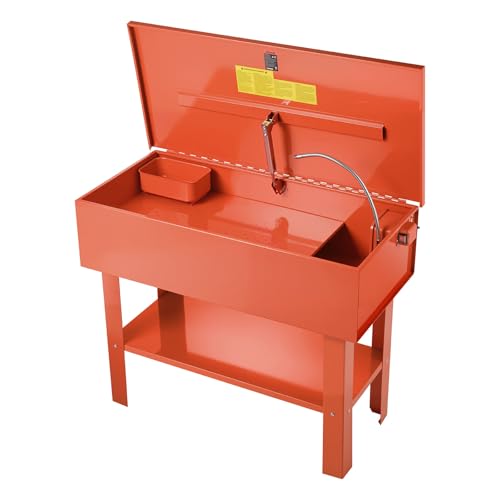
I rely on the VEVOR 40-Gallon Parts Washer Cleaner when tackling heavy-duty cleaning jobs in my workspace, especially for engine components that demand thorough degreasing and precise maintenance. Its 40-gallon tank holds 17 gallons of solvent, built from durable steel with a rust-resistant powder coating. It supports up to 220 lbs, ideal for large transmissions or engine blocks. The electric pump circulates solution at 1 GPM through a mesh filter and adjustable gooseneck tube, enabling continuous, efficient cleaning. Filtration reduces detergent use by reusing cleaned solvent. A bottom shelf stores tools and supplies, improving workspace organization.
Best For: Automotive technicians and DIY mechanics who need a durable, high-capacity parts washer for heavy-duty degreasing and efficient cleaning of large engine components.
Pros:
- Durable steel construction with rust- and corrosion-resistant coating supports up to 220 lbs for heavy automotive parts
- Electric pump and filtration system circulate solvent at 1 GPM, enabling continuous reuse and reduced detergent consumption
- Adjustable gooseneck tube and spacious 40-gallon tank allow thorough cleaning of large or complex parts, with a bottom shelf for organized tool storage
Cons:
- Solvent capacity is limited to 17 gallons, which may require frequent refills during extended use
- Electric pump may require maintenance over time, especially with heavy use or exposure to heavy contaminants
- Large footprint may be unsuitable for small workspaces or limited garage areas
Parts Washer 3.5 Gallon Portable Cleaner
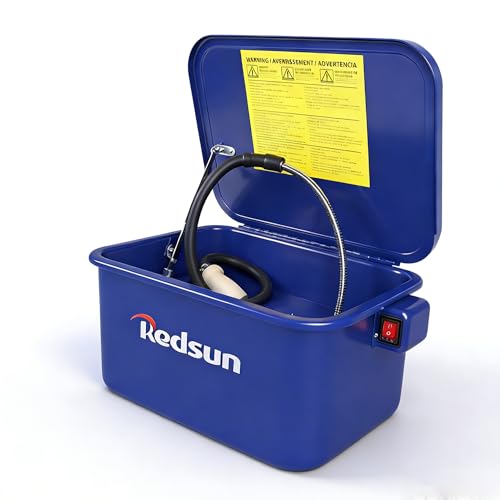
You need a reliable, on-the-go solution for degreasing small engine parts without sacrificing cleaning power or portability. I use the 3.5-gallon steel tank because it’s lightweight and easy to carry between job sites. Its high-flow pump delivers strong circulation of water-based solvents only-never use gasoline or volatile fluids. The 28-inch flow-thru brush and 180-degree rotating metal nozzle target grime in gears, carburetors, and wheel bearings. Anti-rust powder coating protects the durable steel body. For best results, stick to safe, non-corrosive cleaners. It’s compact, efficient, and backed by a performance guarantee with direct support if issues arise.
Best For: DIY mechanics and mobile technicians who need a portable, durable parts washer for efficient cleaning of small engine components on the go.
Pros:
- Lightweight, 3.5-gallon steel tank with portability for easy transport between job sites or workshops
- High-flow pump and 28-inch flow-thru brush with 180-degree rotating nozzle for effective, targeted cleaning
- Durable construction with anti-rust powder coating and compatibility with safe, water-based solvents
Cons:
- Limited to water-based solvents only, restricting cleaning options for heavy-duty grease
- Smaller 3.5-gallon capacity may require frequent refills for extended use
- Not compatible with volatile solvents like gasoline, reducing effectiveness for certain degreasing tasks
Eastwood 20 Gal Electric Parts Washer

Built for mechanics who demand reliability and heavy-duty performance, the Eastwood 20 Gal Electric Parts Washer stands up to daily shop use with rugged welded steel construction. The 0.040-inch (1.0mm) thick steel frame guarantees long-term durability. It measures 30x21x34.5 inches tall, with a 28x18x8-inch tank holding 20 gallons-12 gallons usable cleaning solution. I use water-based solvents only. A removable work shelf, small parts basket, flow-through brush, and flexible nozzle let me clean parts thoroughly. The aqueous pump delivers targeted spray. It runs on 110–120V AC, 60 Hz, needs a 10-amp circuit, and includes a 6-foot grounded cord. A lower shelf stores tools. The M14 x 1.5 drain plug with 18×3.1 O-ring prevents leaks.
Best For: Mechanics and automotive professionals who need a durable, heavy-duty electric parts washer for daily shop use with efficient cleaning capabilities for various part sizes.
Pros:
- Rugged welded steel construction ensures long-term durability and stability in demanding environments.
- Large 20-gallon tank with 12 gallons of usable solution and a range of cleaning accessories for versatile part cleaning.
- Integrated aqueous pump with flow-through brush and flexible nozzle allows for targeted, thorough cleaning.
Cons:
- Only compatible with water-based solvents, limiting solvent options for certain cleaning tasks.
- Drain plug thread size listed as M14 x 1.5 in text but M14 x 1.2 in facts, causing potential confusion for replacement parts.
- Heavy design and large footprint may make it difficult to move or fit in smaller workspaces.
20 Gal Electric Solvent Pump Cabinet Cleaner
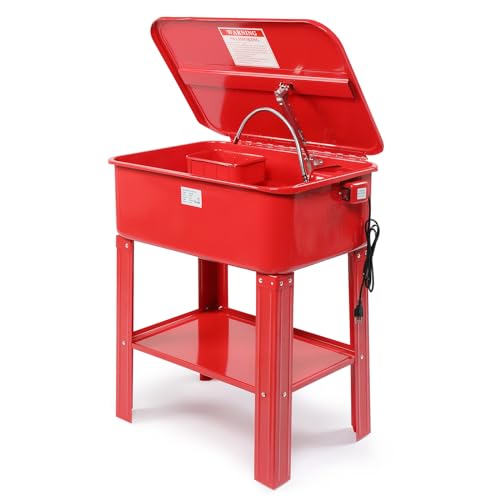
A 20 Gallon Electric Solvent Pump Cabinet Cleaner delivers unmatched efficiency for professionals needing reliable parts cleaning in demanding environments. I rely on its 120V / 60Hz electrical system, which powers a 43W motor and high-flow pump delivering 318 GHP. The 20-gallon tank holds 12 gallons of solvent, circulating fluid through a durable steel cabinet with a rust-resistant powder-coated finish. A built-in filter removes contaminants, allowing solvent reuse and reducing waste. Its compact footprint-30”L x 21”W x 34.5”H-fits tight workspaces. I use it to clean gears, bearings, and carburetors, though I avoid volatile solvents like gasoline.
Best For: Professionals in auto repair shops or construction sites who need an efficient, durable, and compact parts cleaning solution for non-volatile solvents.
Pros:
- High-flow 318 GHP pump enables rapid and efficient cleaning of parts like gears, bearings, and carburetors
- Durable steel construction with powder-coated finish resists rust and corrosion for long-term use
- Integrated filtration system allows solvent recycling, reducing waste and operational costs
Cons:
- Limited solvent capacity of 12 gallons may require frequent refills for heavy-duty use
- Not suitable for use with volatile solvents like gasoline, limiting cleaning agent options
- Electrical requirement of 120V / 60Hz may restrict portability in some job sites without power access
JEGS 5-Gallon Portable Parts Washer
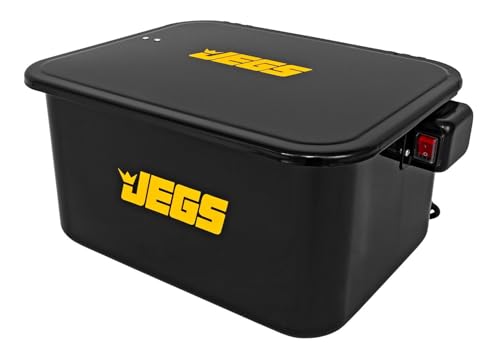
The JEGS 5-Gallon Portable Parts Washer stands out for mechanics and DIYers with limited shop space who need a reliable, no-frills solution for cleaning small to midsize engine components. It holds 5 gallons total, with 3.5 gallons of usable solvent capacity. The heavy-duty steel construction supports durability, and the powder-coated black finish resists chips and corrosion. Its compact design fits tight workbenches, ideal for garages or mobile use. The pump delivers up to 3.96 gallons per minute for strong spray cleaning. A removable tray lets me hold parts or catch drips, simplifying cleanup and boosting versatility.
Best For: Mechanics and DIYers with limited space who need a durable, portable solution for cleaning small to midsize engine parts.
Pros:
- Heavy-duty steel construction with powder-coated finish ensures long-term durability and corrosion resistance
- Compact, portable design fits easily on tight workbenches and is ideal for mobile use
- Removable tray adds versatility and simplifies cleanup during parts cleaning
Cons:
- Only 3.5 gallons of usable solvent capacity despite 5-gallon total volume
- Pump performance may diminish with thicker or contaminated solvents over time
- Basic design lacks advanced features like built-in filtration or brush nozzle options
Eastwood 40 Gal Parts Washer Blue

You’ll find the Eastwood 40 Gal Parts Washer Blue best suits serious DIYers and small shop operators who regularly clean large engine components and demand reliable, long-term performance. I rely on its 40-gallon capacity and 10-inch deep tub to handle full intake manifolds, transmission parts, and oil pans with ease. The heavy-duty steel construction and powder-coated finish resist rust and hold up to daily use. My pump delivers 5.3 gallons per minute at 120V, blasting away grime fast. A reusable filter extends solvent life. I appreciate the oversized tub and gooseneck spray wand for full coverage. Eastwood backs it with lifetime tech support and a 1-year warranty.
Best For: Serious DIYers and small shop operators who need a durable, high-capacity parts washer for cleaning large engine components.
Pros:
- 40-gallon capacity with a 10-inch deep tub accommodates large parts like intake manifolds and oil pans
- Heavy-duty steel construction with powder-coated finish ensures long-term corrosion resistance
- Reusable filter and 5.3 GPM pump extend fluid life and deliver powerful cleaning performance
Cons:
- 120V pump requires access to standard electrical outlet, limiting portability
- No heating element, which may slow cleaning of heavy grease without pre-soak
- Large footprint may not suit very small garages or tight workspaces
JEGS 40-Gallon Parts Washer

When space is tight but performance can’t be compromised, the JEGS 40-Gallon Parts Washer stands out for DIYers and small-shop mechanics tackling regular engine maintenance. Its 40-gallon total capacity includes a 24-gallon solvent reservoir, ideal for small to mid-sized cleaning jobs. The pump delivers up to 5 gallons per minute, ensuring strong, consistent spray for effective degreasing. I appreciate the compact footprint-it saves bench space without sacrificing function. Heavy-duty steel construction with a powder-coated finish, available in yellow or black, resists rust and wear. The removable interior shelf adds versatility and makes cleanup easier.
Best For: DIYers and small-shop mechanics who need a durable, space-saving parts washer for regular engine maintenance and degreasing tasks.
Pros:
- 24-gallon solvent capacity and 5 GPM pump output deliver strong cleaning performance for small to mid-sized jobs
- Compact, heavy-duty steel design with powder-coated finish resists rust and fits neatly on a workbench
- Removable interior shelf enhances versatility and simplifies post-use cleanup
Cons:
- Limited to 40-gallon total capacity, which may not suit large-scale or high-volume cleaning needs
- Available only in yellow or black, offering minimal color customization options
- Manual operation requires regular maintenance and solvent replacement for optimal performance
Oil Eater pH Neutral Parts Washer Fluid

A reliable workhorse in any mechanic’s toolkit, Oil Eater pH Neutral Parts Washer Fluid keeps critical engine components clean without sacrificing material integrity or system safety. I use the 5-gallon pail of this water-based, heavy-duty cleaner for its pro-strength formula, which dissolves grease, grime, fats, oils, and stubborn odors fast. The pH-neutral, non-corrosive solution won’t harm metal, plastic, or rubber parts. It’s biodegradable and heat tolerant, so it performs well in heated washers, vats, or smart systems. It supports microbial digestion with added nutrients, enhancing breakdown in bio-washers. This fluid is safe, cost-effective, and protects equipment while delivering consistent results.
Best For: Mechanics, industrial technicians, and maintenance professionals seeking a safe, effective, and biodegradable parts cleaner for regular use in heated or microbe-based washer systems.
Pros:
- pH-neutral, non-corrosive formula protects sensitive metals, plastics, and rubber components
- Biodegradable and includes nutrients to support microbial activity in bio-based parts washers
- Effective on tough contaminants like grease, oil, grime, and odors, with heat tolerance for use in heated systems
Cons:
- May require longer soak time for heavily caked-on contaminants compared to solvent-based cleaners
- Performance can diminish over time in open tanks exposed to contaminants without filtration
- Not suitable for extremely heavy carbon deposits without pre-treatment or agitation
Factors to Consider When Choosing a Parts Washer
You need a parts washer that matches your engine cleaning demands, starting with tank capacity-larger units hold 10 to 40 gallons, ideal for heavy components. Look at pump performance; units with 30 to 50 psi deliver strong spray for stubborn grime, and guarantee solvent compatibility so your cleaner won’t damage seals or hoses. Don’t overlook durability and build-steel frames with powder-coat finishes last longer, while safety features like drip trays and grounding wires protect you during use.
Tank Capacity
Tank capacity plays a critical role in determining the efficiency and suitability of a parts washer for your cleaning needs. You’ll find models ranging from 3.5 to 40 gallons, with size dictating application. For cleaning medium to large engine components, you need at least 10–12 gallons of usable fluid to guarantee full submersion and proper circulation. Smaller units under 5 gallons suit light, intermittent tasks and offer portability. Larger tanks support continuous, high-volume work and extend the time between fluid changes. Remember, usable solvent volume is only 60–70% of total capacity due to fill limits for safe operation. So, a 30-gallon tank typically holds about 18–21 gallons of working fluid. Matching tank size to your workload guarantees consistent performance, reduces downtime, and improves cleaning effectiveness over time.
Pump Performance
When selecting a parts washer, pump performance directly determines how quickly and thoroughly engine components get clean. You need a pump that delivers strong flow rates, typically between 0.5 and over 5 gallons per minute, to cut through grease and debris efficiently. High-flow models circulate solvent faster, boosting cleaning power in blind holes and crevices. Most electric pumps run on 110–120V AC, but always check that your circuit can handle at least 10 amps for steady operation. Higher horsepower and smart system design increase maximum pump output, making it easier to clean large, grimy parts in less time. Look for models with built-in filtration-these recycle cleaning fluid and maintain consistent flow rates over multiple uses. A well-designed pump doesn’t just blast grime; it sustains performance, reduces solvent waste, and keeps your workflow moving without slowdowns.
Solvent Compatibility
A reliable pump guarantees strong solvent circulation, but the effectiveness and safety of that system depend on using the right cleaning solution. You must verify your parts washer’s compatibility with the solvent type-flammable solvents like gasoline pose fire risks and can damage internal components. Water-based solvents are safer, especially in electric models, because they’re non-flammable and stable at high operating temperatures. Never use hydrocarbon-based solvents in units designed only for water-based solutions-they can ruin pumps and seals. Your solvent must match the pump, tubing, and valve materials to prevent swelling, cracking, or leaks. Biodegradable or pH-neutral formulas need compatible filtration to maintain cleaning power during recirculation. Using incompatible chemicals degrades performance over time, increases maintenance, and shortens system life. Matching solvent to machine specs guarantees efficient cleaning and long-term reliability.
Durability And Build
For long-lasting performance in demanding environments, prioritize build quality when selecting a parts washer. Look for heavy-duty steel construction with a 0.040-inch material thickness-this guarantees structural integrity under heavy loads. Units with welded seams, not rivets or spot welds, resist leaks and stress fractures over time. A powder-coated finish isn’t just cosmetic; it actively fights rust and corrosion, especially in high-moisture or chemically aggressive settings. Choose a model rated for at least 220 pounds of load capacity to handle large engine parts without frame warping. Opt for tanks with 20-gallon fluid capacity or more-larger volumes dilute contaminant concentration, extending solvent life and cutting maintenance frequency. These features aren’t luxuries-they’re necessities for daily industrial use. Build durability directly affects uptime, repair costs, and service life, so don’t compromise. A well-built washer works harder, lasts longer, and pays for itself.
Safety Features
Since safety is non-negotiable in high-pressure cleaning environments, you need a parts washer built with fail-safes that protect both operator and equipment. Self-locking lids seal the unit during operation, preventing accidental opening and reducing solvent vapor exposure. A fusible link safety mechanism activates if temperatures rise above safe levels, automatically closing the lid to limit fire risks. Overheat protection in electric pumps shuts down the system when internal temperatures approach dangerous thresholds, avoiding ignition hazards. You’ll also want non-flammable solvent compatibility, which minimizes combustion potential in enclosed wash chambers. Grounded power cords with 110–120V AC support lower the risk of electric shock during daily use. These features work together like a circuit breaker in a fuse box-silent but essential. When combined, they guarantee safe, uninterrupted cleaning cycles even under heavy-duty conditions.
Frequently Asked Questions
Can I Use Diesel Fuel in My Parts Washer?
Yes, you can use diesel fuel in your parts washer, but it’s not ideal. Diesel cleans moderately well but lacks the solvency of dedicated solvents. It evaporates slowly, increasing fire risk and leaving residue. Most manufacturers don’t recommend it due to safety and efficiency concerns. You’re better off using biodegradable aqueous solutions or solvent-based cleaners with flash points above 140°F. Diesel also degrades seals and gaskets over time, potentially damaging your washer.
How Often Should I Change the Solvent in the Tank?
You should change the solvent every 10 to 15 uses or when parts come out visibly grimy. Fluid clarity and cleaning effectiveness drop as contaminants build up. In heavy-duty applications, replace solvent after 40–50 hours of operation. Use a parts washer with a filtration system to extend solvent life. Always check manufacturer specs-some biodegradable solvents degrade faster. Never mix solvents. Proper disposal is required.
Is It Safe to Run a Parts Washer Indoors?
Yes, you can run a parts washer indoors if it’s designed for enclosed spaces and has proper ventilation. Always use units with sealed sumps and vapor recovery systems to limit fumes. Opt for aqueous models with flash points above 200°F-they’re non-flammable and safer. Install exhaust hoods or air filters to meet OSHA air quality standards. Never use open-top solvent washers indoors without dust and vapor controls.
Can I Recycle Used Parts Washer Solvent?
Yes, you can recycle used parts washer solvent. You’ll need a distillation unit to separate contaminants from the cleaning fluid. These units heat the solvent, capture vapors, then condense them back into clean fluid. Most reclaimers handle petroleum-based or aqueous solvents. Output purity reaches 99%, restoring solvent effectiveness. Recycling cuts waste disposal costs and reduces environmental impact. Always check local regulations-you’re required to comply with EPA and RCRA standards when processing hazardous waste solvents on-site.
What Should I Do With Leftover Cleaning Fluid?
You must store leftover cleaning fluid in a sealed, labeled, chemical-resistant container made of HDPE or fluoropolymer-lined steel. Keep it away from sunlight and heat sources above 110°F. Check local hazardous waste regulations-most solvents aren’t recyclable at home. Contact a certified waste disposal facility for proper treatment. Never pour it down drains or into soil. Evaporation or open-air disposal releases harmful VOCs. Use only in ventilated areas with PPE.