Dynamic Balancing Requirements for Custom-Length Driveshafts in Modified Muscle Cars
You need dynamic balancing for your custom driveshaft because even slight imbalances amplify into destructive vibrations at high RPM. A 1 oz-in imbalance creates over 12 lbs of centrifugal force at 3,000 RPM. Resonance near 3,200 RPM excites harmonic shudder, especially with torque harmonics from engines over 600 hp. Proper balancing uses laser-measured lengths, computerized spinning, and precision welded weights to achieve ≤0.5 g-in tolerance-critical for aluminum shafts with 45% of steel’s rigidity. Misalignment or phasing errors as small as 1 degree mimic imbalance. You’ll discover how to avoid critical failures and match balance to your build’s power goals.
Notable Insights
- Custom-length driveshafts require dynamic balancing to prevent resonance at high RPM, especially near critical speeds like 3,200 RPM.
- Imbalance as small as 1 ounce-inch can generate over 12 lbs of centrifugal force at 3,000 RPM, accelerating drivetrain wear.
- Dynamic balancing involves spinning the shaft on a computerized balancer and correcting imbalance to within 0.5 g-in tolerance.
- Aluminum driveshafts need tighter balance tolerances than steel due to lower torsional rigidity and higher susceptibility to harmonic excitation.
- Proper installation with correct pinion angle and u-joint phasing within 1 degree is essential to maintain dynamic balance.
The Real Cause of Custom Driveshaft Vibration
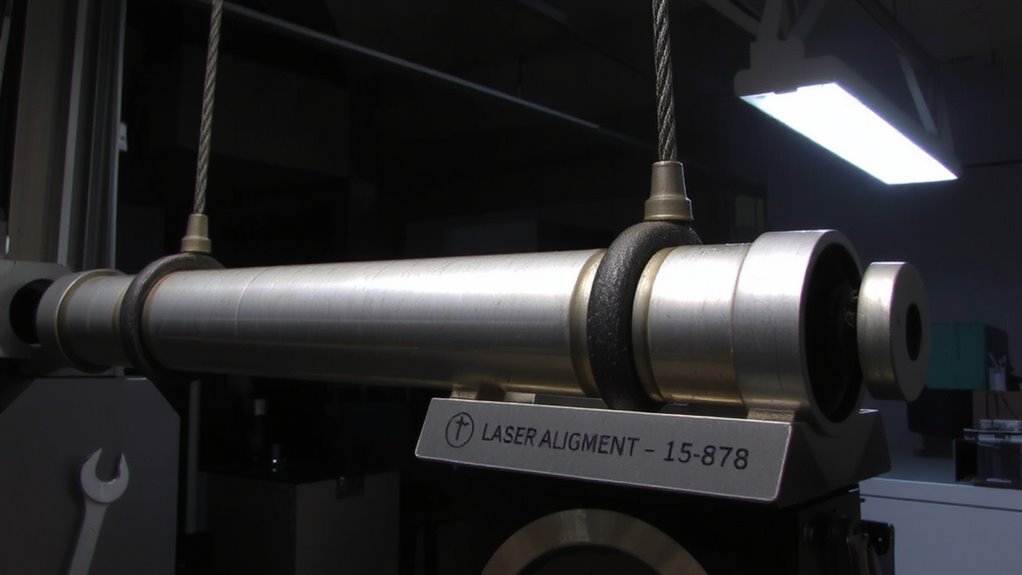
Why do perfectly balanced custom driveshafts still cause vibration? Because balance isn’t the only factor. Material resonance occurs when the driveshaft’s natural frequency aligns with operational RPM, amplifying oscillations. Even minor excitations grow destructive at critical speeds. You’ve likely noticed this as a harmonic shudder around 3,200 RPM-a telltale sign of resonant frequency excitation. Torque harmonics from high-output engines further complicate matters. These pulsations, especially in modified V8s with aggressive cam profiles, input torsional energy that excites the shaft. Standard balancing corrects mass distribution but ignores dynamic elasticity. A shaft may be 0.001-ounce-inch balanced and still vibrate violently. The real cause isn’t imbalance-it’s system dynamics. Resonance depends on material stiffness, wall thickness, diameter, and length. For example, a 4-inch DOM tube at 60 inches long has a first-mode critical speed of ~4,100 RPM. Exceed it, and material resonance dominates.
How Imbalance Destroys Your Muscle Car’s Drivetrain
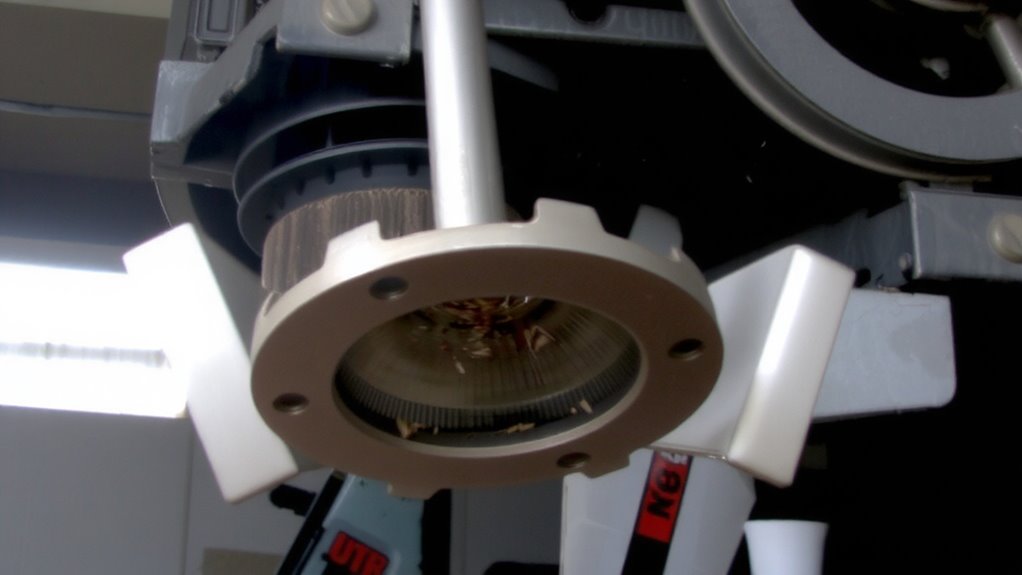
You’ve seen how resonance turns a well-balanced shaft into a source of vibration, even when specs look perfect on paper. Imbalance induces harmonic resonance, amplifying forces exponentially as rotational speed increases. At 3,000 rpm, just 1 ounce-inch of imbalance generates over 12 pounds of centrifugal force. That force doesn’t just shake your car-it transfers directly into the drivetrain. Repeated stress cycles accelerate drivetrain fatigue, weakening u-joints, centering bells, and transmission output shafts. Bearings wear prematurely. Yokes deform. Over time, microscopic cracks propagate in critical components, leading to sudden failure. Harmonic resonance magnifies these effects at specific critical speeds, matching the driveshaft’s natural frequency. Without proper dynamic balancing, even a custom-fitted shaft becomes a destructive oscillator. The result isn’t just noise or vibration-it’s compromised structural integrity, reduced power transfer efficiency, and eventual catastrophic drivetrain damage under sustained load.
The 5-Step Dynamic Balancing Process for Custom Driveshafts
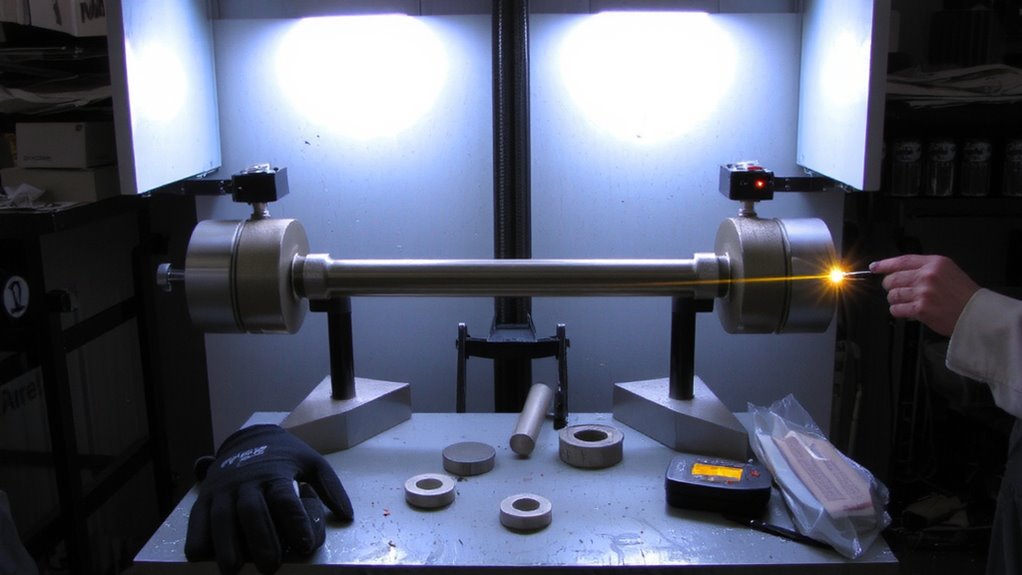
A precise five-step process guarantees custom driveshafts operate smoothly under high-speed conditions. First, you perform material selection, matching alloy grade and wall thickness to engine output and rpm range-steel or aluminum must suit torque demands. Second, you achieve exact length calibration using laser measurement from output shaft to pinion, guaranteeing correct spline engagement and clearance. Third, the shaft spins on a computerized balancer to detect imbalance in grams-inch. Fourth, you weld or bond precision weights at calculated positions to counteract detected forces. Finally, you re-spin the shaft to verify balance within 0.5 g-in tolerance. Each step prevents harmful harmonic vibrations. Proper material selection avoids flex; accurate length calibration maintains driveline angle. This process guarantees reliability at 6,000+ rpm, critical for high-performance muscle cars with modified suspensions and aggressive gearing.
Steel vs Aluminum: Which Balances Better Under High Torque?
Steel and aluminum each respond differently to high-torque loads, affecting how well they maintain dynamic balance in performance drivelines. Steel’s higher material density increases rotational inertia, demanding more precise balancing. Yet, its superior torsional rigidity resists twisting under load, preserving alignment and balance. Aluminum is lighter, reducing overall mass and stress on U-joints, but its lower torsional rigidity allows more deflection, risking imbalance under high torque. Choose based on power output and balance needs.
| Property | Steel | Aluminum |
|---|---|---|
| Material Density (g/cm³) | 7.85 | 2.70 |
| Torsional Rigidity (% relative) | 100% | ~45% |
| Typical Torque Limit (lb-ft) | 1,200+ | 800 (safe range) |
High material density in steel aids stability, while aluminum’s flexibility requires tighter balance tolerances.
High-Performance Balance Classes Explained
When every fraction of a gram matters at high RPM, balancing isn’t just maintenance-it’s precision engineering. High-performance balance classes, like ISO G2.5 and G1.0, define acceptable vibration levels for custom driveshafts. You’ll need ISO G1.0 for engines exceeding 6,000 RPM-typical in modified muscle cars. This class allows only 1.0 mm/s of vibration velocity, demanding extreme accuracy. Precision weighting removes or adds mass with tolerances within 0.1 gram increments. It guarantees perfect rotational symmetry, minimizing harmonic distortion. Any imbalance creates centrifugal force that rises with RPM squared-a 5-gram imbalance at 7,000 RPM generates over 15 lbs of force. Driveshafts balanced to G1.0 use computerized spin balancing at operational speeds. Rotational symmetry is verified in both radial and axial planes. Proper class selection guarantees drivetrain longevity, reduces wear on bearings, and maintains power delivery. You’re not just balancing a shaft-you’re optimizing system dynamics.
6 Installation Mistakes That Ruin Driveshaft Balance
Even if your driveshaft is balanced to ISO G1.0, improper installation can destroy that precision in minutes. Improper alignment causes immediate vibration and rapid u-joint wear. Misalignment beyond 0.05 degrees creates harmonic distortion that mimics imbalance. You must check pinion angle with a digital protractor-maintain 1 to 2 degrees down from transmission output for ideal driveline geometry. Incorrect phasing shifts the u-joint’s rotational timing, introducing destructive forces. When the yokes aren’t aligned within 1 degree, canceling forces become additive, increasing vibration amplitude. Always mark the rear yoke and flange before disassembly. Reinstall with timing marks matched exactly. The driveshaft and yoke operate as a matched set-any shift disrupts dynamic equilibrium. Factory phasing guarantees force vectors oppose correctly. A 10-degree deviation increases vibration by up to 70%. Measure twice, install once.
On a final note
You must balance custom driveshafts dynamically to prevent destructive harmonic vibrations. Im박alance as small as 0.5 ounce-inches induces driveline oscillation at high RPM. Precision balancing to G1.0 at 6,000 RPM guarantees smooth power delivery. Aluminum shafts require tighter weight distribution than steel due to lower mass. Proper phase alignment and balanced weld seams reduce rotational anomalies. A correctly balanced shaft maintains longevity in high-torque, high-horsepower applications.