Why High-Flow Air Filters Improve Combustion Efficiency in Modified Engines
Your modified engine needs more air, and high-flow filters deliver. Stock paper units restrict airflow at 50–60 cfm, starving performance. High-flow filters pass over 100 cfm, increasing oxygen in the combustion chamber. Oiled cotton gauze flows 30% more than stock and offers 50–70% greater surface area. This reduces restriction to just 0.5–1.2 in. H₂O, improving air density and fuel atomization. Cleaner, faster burns mean efficient power. Properly maintained, these filters sustain peak airflow-there’s more to optimizing your intake than just the filter itself.
Notable Insights
- High-flow filters increase airflow to modified engines, ensuring more oxygen reaches the combustion chamber for efficient fuel burn.
- Cotton gauze high-flow filters reduce airflow restriction, offering 50–70% more surface area than restrictive stock paper filters.
- Reduced intake resistance allows higher air density, improving fuel atomization and promoting a faster, cleaner combustion cycle.
- Oiled cotton gauze maintains superior airflow (30% more than stock) and sustains oxygen delivery under high-demand conditions.
- Properly sized high-flow filters match engine displacement and cam timing, meeting peak cfm demands for optimal combustion efficiency.
How High-Flow Filters Fix Air Starvation in Modified Engines
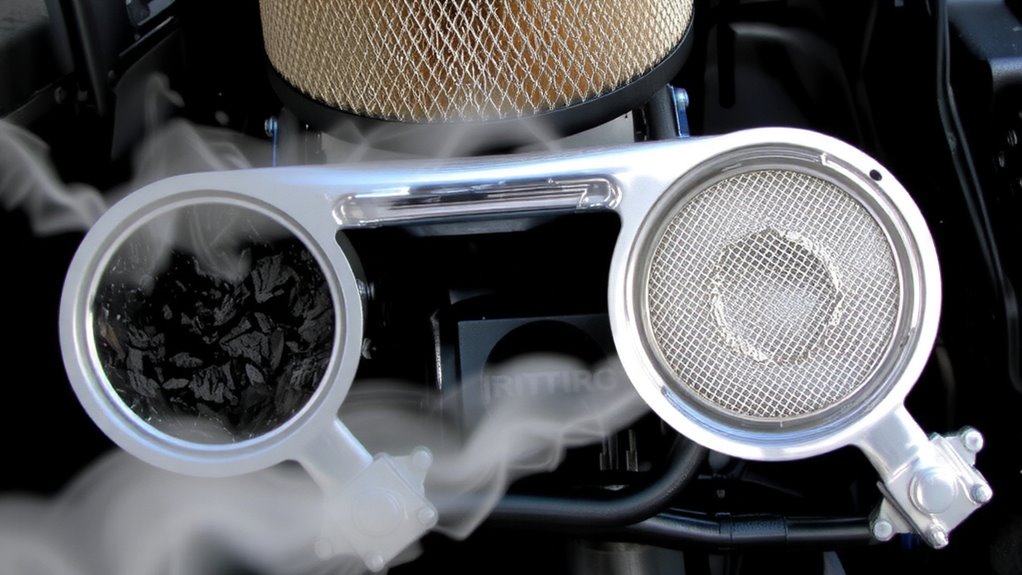
While your engine’s stock air filter may suffice under factory conditions, upgrading to a high-flow filter becomes essential when performance modifications increase airflow demands. Your modified engine requires more oxygen to burn fuel efficiently, and stock filters restrict airflow, causing air starvation. High-flow filters reduce restriction, allowing more air volume to reach the combustion chamber. Increased air density means more oxygen molecules per cubic foot, improving combustion efficiency. Higher intake velocity guarantees responsive throttle and better cylinder filling. These filters typically feature expanded mesh media with 50–70% greater surface area, maintaining filtration while minimizing pressure drop. You’ll see gains in horsepower and torque, especially at higher RPMs. Unlike stock paper elements, high-flow units maintain performance under extreme conditions, guaranteeing your engine breathes freely when it needs to most. Top options include reusable high-flow air filters designed for superior airflow and durability.
Cotton Gauze vs. Foam: Which Air Filter Flows Best?

Why do so many performance enthusiasts debate cotton gauze versus foam when choosing a high-flow air filter? You’re deciding between materials that directly impact air density and flow resistance. Cotton gauze filters typically offer lower flow resistance, allowing more air volume per stroke. Foam filters seal well but can restrict airflow under high demand. Air density matters because denser air contains more oxygen for combustion, but only if the filter allows it through.
| Filter Type | Flow Resistance (in. H₂O) | Air Density Efficiency |
|---|---|---|
| Cotton Gauze | 0.5–1.2 | High, with clean oil |
| Open-Cell Foam | 1.0–2.0 | Moderate, degrades fast |
| Oiled Gauze | 0.7 | Best sustained flow |
You’ll want consistent airflow without sacrificing filtration.
Why High-Flow Filters Improve Combustion Efficiency
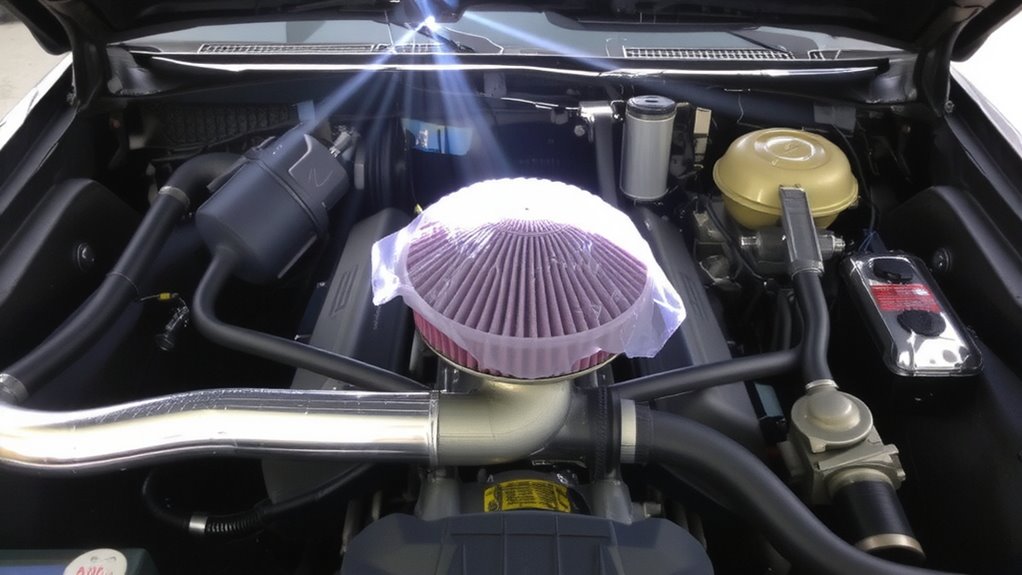
You get better combustion efficiency when your engine breathes easier, and that starts with reducing airflow restrictions. High-flow air filters allow more air volume into the intake, increasing air density in the combustion chamber. Higher air density means more oxygen molecules per cubic foot, enabling more complete fuel burn. You’re optimizing the air-to-fuel ratio without adjusting fuel input. Improved airflow also enhances fuel atomization-tiny fuel droplets mix more uniformly with air, creating a faster, cleaner burn. Think of it like mist versus droplets from a spray bottle-smaller particles ignite more efficiently. Factory filters often restrict at 50–60 cfm; high-flow units pass 100+ cfm with the same pressure drop. That reduced restriction supports higher RPM operation and sustained power output. Better airflow supports precise combustion events, improving thermal efficiency and reducing unburned hydrocarbons. You’re not just adding power-you’re making every combustion cycle more effective.
Match Your Filter to Your Modified Engine
Choosing the right high-flow air filter isn’t a one-size-fits-all decision-your modified engine’s airflow demands depend on displacement, cam profile, and induction dialogy. A larger displacement engine with aggressive cam timing needs greater airflow capacity. You must match the filter’s flow rating-measured in cubic feet per minute (cfm)-to your engine’s peak airflow requirements. High intake velocity improves air density in the manifold, enhancing charge efficiency. If the filter restricts airflow, intake velocity drops, reducing air density and cylinder filling. Oiled cotton gauze filters offer high flow and filtration, typically flowing 30% more than stock paper units. Synthetic dry media filters provide consistent flow without oil but may have slightly lower airflow. The filter’s surface area and depth-commonly 6 to 8 inches in diameter and 2 to 4 inches thick-must suit your intake’s geometry. Proper fit guarantees sealed, turbulent-free airflow.
Horsepower, Throttle, and Efficiency: The Real Gains
While stock air filters restrict airflow to guarantee dust protection, upgrading to a high-flow unit can reveal real gains in horsepower, throttle response, and overall engine efficiency. You gain up to 8–15 horsepower depending on engine modifications and airflow demand. Increased intake velocity improves air movement into the combustion chamber, enhancing cylinder filling. This higher velocity promotes better fuel atomization, breaking fuel into finer droplets for more complete combustion. Improved atomization increases burn efficiency, extracting more energy from each fuel charge. Throttle response sharpens because the engine breathes easier, reducing lag between pedal input and power delivery. High-flow filters typically offer 30–50% more airflow than stock paper elements, measured in cubic feet per minute (CFM). These gains are most noticeable in modified engines with performance camshafts, forced induction, or high-RPM operation. You achieve measurable efficiency without sacrificing reliability.
Clean & Re-Oil Your High-Flow Filter for Lasting Power
Maintenance isn’t optional-it’s mandatory for peak performance. Proper filter maintenance guarantees your high-flow air filter sustains airflow and protects your modified engine. Over time, debris clogs the filter media, reducing efficiency and risking dirt ingestion. Clean your filter every 15,000 miles, or every 5,000 miles in dusty conditions. Re-oiling is critical-without proper oil coverage, the filter can’t trap fine particles effectively.
| Condition | Re-Oiling Frequency |
|---|---|
| Normal driving | Every 15,000 miles |
| Dusty/off-road | Every 5,000 miles |
Use manufacturer-specified air filter oil and follow drying instructions-prevents over-oiling. A correctly re-oiled filter maintains viscosity to capture contaminants without restricting airflow. Neglecting re-oiling frequency compromises filtration and long-term engine health. Stick to the schedule, and your high-flow filter delivers lasting power.
On a final note
Your modified engine demands more airflow to achieve ideal combustion. High-flow air filters deliver up to 30% greater airflow than stock paper filters, measured in cubic feet per minute (CFM). This increased airflow supports precise air-to-fuel ratios, improving throttle response and horsepower by 5–15 HP on average. Filter materials like oiled cotton gauze offer repeatable performance and trap 98% of contaminants. Proper maintenance guarantees lasting efficiency.