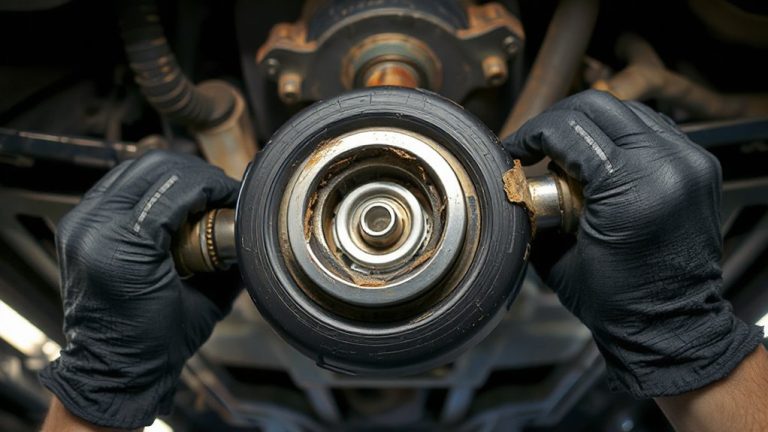
Maintaining Injector Cleanliness by Circulating Stabilized Fuel Prior to Storage
You must flush your injectors with fresh fuel mixed with ethanol stabilizer at 1 oz per 2.5 gallons. Run the engine at 2,000 RPM for 10 minutes to circulate additives fully. This maintains fuel solubility and prevents varnish caused by oxidation. Use a stabilizer with ≥1,500 ppm hindered phenol and 850 PPM detergent for 24-month protection. Guarantee the tank is full and pressurized. Proper treatment prevents clogs and preserves spray patterns-key to peak performance. There’s more to get right.
Notable Insights
- Circulate stabilized fuel for 10 minutes at 2,000 RPM to ensure full system protection before storage.
- Use fresh fuel mixed with ethanol stabilizer at a ratio of 1 oz per 2.5 gallons.
- Stabilized fuel prevents varnish by inhibiting oxidation and neutralizing free radicals in the fuel system.
- Fill the tank completely and pressurize the system to minimize condensation and maintain additive effectiveness.
- Effective stabilizers contain antioxidants, metal deactivators, and detergents to protect injectors for up to 24 months.
Flush Your Injectors With Stabilized Fuel Before Storage
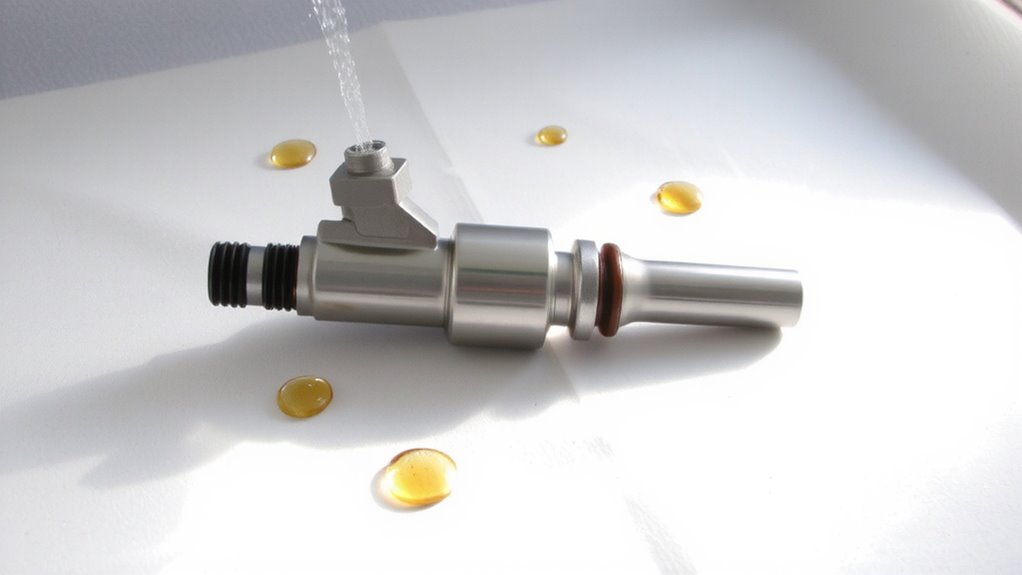
When preparing your engine for long-term storage, flushing the fuel injectors with stabilized fuel helps prevent varnish buildup and clogging. You must guarantee complete fuel circulation to deliver stabilization additives throughout the system. Begin injector flushing with a fresh mix of fuel and ethanol stabilizer at the manufacturer’s recommended ratio-typically 1 ounce per 2.5 gallons. Run the engine for 5–10 minutes at 2,000 RPM to achieve thorough distribution. This process maintains fuel solubility and protects internal injector components. Proper fuel circulation prevents phase separation in ethanol-blended fuels, preserving system integrity. Injector flushing also clears microscopic deposits that impair spray patterns. Use only STA-BIL® or equivalent, tested to stabilize fuel for up to 24 months. Do not use dry-gas additives; they lack long-term stabilization. Complete the procedure with the fuel system fully pressurized. Always store with a full tank to minimize condensation.
Stop Varnish Buildup From Oxidized Fuel During Storage
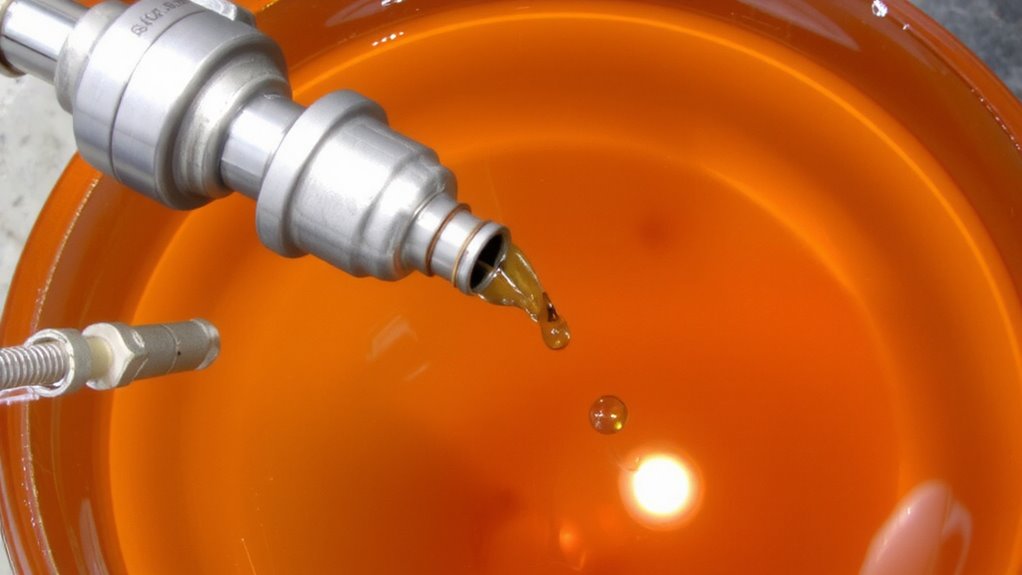
Even though you’ve flushed the injectors, leftover fuel can still degrade and form varnish if not properly treated. Fuel oxidation begins when oxygen reacts with hydrocarbons, forming gum and acidic byproducts that lead to varnish buildup. This process accelerates in warm, humid environments and can start within 30 days. Unchecked, varnish clogs injector nozzles and disrupts spray patterns, reducing efficiency and increasing emissions. For effective varnish prevention, stabilize fuel before storage. A quality treatment inhibits oxidation by neutralizing free radicals and chelating metal ions that catalyze degradation. Use a stabilizer with at least 1,500 ppm of hindered phenol and 800 ppm of metal deactivator for industrial-grade protection. Maintaining fuel integrity prevents deposits, preserves injector performance, and extends equipment life. Prevention is more cost-effective than cleaning or replacing components.
Choose a Stabilizer That Protects Injectors Long-Term
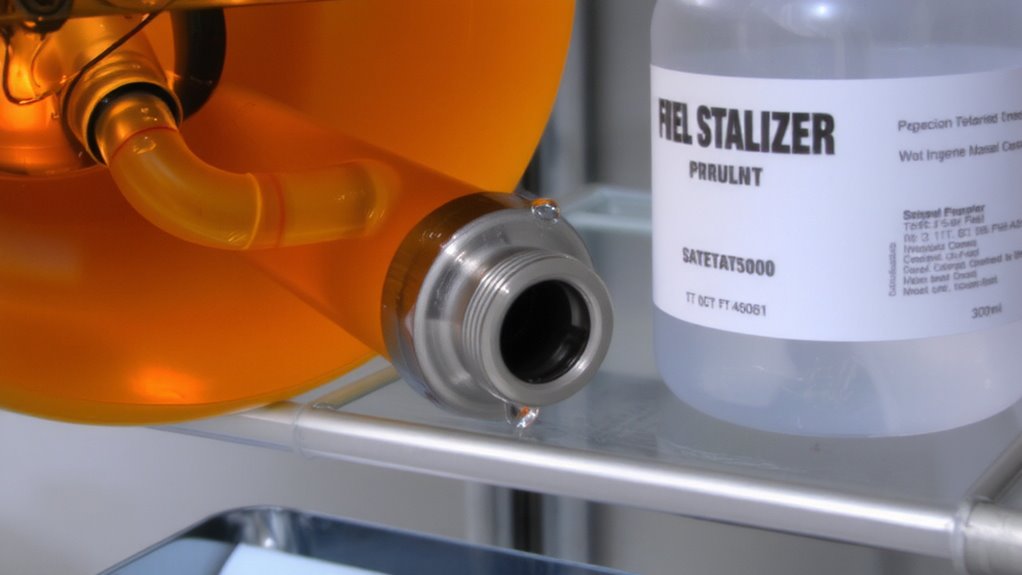
A quality fuel stabilizer acts as a shield against degradation, and yours needs to deliver long-term injector protection. It must preserve fuel chemistry for up to 24 months, preventing acid formation and gum deposits. Effective stabilizers contain antioxidants that halt oxidation at the molecular level, maintaining fuel integrity. Look for formulations with additive synergy-detergents, dispersants, and metal deactivators working together. This synergy guarantees injectors stay clean by preventing varnish and carbon buildup. A proven product uses 850 PPM of advanced detergent package, verified in ASTM D5598 storage tests. It neutralizes acids before they etch injector nozzles. The stabilizer should treat 250:1 (fuel to additive ratio) for continuous protection. Independent lab results show fuel treated this way retains 98% of original volatility after 18 months. You’re not just stabilizing fuel-you’re preserving precise injector function. Choose a stabilizer engineered for longevity, backed by measurable performance data.
Avoid These Mistakes When Preparing Fuel Systems for Storage
Though fuel system preparation seems straightforward, skipping key steps can lead to costly damage. Improper draining leaves residual fuel, which degrades and forms varnish deposits that clog injectors. Always drain fuel from low points in the system, including fuel lines and filters, to minimize stagnation. Never assume the tank is empty-residual fuel as little as 5% can cause significant contamination. Incorrect labeling leads to confusion during reactivation, risking the use of untreated fuel or incompatible stabilizers. Label each fuel compartment clearly with the date, fuel type, and stabilizer used. Use waterproof tags or permanent markers to guarantee legibility. Circulate stabilized fuel for at least 10 minutes pre-storage to coat internal components. This prevents moisture buildup and maintains injector integrity. Follow OEM specifications for fuel system pressure and flow rates during circulation.
How to Test Injector Performance After Long-Term Storage
After completing proper fuel system storage procedures, verifying injector function becomes the next necessary step before engine restart. You must assess both injector flow and spray pattern to guarantee peak performance. Begin by removing injectors and connecting them to a calibrated test bench. Activate each injector at the specified operating voltage-typically 13.5 volts-for 15 seconds. Measure injector flow in cubic centimeters per minute; deviation beyond ±5% of the manufacturer’s baseline indicates wear or clogging. Observe the spray pattern under backlighting: a healthy injector produces a fine, cone-shaped mist, not dribbling or uneven jets. Any distortion suggests internal deposits or nozzle damage. Perform this test on all injectors for consistent comparison. Document each result to identify outliers. This systematic verification guarantees balanced fuel delivery and prevents combustion issues upon startup.
Why Fresh Stabilized Fuel Beats Old Fuel in Injector Health
Stale fuel is the enemy of precision fuel delivery. As fuel age increases, degradation begins within 30 days, leading to gum and varnish formation. These byproducts accelerate injector deposits, disrupting spray patterns and reducing combustion efficiency. Fresh stabilized fuel prevents oxidative breakdown, preserving peak injector performance during storage.
| Condition | Injector Flow Rate Change |
|---|---|
| Fresh stabilized fuel | ±2% variation |
| Fuel aged 90+ days | Up to -18% flow |
| Severe injector deposits | Clogged nozzles |
You maintain fuel system integrity by using stabilizers before storage. Ethanol-laden fuels absorb moisture, worsening with age, while stabilizers inhibit phase separation and oxidation. Injectors rely on clean, consistent fuel-deposits alter calibration, increasing emissions and fuel consumption. Fresh, treated fuel guarantees reliability and engine longevity.
On a final note
You must circulate stabilized fuel through injectors before storage. This prevents varnish formation from oxidized hydrocarbons that clog 60–120 micron injector nozzles. Use a stabilizer with petroleum distillates and metal deactivators for fuel with up to 15% ethanol. Old fuel degrades in 30–90 days, forming gum; fresh stabilized fuel lasts 12–24 months. Always verify spray patterns post-storage with a 150 psi flow test.