How to Identify and Fix Phase Issues in Multi-Way Car Audio Systems
You can identify phase issues by checking for weak bass or a collapsed soundstage, which often stem from reversed polarity or timing delays. Use a 9V battery to test each speaker-connect the positive terminal to the positive wire; if the cone moves outward, polarity is correct. Play a 500 Hz tone to detect cancellations, and flip speaker leads if you hear thin or hollow sound. Guarantee all drivers reach your ears in sync by applying time alignment: delay the closer speaker using DSP settings, calculated at 1.13 μs per inch of distance difference. Match polarity across woofers and tweeters at crossover points to avoid dips around 80–100 Hz. Correcting these factors restores coherence and impact-there’s more to fine-tuning beyond basic connections.
Notable Insights
- Check speaker polarity with a 9V battery: cone outward means correct, inward indicates reversed wiring.
- Verify consistent polarity across all speakers to prevent phase cancellation and weak bass response.
- Use 500 Hz or 1 kHz test tones to detect phase issues by listening for volume dips or hollow sound.
- Flip polarity on one speaker to test for improved bass, especially around crossover frequencies (50–80 Hz).
- Apply time alignment via DSP to delay closer drivers, ensuring simultaneous sound arrival at the listening position.
Check If Your Car Speakers Are Out of Phase?
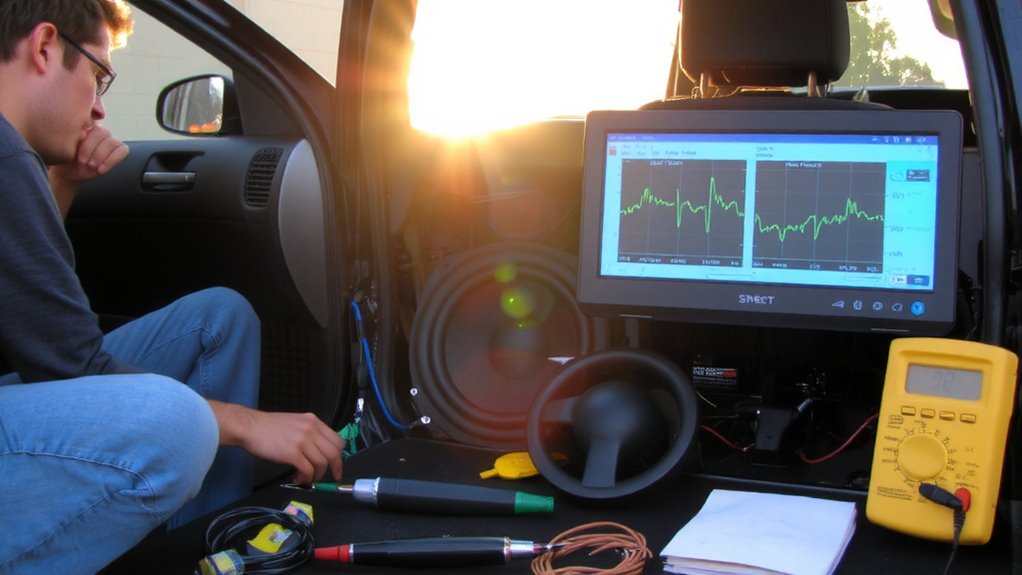
Ever wonder why your car audio lacks punch or sounds unfocused? Poor speaker placement or wiring errors might be causing phase issues. If your front and rear speakers are out of phase, bass response weakens and stereo imaging collapses. Check that all speaker wires connect with consistent polarity-positive to positive, negative to negative-across all channels. Even one reversed voice coil throws off timing alignment, creating cancellation at critical crossover frequencies like 80–100 Hz. Misaligned tweeters or off-axis mounting alters sound arrival time, mimicking phase problems. Guarantee drivers are equidistant from the listening position and flush-mounted to prevent diffraction. Factory harnesses or aftermarket adapters can introduce wiring errors if not verified. Use an oscilloscope or phase meter to measure waveform alignment. Correct speaker placement and eliminating wiring errors restores coherence, delivering tighter bass and precise imaging.
Test Polarity With a 9V Battery (Fast Fix)
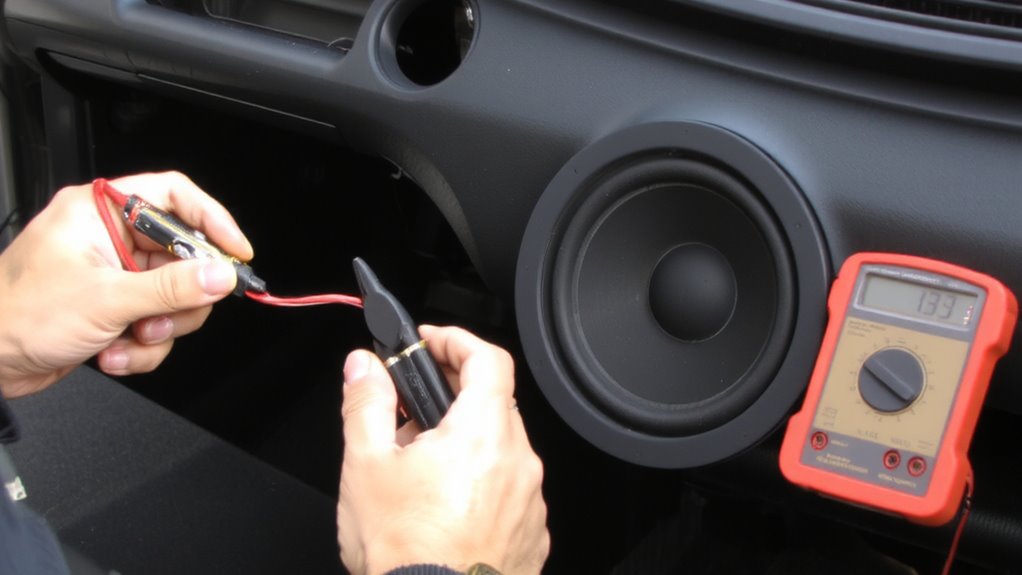
A simple 9V battery can quickly reveal if your speakers are wired with incorrect polarity. This method, known as a battery test, provides an instant polarity check without needing powered equipment. Disconnect the speaker wire from the amplifier. Touch the positive battery terminal to the speaker’s positive wire and the negative to the negative wire. If the speaker cone moves outward, the polarity is correct. If it pulls inward, the wires are reversed. Perform this test on each speaker to guarantee consistency. A 9V battery delivers a brief DC pulse, causing a momentary current flow that deflects the voice coil. Correct alignment ensures all cones move in sync when installed. This quick diagnostic takes seconds and prevents phase issues before they affect sound quality. Use this battery test during installation or troubleshooting to confirm wiring integrity and maintain accurate audio reproduction across your multi-way car audio system.
Use Test Tones to Hear Phase Cancellation
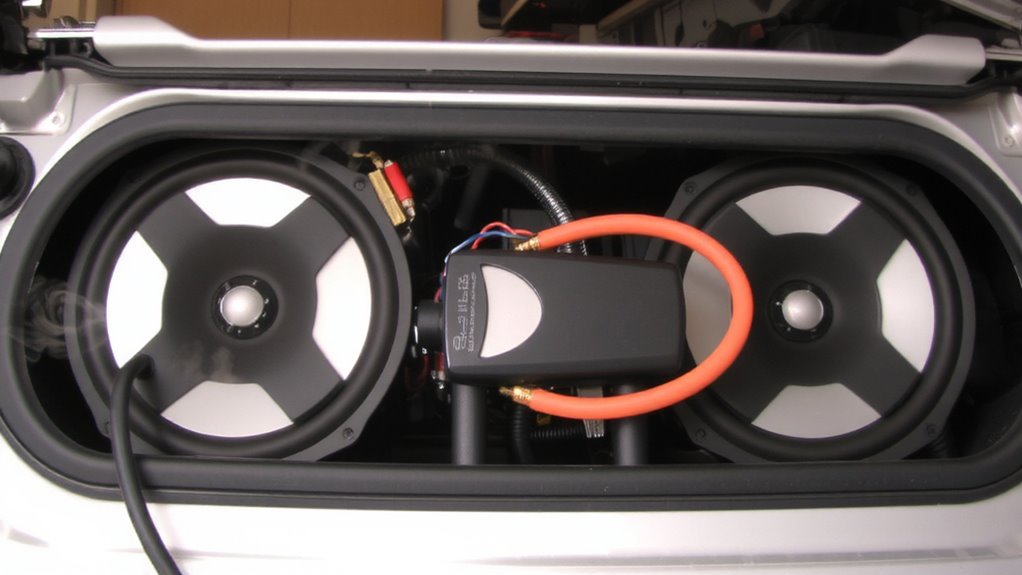
Playing a test tone through your car audio system lets you detect phase cancellation by ear, a critical step in achieving coherent sound. You’ll hear dips in volume or a thin, hollow tone when speakers are out of phase. This happens due to audio interference, where sound waves from different drivers arrive at different times, causing destructive cancellation. A common cause is signal delay between components like tweeters and woofers. Use a 500 Hz or 1 kHz tone to identify issues. Walk around the cabin to locate inconsistencies in sound pressure. Below is a reference table showing phase misalignment effects:
| Frequency (Hz) | Phase Difference | Resulting Audio Interference |
|---|---|---|
| 500 | 90° | Mild volume loss |
| 500 | 180° | Severe cancellation |
| 1000 | 90° | Noticeable thinning |
| 1000 | 180° | Near-total silence |
| All | Signal delay ≥1ms | Perceived echo or smear |
Flip Polarity to Correct Phase Issues
When you suspect phase issues in your car audio system, flipping the polarity of one speaker can quickly reveal whether the drivers are working against each other. Reversing speaker polarity swaps the positive and negative connections, inverting the output waveform. If bass response improves after the flip, the original setup had poor waveform alignment. Proper polarity guarantees all speakers push air simultaneously, reinforcing low frequencies instead of canceling them. Most amplifiers and head units include a polarity switch or setting for testing. For component systems, verify tweeter and woofer polarity match at crossover points. Use a 50–80 Hz test tone and listen for volume drops. Correct waveform alignment maximizes efficiency and clarity. Never rely on visuals alone-measure with a microphone and RTA if possible. Flipping polarity is a fast, low-risk step that fixes simple phase problems instantly. It’s the first action after confirming phase issues with test tones.
Sync Speakers With Time Alignment
Why does sound from your front speakers arrive at your ears at different times? Physical distance creates a time delay between drivers. If your midrange is closer than your tweeter, the signal latency disrupts phase coherence. Time alignment fixes this by delaying the closer speaker’s output. Most digital signal processors (DSPs) include precise time alignment controls in milliseconds. Set it using the formula: distance difference (in inches) × 1.13 = delay needed (in μs). For example, a 6-inch offset needs about 6.8 μs delay. Apply this to the nearest driver so all frequencies reach you simultaneously. Proper alignment guarantees wavefront coherence at the listening position. It reduces comb filtering and improves imaging. Adjust while measuring arrival times with a calibrated microphone and oscilloscope, not by ear. Correct time alignment is critical before any equalization. It’s not optional-it’s foundational for phase accuracy. A comfortable seating position supported by a car seat cushion can help maintain proper posture during long listening sessions, enhancing auditory focus and reducing listener fatigue.
Measure Phase With a Real-Time Analyzer
How accurately can you assess phase coherence in your car audio system without visual feedback? You can’t. A real-time analyzer (RTA) gives you the precision needed to detect phase issues across frequencies. By measuring output from each speaker driver at the listening position, an RTA reveals how well your system maintains phase coherence. Misalignments often stem from physical offsets or electronic signal delay in crossovers. Use the RTA to compare amplitude and phase response between drivers, especially at crossover points. Look for dips or cancellations that indicate destructive interference due to poor phase alignment. Integrating a high-quality digital signal processor ensures precise time alignment and phase correction for optimal sound staging.
| Frequency (Hz) | Phase Deviation (°) | Signal Delay (ms) |
|---|---|---|
| 800 | -45 | 0.16 |
| 1,200 | +30 | 0.07 |
| 2,000 | -90 | 0.125 |
Adjustments based on this data prepare you for smarter crossover tuning.
Fix Phase With Smarter Crossover Settings
Even if your speakers are perfectly installed, poor crossover settings can still wreck phase coherence. Crossover slopes determine how quickly frequencies are filtered between drivers. Use 24 dB/octave Linkwitz-Riley slopes-they align phase naturally at the crossover point. Shallower slopes like 12 dB/octave may cause phase misalignment due to broader frequency overlap. Too much overlap creates summation and cancellations in the passband, especially between midranges and tweeters. Set your crossover frequencies to minimize this overlap, typically one octave above and below the driver’s ideal range. For example, if your midrange rolls off at 2,500 Hz, cross at 3,000 Hz. Digital signal processors allow precise control over slope type, frequency, and phase. Always re-measure phase with your RTA after adjustments. Smarter crossover settings correct timing errors and guarantee seamless integration.
On a final note
You’ve verified speaker polarity and corrected phase misalignment. A 9V battery test confirmed each driver’s polarity, while test tones exposed cancellation at crossover points. Time alignment, measured in milliseconds, synchronized acoustic arrival times across drivers. Real-time analyzer readings, accurate to ±1 dB, validated phase coherence. Properly set Linkwitz-Riley 24 dB/octave crossovers guarantee summed response remains flat. Corrected phase yields tighter bass, improved imaging, and 3 dB efficiency gain by eliminating destructive interference. Your system now performs with peak fidelity.