Fuel Injector Sizing Charts Correlated to Supercharger Displacement and VE%
Your supercharger’s displacement and engine VE directly dictate injector size. A 2.9L blower at 15 psi can push VE to 140%, demanding 1,000 cc/min injectors on E85. Larger blowers move more air, increasing fuel needs proportionally. Every 5 psi of boost raises air density ~25%, requiring higher-flow injectors. Undersized injectors starve the engine, while oversized ones harm idle quality due to poor pulse width control. You’ll find out how to balance these factors precisely.
Notable Insights
- Supercharger displacement directly influences airflow, requiring larger injectors to match increased air volume and maintain proper air-fuel ratios.
- Volumetric efficiency (VE) in forced induction engines typically ranges from 120–150%, increasing fuel demand proportionally with airflow.
- Injector size must account for both supercharger-induced airflow and boosted air density, which rises ~25% per 5 psi of boost.
- Oversized injectors can cause idle quality issues due to poor pulse width control at low engine loads.
- Accurate injector sizing combines supercharger displacement, VE%, boost pressure, fuel type, and fuel system pressure for optimal performance.
How Supercharger Size Affects Fuel Injector Sizing
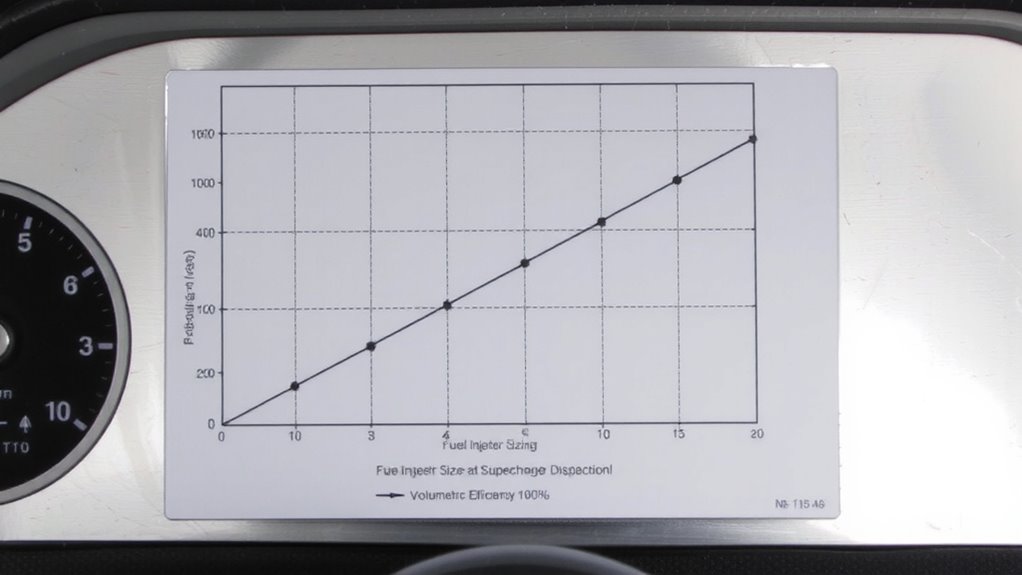
Supercharger size directly impacts the amount of air forced into your engine, and that means your fuel injectors have to keep up. Larger superchargers move more air, requiring injectors with higher flow rates to maintain proper air-fuel ratios. Increased blower heat generation raises intake temperatures, reducing air density and demanding richer mixtures. You must compensate with additional fuel delivery, effectively increasing injector size requirements. Airflow turbulence from high-volume blowers disrupts smooth intake flow, creating uneven cylinder filling. This turbulence affects fuel atomization and distribution, necessitating injectors that respond quickly to rapid airflow changes. A 2.9L ProCharger running 15 psi, for example, may require 1,000 cc/min injectors on E85, while a smaller 1.7L blower at 8 psi might only need 650 cc/min. Matching injector capacity to supercharger output guarantees consistent performance and protects against lean conditions. Regular maintenance using a high-quality Duramax injector cleaner can prevent deposits that impair fuel atomization and disrupt optimal air-fuel mixing.
Why Volumetric Efficiency Changes Injector Requirements
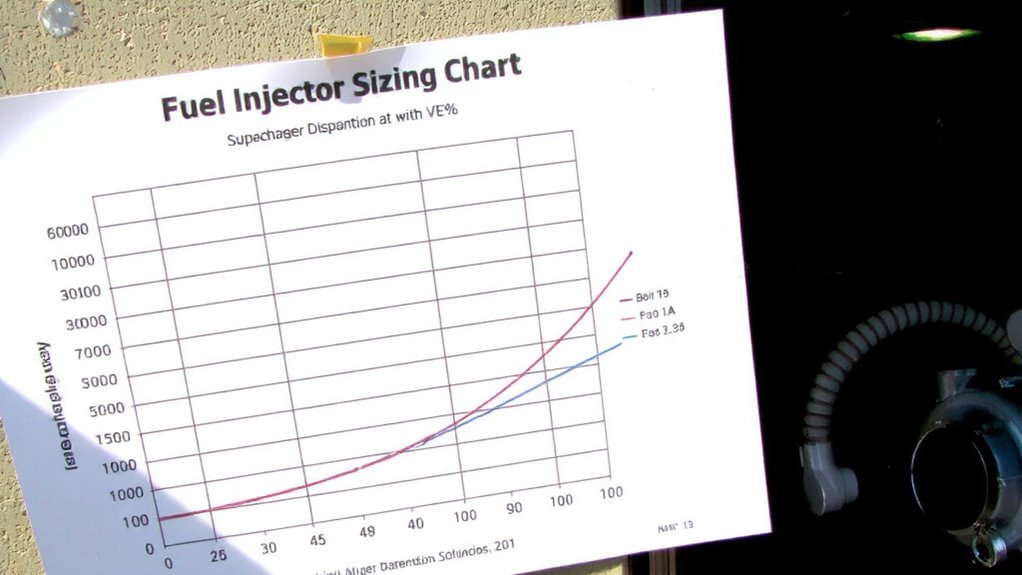
Most street engines don’t fill their cylinders completely, but forced induction systems change that-dramatically. You’re dealing with volumetric efficiency (VE) over 100%, sometimes reaching 120–150%. Higher VE means more air density packed into each cylinder per stroke. That increased air mass demands more fuel to maintain a proper air-fuel ratio. Your injectors must deliver higher flow rates to match this demand. Poor fuel atomization occurs if injectors can’t keep up, leading to incomplete combustion and hot spots. Efficient atomization requires precise fuel droplet size and spray pattern, which depends on injector design and fuel pressure. When VE rises, your engine effectively consumes more air per cycle-even at the same RPM-so your current injectors may starve the mixture. Under these conditions, stock or undersized injectors can’t support power safely. You need larger injectors to maintain control, response, and combustion efficiency under load.
How Boost Level Impacts Fuel Demand
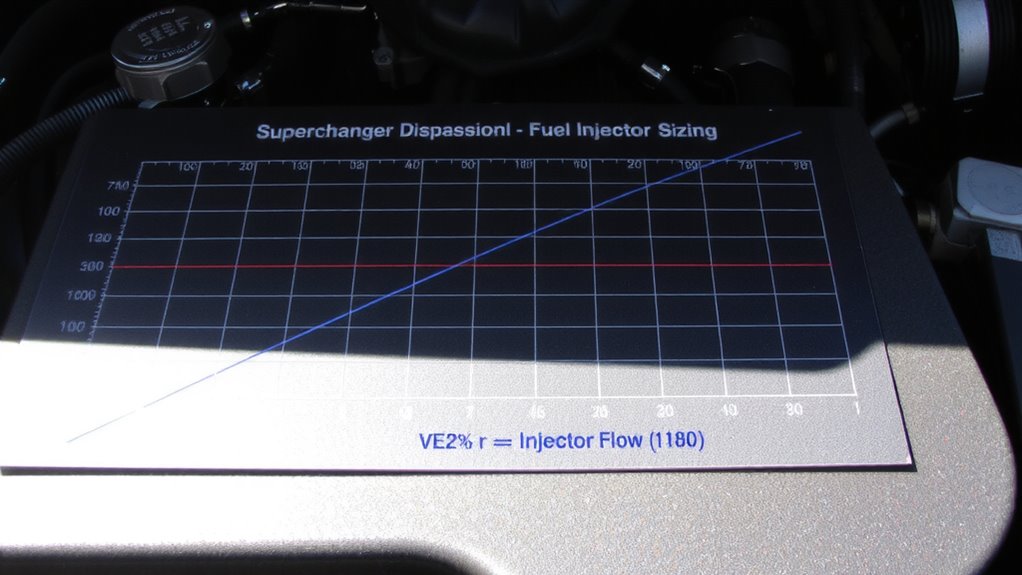
Because boost pressure forces more air into the combustion chamber, your engine’s fuel demand rises proportionally. Higher boost increases air density, meaning more oxygen molecules are packed into each intake cycle. To maintain a proper air-fuel ratio, you must deliver more fuel. This isn’t just about increasing injector pulse width-fuel pressure must also be considered. As boost rises, differential fuel pressure across the injector nozzle drops unless you use a rising-rate regulator or return-style fuel system. Without compensation, the effective flow rate of your injectors decreases, risking lean conditions. For every 5 psi of boost, air density increases by roughly 25%, directly increasing fuel needs. You must size injectors to meet this higher mass airflow, using corrected flow rates based on actual fuel pressure and boosted air density. Neglecting these factors leads to inaccurate tuning and potential engine damage.
Why Bigger Injectors Ruin Idle Quality
You’ve seen how boost increases air density and forces larger fuel demands, requiring bigger injectors to keep up. But at idle, you’re not under boost-your engine needs far less fuel. Oversized injectors can’t meter small amounts precisely, leading to a rich mixture and idle instability. They deliver fuel in coarse pulses, disrupting smooth combustion when fine control is critical. Think of using a firehose to water an orchid-it’s simply too much.
| Injector Size (lb/hr) | Minimum Pulse Width (ms) |
|---|---|
| 42 | 0.8 |
| 60 | 1.1 |
| 80 | 1.4 |
| 100 | 1.7 |
| 120 | 2.0 |
As the required fuel pulse drops near idle, injectors with high flow rates hit their operational floor. You lose tuning resolution, inviting hesitation, stalling, or elevated emissions-all from compromised low-end control.
Calculate Injector Size Using VE, Displacement, and BSFC
Injector size isn’t just about horsepower-it’s about matching fuel delivery to your engine’s actual air consumption. You must calculate airflow using engine displacement, volumetric efficiency (VE), and RPM. Start with this formula: airflow (lb/min) = (displacement × RPM × VE%) / (5660 × 2). Then, multiply by BSFC (brake-specific fuel consumption)-typically 0.50–0.60 for forced-induction engines-to get fuel flow in pounds per hour. Divide by the number of injectors and convert to cc/min using fuel-specific gravity. You’ll need to adjust injector pulse width accordingly-too long, and you risk fuel pooling; too short, and idle suffers. Fuel pressure tuning also impacts flow rate; increasing pressure raises output without changing injectors. Always target 80–85% duty cycle max for reliability. That guarantees headroom for tuning adjustments.
Matching Injectors to Engine RPM and Blower Flow
Every 1,000 RPM increase demands precise fuel delivery to match airflow, especially with a blower. Your injectors must scale fuel output proportionally to maintain ideal air-fuel ratios. If they can’t keep up, power drops and combustion suffers. High-RPM performance relies on injectors that respond instantly, delivering consistent fuel pulses even at peak engine speeds. You’ll need sufficient flow rate-measured in pounds per hour or cubic centimeters per minute-at your blower’s maximum CFM output. Undersized injectors cause lean conditions, while oversized ones hurt idle stability. They can’t meter fuel accurately at low pulse widths, leading to rough idling or stalling. Properly matched injectors also sharpen throttle response, eliminating hesitation during quick acceleration. Think of it like matching a hose size to water demand-too small and flow is restricted; too large and control is lost at low volumes. Match injector size to both RPM range and blower airflow for seamless performance.
Supporting Upgrades: Fuel Pumps and Regulators for High-Flow Injectors
While high-flow injectors demand more fuel volume, your existing fuel system might not keep pace under increased load. You need a high-capacity fuel pump rated for at least 300 liters per hour to maintain supply. Without it, fuel pressure drops during wide-open throttle, risking lean conditions. A performance pump like an A1000 or Bosch 044 guarantees consistent flow, especially with boost. You’ll also need an upgraded fuel pressure regulator to manage rising pressure. A boost-referenced regulator adjusts fuel pressure proportionally to manifold pressure, preventing fuel starvation. Proper regulator tuning guarantees ideal pressure at idle and peak load-usually 43.5 psi base pressure plus 1 psi per pound of boost. Use an adjustable regulator with a braided stainless feed line for accuracy. These upgrades maintain precise air-fuel ratios, letting your injectors perform safely and efficiently at high power levels.
On a final note
Your supercharger’s displacement directly determines airflow, demanding precise fuel injector sizing. Larger blowers increase volumetric efficiency beyond 100%, raising fuel requirements. At 8 psi, a 500ci engine with 120% VE may need 120-lb/hr injectors. Excessive injector size causes poor atomization at idle, leading to rough operation. Always match injector flow to BSFC, RPM, and actual boost. Use a 0.85–0.95 duty cycle max. Upgrade fuel pumps and regulators to sustain rail pressure.