Monitoring Brake Fluid Conductivity Trends to Anticipate Internal Corrosion Onset
You can monitor brake fluid conductivity to catch corrosion before it damages your system. Rising conductivity means moisture and ions are building up-fresh DOT 3 fluid starts below 100 µS/cm. Once it hits 700–1,000 µS/cm, corrosion risk increases; above 1,000 µS/cm, a flush is urgent. Moisture lowers boiling points and enables electrolytic decay, harming calipers and ABS valves. Testing regularly gives you early warning-and reveals what’s really happening inside your lines.
Notable Insights
- Rising brake fluid conductivity indicates moisture absorption and ionic contamination, signaling early stages of chemical degradation.
- Conductivity above 800 µS/cm correlates with increased risk of internal corrosion in calipers and master cylinders.
- Regular monitoring of conductivity trends helps detect degradation before corrosive damage becomes severe or irreversible.
- Conductivity exceeding 1,000 µS/cm warrants immediate fluid replacement to prevent electrolytic corrosion and boiling point loss.
- Testing at consistent temperatures with calibrated tools ensures accurate trend tracking for predictive maintenance decisions.
Why Brake Fluid Conductivity Matters
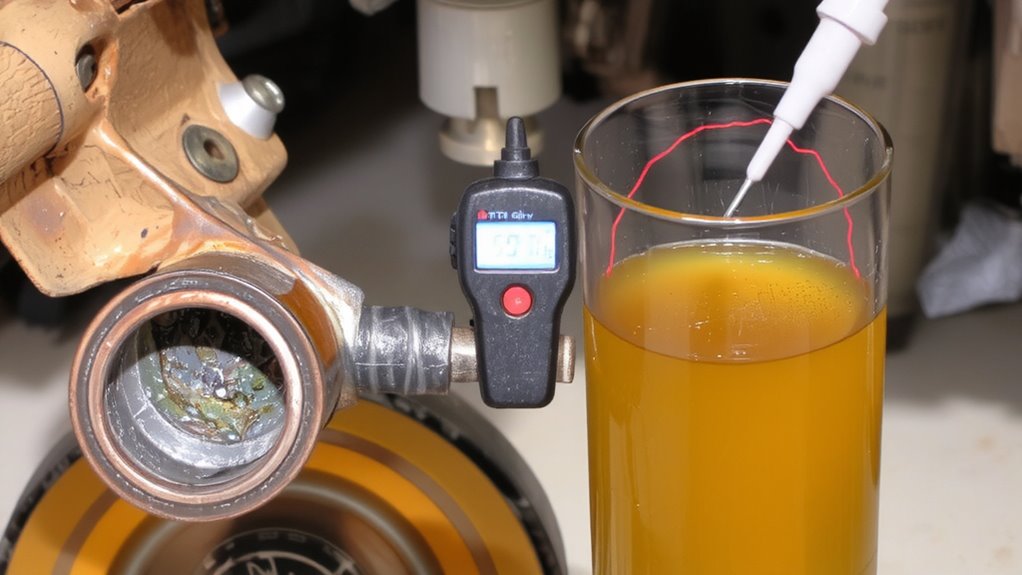
Why should you care about brake fluid conductivity? Because it’s a direct indicator of your brake system’s health. As brake fluid age increases, its chemical stability declines, raising electrical conductivity. Higher conductivity signals degraded fluid, often due to absorbed ions and contaminants. You’re not just measuring electricity-you’re detecting internal corrosion risk before damage occurs. Reservoir contamination accelerates this process, introducing conductive particles and moisture through the cap seal. Even small breaches compromise fluid integrity. Fresh DOT 3 fluid starts with conductivity below 100 μS/cm, but aged fluid can exceed 500 μS/cm, nearing critical thresholds. Conductivity above 1,000 μS/cm usually mandates immediate replacement. Monitoring these shifts lets you act proactively. It’s like checking blood chemistry rather than waiting for symptoms. Conductivity testing gives objective, quantifiable data-no guesswork. You maintain peak braking performance and avoid premature wear.
How Moisture Increases Conductivity and Corrosion
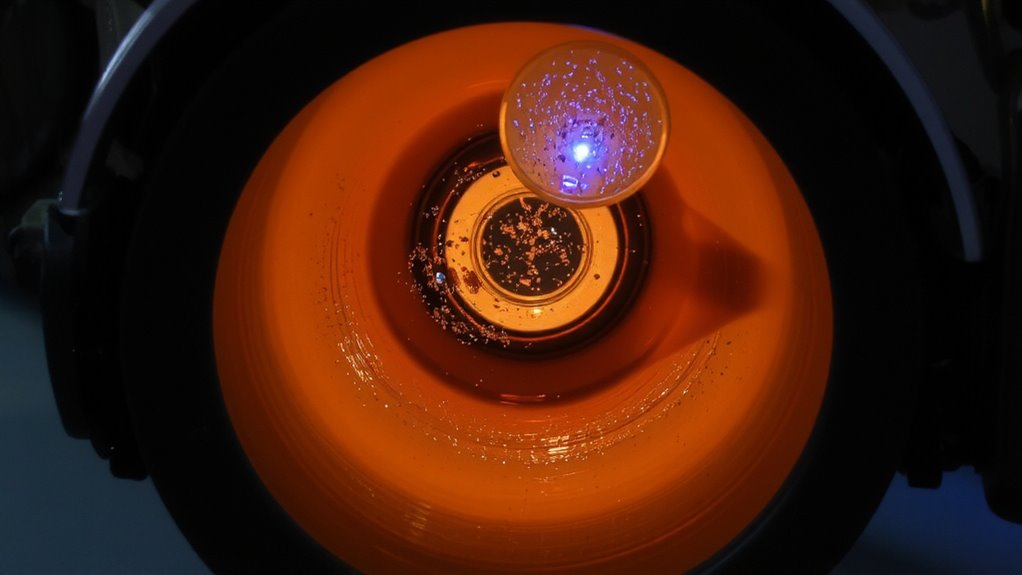
Because brake fluid is hygroscopic, it naturally absorbs moisture from the atmosphere, and that moisture drastically alters its electrical properties. You can expect moisture absorption to begin immediately after the fluid is exposed to air, even during routine servicing. As water mixes with the fluid, ionic contaminants dissolve, increasing ion concentration and boosting electrical conductivity. Higher conductivity enables stray currents to flow more easily through the system. These currents accelerate electrolytic degradation of metal components, especially aluminum and steel parts in calipers and lines. Moisture also lowers the fluid’s boiling point, increasing vapor lock risk under heavy braking. Even 3% water content by volume can reduce boiling temperature by over 50°C. The combination of elevated conductivity and lowered thermal stability creates ideal conditions for internal corrosion. You’re not just compromising performance-moisture absorption silently undermines system integrity over time.
High Conductivity? Your Brakes May Be Corroding
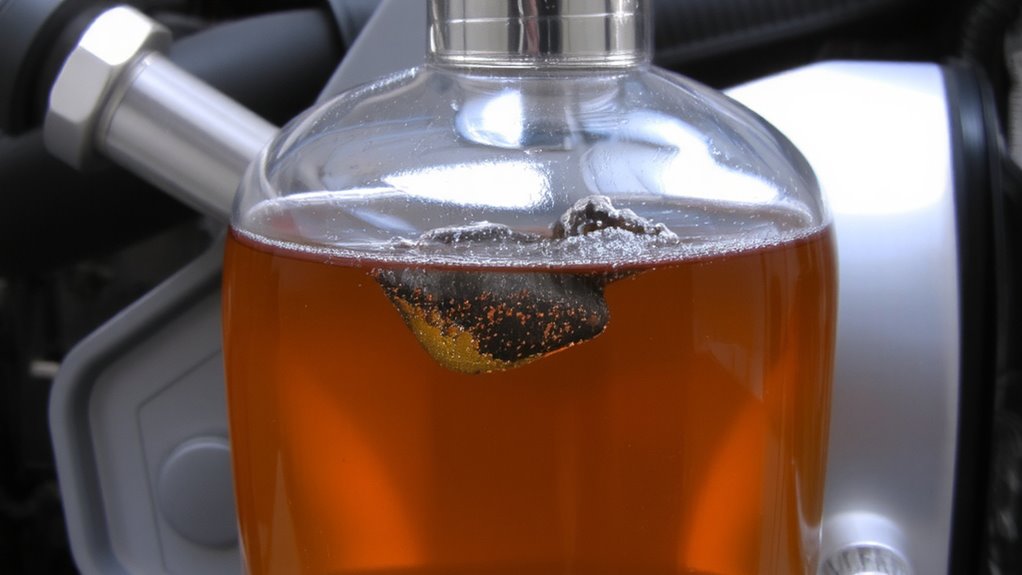
Could your brake fluid be conducting more than just hydraulic force? High conductivity signals trouble-likely internal corrosion. When conductivity exceeds 800 µS/cm, metal components like calipers and master cylinders begin corroding. Moisture contamination lowers boiling point and accelerates electrochemical degradation. This isn’t just about fluid age; it’s about system integrity. Corrosion debris circulates, accelerating brake pad wear by up to 30% and creating uneven pressure distribution. You’ll notice reduced pedal firmness and longer stopping distances. Elevated rotor temperature-frequently above 500°F during aggressive braking-worsens moisture boil, creating air pockets. Those hot spots also bake contaminants into deposits, further raising conductivity. Internal rust pits housing bores, compromising seals. Unlike visible rust, this damage hides inside lines and ABS valves. Once conductivity spikes, corrosion progresses exponentially. Your safety margins shrink with each braking cycle. High conductivity isn’t a warning-it’s confirmation: corrosion is already occurring.
How to Test Brake Fluid Conductivity Accurately
How do you know when invisible damage is already underway? You test your brake fluid’s conductivity accurately and regularly. Use a digital conductivity meter calibrated specifically for automotive fluids. Instrument calibration guarantees readings reflect true ion concentration-critical since even slight drift affects accuracy. Always calibrate before each use with standard reference solutions, typically 12,880 µS/cm at 25°C. Draw fluid directly from the master cylinder using a clean, dry syringe to prevent sample contamination. Introducing moisture, dirt, or oils skews results by increasing ions falsely. Test immediately after collection; delay risks ambient absorption of atmospheric moisture. Hold the meter steady, immerse the probe fully, and allow temperature stabilization-conductivity rises 2% per °C. Record results in microsiemens per centimeter (µS/cm) at a corrected 20°C to standardize comparisons. Accuracy lies not just in the tool, but in disciplined procedure-calibration and contamination control make or break reliability.
What Your Conductivity Reading Means
What does it mean when your brake fluid registers 9,500 µS/cm? That reading signals high ion concentration, indicating advanced moisture absorption. Your brake fluid’s chemical composition degrades as water integrates into the glycol-based mixture, reducing boiling point and increasing corrosion risk. Conductivity rises because dissolved ions-like chlorides and metal salts-move freely in the contaminated fluid. Temperature effects also influence readings: warmer fluid shows higher conductivity, so always measure at stable, moderate temperatures (20–25°C) for accuracy. A result near 9,500 µS/cm suggests the fluid has likely exceeded safe moisture levels (typically above 3%). This doesn’t confirm corrosion yet, but it warns that conditions now favor electrochemical reactions inside the system. You’re seeing a measurable shift in fluid integrity, driven by both environmental exposure and inherent chemical instability. Your next step is interpretation-not immediate action.
When to Flush Fluid Based on Conductivity
So when exactly should you pull the trigger on a flush? When conductivity exceeds 1,000 µS/cm, corrosion risk spikes-time to act. High conductivity means moisture-contaminated fluid, which degrades performance and accelerates brake pad wear. Poor fluid quality also affects hydraulic response, indirectly influencing rotor alignment due to uneven pressure distribution.
Don’t wait for symptoms. Use these thresholds:
| Conductivity (µS/cm) | Condition | Action |
|---|---|---|
| < 700 | Normal | Monitor |
| 700–1,000 | Caution | Inspect soon |
| > 1,000 | High Risk | Flush immediately |
Flushing restores proper viscosity and boiling point, maintaining clamping force accuracy. You preserve rotor alignment by ensuring even caliper operation. Clean fluid reduces internal corrosion, preventing seized pistons that skew brake pad wear. Regular flushing at or before 1,000 µS/cm protects system integrity. Stick to specs-most manufacturers recommend fluid replacement every two years regardless.
Stay Ahead: Monitor Brake Fluid to Prevent Damage
A smart maintenance routine starts with regular brake fluid monitoring, and you can’t afford to overlook conductivity as a key indicator. High conductivity signals moisture contamination, which accelerates internal corrosion. Check your brake fluid color regularly; fresh fluid is amber and clear, while dark or murky fluid indicates degradation and contamination. Moisture-laden fluid lowers boiling point stability, increasing the risk of vapor lock under hard braking. DOT 3 fluid must maintain a minimum dry boiling point of 205°C, while DOT 4 requires 230°C. Conductivity above 2,000 µS/cm often means it’s time to flush. Consistent monitoring preserves boiling point stability and prevents rust in calipers, lines, and master cylinders. You protect sensitive ABS components and guarantee reliable pedal response. Monitoring isn’t guesswork-it’s precision maintenance. Replace fluid before conductivity spikes compromise safety. Stay ahead: test often, flush proactively, and trust the data.
On a final note
You must monitor brake fluid conductivity to detect moisture contamination early. High conductivity-above 200 µS/cm-signals increased corrosion risk in calipers, lines, and ABS modules. Moisture ingress lowers fluid’s boiling point and accelerates metal degradation. Use a calibrated digital tester for accurate readings. Flush fluid when conductivity exceeds recommended thresholds. Regular testing every 6 months safeguards system integrity. Preventive maintenance prevents costly repairs and maintains braking performance under high-temperature conditions.