How Proximity to Industrial Zones Increases Ferrous Contamination Risk on Vehicles
You’re exposed to airborne ferrous dust when within 300 meters of industrial zones, where concentrations exceed 50 micrograms per cubic meter. These magnetically charged particles, as small as 5 microns, embed into paint and act as galvanic nuclei. Moisture triggers oxidation beneath the surface, causing rust spots and clear coat failure. A single particle under 50 microns can corrode steel up to 0.1 mm deep in weeks-protection strategies are essential to stop long-term damage before it starts.
Notable Insights
- Vehicles near industrial zones face higher ferrous contamination due to airborne iron particles from metalworking activities.
- Ferrous dust concentrations exceed 50 µg/m³ within 300 meters of industrial sites, increasing deposition on vehicle surfaces.
- Microscopic iron particles (5–50 microns) embed in paint and act as galvanic cells, initiating hidden corrosion.
- Standard washing fails to remove embedded magnetic particles, allowing moisture-triggered oxidation beneath protective layers.
- Continuous exposure near industrial areas accelerates rust formation, reducing vehicle lifespan by up to 30% if untreated.
What Is Ferrous Contamination: and Why Is It Bad for Cars?
Metal dust. It’s the core of ferrous contamination, and it’s silently damaging your car. You’re dealing with tiny iron particles from industrial activity that cling to your vehicle through magnetic attraction. These particles carry a charge, making them stick to steel surfaces like brake components and suspension parts. Once settled, they undergo chemical oxidation when exposed to moisture-turning into rust. That rust spreads, compromising metal integrity. A single particle, often smaller than 50 microns, can initiate corrosion that penetrates 0.1 mm deep within weeks. Unlike surface grime, ferrous contamination isn’t visible to the naked eye until damage appears. It accelerates wear on paint, undercarriage, and critical mechanical systems. Left untreated, this process reduces vehicle lifespan by up to 30%. You need targeted decontamination methods, not just washing. Recognizing this threat early helps prevent costly structural and cosmetic deterioration.
How Industrial Areas Expose Your Car to Metal Dust
You’re surrounded by invisible threats every time you park near a factory or drive through an industrial corridor. Airborne ferrous dust from heavy machinery, grinding operations, and metal fabrication settles on your vehicle’s surface unnoticed. These microscopic iron particles are magnetically active and embed into paint and crevices. Proximity to industrial activity increases exposure-research shows concentrations exceeding 50 micrograms per cubic meter in zones within 300 meters of active metalworking sites. Over time, embedded particles promote metal fatigue in body panels by disrupting molecular integrity. They also create pinpoint corrosion sites, especially on edges and seams where moisture accumulates. Unlike organic debris, ferrous dust isn’t removed by standard washing. Each particle acts as a galvanic cell nucleus, accelerating degradation. Exposure duration directly correlates with contamination levels. Immediate decontamination using specialized clay treatments is critical to prevent long-term structural compromise. Industrial environments don’t just dirty your car-they actively load it with destructive material.
How Ferrous Particles Wreck Paint and Cause Rust
Ferrous contamination is a silent paint killer. When microscopic iron particles settle on your car’s surface, they bond with the clear coat and begin to oxidize. This process, known as embedded oxidation, starts beneath the paint layer where moisture and oxygen accelerate decay. Over time, these particles swell and puncture the protective finish, exposing bare metal. Magnetic corrosion follows-iron particles attract moisture from the air, creating electrolytic conditions that speed rust formation. Even tiny, invisible particles can cause significant damage over months. Once embedded, they act like wicks, drawing in humidity and deepening corrosion. Surface hardness of most clear coats ranges between 2H–4H pencil hardness, yet ferrous specks penetrate easily under thermal cycling. The result is pinpoint rust spots, halo discoloration, and compromised structural integrity-not just surface blemishes. This degradation is irreversible without intervention. Regular decontamination using a car clay bar kit can effectively remove embedded ferrous particles before they cause lasting damage.
How to Spot Hidden Ferrous Contamination Early
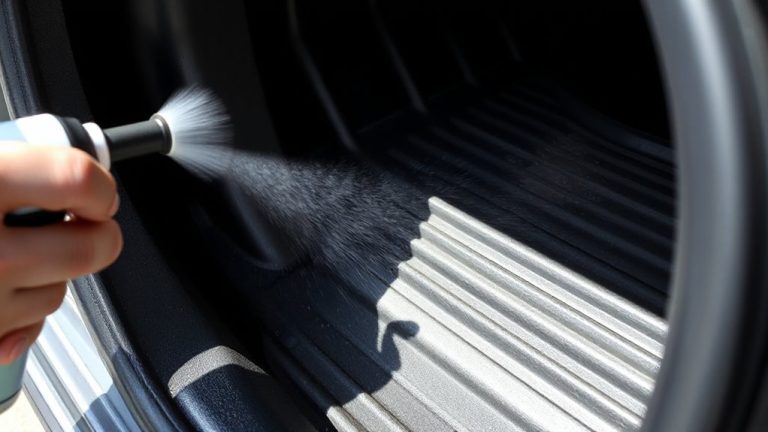
How can you detect contamination before damage becomes visible? Use a ferrous detection paste or cloth to reveal hidden iron particles through magnetic attraction. These tools pull ferrous debris from microscopic pores in clear coats, showing contamination invisible to the naked eye. You might also notice faint surface discoloration-often brownish or rust-toned-during high-angle lighting inspections. This discoloration indicates oxidized metal particles embedded in the paint. Perform checks monthly if parked near industrial zones, where airborne emissions carry fine metal particulates. Industrial fallout typically measures 5–50 microns-small enough to penetrate paint barriers but detectable with the right method. Early identification prevents etching and subsurface rust. Use lint-free cloths with iron-removing gels, which react chemically to draw out contaminants. Regular inspections double your defense window, reducing long-term damage risk by up to 70% compared to visual-only assessments.
Can You Remove Ferrous Contamination From Car Paint?
Surface contamination might go unnoticed for months, but once detected, removal is both possible and necessary to prevent lasting harm. You can safely remove ferrous particles using a clay bar, which lifts embedded contaminants without scratching the clear coat. Use a lubricant like a quick detailer spray and glide the clay bar over the surface in straight lines-don’t rub in circles. Once decontaminated, inspect the surface; if minor etching remains, a polish finish corrects shallow imperfections. Choose a diminishing abrasive polish with silica particles (3–5 microns) and apply at 1,200–1,800 RPM using a dual-action polisher. This step erases light oxidation and restores gloss. Always finish with a protective sealant. The clay bar process removes 95% of surface-level ferrous debris, while the polish finish guarantees optical clarity and surface uniformity. Immediate treatment prevents rust jacking and paint failure. For optimal results, select a high-quality clay bar formulation designed to capture fine metallic particles without crumbling during use.
How to Protect Your Car Near Industrial Zones
To minimize paint degradation near industrial zones, proactive protection is essential. Install high-efficiency air filtration systems in your garage to reduce airborne particulate matter. These systems capture ferrous dust as small as 0.3 microns, decreasing contaminant exposure when the vehicle is stationary. Apply ceramic-based protective coatings with a hardness rating of 9H to create a chemical and physical barrier. These coatings resist acid rain and metal particle adhesion better than wax. Reapply every 18–24 months or as per manufacturer specifications. Park indoors or use a car cover with electrostatic shielding to block metallic debris. Rinse your vehicle weekly with deionized water to remove embedded particles before they oxidize. Conduct monthly ferrous contamination checks using a clay bar and iron detector spray. Immediate decontamination prevents etching. Protective coatings combined with air filtration markedly reduce long-term damage risk.
On a final note
You face higher ferrous contamination risk near industrial zones due to airborne iron particles from machinery, welding, and abrasion. These microscopic fragments embed in paint, oxidize, and cause rust nucleation sites. Surface contamination levels can exceed 500 particles per square centimeter in high-exposure zones. Use iron-removing clay bars with lubricants and follow with pH-neutral decontamination washes. Apply ceramic coatings (0.5–1.0 mm thickness) to create a sacrificial barrier. Regular inspection and maintenance reduce long-term damage.