Semi-Trailing Arm Rear Suspension: How Porsche 911 & BMW E30 Used It
You used semi-trailing arm rear suspension in older performance cars to achieve predictable handling with mechanical simplicity. A lateral arm pivoted inward toward the chassis at roughly 45 degrees, allowing independent wheel travel. It followed an arc, producing controlled camber changes-up to 1.5° per inch of deflection. This design reduced unsprung weight and improved grip over bumps. BMW and Porsche favored it for compact packaging and rear-engine layouts. Its kinematics were less precise than modern systems, but tuning via bushings enhanced behavior. There’s more to how it shaped classic sports car dynamics.
Notable Insights
- Semi-trailing arm suspension allows independent rear wheel movement, improving traction and handling on uneven surfaces.
- It follows an arc during compression, inducing controlled positive camber for predictable grip in cornering.
- Designed with a compact 45-degree pivot, it saves space and suits rear-engine or transaxle layouts in performance cars.
- Used by Porsche 911 and BMW E30 models, it offered balanced dynamics with tuning via bushings and mounts.
- Simpler and lighter than multi-link systems, it provided durable, communicative rear-end behavior in older performance vehicles.
How Semi-Trailing Arm Suspension Works
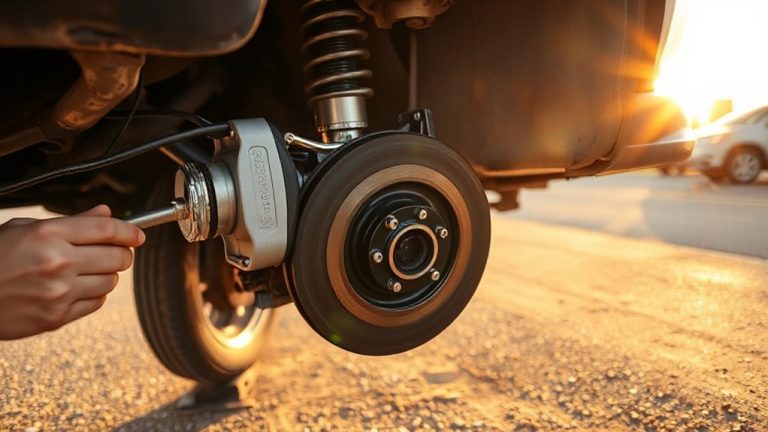
Think of the semi-trailing arm suspension as a smart compromise between simplicity and control. You’ll see it commonly in older performance cars, where engineers prioritized balanced handling without excessive complexity. Each rear wheel connects to a lateral arm that pivots inward toward the chassis at roughly a 45-degree angle. This setup defines the suspension geometry, dictating how the wheel moves through its travel. As the wheel rises, the arm’s arc causes noticeable camber change-typically moving into positive camber during compression. That shift affects tire contact under cornering loads. The design allows moderate compliance over bumps while maintaining predictable alignment behavior. Though not as precise as multi-link systems, it offers better lateral control than a solid axle. You get decent ride quality and manageable production costs. The semi-trailing arm strikes a practical balance for rear-wheel-drive platforms where space and weight matter.
Why BMW and Porsche Favored Semi-Trailing Arms
Engineers at BMW and Porsche didn’t adopt semi-trailing arm suspensions by accident-they chose them for specific performance and packaging advantages. You benefit from their precision engineering rooted in Porsche heritage and BMW tradition. The design saves space, allowing wider tires and better weight distribution. It offers predictable handling, especially during cornering, thanks to controlled camber changes.
| Feature | BMW Application | Porsche Application |
|---|---|---|
| Suspension Type | Semi-trailing arm | Semi-trailing arm |
| Model Examples | 2002, E30 3 Series | 911 (1964–1989) |
| Camber Gain | Moderate, progressive | Slight, stable |
| Packaging Efficiency | High (transaxle fit) | High (rear-engine layout) |
| Tuning Flexibility | Via bushings and geometry | Via adjustable mounts |
You gain direct feedback and balanced dynamics essential for performance driving-all within compact rear layouts.
How Semi-Trailing Arms Beat Solid Axles
While solid axles were once common in rear suspensions, they limit wheel independence and handling precision-problems semi-trailing arms solve effectively. You get improved handling because each wheel moves independently, maintaining better contact with the road. Unlike a solid axle, which links both wheels rigidly, semi-trailing arms allow for controlled camber changes during cornering. This design reduces body roll and enhances grip. Reduced unsprung weight is achieved by using lighter forged arms and mounting components closer to the chassis. Lighter wheels and brakes contribute further, improving ride quality and responsiveness. Each arm pivots near the chassis and angles inward, creating a compromise between trailing and semi-independent geometry. That setup delivers predictable behavior under acceleration and braking. You’ll notice quicker steering response and increased stability at speed-especially on uneven pavement. It’s why many high-performance models adopted this system.
Iconic Cars That Used Semi-Trailing Arm Suspension
A handful of legendary performance machines from the 1960s through the 1990s relied on semi-trailing arm rear suspension to deliver balanced handling and ride comfort. You’ll find this design in the Porsche 911 up to the 993 generation, where precise rear wheel alignment enhanced stability during hard cornering. The suspension mounting points were rigidly set in the rear subframe, minimizing flex and improving responsiveness. BMW used it in the E21 3 Series and E24 6 Series, giving them communicative rear-end grip and predictable breakaway characteristics. Audi applied it in the original Quattro, balancing weight distribution and minimizing unsprung mass. Each system used laterally mounted arms to control axle movement, allowing independent wheel travel while maintaining consistent camber angles. This setup simplified alignment adjustments and reduced complexity compared to multi-link systems, making it a pragmatic engineering choice for performance-oriented chassis tuning.
Semi-Trailing Arm Vs. Modern Suspension: The Downsides
You admired the semi-trailing arm suspension in classics like the Porsche 911 and BMW E21 for its simplicity and predictable behavior, but compared to modern systems, it reveals clear limitations. It offers reduced camber control during cornering, where vertical wheel travel causes large camber angle shifts-up to 1.5° per inch of deflection in some models. This diminishes tire contact patch stability under load. The design also allows increased lateral movement, with compliance bushings deflecting up to 3–5 mm under hard cornering, introducing imprecision. Modern multi-link setups minimize these issues with rigid mounts and geometry that maintain ideal camber. Unlike those, the semi-trailing arm uses a single pivot angled toward the vehicle center, amplifying lateral forces during compression. That compromises grip and steering response. While durable and space-efficient, its kinematic behavior falls short in high-performance applications today.
On a final note
You now understand the semi-trailing arm’s role in classic performance cars. It provided precise camber control during suspension travel, unlike solid axles. BMW and Porsche used it for balanced handling and compact packaging. Each arm pivoted inward, allowing independent wheel movement. Still, it added unsprung weight and compromised high-speed stability versus modern multi-link systems. Limited by geometry changes under load, it was eventually phased out. Yet, its durability and simplicity remain notable in automotive engineering history.