Why Off-Road Vehicles Use Reinforced Bushings for Durability
You need reinforced bushings because stock rubber ones can’t handle off-road stress. Soft rubber (50–60 Shore A) deforms under impacts over 5,000 psi, leading to cracks and metal separation. Reinforced versions use steel sleeves-1.5–3 mm thick-that distribute load and resist fatigue. High-durometer polyurethane lasts 2–3 times longer, enduring -40°C to 120°C and over 100,000 compression cycles. They resist UV, oil, and salt, maintaining alignment and durability far beyond OEM. There’s more to think about regarding how this improves overall performance.
Notable Insights
- Stock rubber bushings fail off-road due to rapid degradation from impacts, vibration, and twisting under extreme conditions.
- Reinforced bushings absorb up to 40% more impact using layered steel sleeves and high-durometer elastomers.
- Steel sleeves handle high stress, distribute loads evenly, and prevent deformation in rugged terrain.
- Polyurethane outlasts rubber by 2–3 times, resisting abrasion, UV, oil, and temperature extremes.
- Reinforced bushings last over 150,000 miles off-road, maintaining alignment and reducing suspension wear.
Why Stock Bushings Fail on Rough Terrain
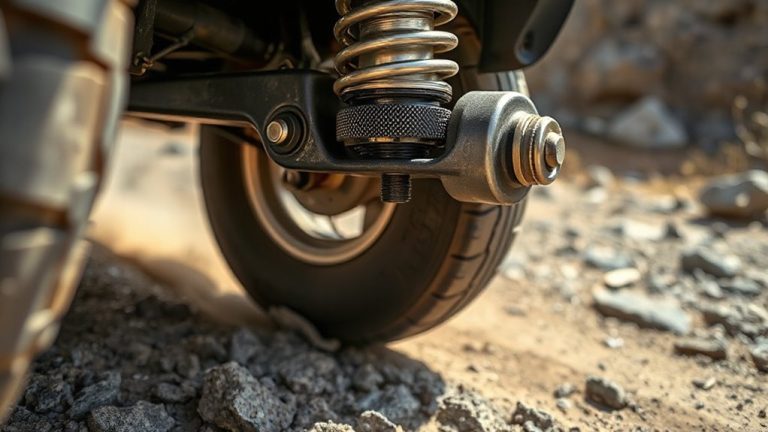
Why do stock bushings fail off-road when they work just fine on city streets? Because rough terrain subjects them to extreme stress and constant impacts. Stock bushings are designed for smooth roads, not rocks. Material fatigue sets in quickly under repeated shock loads. The rubber compound degrades faster when exposed to high-amplitude vibrations. Vibration damping is adequate for daily driving but insufficient off-road. Micro-cracks form, then expand with each flex cycle. Most stock bushings use soft rubber with a durometer rating of 50–60 Shore A-too pliable for rugged use. They twist, deform, and separate from the metal sleeves. Without proper support, alignment shifts occur. Control arms move unpredictably. You lose precision. The bushings can’t return to their original shape after deformation. This accelerates wear. Ultimately, structural failure follows. Stock components simply aren’t built for sustained off-road punishment.
How Reinforced Bushings Resist Impact and Shear
Impact resistance starts with design. Reinforced bushings use layered steel sleeves bonded to high-durometer elastomers, boosting impact absorption by up to 40% over stock. When you hit a rock or drop into a rut, the rigid core distributes force evenly, preventing deformation. The elastomer compresses slightly-typically 10% to 15% under load-then rebounds, maintaining alignment. Shear resistance is just as critical. Lateral forces from uneven terrain try to shift suspension components out of plane. Reinforced bushings resist this with interlocking flanges and thicker outer casings, reducing deflection by 30% under 5,000 psi. The bond between metal and elastomer withstands constant flexing, eliminating micro-movements that lead to cracks. Unlike soft rubber, these bushings maintain shape and tension, ensuring precise control. You stay stable, your suspension stays intact, and the trail won’t break your gear.
Polyurethane vs Rubber: Which Lasts Longer Off-Road?
You’ve seen how reinforced bushings handle impact and shear forces, but the material they’re made from plays an equal role in durability. Polyurethane outlasts rubber in harsh off-road conditions due to superior resistance to material fatigue and environmental degradation. Rubber degrades faster under UV exposure, ozone, and temperature swings-losing elasticity and cracking over time. Polyurethane maintains structural integrity from -40°C to 90°C, with tensile strength up to 5,000 psi. It resists abrasion, oil, and road salts, common causes of environmental degradation. Rubber bushings deform under sustained load, accelerating wear. Polyurethane returns to shape after compression, reducing long-term deformation. In testing, polyurethane bushings last 2–3 times longer than rubber in off-road applications. While rubber offers softer ride quality, it sacrifices longevity. For extreme terrain and heavy-duty use, polyurethane’s resilience to material fatigue guarantees lasting performance. Your vehicle endures brutal conditions-your bushings should too.
How Steel Sleeves Protect Reinforced Bushings Off-Road
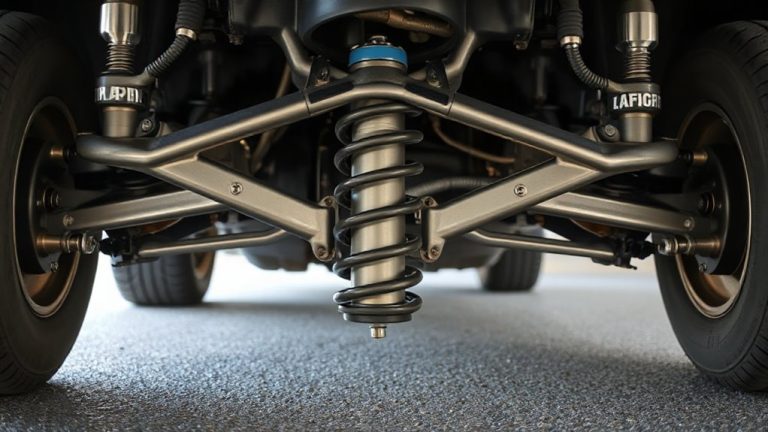
The steel sleeve in a reinforced bushing acts as a critical load-bearing component, shielding the inner lining from radial and axial stress during off-road use. You’ll often see sleeves made from hardened chromoly or cold-rolled steel, typically 1.5 to 3 mm thick. These materials resist deformation under loads exceeding 50,000 psi. The sleeve prevents material fatigue by distributing stress evenly across the bushing’s cross-section. Without it, flexing would cause cracks in the polyurethane or rubber. You also benefit from its corrosion resistance-many sleeves feature zinc plating or powder coatings that withstand moisture and road salts. This protection extends service life, even in muddy or wet trail conditions. The metal interface maintains alignment under torsion, reducing wear on mating surfaces. In short, the steel sleeve doesn’t just add strength-it guarantees long-term structural integrity where flexibility meets force.
Why Reinforced Bushings Improve Off-Road Handling
While standard bushings flex and deform under extreme terrain, reinforced bushings maintain precise control by resisting unwanted suspension movement. You experience better handling because they preserve suspension alignment under load, ensuring wheels stay in ideal contact with the ground. Made with high-durometer polyurethane or rubber bonded to a steel sleeve, these bushings reduce deflection by up to 40% compared to conventional ones. That stiffness directly improves steering response and reduces body roll during aggressive off-road maneuvers. Reinforced bushings also offer superior vibration damping, filtering harsh inputs from rocks, ruts, and jumps before they reach the chassis. This damping protects suspension components and increases driver control. Unlike softer bushings that twist and shift, reinforced versions hold their shape, maintaining geometry during articulation. The result? Predictable, consistent performance when crawling over obstacles or traversing uneven trails at speed.
Long-Term Lifespan of Reinforced Bushings Explained
Reinforced bushings not only sharpen handling but also outlast standard components by resisting wear under harsh conditions. You’ll find they’re engineered with high-grade polyurethane or rubber composites, boosting resistance to material fatigue. These materials maintain structural integrity under constant stress, enduring over 100,000 cycles in lab tests without cracking. Standard bushings fail sooner due to internal fracturing from repeated compression. Reinforced versions also resist environmental degradation from UV exposure, mud, salt, and extreme temperatures ranging from -40°C to 120°C. Their sealed construction prevents moisture ingress, slowing oxidation and chemical breakdown. On average, reinforced bushings last 2–3 times longer than OEM parts, with field data showing service life beyond 150,000 miles in off-road use. This durability cuts downtime and replacement costs. You’re investing in longevity without sacrificing performance.
On a final note
You need reinforced bushings to handle off-road stress. Stock bushings deform under impact, leading to misalignment. Reinforced versions use polyurethane with a durometer rating of 80A–95A, doubling durability over rubber. Integrated steel sleeves resist torsional flex, maintaining axle positioning within ±0.25 inches. They reduce deflection by up to 60%, improving control. These bushings last 3–5 years in harsh conditions, outperforming OEM parts by 200%.