Optimizing Front Camber Settings With Adjustable Coilovers for Improved Cornering Grip
You optimize front camber with adjustable coilovers by fine-tuning suspension geometry to maintain ideal tire contact during cornering. Negative camber, typically -2.0° to -3.5° for track use, increases grip under lateral loads. Adjust ride height and top-mount position to set camber accurately. Measure with a digital gauge at operating tire pressure and loaded suspension. Excessive angles beyond -3.0° accelerate inside edge wear. Proper setup guarantees balanced contact patch loading and consistent handling-further refinements reveal how dynamic camber gain affects real-world performance.
Notable Insights
- Adjustable coilovers allow precise front camber tuning by altering ride height and control arm angles for optimal cornering grip.
- Set camber between -2.0° and -3.5° for track use to maximize tire contact under high lateral loads.
- Use camber plates or adjustable upper mounts to fine-tune camber angles without compromising suspension geometry.
- Measure camber on a level surface with proper ride height, tire pressure, and suspension preload for accurate results.
- Avoid excessive negative camber beyond -3.5° unless track-only to prevent accelerated tire wear and alignment instability.
What Is Front Camber and Why It Matters for Grip
Camber is the angle at which your front tires tilt inward or outward when viewed from the front of the vehicle. You measure it in degrees, and it directly affects tire contact with the road. Negative camber means the top of the tire leans inward, improving grip during cornering by balancing load across the tread. Positive camber, where the top tilts outward, reduces handling precision and increases wear. Proper camber settings optimize contact patch under lateral forces. Your suspension geometry determines how camber changes during compression and rebound. Incorrect alignment reduces grip and accelerates tire wear. Adjusting camber guarantees maximum tire contact during aggressive driving. Factory settings often prioritize comfort over performance. For track use, fine-tuning camber improves turn-in response and lateral grip. Precision alignment tools measure changes accurately. Even 0.5 degrees impacts performance. Camber isn’t static-it interacts dynamically with suspension travel and load transfer.
How Adjustable Coilovers Control Front Camber
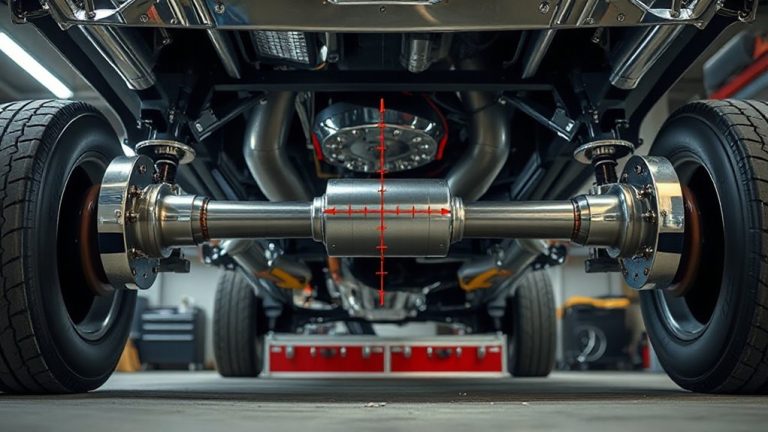
While driving through corners, your front tires experience shifting loads that demand precise alignment control, and this is where adjustable coilovers make a critical difference. By altering ride height, you directly influence front camber-how much the tire tilts inward at the top. Adjustable coilovers let you fine-tune both shock geometry and coilover preload, guaranteeing peak contact during cornering. Adjusting the threaded body changes spring perch position, modifying suspension travel and control arm angles. Correct shock geometry maintains consistent camber curves through compression. Proper coilover preload guarantees responsive damping without binding.
| Feature | Effect on Camber | Adjustment Tool |
|---|---|---|
| Ride Height | Increases negative camber | Spanner wrench |
| Spring Preload | Affects load distribution | Locking rings |
| Mounting Position | Alters control arm angle | Top hat bolts |
| Damping Settings | Influences transient response | Rebound knob |
| Shock Length | Changes camber gain | Collar adjustment |
How to Measure and Set Camber – Step by Step
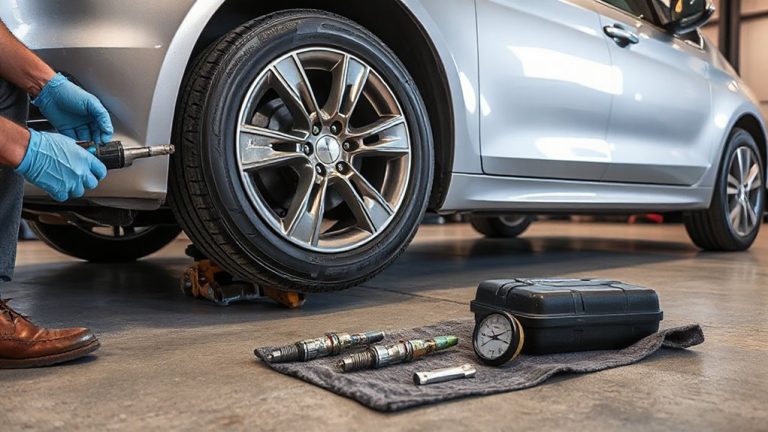
Since accurate camber settings are essential for maximizing tire contact and handling precision, you’ll want to start with the right tools and a level surface. Use a digital camber gauge or alignment rack for readings within ±0.1° accuracy. Position the car on a flat, level ground with the suspension loaded-wheels straight and tires inflated to racing pressure. Measure camber at the spindle or hub using the gauge. Adjust your coilovers’ upper mount or camber plate incrementally, tracking changes. Recheck after each adjustment. Monitor tire temperature across the tread; even heat indicates proper contact, while excessive inner or outer wear suggests incorrect camber. Remember, suspension geometry affects camber gain during cornering, so static settings must account for dynamic changes. Always verify settings with the vehicle at ride height. Finalize only after confirming consistency through multiple measurements.
Choose the Right Camber for Street, Track, or AutoX
You’ve got your tools ready and the car sitting level, tires inflated, suspension loaded-now it’s time to decide how much camber suits your driving. Your choice depends on purpose: street, track, or AutoX. Adjusting camber affects tire compound wear and suspension alignment, optimizing contact under load. Too much negative camber reduces straight-line grip; too little sacrifices cornering performance. Match settings to your use case for best results.
| Driving Style | Recommended Camber (Front) |
|---|---|
| Street | -0.5° to -1.0° |
| Track | -2.0° to -3.5° |
| AutoX | -2.5° to -4.0° |
Track and AutoX demand aggressive settings to maximize tire compound grip during high lateral loads. Street setups prioritize longevity and stability. Always verify suspension alignment after adjustments.
Fine-Tuning Camber on Adjustable Coilovers for Track vs Street
How do you extract maximum grip without sacrificing critical alignment parameters? For street driving, you’ll want -0.5 to -1.0 degrees of camber-comfortable for daily use while improving cornering. On track, push to -2.5 to -3.5 degrees for maximum tire contact under hard loads. Adjusting camber on adjustable coilovers requires precise changes to upper mounts, not coilover preload, which affects ride height and spring tension, not camber directly. Misadjusting can introduce bump steer effects, especially if suspension geometry shifts unevenly. Always reset toe after camber changes. Use a digital camber gauge for accuracy within 0.1 degrees. Track setups demand stiffer spring rates and optimized droop to maintain camber control through bumps. Street setups prioritize compliance-excessive camber increases wear and steering kickback. Fine-tuning means balancing response, stability, and alignment integrity across driving conditions.
Avoiding Excessive Camber: Wear vs. Grip Trade-Offs
Excessive camber might seem like a quick fix for maximizing grip, but it quickly introduces more problems than it solves. You’ll gain minimal cornering traction while accelerating tire wear dramatically. Negative camber beyond -2.5 degrees on most street-driven performance cars causes uneven contact patch loading. This increases tire scrub, where the inside edge drags rather than rolls, reducing lifespan by up to 40%. Even on track cars, exceeding -3.5 degrees requires frequent inspection. Camber settings also affect toe stability-excessive angles promote alignment drift due to altered suspension geometry under load. That means your carefully dialed-in toe can shift during hard cornering, compromising handling predictability. For daily drivers, keep front camber between -1.0 and -1.8 degrees. Track-only setups can go lower, but monitor wear patterns every two track sessions. Balance is key-extreme angles sacrifice longevity and control.
On a final note
You’ve optimized front camber using adjustable coilovers for maximum cornering grip. Proper camber settings-typically -2.5 to -3.5 degrees for track-ensure full tire contact during hard cornering. Street setups favor -1.0 to -1.5 degrees to balance wear and handling. Adjustable upper mounts let you fine-tune angles precisely. Over-cambering causes inside-edge wear. Use alignment tools to measure within 0.1-degree accuracy. Your setup now maximizes contact patch, reducing lap times and improving turn-in response.