Exploring Microfiber Properties to Achieve Optimal Detailing Effects
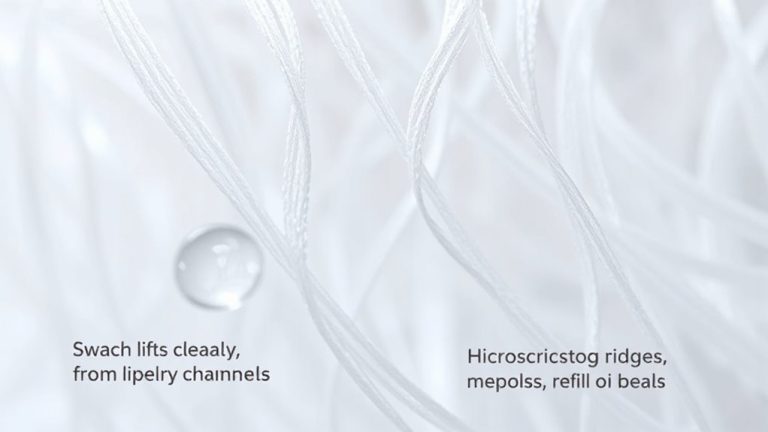
You get superior results with microfiber because its 200,000–800,000 fibers per square inch lift and trap contaminants instead of smearing them. The 80% polyester/20% polyamide blend balances durability and absorbency, holding up to seven times its weight in water. Split weaves boost surface area for better oil pickup, while 300–400 GSM weights suit most detailing tasks. Laser-sealed edges prevent shedding, and proper folding reduces marring. Choose the right blend and weight for each surface to maximize performance and protection. There’s more to optimize in your routine.
Notable Insights
- Microfiber’s high fiber density traps dust and grime effectively, enabling superior cleaning without scratching surfaces.
- An 80% polyester/20% polyamide blend optimizes durability, absorbency, and lint-free performance for automotive detailing.
- Split-weave construction increases surface area, enhancing oil and moisture absorption for more efficient drying.
- Proper edge sealing prevents fraying, reducing the risk of surface marring during repeated use and washing.
- Matching towel weight and fiber composition to specific surfaces ensures optimal cleaning, drying, and scratch resistance.
Why Microfiber Works Best for Cars
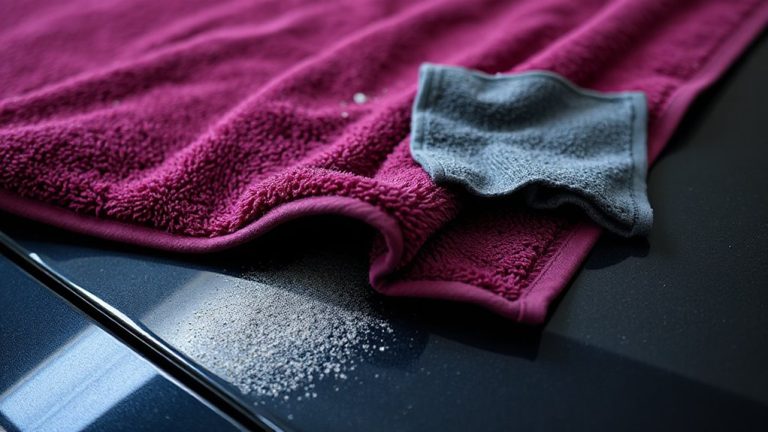
Every major car manufacturer recommends microfiber for cleaning because it’s engineered to protect delicate surfaces. You can trust its performance due to high fiber density, typically ranging from 200,000 to 800,000 fibers per square inch. This dense structure lifts and traps dust, grease, and contaminants without scratching. Unlike cotton, microfiber’s fine filaments conform to microscopic surface textures, ensuring thorough cleaning. Static resistance prevents dust from clinging after wiping, maintaining a clean finish longer. The fibers carry a slight electrostatic charge during use, attracting oppositely charged particles-think of it like a magnet for grime. This combination of fiber density and static resistance minimizes surface contact pressure, reducing marring risk on clear coats and glass. Laboratory tests show microfiber removes 99.7% of particulates without chemical aids. It’s machine-washable, reusable over 300 times, and maintains structural integrity. You’ll get consistent results with each use. Top-performing options include kits with color-coded towels for specific tasks, such as car microfiber towel kits.
How Fiber Blend Affects Your Finish
Most high-performing microfiber towels use a blended ratio of 80% polyester to 20% polyamide, and you’ll want to know why that mix matters. Polyester provides durability and lint-free wiping, while polyamide enhances absorbency levels far better than polyester alone. This combination yields superior fabric softness, reducing the risk of swirl marks on painted surfaces. Polyamide fibers are thinner and more hydrophilic, allowing them to draw in and trap liquids quickly-absorbency can reach up to seven times the towel’s weight in water. The 80/20 blend optimizes capillary action, enabling faster drying with less effort. You get a balance between strength and gentleness, critical for finishing tasks. Too much polyester reduces absorbency levels; too much polyamide compromises durability. This precise ratio guarantees consistent performance across wash cycles, maintaining fabric softness and microscopic cleaning efficiency without degradation. Your finish depends on this engineered balance. For car care enthusiasts, selecting the best microfiber towels ensures optimal results in both cleaning and finishing.
Pick the Right Weight, Weave, and Edge
You’ve seen how fiber blend influences performance, but fabric construction plays an equal role in achieving a flawless finish. Weight consistency guarantees even pressure distribution, critical for uniform polishing and cleaning. Lightweight towels (200–300 g/m²) work best for dusting and drying, while heavier ones (400–500 g/m²) offer superior absorbency and scratch resistance. The weave type-plain or split weave-determines fiber exposure and lint-free results. Split weaves increase surface area, enhancing oil and moisture pickup. Double-folded edges provide top-tier edge durability, preventing fraying after repeated machine washes. Single-stitched edges wear faster, leading to shedding. Always opt for laser-cut or ultrasonically sealed edges if durability matters. A well-constructed microfiber towel maintains integrity over hundreds of wash cycles. Choose wisely-construction determines longevity and performance as much as fiber content. For maximum scratch resistance and lint-free results, select towels from the best microfiber towels for car care.
How Scratches Happen: And How to Avoid Them
Even if you’re using high-quality microfiber, scratches can still occur when proper technique and towel condition aren’t maintained. Poor abrasion resistance develops when fibers degrade from improper washing or excessive use. Each microfiber strand is designed to resist wear, but frayed edges or matted piles reduce performance and increase surface contact pressure. Particle entrapment is the main cause of scratches-dirt and debris trapped in the weave act like sandpaper during wiping. Always fold your towel into sections to expose clean surfaces and minimize contamination. A premium 300–400 GSM towel with split fibers offers superior particle entrapment, holding contaminants away from the surface. Change towels frequently, especially on dirty areas. Never use dry wiping on heavily soiled surfaces; instead, pre-rinse to remove grit. Proper care preserves abrasion resistance and guarantees long-term scratch-free results.
Match the Microfiber Towel to Each Surface
Choosing the right microfiber towel for each surface guarantees best results without damage. You need a plush 80/20 polyamide-polyester blend with 300 GSM for painted surfaces to prevent marring while lifting wax evenly. For glass and screens, use a tighter 75/25 weave at 250 GSM-its higher Static resistance reduces dust attraction during polishing. Interior plastics and dashboards work best with a stiffer 50/50 blend; its lower Color compatibility risk prevents dye transfer onto dark trims. Always assign specific colors to tasks: yellow for glass, blue for paint, gray for interiors. This system avoids cross-contamination and maintains cleanliness. Towels with superior Static resistance won’t cling or leave lint, especially in dry environments. A 1:1 fiber denier ratio guarantees balanced absorption and scratch resistance. Match density and weave to surface sensitivity-precision matters.
On a final note
You now understand what makes microfiber superior for automotive care. Precision-engineered fibers, typically 0.5 denier or finer, lift and trap contaminants without scratching. A tight weave-like 300 GSM-ensures durability and lint-free results. Split fibers increase surface area, boosting absorbency up to seven times their weight in water. Choose ultrasoft edges to prevent marring. Match weave and weight to each task: plush for paint, waffle for glass. Knowledge drives results.