Upper vs Lower Control Arms: Key Suspension Differences
Your lower control arm bears most of the vehicle’s weight-up to 1,500 lbs-handling suspension loads during acceleration, braking, and cornering. It connects via two bushings and a ball joint, allowing 15–25 degrees of travel. The upper control arm fine-tunes camber and caster, maintaining wheel alignment under dynamic forces. While the lower arm supports mass, the upper manages geometry, working together in double-wishbone setups for precise handling. Some front-wheel-drive vehicles skip the upper arm entirely, using a strut instead. You’ll see how design choices impact performance and serviceability.
Notable Insights
- Lower control arms bear most of the vehicle’s weight and handle suspension loads during acceleration, braking, and cornering.
- Upper control arms primarily control camber and caster angles to maintain wheel alignment during dynamic driving.
- Lower control arms connect the spindle via a ball joint and attach to the frame with two bushings for load support.
- Upper control arms are often shorter and designed for minimal deflection to ensure precise steering and handling response.
- Some vehicles omit upper control arms by using strut suspensions, where the strut replaces the upper arm’s structural role.
What Are Upper and Lower Control Arms?
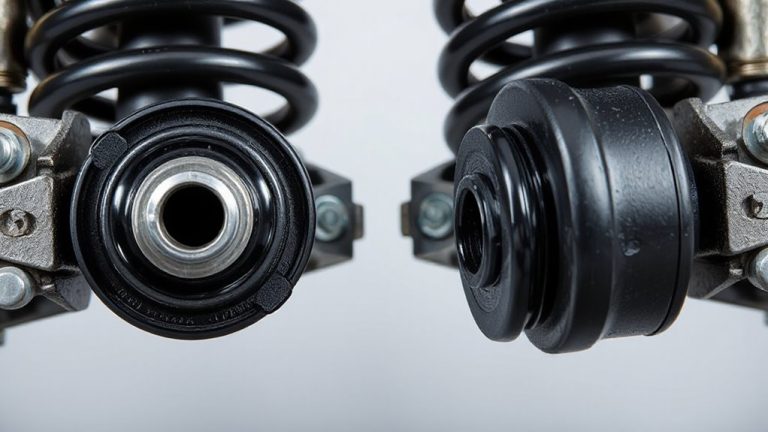
Control arms-also known as A-arms due to their shape-are pivotal components in a vehicle’s independent suspension system, linking the wheel hub to the chassis. You’ll typically find upper and lower control arms managing vertical wheel motion while maintaining alignment. The lower arm usually handles more load, but both endure constant stress. Over time, ball joint wear compromises steering response and can lead to unsafe conditions if unchecked. Each arm connects via bushings-usually made of rubber or polyurethane-that absorb vibrations and allow slight movement. Bushing deterioration results in clunking noises, poor handling, and misalignment. Modern control arms use stamped steel or forged aluminum, with OEM specs allowing no more than 0.030 inches of deflection under load. After 80,000 miles, fatigue and corrosion often accelerate wear. Replacement arms should match factory angles and mounting points exactly to preserve suspension geometry.
How Lower Control Arms Bear Vehicle Weight
The lower control arm handles the bulk of your vehicle’s weight, acting as the primary link between the front wheel and the chassis. It directly manages load distribution across the suspension, ensuring even contact with the road. During acceleration, braking, and cornering, the arm controls weight transfer to maintain stability.
| Function | Specification |
|---|---|
| Load Capacity | Up to 1,500 lbs per arm, depending on design |
| Material | Forged steel or cast aluminum |
| Mounting Points | Two bushings to the frame, one ball joint to the spindle |
| Articulation Range | 15–25 degrees of vertical travel |
This structural role minimizes stress on other components. Proper load distribution reduces tire wear and improves handling. The arm’s geometry affects ride height and camber under weight transfer, making it critical for performance and safety.
How Upper Control Arms Keep Your Wheels Aligned
While they don’t carry as much weight as their lower counterparts, upper control arms play a critical role in maintaining your wheel alignment under dynamic driving conditions. They primarily govern camber adjustment, ensuring the tire’s contact patch stays optimized during cornering. As suspension compresses, the upper arm pivots to control the top of the wheel, minimizing excessive camber gain or loss. This precise motion maintains grip and extends tire life. Upper control arms also contribute to caster stabilization, which affects steering feel and returnability. A properly designed upper arm keeps the spindle’s tilt consistent, promoting straight-line stability and responsive handling. Most performance vehicles use adjustable upper arms to fine-tune camber and caster for track or load conditions. These arms typically feature ball joints or bushings engineered for minimal deflection-often within ±0.5 degrees of specified alignment settings. Even small tolerances directly influence control, safety, and tire wear over time.
Why Some Cars Don’t Have Upper Control Arms
Why do so many front-wheel-drive cars lack upper control arms? They use strut suspensions instead. In this setup, the strut replaces the upper control arm’s role. The strut connects the top of the wheel assembly to the chassis, handling both shock absorption and upper control. This design saves space and reduces weight. You’ll typically find it in compact and midsize cars where efficiency matters. The lower control arm works with the strut to guide wheel motion. Rear suspensions often use trailing arms to control forward and backward movement. Trailing arms are simple, effective, and cost-efficient. Strut suspensions limit camber adjustment compared to double control arm systems. But they’re durable and require less maintenance. Automakers choose them for their balance of performance, cost, and packaging. So, if your car has struts, it doesn’t need an upper control arm. The system’s integrated design makes it a practical choice.
How Control Arms Work Together for Better Handling
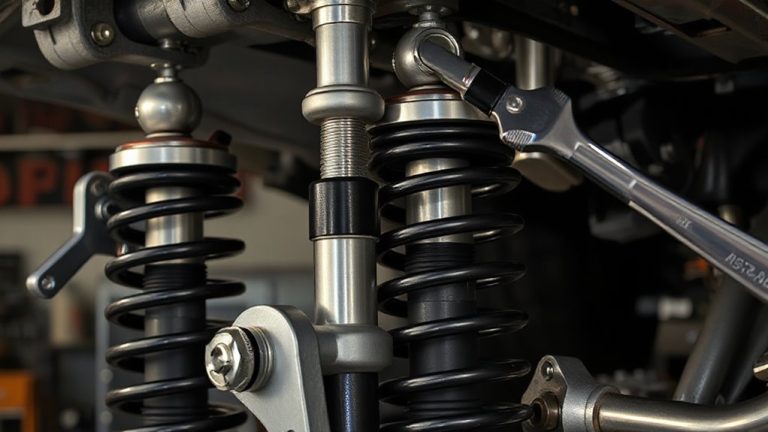
You’ve seen how strut suspensions replace upper control arms in many front-wheel-drive vehicles, but when both upper and lower control arms are present, they work in tandem to fine-tune wheel motion and improve handling. The upper control arm anchors the top of the steering knuckle, while the lower arm supports the bottom, creating a double-wishbone suspension setup. This design allows precise control of suspension geometry, maintaining ideal tire contact during cornering and over bumps. Ball joint function is critical here-the lower ball joint carries the vehicle’s weight and enables smooth steering angles, while the upper ball joint manages lateral forces. Together, they control camber, caster, and toe changes throughout the suspension travel. Control arm lengths and angles are engineered to minimize wheel scrub and maximize stability. Proper alignment guarantees even tire wear and responsive steering. This system delivers superior ride quality and control, especially in performance and all-wheel-drive vehicles.
On a final note
You rely on control arms for precise suspension operation. The lower control arm bears most of the vehicle’s weight, typically supporting 60–70% of the unsprung mass. Upper control arms maintain camber and alignment, ensuring tire contact during cornering. Some vehicles eliminate upper arms in favor of cost-effective struts. Together, they optimize wheel geometry, improving handling and ride stability across varying road conditions.