How to Apply UV-Stabilizing Polish to Black Plastic Trim
Choose a water-based silicone polish with at least 2% UV inhibitors and 1,500–2,500 cP viscosity. Clean the trim first with a pH-neutral cleaner and soft brush, then dry thoroughly. Apply the polish in 2′ x 2′ sections using a microfiber pad with light, circular motions and 2–3 psi pressure. Allow 30–60 seconds of dwell time before buffing to a streak-free finish with a clean cloth at 16–20 inches per second. Reapply every 3–6 months, or every 90 days in high-sun regions, for sustained protection-additional best practices guarantee long-term durability and gloss retention.
Notable Insights
- Clean trim with water and a mild plastic cleaner, then decontaminate oxidation or residue before polishing.
- Choose a water-based polish with 2% UV inhibitors and 1,500–2,500 cP viscosity for optimal protection and adhesion.
- Apply polish in small sections using a microfiber pad with light pressure and circular motions.
- Allow 30–60 seconds of dwell time for polymer bonding before buffing to a high gloss.
- Buff with a clean microfiber cloth at 16–20 inches per second to achieve 85–90 GU gloss and prevent hazing.
Choose the Right Polish for Black Plastic Trim
A good UV-stabilizing polish starts with selecting the right product for black plastic trim. Not all polishes are formulated for exterior plastics, so checking polish compatibility is essential. Choose water-based silicone polishes with at least 2% UV inhibitors to prevent trim discoloration from sun exposure. Avoid solvent-heavy formulas-they may restore color temporarily but degrade plastic over time. Look for products labeled non-petroleum and non-siloxane; these reduce long-term brittleness. Opt for polishes with a viscosity between 1,500–2,500 cP for even application and lasting adhesion. Products containing titanium dioxide (up to 0.5%) offer enhanced UV reflection. Apply in shaded areas below 85°F (29°C) for best absorption. Reapply every 3–6 months, depending on climate. Your polish choice directly impacts finish longevity and appearance. A compatible formula preserves factory blackness, minimizing trim discoloration caused by oxidation and UV exposure. For best results, consider a product from a list of top-rated trim protectants to ensure quality and performance.
Clean and Decontaminate Black Plastic Trim
Dirt, grime, and environmental contaminants compromise polish adhesion and accelerate plastic degradation. You must thoroughly clean the trim before applying any UV-stabilizing product. Start by rinsing the surface with water to remove loose debris. Use a dedicated plastic cleaner or mild automotive soap with a soft-bristle brush to lift built-up grime. Surface oxidation, identifiable as a faded, chalky layer, requires a plastic restorer or clay bar treatment to remove effectively. Left intact, oxidation prevents proper polish bonding. Check for adhesive residue from previous tape, badges, or decals; use a citrus-based adhesive remover and a microfiber towel to dissolve and wipe it away. Avoid abrasive scrubbing, which can scratch the trim. Rinse again and dry completely with a clean microfiber cloth. A contaminant-free surface guarantees maximum polish adhesion and long-term protection. For best results, use a car detailing brush designed specifically for delicate plastic surfaces to avoid marring while ensuring thorough cleaning.
Apply Polish With a Microfiber Pad
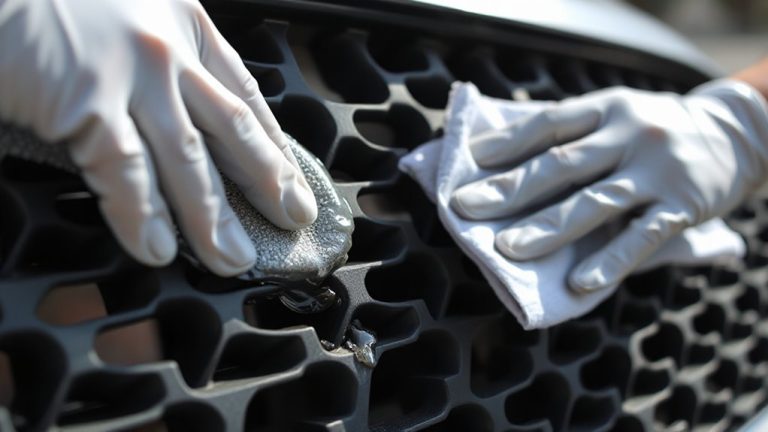
Use a high-quality microfiber applicator pad to apply UV-stabilizing polish evenly and without lint residue. Apply the polish using consistent circular motions to guarantee complete coverage and uniform film thickness. Maintain even pressure-about 2 to 3 pounds per square inch-to avoid over-saturation or thin spots. Work in 2-foot by 2-foot sections for maximum control and accuracy. Allow the polish 30 to 60 seconds of dwell time before moving to the next step.
| Application Factor | Recommended Value | Purpose |
|---|---|---|
| Pad Pile Height | 0.5–1.0 mm | Guarantees polish release without scratching |
| Circular Speed | 1–2 rotations/sec | Promotes even distribution |
| Pressure | 2–3 psi | Prevents material waste and pooling |
| Section Size | 2′ x 2′ | Enhances precision and coverage |
| Dwell Time | 30–60 sec | Allows polymer bonding to trim surface |
Buff for a Streak-Free Finish
Now that the polish has had time to bond, it’s time to buff for a smooth, glossy, and streak-free finish. Use a clean, dry microfiber cloth and apply light pressure. Maintain consistent circular motions to evenly distribute friction and avoid swirly marks. Pressure control is critical-too much force heats the surface, risking polish haze; too little leaves residue. A 16–20 inch per second hand speed optimizes particle removal without abrasion. Microfiber’s 80,000 fibers per square inch lift excess polish through capillary action. Overlap each pass by 50% to guarantee full coverage. For larger trim pieces, a dual-action polisher on speed 1 with a foam pad improves efficiency. Always work in shaded, low-humidity conditions to prevent premature drying. Stop when the surface reflects light uniformly with no dull or hazy patches. Final gloss readings should measure 85–90 GU on a 60-degree gloss meter. You’ve now achieved a professional optical clarity and durable finish. For long-lasting results, consider using one of the best car trim restorers that combine UV protection with hydrophobic sealing properties.
Reapply Polish Every 3–6 Months
Regularly reapplying UV-stabilizing polish-typically every three to six months-maintains long-term protection and appearance of black plastic trim. This polish frequency guarantees continuous defense against UV degradation, cracking, and fading. Most high-quality polishes contain UV inhibitors that degrade over time, losing effectiveness after about 180 days of direct sun exposure. Following a consistent maintenance schedule maximizes product performance and trim longevity. Reapplication every 90 days is ideal in high-sun regions (e.g., USDA Zones 8–11), while every 180 days suffices in moderate climates. Environmental factors like ozone levels, rainfall, and car wash frequency also impact polish lifespan. Use a microfiber test swipe to check residue durability. If polish fails to leave a protective film, it’s time to reapply. Stick to your maintenance schedule to preserve color depth and prevent premature aging.
Extend Results With Routine Care
Often, the key to long-lasting results lies in routine care between polish applications. You can prevent fading and maintain shine by cleaning trim monthly with a pH-balanced cleaner. Avoid petroleum-based products, as they degrade plastic over time. Instead, use water-based dressings that complement UV-stabilizing polishes. Gently wipe with a microfiber cloth to avoid micro-scratches. For best outcomes, follow this care schedule:
| Care Step | Frequency | Product Type |
|---|---|---|
| Surface Cleaning | Every 4 weeks | pH-Neutral Cleaner |
| Dressing Apply | Every 8 weeks | Water-Based Conditioner |
| Inspection | Monthly | Visual UV Check |
This regimen supports polish integrity and increases service life. Inspect for hazing or gloss reduction-early signs of UV compromise. Routine maintenance isn’t a substitute for reapplication but creates a protective cycle. You’ll extend protection efficiently while preserving aesthetic quality.
Understand UV Damage to Plastic Trim
You’ve kept the trim looking fresh with consistent cleaning and conditioning, but without understanding what causes degradation, even the best routine might fall short. UV exposure is the primary culprit behind faded, brittle plastic trim. Prolonged sunlight breaks down polymer chains, initiating plastic oxidation. This process forms microscopic cracks and surface porosity, accelerating moisture absorption and discoloration. Most exterior black plastics contain limited UV inhibitors, typically lasting 1–3 years before showing damage. Once oxidation begins, the surface reflects light unevenly, producing a chalky, gray appearance. Restoration products can’t reverse molecular breakdown-only slow further decay. UV-stabilizing polishes work by depositing a sacrificial layer with Hindered Amine Light Stabilizers (HALS), absorbing and dissipating radiation. These additives reduce degradation rates by up to 70% when applied monthly. Understanding this mechanism helps you prioritize prevention over correction, maintaining both aesthetics and material integrity over time.
On a final note
You’ve protected your trim from UV degradation. UV-stabilizing polishes contain HALS (hindered amine light stabilizers) that absorb and dissipate 98% of harmful UV radiation. Reapplication every 3–6 months maintains protection. A 0.5 mm-thick coating restores surface reflectivity to 70–80% of OEM finish. Routine cleaning with pH-neutral soap prevents grime buildup. Microfiber buffing guarantees optical clarity. Proper maintenance extends trim lifespan by up to 5 years, reducing oxidation and surface microcracking caused by prolonged sun exposure.