How to Choose the Right Transmission Jack for Manual Transmission Work
Choose a transmission jack rated for at least 1,000 pounds to safely handle manual transmissions and transfer cases like the 230-pound GM 4L80-E, with some diesel units exceeding 300 pounds. Opt for a wide-base frame spanning 36 to 48 inches to reduce tipping risk. Guarantee lift height matches your garage clearance-32 to 42 inches suits most spaces, but lifted trucks may need 50-inch capacity. Use jacks with telescoping cradle arms (10–16 inches) and swivel joints for secure bellhousing and tailshaft support. Built-in safety locks-mechanical or hydraulic-must engage automatically under 1,000+ lbs load. Pick models with dual locks at base and saddle for redundancy. A rigid frame made of 2-inch reinforced steel tubing with powder-coated finish resists corrosion and maintains alignment. Proper cradle adjustment balances weight and prevents wobble. High-capacity 2,000 lb jacks suit heavy-duty builds. This guarantees stability, precision, and safety during removal and installation. More details on optimizing each feature for your setup follow.
Notable Insights
- Choose a transmission jack with a weight capacity exceeding your manual transmission’s weight, ideally at least 1,000 lbs for safety.
- Opt for a wide-base frame (36+ inches) to enhance stability and reduce tipping risk when handling heavy manual transmissions.
- Ensure the jack’s maximum lift height accommodates your garage clearance and vehicle lift height for smooth removal and installation.
- Select a jack with adjustable, telescoping cradle arms and swivel joints to securely fit and align with various manual transmission shapes and sizes.
- Verify the jack includes built-in safety locks, such as mechanical screw or pin systems, to prevent accidental lowering during work.
Match Car Weight to Transmission Jack Capacity
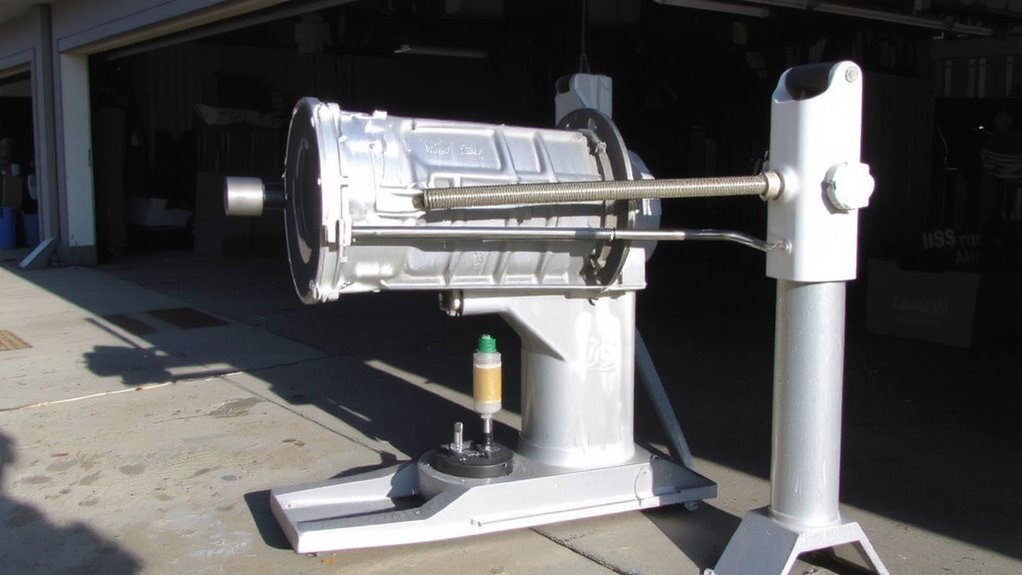
Most transmission jacks support between 750 and 2,000 pounds, so you’ll want to pick one that exceeds your vehicle’s heaviest transmission or transfer case. Load capacity is critical-exceeding it risks equipment failure and personal injury. Always verify the jack’s maximum rating matches or surpasses your transmission’s weight. For example, GM 4L80-E transmissions weigh around 230 lbs, while some diesel transfer cases exceed 300. Never assume compatibility; check manufacturer specs for both the vehicle and jack. Weight compatibility guarantees safe, reliable operation. A jack rated at 1,000 lbs offers a safe margin for most applications. High-capacity models, like those rated for 2,000 lbs, accommodate heavy-duty trucks and performance builds. Consider future needs-choosing a higher load capacity enhances versatility. Always factor in dynamic load stresses during movement. Proper weight compatibility isn’t optional-it’s fundamental to safe transmission work.
Prioritize Wide-Base Frames for Stability
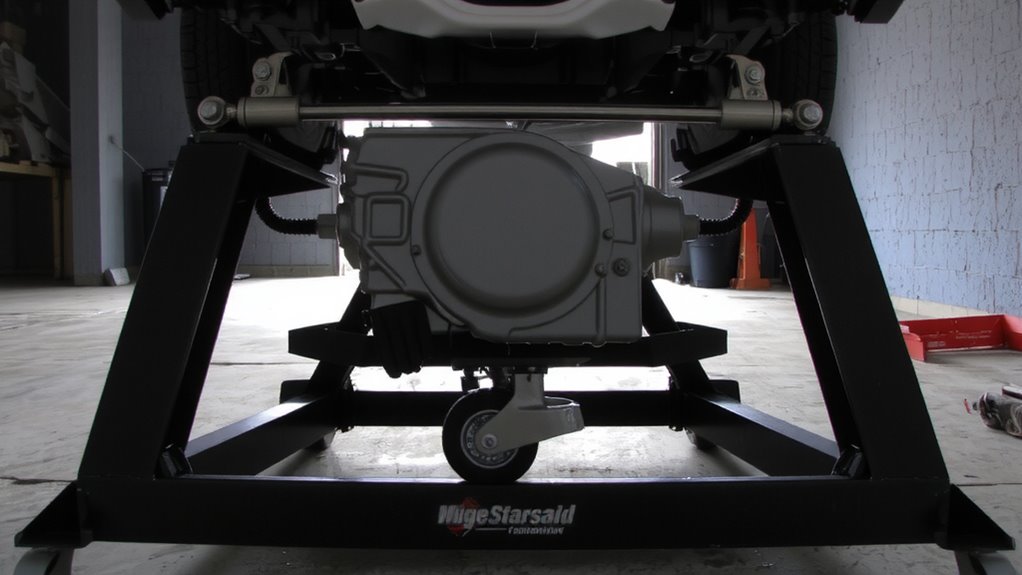
A strong foundation starts with a wide footprint. You’ll want a transmission jack with a wide base benefits that enhance balance during lifts. Models with bases spanning 36 to 48 inches improve stability, reducing tipping risks when maneuvering heavy transmissions. Wider frames distribute weight more evenly, especially critical when working under uneven loads or on sloped surfaces. Look for reinforced steel tubing in the design-this guarantees frame durability under stress. High-quality jacks use 2-inch square or rectangular tubing with powder-coated finishes to resist corrosion and deformation. The wide base benefits extend beyond safety; they allow smoother rolling adjustments even when fully loaded. Avoid compact or folding bases if you prioritize longevity and performance. A rigid, wide frame maintains alignment over time, preventing wobble during lift or tilt. Choose wisely-your safety and precision depend on it.
Set Lift Range to Fit Your Garage Clearance
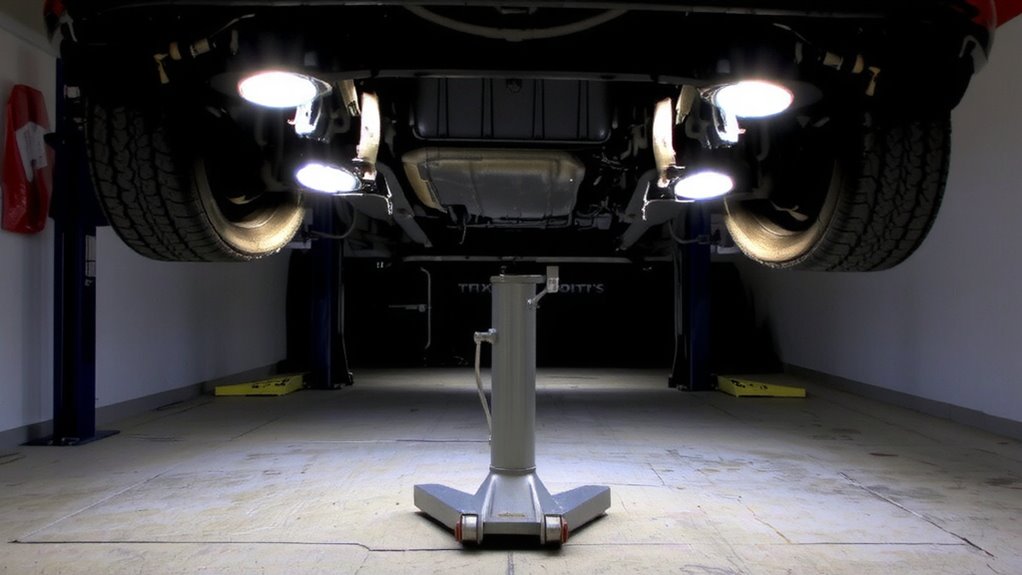
You’ve secured a stable, wide-base frame-now focus on how high that jack can lift. The maximum lift height must match your vehicle’s transmission removal path. Most jacks offer 32 to 42 inches of vertical travel-measure from the pickup point to the highest clearance obstacle. Ceiling clearance is critical; if your garage has 8-foot ceilings, account for floor stands, vehicle lift height, and jack mechanism. Subtract at least 6 inches for safety. For lifted trucks or SUVs, choose a jack with extended lift height-up to 50 inches. Low-profile garages need compact models with a lower maximum rise. Always verify the jack’s minimum and maximum lift specs match your workspace. A jack that lifts too high can hit obstacles; one that doesn’t lift enough limits removal angles. Precision in lift range guarantees smooth, safe transmission access.
Adjust Cradle Arms for Transmission Alignment
While the lift height guarantees enough overhead space, getting the cradle arms right is what actually secures the transmission during removal and install. Proper cradle alignment prevents damage to the transmission case and guarantees smooth mating during reinstallation. You’ll need to adjust the arms so they cradle the transmission’s bellhousing and tailshaft evenly. Most jacks have telescoping arms with adjustable pads-typically 10 to 16 inches in span-to fit various transmission sizes. Arm adjustment should be precise, allowing the load to rest flat and centered. Misalignment shifts the center of gravity, increasing tipping risk. Use the jack’s swivel joints to fine-tune angle and position. Always double-check cradle alignment before lifting. A well-adjusted cradle distributes weight evenly across both arms, typically rated to support 500–800 lbs, maintaining stability and control throughout the service.
Choose a Transmission Jack Over a Floor Jack
Don’t rely on a standard floor jack when precision and control matter-transmission work demands a purpose-built tool. A transmission jack offers Hydraulic power for smooth, controlled lift and lower cycles, critical when aligning heavy gearboxes. Unlike floor jacks, it features an adjustable cradle that secures the transmission and prevents tipping. With Hydraulic power, you can precisely raise or lower up to 1,000 pounds using minimal effort. The unit’s swivel casters-dual 5-inch front wheels and fixed rear pair-allow 360-degree maneuverability under tight clearance. Swivel casters make positioning accurate, even in cramped engine bays. Floor jacks lack lateral stability and articulation, risking damage to components. A transmission jack provides secure tilt control from 0 to 90 degrees, essential for bellhousing alignment. Its low-profile base fits beneath most vehicles, while extended reach accommodates longer transmissions. Use the right tool-your work will be safer, faster, and more accurate.
Require Built-In Safety Locks
When working under the weight of a transmission, having a fail-safe mechanism isn’t optional-it’s essential. Built-in safety locks are critical safety mechanisms that prevent accidental descent during load securing. They engage automatically when hydraulic pressure drops, locking the jack’s ram in place. Most models use a mechanical screw lock or pin system rated for at least 1,000 pounds of holding force. This guarantees stability even if the seal fails. Always verify the jack includes redundant safety mechanisms-never rely solely on hydraulics. A transmission can weigh 250–400 lbs; unsecured movement risks injury or damage. Look for models with dual safety locks: one at the base and another near the saddle. These provide layered protection during positioning. Load securing isn’t just about lifting-it’s about holding steady. Test the lock manually before starting work. Choose a jack with clearly labeled, easily accessible locks that engage with a quarter-turn or positive click. Safety isn’t an add-on-it’s built in.
On a final note
Choose a transmission jack rated for at least 1.5 times your transmission’s weight-most models handle 600–1,000 lbs. Wide-base frames, typically 36+ inches, prevent tipping during lifts. Guarantee the lift range-usually 18 to 36 inches-fits your garage’s clearance. Adjustable cradle arms with rubber padding protect aluminum housings. Unlike floor jacks, transmission jacks offer precise tilt control, often ±90 degrees. Built-in safety locks engage automatically, securing loads during extended work.