How to Install Speakers in Vehicles With Factory Bose Systems
Keep your factory Bose amplifier-it handles equal cération, time alignment, and crossover filtering essential for sound staging. Use 4-ohm speakers with 87–92 dB sensitivity and a 50 Hz–20 kHz frequency response to match amp specs. Disconnect the battery’s negative terminal before removing door panels with a trim tool. Extract screws (20–25 mm), pivot speakers out, and unplug connectors carefully. Connect new speakers to factory harnesses without splicing. Match impedance across all positions to prevent distortion. Balance output using test tones at 500 Hz, 1 kHz, and 2 kHz, adjusting gains for ±1 dB accuracy at ear level. Proper setup guarantees factory-grade clarity and dynamic range-optimal tuning methods follow.
Notable Insights
- Retain the factory Bose amplifier to preserve OEM sound tuning and prevent system errors.
- Install 4-ohm replacement speakers to match the factory impedance and avoid amp instability.
- Use trim tools and disconnect the battery before removing door panels to prevent damage.
- Connect speakers using factory harnesses without splicing to maintain signal integrity and proper phasing.
- Balance speaker output with test tones and a sound meter for optimal acoustic performance.
Understand Your Bose Amplifier and Keep It
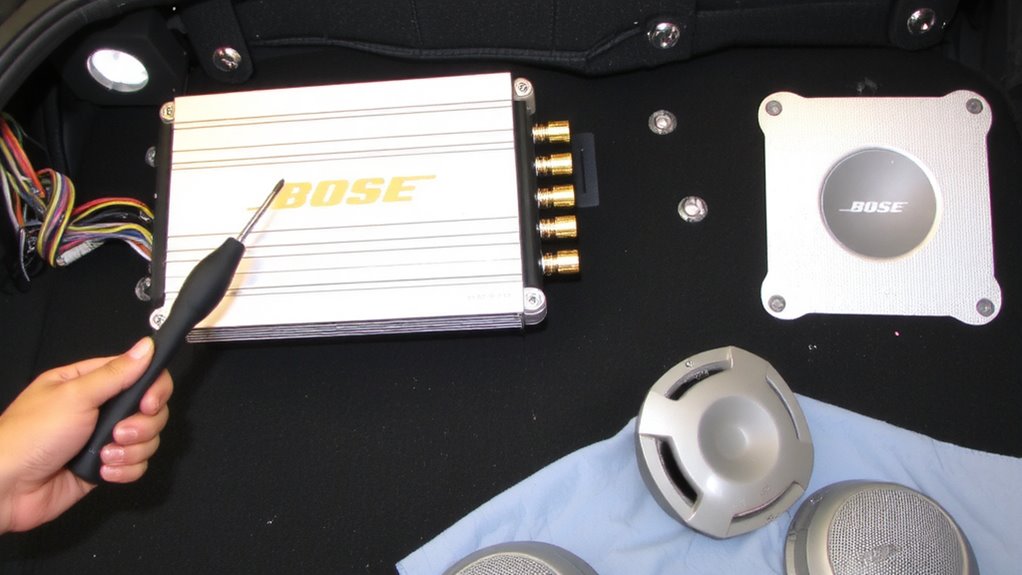
Most factory Bose amplifiers are designed specifically to work with the vehicle’s OEM speaker configuration and signal processing, so you’ll want to keep it in place. Retaining the factory amp guarantees seamless Bose integration and maintains factory tuning. These amplifiers apply precise equalization, time alignment, and crossover filtering tailored to your vehicle’s acoustics. Removing it disrupts signal preservation, leading to distorted sound or channel imbalance. The amplifier processes line-level signals from the head unit before sending amplified signals to each speaker. This calibrated output relies on specific impedance and sensitivity matching, typically 4 ohms and 87–92 dB efficiency. Bypassing or replacing the amp without proper recalibration degrades performance. Keeping the factory amplifier also avoids error codes and dashboard warnings. Signal integrity remains intact, preserving factory sound staging and dynamics. You’ll retain the engineered sound signature the vehicle was designed with. For best results, modify only the speakers-keep the Bose amplifier as the core of your audio system.
Choose Speakers Compatible With the Bose Amp
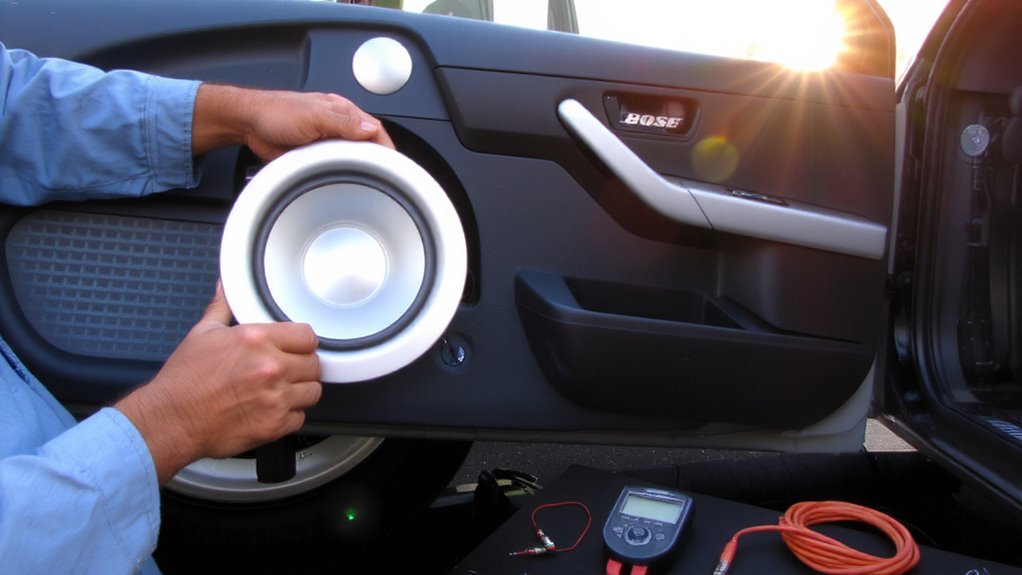
You’ve kept the factory Bose amplifier to preserve signal integrity and acoustic calibration, so now it’s time to select speakers that work within that system’s engineered parameters. Choose replacements matching the original speaker impedance-typically 4 ohms-to prevent amp instability or shutdown. The Bose amp is tuned for a specific frequency response, so speakers must align with the factory range, usually 50 Hz–20 kHz. Deviating from this can disrupt tonal balance and reduce clarity. Use component or coaxial speakers rated for full-range output if replacing front sets. Guarantee sensitivity ratings are between 87–92 dB for peak performance. Avoid high-impedance (8-ohm) or low-impedance (2-ohm) models. Factory Bose systems use precise crossover networks; select speakers that integrate seamlessly. Compatibility ensures clean sound without distortion.
Remove Factory Speakers Without Cutting Wires
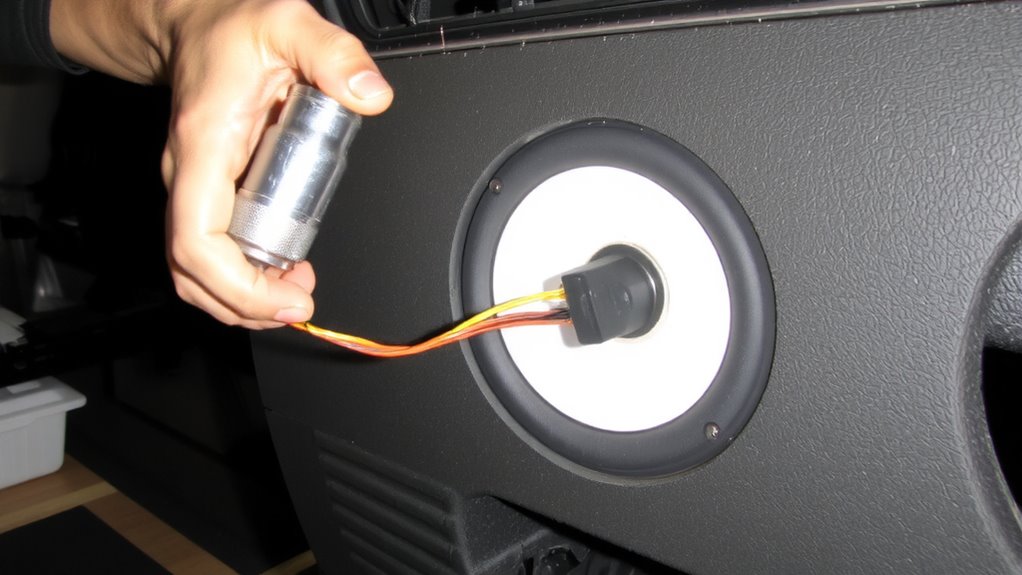
Your vehicle’s factory speaker installation uses designed access points and fasteners to allow removal without wire damage. Speaker extraction requires precision to maintain wire preservation. Begin by disconnecting the negative battery terminal for safety. Use a trim removal tool to gently pry away door panels or speaker grilles without cracking plastic. Most factory Bose speakers secure with Torx or Phillips screws-typically 20–25 mm in length-anchored to metal brackets. Remove these fasteners, then carefully pivot the speaker outward. Avoid pulling on wires. Factory connectors are usually snap-in types with locking tabs. Press the release tab firmly with a small flathead screwdriver to disconnect. This method protects the factory harness for future use. Wire preservation guarantees compatibility if reverting to stock. Always inspect wiring for wear during removal. Label connectors if replacing multiple units. This process applies to door, dash, and rear deck installations.
Wire New Speakers to the Bose Amp Safely
Since the Bose amplifier in your vehicle is calibrated for specific impedance and signal levels, connecting aftermarket speakers improperly can lead to distortion, damage, or system shutdown. You must maintain proper impedance matching to guarantee the amp operates within its design parameters. Mismatched loads can overheat the amplifier or reduce audio clarity. Use 4-ohm speakers unless your system specifies otherwise, as most factory Bose systems are designed for this impedance. Pay close attention to signal routing-each speaker wire must connect to its corresponding channel output on the Bose amp to prevent phase issues or channel overload.
| Speaker Location | Impedance |
|---|---|
| Front Door | 4 ohms |
| Rear Shelf | 4 ohms |
| Dash Tweeters | 4 ohms |
| Center Channel | 4 ohms |
Correct signal routing and impedance matching preserve sound integrity and protect your system.
Fine-Tune the Bose Amplifier for Better Sound
Once the new speakers are correctly wired to the Bose amplifier with proper impedance and signal routing, the❏ system is ready for acoustic optimization. Fine-tuning begins with sound calibration to match the amplifier’s output to the vehicle’s acoustics. You’ll need a digital sound meter and test tones, ideally at 500 Hz, 1 kHz, and 2 kHz. Measure output from each speaker at ear level and adjust gain settings to balance levels within ±1 dB. Most factory Bose amps have fixed equalizer settings, but some models allow limited adjustment via built-in potentiometers or service software. Tweaking equalizer settings helps correct frequency imbalances caused by speaker placement or cabin resonance. Avoid over-amplifying bass frequencies, as Bose systems are tuned for accuracy, not boom. Calibration guarantees clarity, imaging, and dynamic range are preserved across all listening positions.
On a final note
You preserve the factory Bose amp because it’s impedance-matched to the audio system and provides optimized crossover filtering. Replace speakers with 4-ohm models like the Hertz HX 165.30, ensuring compatibility. Use OEM harness adapters to avoid cutting wires. Secure connections with crimp terminals. Tune head unit settings: set fader to neutral, disable bass boost. The result is clearer sound with 89 dB sensitivity and tighter bass response.