How Trailing Arms Manage Longitudinal Forces in Rear Suspension
You rely on trailing arms to control your rear axle during hard acceleration and braking. They manage longitudinal forces by guiding the axle’s path, preventing wheel hop and maintaining stability. Made from high-strength alloy-up to 280 MPa tensile strength-they resist flex while transferring thrust directly to the frame. Rubber or polyurethane bushings at each end absorb 2,000–5,000 pounds of load, with a 70–90 Shore A durometer balancing compliance and rigidity. Optimized pivot points and offset mounts refine control. Asymmetric layouts improve traction by 5–8%. Reinforced pivot bosses hold camber within ±0.5° under load. This precise geometry guarantees consistent pinion angle and wheelbase. You’ll discover how design tweaks boost performance even further.
Notable Insights
- Trailing arms transfer acceleration and braking forces directly to the chassis, maintaining stability under longitudinal loads.
- They control the rear axle’s path to prevent wheelbase changes and reduce wheel hop during thrust or deceleration.
- High-durometer bushings at mounting points absorb and manage longitudinal forces while allowing slight compliance.
- Reinforced pivot designs and high-strength alloys minimize flex, improving response and force transmission efficiency.
- Optimized arm geometry and asymmetric layouts enhance traction by stabilizing axle movement under dynamic loads.
What Are Trailing Arms and Where Are They Used?
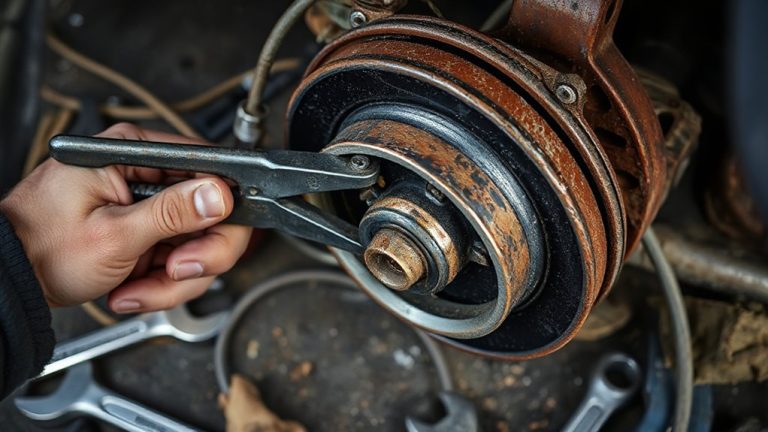
A trailing arm is a structural suspension component that links the rear axle to the vehicle frame, controlling wheel movement as you drive over uneven surfaces. It plays a critical role in maintaining rear axle alignment under dynamic conditions. Trailing arms are commonly used in solid rear axle suspensions, especially in trucks, SUVs, and performance rear-wheel-drive cars. They pivot at the frame and allow vertical axle movement while resisting lateral shift. This design supports suspension geometry optimization by constraining axle motion along a controlled path. Most trailing arms are made from forged steel or aluminum, measuring 18–36 inches long, depending on the platform. Their mounting bushings, usually rubber or polyurethane, dampen vibrations and permit slight articulation. You’ll find them paired with coil springs or leaf springs in configurations requiring durability and precise axle location. Proper alignment and stiffness guarantee consistent handling and tire contact.
Trailing Arms and Longitudinal Force Management
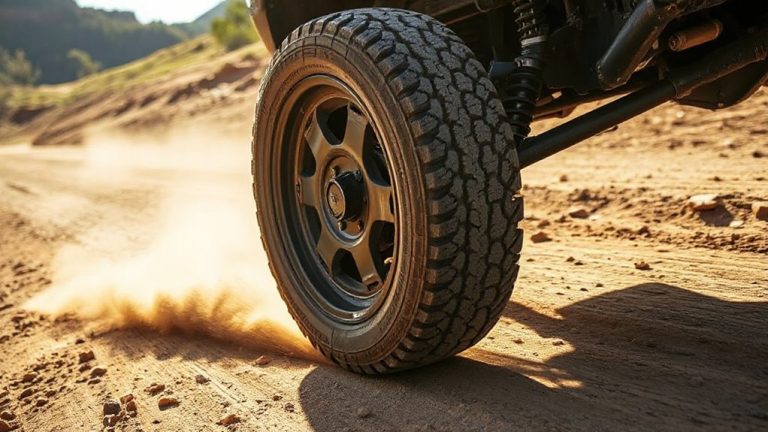
When your vehicle accelerates or brakes hard, the rear axle experiences significant longitudinal forces-trailing arms are designed to handle these loads. They control the axle path, guaranteeing the rear wheels move predictably during acceleration and deceleration. This precise guidance prevents unwanted wheelbase changes and maintains stability. Trailing arms manage load distribution by transferring thrust and braking forces directly to the chassis frame. Their rigid mounting points and optimized geometry reduce wheel hop and improve traction. Most trailing arms use high-strength steel or aluminum, with lengths ranging from 30 to 50 inches depending on vehicle size. By constraining fore-aft motion, they keep suspension components aligned. The result is consistent handling and reduced drivetrain stress. Proper alignment of the trailing arms guarantees symmetrical load distribution across the rear axle. This enhances tire contact and braking efficiency.
How Bushings in Trailing Arms Manage Force
Because they sit at each end of the trailing arm, bushings play a critical role in managing how forces transfer between the suspension and the chassis. You rely on them to absorb longitudinal loads during acceleration and braking. Made from high-grade rubber or polyurethane, they balance compliance and rigidity. Material durability guarantees they resist cracking, deformation, and wear over tens of thousands of miles. Poor installation alignment leads to premature failure and uneven force distribution. Even a 2-degree misalignment can increase stress by up to 30%. Properly aligned bushings maintain precise suspension geometry, preventing unwanted toe or camber changes. They typically handle loads between 2,000 and 5,000 pounds, depending on vehicle weight and driving conditions. Their durometer rating-usually 70 to 90 Shore A-dictates stiffness and vibration damping. They’re engineered to last 80,000 miles under normal use, provided material durability and installation alignment meet OEM specifications.
Design Variations That Improve Longitudinal Control
While you may not notice the difference at first glance, subtle changes in trailing arm design can markedly sharpen how your vehicle handles acceleration and braking forces. Enhanced designs improve Multi link precision and maintain camber stability under load. Engineers tweak pivot points, arm length, and mounting angles to optimize control.
| Design Feature | Benefit | Spec Example |
|---|---|---|
| Asymmetric Arm Layout | Improves torque control | 5–8% better traction |
| Reinforced Pivot Boss | Increases camber stability | ±0.5° variance under load |
| High-Strength Alloy | Reduces flex, boosts response | 280 MPa tensile strength |
| Offset Bushing Mounts | Enhances Multi link precision | 1.2 mm lateral control |
These variations target longitudinal force management without altering overall suspension architecture. You get sharper response and consistent tire contact. It’s not just stiffness-smart geometry makes the difference.
Trailing Arms vs. Other Rear Suspension Parts
Though they’re just one component in a complex system, trailing arms play a defining role in how your vehicle manages rear axle motion compared to other suspension parts. They primarily control longitudinal forces-those from acceleration and braking-while other components like toe links and control arms fine-tune rear alignment. Unlike lateral links, which focus on side-to-side stability, trailing arms resist forward and backward axle movement. This separation of duties guarantees precise geometry under load. For example, trailing arms maintain consistent pinion angle during hard launches, preserving drivetrain efficiency. At the same time, they support lateral stability by working in tandem with other links, though they aren’t the primary lateral constraint. Their mounting points, typically with rubber or polyurethane bushings, absorb vibrations without sacrificing rigidity. In beam axle and independent setups alike, trailing arms provide the foundational control other parts rely on for accurate wheel positioning and balanced handling.
Symptoms of Failing Trailing Arms
A failing trailing arm compromises rear suspension integrity, and you’ll usually notice it through distinct handling and noise issues. You may hear clunking or rattling over bumps due to worn bushings or loose ball joints. These components typically endure 80,000 to 100,000 miles before degradation. Misaligned suspension geometry affects rear alignment, leading to uneven tire wear and tracking problems. Your vehicle pulls to one side or feels unstable during cornering. Ride stability declines because the trailing arm can’t properly control longitudinal and lateral forces. Laser alignment tools detect deviations beyond 0.1 degrees-exceeding OEM tolerance. A sagging rear end or visible frame contact indicates severe damage. Inspect mounting points for cracks or corrosion. Replace both arms if one fails to maintain balance. Use torque specifications precisely-over- or under-tightening reduces fatigue life.
On a final note
You rely on trailing arms to control longitudinal forces in rear suspension. They anchor the axle to the chassis, managing thrust and braking loads. High-grade steel or aluminum arms resist deformation under 2,000–4,000 lbs of force. Precision bushings with durometer ratings of 70–90 Shore A dampen vibrations. Proper alignment guarantees ±0.5° tolerance, optimizing traction and stability.