Front & Rear Suspension Rates: The 1.2:1 to 1.5:1 Ratio
You feel understeer, dive, or instability because mismatched front and rear spring rates disrupt weight transfer and tire contact. Front springs are typically 20–30% stiffer than rear to manage braking and steering loads. A balanced setup keeps spring rates within a 1.2:1 to 1.5:1 front-to-rear ratio, ensuring even load distribution. Mismatched rates cause uneven body roll, bump steer, or excessive tire wear. Proper damping must match spring rates-350 lb/in front and 275 lb/in rear needs coordinated shock tuning. Correct pairing improves grip, stopping distance, and cornering precision. Further optimization depends on weight distribution and driving dynamics.
Notable Insights
- Matching front and rear suspension rates ensures balanced weight transfer during braking, cornering, and acceleration.
- Proper spring rate harmony prevents excessive understeer or oversteer caused by front-to-rear stiffness imbalances.
- Balanced suspension rates minimize body roll and dive, maintaining optimal tire contact and road grip.
- Correct front-to-rear spring rate ratios, typically 1.2:1 to 1.5:1, suit vehicle weight distribution and handling goals.
- Coordinated damping and spring rates improve stability, reduce tire wear, and enhance overall safety and control.
What Happens When Suspension Rates Are Unbalanced
Why does your car feel unstable during cornering or braking? Unbalanced suspension rates disrupt weight transfer dynamics, compromising control. When front and rear spring rates don’t match, one end of the car reacts faster than the other. This imbalance causes excessive body roll or dive, reducing tire contact. You’ll notice bump steer, where suspension movement changes toe angle, making the car dart unexpectedly over bumps. Tire squirm also increases, as uneven load distribution causes the tread to deform and lose grip during shifts. Without synchronized damping, energy isn’t absorbed evenly-front or rear tires overload before the opposite end reacts. Ideal setups maintain balanced roll stiffness, typically within 10–15% front-to-rear split depending on weight distribution. Mismatched rates exceed this window, degrading response. Correct tuning eliminates vague handling, ensuring both axles work cohesively under load.
How Front and Rear Suspension Work Differently
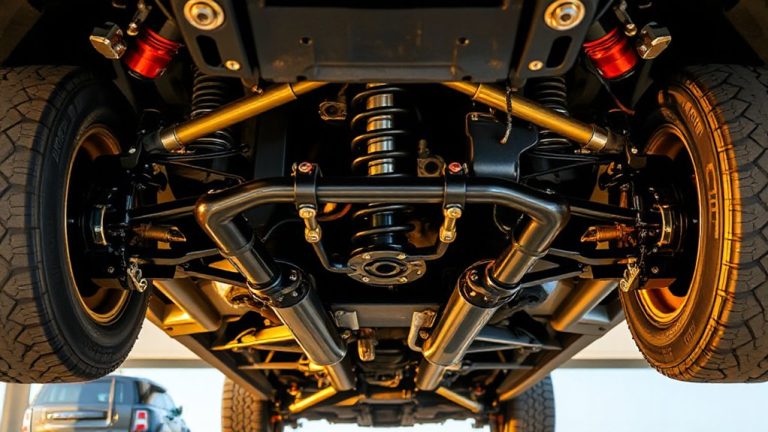
Suspension systems at the front and rear serve distinct roles shaped by their position and function within the vehicle’s dynamics. You’ll notice the front suspension handles steering and a larger portion of braking forces, requiring higher spring rates-typically 20–30% stiffer than rear-to manage weight transfer during deceleration. Meanwhile, the rear suspension primarily supports acceleration and lateral load, relying on tuned compliance to maintain traction balance. During cornering, front tires generate initial grip, but the rear must match this responsiveness to prevent understeer or oversteer. Dampers at each end are valved differently: front shocks often have firmer compression settings, while rear shocks prioritize rebound control. The front’s geometry includes caster and camber angles critical for stability, whereas the rear focuses on toe control for tracking precision. Proper coordination guarantees even load distribution.
Why Mismatched Rates Hurt Handling?
How does your car behave when the front and rear suspension rates don’t align? Mismatched rates disrupt weight transfer, causing unpredictable handling. If the front is stiffer than the rear, you’ll experience excessive understeer; too soft up front leads to oversteer. Either imbalance increases body roll during cornering, reducing stability. Uneven body roll shifts load unevenly across tires, accelerating tire wear on the most stressed corners. Properly matched spring rates-typically within 10–15% of front-to-rear ratios-ensure balanced load distribution. This synchronization optimizes grip and maximizes tire contact patch. Without it, suspension travel becomes inconsistent, compromising damping efficiency. The result? Reduced cornering precision, longer stopping distances, and compromised safety. Matching rates isn’t optional; it’s essential for balanced dynamics. Correct tuning minimizes energy loss in the chassis and maintains predictable response under stress.
Signs Your Suspension Rates Are Out of Sync
What happens when your car feels unsettled through corners or dives excessively under braking? You’re likely dealing with suspension rates out of sync. These imbalances cause poor weight transfer control and reduce tire contact. You’ll notice the rear bouncing lightly over bumps while the front sags, creating uneven settling after dips or turns.
| Condition | Front Behavior | Rear Behavior |
|---|---|---|
| Braking | Dives deeply | Lifts slightly |
| Accelerating | Rises quickly | Squats abnormally |
| Cornering | Understeers | Oversteers suddenly |
This mismatch disrupts balance. Uneven settling means one end reacts faster than the other, reducing grip. Bouncing lightly over imperfections indicates insufficient damping coordination. Properly matched rates guarantee both ends work together, maintaining chassis stability. You need balanced spring rates-measured in lb/in-to achieve neutral handling. Debug these signs early.
How to Match Front and Rear Suspension Rates
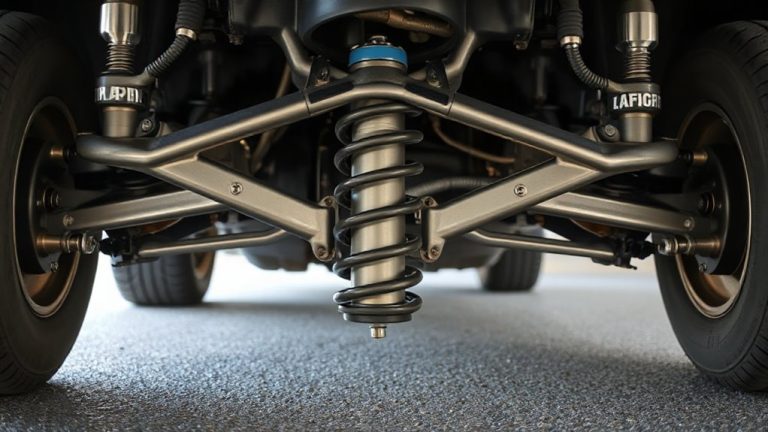
Ever wonder why your car’s handling feels off even after upgrading the springs? The issue often lies in improper spring pairing between front and rear axles. Matching suspension rates requires balancing spring rates-measured in pounds per inch (lb/in)-to maintain balance. For most performance street cars, a front-to-rear ratio of 1.2:1 to 1.5:1 works best, depending on weight distribution. A 55/45 front-biased car typically uses stiffer front springs. Adjusting without considering damping harmony leads to poor control. Shock absorbers must complement spring rates; otherwise, energy dissipation becomes uneven. For example, pairing 350 lb/in front springs with 275 lb/in rear springs on a 3,200-lb sedan works only if dampers are valved to match. Without damping harmony, body motions persist, reducing grip. Match rates using manufacturer specs or dyno-tested data. Upgrading to high-performance shocks for Ram 2500 4×4 can significantly improve damping harmony and overall ride control.
Proven Adjustments for Balanced Suspension Setup
Why do some cars still dive, roll, or understeer despite having high-rate springs? Because spring tuning alone isn’t enough-proper shock pairing is critical. Balanced suspension requires harmony between spring rates and damping forces. Mismatched components disrupt weight transfer, hurting handling. Use this guide for proven adjustments:
| End | Spring Rate (lb/in) | Shock Setting (compression/rebound) |
|---|---|---|
| Front | 350 | 6/8 |
| Front | 400 | 7/9 |
| Rear | 300 | 5/7 |
| Rear | 350 | 6/8 |
| Balanced | Matched front/rear | Tuned damping front and rear |
Adjust spring tuning incrementally. Verify with steady-state cornering tests. Ideal shock pairing controls oscillations, improves tire contact. Always tune front and rear together-handling is a system, not separate ends. Track data or lap times confirm gains. Practical, repeatable changes beat guesswork every time.
On a final note
You need balanced suspension rates for ideal vehicle control. Mismatched front and rear spring rates disrupt weight transfer, reducing grip and stability. A properly tuned setup typically maintains a 5–10% stiffer front rate to manage pitching under braking. Adjust spring rates in 10–25 lb/in increments. Verify alignment with corner-weight measurements and rebound damping settings. Balanced suspension improves turn-in response and tire contact patch consistency.