Protecting Paint Finish With Ceramic Coating Against Road Salt Etching
Ceramic coating protects your car’s paint from road salt etching by forming a 2–3 micron-thick SiO₂ layer that bonds molecularly to the clear coat. Its hydrophobic surface repels water and blocks chloride ions, preventing electrolyte formation. With 9H hardness, it resists micro-scratches and withstands temperatures up to 600°F. Unlike wax, it lasts 2–5 years and remains stable in subzero conditions. Proper application and maintenance greatly extend paint integrity.
Notable Insights
- Ceramic coating forms a hydrophobic, 2–3 micron silica layer that repels salt-laden moisture and prevents electrolyte adhesion.
- Its 9H hardness resists micro-abrasions from road salt, reducing etching and preserving paint integrity.
- The chemically bonded coating blocks chloride ions, eliminating direct contact between salt and paint.
- Unlike wax, ceramic remains stable in subzero temperatures and lasts years without frequent reapplication.
- Proper maintenance with pH-neutral washes and deionized water preserves coating performance against winter corrosion.
Why Road Salt Damages Car Paint Without Protection
While winter roads may look harmless after a fresh snowfall, the salt used to melt ice creates a corrosive environment that can severely damage your car’s paint over time. Salt corrosion begins when sodium chloride attracts moisture, forming an electrolyte solution that clings to your vehicle’s undercarriage and panels. This solution accelerates electrochemical reactions, promoting rust on metal surfaces and degrading clear coat layers. Without protection, prolonged exposure leads to paint oxidation, where ultraviolet light and oxygen break down organic binders in the paint matrix. Oxidation results in fading, chalkiness, and loss of gloss-typically measurable as a 20–30% reduction in reflectivity over one winter season. Road salt also embeds microscopic abrasives, etching surfaces at a micron-level depth. These cumulative effects compromise both appearance and structural integrity. Preventative maintenance is critical, as untreated oxidation progresses irreversible damage within months. Applying a ceramic coating kit can provide long-lasting protection against salt-induced etching and maintain your vehicle’s finish.
How Ceramic Coating Blocks Winter Salt Damage
Your car’s factory paint provides minimal defense against winter’s harsh conditions, but a ceramic coating dramatically improves its resistance to salt damage. The coating forms a cross-linked silica layer, typically 2–3 microns thick, that bonds through molecular adhesion, creating a permanent shield. This hydrophobic surface repels water and prevents salt from clinging to the paint. Unlike wax, it resists thermal breakdown up to 600°F and maintains integrity for 2–5 years. Salt damage occurs when chloride ions penetrate clear coat, triggering ion exchange that degrades metal and paint. Ceramic coatings block this process by eliminating direct contact between salt and surface molecules. Their high density-measured at 9H hardness on the pencil scale-resists micro-scratches that could harbor corrosive agents. You won’t need frequent reapplication, and routine washing removes contaminants before they react. This is proactive, long-term defense engineered at the molecular level. A ceramic coating kit designed for DIY application makes professional-grade protection accessible to all car owners through top ceramic coating kits.
Ceramic Coating Vs. Wax: Which Wins in Winter?
Ceramic coating outperforms wax in winter conditions by offering a durable, chemically bonded shield that resists salt, freeze-thaw cycles, and temperature extremes. Wax forms a temporary barrier that degrades quickly under harsh weather, lasting only 4–8 weeks. In durability comparison, ceramic coatings maintain integrity for 2–5 years due to their SiO₂-based structure, which cures into a 9H hardness layer. This inorganic matrix bonds covalently with clear coat, creating hydrophobic protection unaffected by subzero temperatures. Wax, often carnauba-based, softens around 30°F and requires frequent reapplication, undermining long-term defense. Application ease favors wax slightly-it’s hand-applied and buffed-but ceramic demands surface decontamination, precise wiping, and 24-hour cure time. Still, ceramic’s permanent bond justifies the effort. Wax sits on the surface, washing away easily. Ceramic integrates, shielding against salt intrusion far more effectively. Among the top options available, Best Car Ceramic Coatings deliver proven performance in extreme winter environments.
Best Time to Apply Ceramic Coating for Winter
When should you apply ceramic coating to get maximum winter protection? For best coating durability, apply it before winter starts-ideally in late fall. Proper application timing guarantees full curing and maximum resistance to road salt.
| Timing | Benefit |
|---|---|
| 4–6 weeks before snow | Allows repeated washings without degradation |
| After deep clean | Prevents trapped contaminants under coating |
| When temps are 50–70°F (10–21°C) | Guarantees proper adhesion and curing |
| Dry weather, low humidity | Reduces curing time and defects |
Apply during stable weather to maximize bond strength. Most professional ceramic coatings need 24–48 hours to cure before exposure to moisture or contaminants. Early application lets you avoid rushed prep and guarantees longer-lasting protection. Coating durability depends heavily on application timing, making fall the ideal window.
How to Prep Your Car for Ceramic Coating
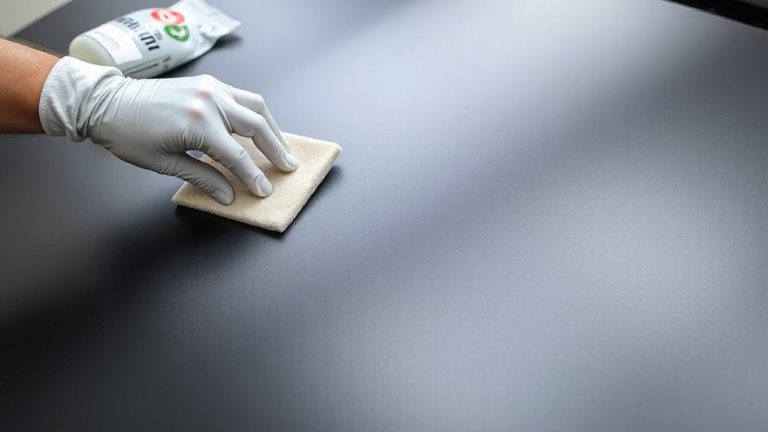
Proper surface preparation is the foundation of a durable ceramic coating bond. Surface cleaning removes dust, oils, and grime using pH-neutral car wash soap and a two-bucket method with a grit guard. Rinse thoroughly with deionized water to prevent mineral deposits. Next, conduct paint decontamination using a clay bar or clay mitt with proper lubricant to pull embedded contaminants like rail dust and industrial fallout from the clear coat. A contaminated surface prevents adhesion, leading to premature coating failure. Follow with an IPA (isopropyl alcohol) wipe-down at 50–70% concentration to eliminate residual oils. Work in small 2′ x 2′ sections, guaranteeing the panel is cool and out of direct sunlight. Use a clean, lint-free microfiber towel to avoid marring. This process guarantees maximum coating cross-linking, enhancing durability and protective performance.
Winter Maintenance for Ceramic Coating
How well is your ceramic coating standing up to winter’s assault? Winter driving exposes your vehicle to road salt, slush, and grime that compromise protection. You must perform routine seasonal cleaning to maintain coating integrity. Wash your car every two weeks using pH-neutral soap and a two-bucket method to prevent micro-scratches. Avoid automatic car washes-they degrade the silica matrix. Use a deionizing rinse for spot-free drying and enhanced hydrophobic performance. Inspect the surface monthly for water beading; diminished sheeting indicates contamination or coating wear. Clay bar the finish every three months to remove bonded contaminants without stripping the coating. Reapply a ceramic maintenance spray every six weeks to reinforce surface durability. Proper care preserves the coating’s 9H hardness and 12-month chemical resistance.
How Long Does Ceramic Coating Prevent Rust?
A ceramic coating won’t stop rust forever, but it markedly delays corrosion by forming a durable, hydrophobic barrier over your vehicle’s paint and metal surfaces. You get long-term protection because the coating repels water, salt, and contaminants. Proper curing time-typically 24 to 72 hours-is critical; incomplete curing weakens bond strength and compromises defense against moisture intrusion. Coating thickness, usually between 1 to 3 microns, directly impacts durability; too thin, and it offers minimal protection, too thick, and it risks cracking. A fully cured, ideally applied layer resists pH shifts from road salt, maintaining integrity for 2 to 5 years. It doesn’t penetrate existing scratches, so surface prep is essential. This shield slows oxidation by limiting electrolyte contact, much like a raincoat keeps skin dry. While not permanent, it markedly extends time before metal exposure and rust initiation, especially in harsh winter climates.
On a final note
You protect your car’s paint by applying ceramic coating before winter. It forms a hydrophobic, 9H hardness layer that resists salt penetration. Unlike wax, it bonds chemically to clear coat, lasting 2–5 years. Regular washing removes salt buildup, preserving coating integrity. Proper prep-decontamination and paint correction-ensures adhesion. Maintenance preserves its 90+ water contact angle. Ceramic coating won’t stop rust under stone chips but shields intact paint effectively.