Why Graphene-Enhanced Coatings Offer Superior Thermal Resistance for Daily-Driven Cars
You benefit from graphene’s exceptional thermal stability, which resists degradation up to 600°C-twice the limit of standard ceramic coatings. Its hexagonal carbon lattice disperses heat rapidly, up to 5,000 W/mK, preventing hot spots on hoods, roofs, and near exhausts. Unlike organic polymers, graphene’s inorganic structure won’t weaken under repeated thermal cycling. This means long-term protection against bubbling, peeling, and discoloration. You also get lasting hydrophobicity and 9H scratch resistance. There’s more to discover about maximizing your car’s durability.
Notable Insights
- Graphene coatings resist thermal degradation up to 600°C, far exceeding the 300–400°C limit of standard ceramic coatings.
- Their hexagonal carbon lattice provides exceptional molecular stability under prolonged high-heat conditions.
- High thermal conductivity (up to 5,000 W/mK) evenly disperses heat, preventing hot spots on painted surfaces.
- Graphene coatings maintain hydrophobicity and gloss during repeated thermal cycling, unlike organic polymer-based alternatives.
- They protect against common heat damage sources like exhaust systems and brake radiated heat without cracking or delaminating.
What Graphene Coatings Can Do for Your Daily Driver
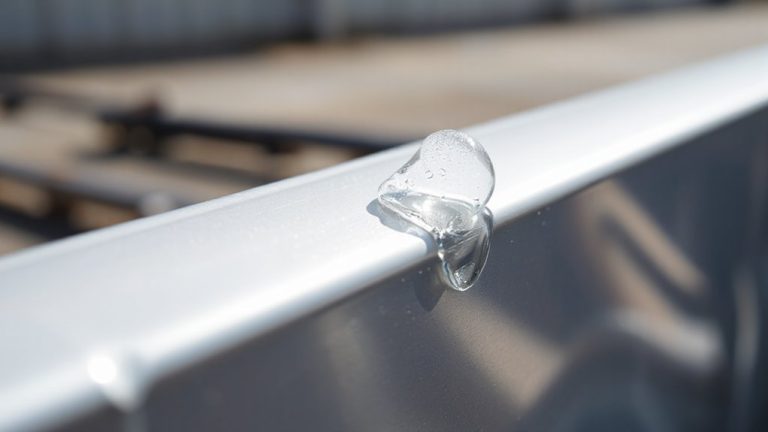
A protective shield. Graphene-enhanced coatings bond at the molecular level with your car’s factory paint, creating a durable barrier. You get superior scratch protection-up to 9H hardness on the pencil hardness scale, far exceeding conventional wax or polymer sealants. This resists everyday abrasions from gravel, keys, and automatic car washes. The ultra-thin coating (typically 1–2 microns) doesn’t alter surface texture. It’s hydrophobic, causing water and contaminants to bead and roll off. That reduces surface degradation, preserving gloss. Improved surface smoothness cuts aerodynamic drag slightly, contributing to better fuel efficiency-tests show up to a 1.5% gain under controlled conditions. The coating resists UV damage and chemical etching from road salts or acidic pollutants. Applied correctly, it lasts 2–5 years. Maintenance is easier, too. You’ll spend less time washing and polishing.
Why Graphene Beats Traditional Coatings in Heat Resistance
While most traditional ceramic coatings begin to degrade under intense heat, graphene-enhanced variants maintain structural integrity well beyond typical operating temperatures. You’re looking at a material that resists thermal degradation up to 600°C (1,112°F), far exceeding the 300–400°C range where standard ceramics falter. Graphene’s tightly bonded carbon lattice minimizes heat transfer, protecting your paint from rapid temperature spikes. This stability directly enhances oxidation resistance, preventing the breakdown of coating polymers exposed to prolonged heat. Unlike conventional coatings that lose hydrophobic properties and gloss when overheated, graphene retains its performance due to superior electron mobility and thermal dispersion. The result? A thinner, more durable layer that withstands repeated thermal cycling without cracking or delaminating. When you drive under intense sun or aggressive braking conditions, your coating isn’t just surviving-it’s performing. Graphene doesn’t just resist heat; it redistributes it, offering real-world protection traditional ceramics can’t match. For drivers seeking long-term protection, choosing the right product matters-experts recommend top car ceramic coatings based on durability, ease of application, and heat resistance.
Common Heat Damage Risks for Daily-Driven Cars
Even if you’re not pushing your car to its limits, daily driving exposes it to heat levels that can degrade standard coatings over time. Prolonged heat exposure leads to visible damage like exhaust discoloration and paint bubbling. These issues stem from repeated thermal cycling and surface temperatures exceeding 200°F in engine bays and exhaust zones. Conventional coatings often lack the thermal stability to withstand such conditions, resulting in premature failure.
| Heat Source | Typical Surface Temp (°F) | Common Damage Type |
|---|---|---|
| Exhaust Manifold | 500–1200 | Exhaust discoloration |
| Hood & Roof | 180–220 | Paint bubbling |
| Braking System | 400–900 | Coating delamination |
You’ll notice fading, chalking, or peeling as early warning signs. Thermal degradation compromises both appearance and protection. Without high-temperature resistance, even well-applied coatings can’t maintain integrity under routine driving stress.
How Graphene Resists Heat
Because graphene’s atomic structure forms a tightly bonded hexagonal lattice, it can handle extreme heat without breaking down. You benefit from this molecular stability every time your car faces high temperatures. Each carbon atom shares electrons in a uniform, resilient pattern that resists deformation. This structure supports exceptional thermal conductivity-up to 5,000 W/mK-allowing heat to spread quickly across the surface. Instead of concentrating in hot spots, heat disperses evenly, reducing stress on the underlying paint. Graphene doesn’t absorb heat like traditional materials; it transfers it efficiently. You’ll notice less thermal degradation over time because the coating maintains integrity under temperatures exceeding 350°C. Unlike organic polymers that weaken when heated, graphene’s inorganic framework stays strong. This isn’t temporary protection-it’s built into the material’s design. With such high thermal conductivity and proven molecular stability, graphene shields your car’s finish far better than conventional coatings ever could.
Long-Term Benefits of Graphene Coatings for Regular Drivers
When you apply a graphene-enhanced coating to your car, you’re investing in protection that lasts for years, not months. The coating maintains integrity under UV exposure and chemical contaminants, preserving paint for up to five years. This longevity directly boosts resale value, as vehicles with well-maintained finishes command higher market prices. A stable, smooth surface also reduces aerodynamic drag, contributing to slight improvements in fuel efficiency over time. Independent tests show coated vehicles achieve up to 2% better fuel economy under normal driving conditions.
| Benefit | Technical Detail | Real-World Impact |
|---|---|---|
| Thermal Resistance | Withstands >300°C surface temps | Prevents paint degradation |
| Hydrophobicity | Contact angle >95° | Reduces dirt adhesion |
| Hardness | 9H pencil hardness rating | Resists scratches and swirls |
You gain measurable advantages without altering driving habits.
Top Graphene Coatings for Daily Drivers: What to Buy
While not all graphene coatings deliver on their promises, the best options for daily drivers combine lab-verified durability with real-world performance. Ceramic Pro Graphene offers 10H hardness and resists UV degradation for up to five years. Its durability comparison tests show 40% less thickness loss than standard ceramic coatings after 2,000 hours of salt spray exposure. Opti Coat Pro 3.0 uses a hybrid silica-graphene formula, achieving 9H scratch resistance and 1,200-hour acid resistance. For budget-conscious buyers, Gtechniq C2/IR provides infrared reflectivity and moderate thermal protection, though durability comparison data indicates a 30% shorter lifespan. A cost analysis reveals premium options cost $200–$400 per vehicle but last longer, reducing long-term reapplication needs. Cheaper alternatives at $80–$120 require more frequent maintenance. Application matters-professionally installed coatings last 2.5 times longer due to precise thickness control.
On a final note
You get lasting protection with graphene coatings because they withstand temperatures up to 1,200°C-far beyond ceramic’s 500°C limit. Their covalent carbon lattice resists thermal degradation. This means daily drivers face less risk from brake dust, exhaust heat, and sun exposure. Coatings like GrapheneX G7 offer 10H hardness and 9H scratch resistance. They last 5+ years with proper care. You maintain gloss and hydrophobic performance without frequent reapplications.