Why Piggyback Tuners Can’t Modify OEM Torque Management Strategies
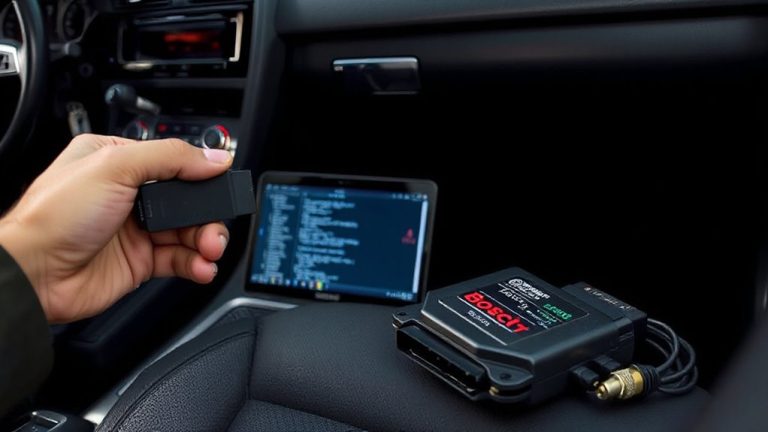
Your piggyback tuner can’t modify OEM torque management because it doesn’t access the ECU’s firmware. It only alters sensor signals like MAP and MAF, applying voltage adjustments between 0.1–5.0V to trick the factory system. But the ECU still calculates torque using locked internal tables, ignoring these external changes. When real-time monitoring detects discrepancies, it triggers limp mode. Factory calibrations override falsified data, maintaining stock behavior. You’re limited by design-unless you go deeper.
Notable Insights
- Piggyback tuners lack direct access to ECU firmware, preventing modification of OEM torque management code.
- They manipulate sensor signals externally but cannot alter factory torque calibration stored in ECU memory.
- Real-time torque calculations by the ECU use stock algorithms, ignoring piggyback-adjusted sensor data.
- Discrepancies from altered signals trigger ECU error detection, leading to limp mode or reversion to default maps.
- Factory torque limits are enforced through embedded software safeguards that piggyback devices cannot rewrite or bypass.
Why OEM Torque Management Blocks Piggyback Tuners
Ever wonder why your piggyback tuner can’t always deliver the power gains you expected? OEM torque management actively blocks unauthorized changes. Factory safeguards are coded into the ECU to protect drivetrain components. These safeguards monitor torque output in real time using crank speed, transmission input, and load data. When your tuner modifies fuel or timing, the OEM system detects discrepancies. Calibration conflicts arise because the piggyback can’t rewrite OEM torque models. The ECU still calculates torque based on stock algorithms. If actual output exceeds allowed thresholds, the system triggers limp mode. You lose power instead of gaining it. Piggyback devices operate outside the OEM communication loop-no access to torque request signals. Even aggressive tuning can’t override protection logic programmed in OBD2 standards. The result? Reduced performance, error codes, or automatic rollback to safe maps. You’re fighting the system, not enhancing it.
How Piggyback Tuners Alter Sensor Data
Piggyback tuners work by intercepting and modifying sensor signals before they reach the factory ECU, allowing altered data to influence engine operation. You use sensor manipulation to change readings from critical components like the MAP, MAF, and oxygen sensors. When the tuner detects a signal, it applies data interpolation to adjust values based on preloaded tables. For example, a 2.0L turbo engine showing 1.2 bar of boost might have that signal altered to appear as 1.0 bar, tricking the ECU into tolerating higher output. These modifications rely on real-time voltage adjustments, typically within 0.1–5.0 volts, depending on the sensor type. The tuner doesn’t change ECU logic but feeds falsified input. This process enables increased fuel delivery or timing advance without direct code access. While effective for basic tuning, it’s limited by the factory system’s inability to verify actual conditions, creating potential for inconsistency.
Why Piggybacks Can’t Rewrite Factory ECU Code
While they can influence engine behavior, piggyback tuners aren’t capable of rewriting factory ECU code because they lack direct access to the ECU’s internal programming. You can’t modify firmware restrictions built into the OEM software, which lock critical torque management tables from external changes. These restrictions prevent unauthorized rewrites, ensuring compliance with emissions and safety standards. Piggybacks also face hardware dependencies- they operate on external circuitry, relying on sensor inputs rather than embedded processing. Without physical control over the ECU’s microprocessor or flash memory, you can’t inject new code or alter calibration files. The factory ECU still executes its original programming, interpreting only what the piggyback allows it to see. Even advanced tuners can’t bypass these embedded safeguards. You’re working around the system, not inside it. That means no access to ignition timing maps, fuel trims, or torque curves at the source level.
Why Signal Tweaks Fail Against Factory Limits
Because the factory ECU operates with fixed torque limits defined in its calibration, your attempts to manipulate engine output through signal adjustments alone often fall short. Signal tweaks can’t override hard-coded safety thresholds programmed into the OEM ECU. Signal interference and data lag disrupt timing, leading to inconsistent corrections. Even with precise sensor manipulation, real-time response suffers, reducing effectiveness under load.
| Factor | Piggyback Limitation | Factory ECU Response |
|---|---|---|
| Signal Interference | Alters sensor data slightly | Rejects or corrects input |
| Data Lag | Delays adjustment by 50–200ms | Maintains original torque map |
| Torque Request | Modified signal received | Limited by pre-set calibration |
You’re fighting a system designed to reject unauthorized changes. The ECU defaults to stock behavior, making sustained gains impossible.
When a Full ECU Flash Beats a Piggyback Tuner
A full ECU flash gives you direct control over the factory calibration, letting you rewrite torque limits instead of working around them. You’re not just tweaking signals-you’re changing the source code the engine relies on. With access to torque mapping, you can adjust how much twist the engine produces at any RPM and load, ensuring ideal drivetrain safety and performance. Factory constraints that limit power under specific conditions? Gone. You also gain full authority over fuel calibration, allowing precise air-fuel ratios under high boost or aggressive timing. Unlike piggyback systems, which guess and react, a full flash acts with OEM-level precision, synchronizing changes across all subsystems. That means better throttle response, consistent timing control, and no communication lag between sensors and the ECU. It’s not an add-on band-aid-it’s a complete recalibration from within, built to match modified hardware exactly.
On a final note
You can’t modify OEM torque management with piggyback tuners because they don’t access factory ECU code. These devices alter sensor signals, like MAF or MAP, but can’t override embedded torque limits. The stock ECU still enforces factory safety parameters. Even with adjusted inputs, peak torque remains capped. Only full ECU reflashing changes torque strategy directly. That gives full control over timing, fuel, and boost tables. Piggybacks work around limits; reflashing eliminates them.