Top-Rated 12 Volt Golf Cart Batteries That Last for Seasons
You want 12-volt golf cart batteries that last season after season. Trojan T-1275 and Crown T-1275 deliver 150Ah capacity with thick, durable plates built for deep cycling. US12VXC2 offers 155Ah and hand-assembled quality. For longer life, 100Ah LiFePO4 batteries provide 4,000–30,000 cycles, weigh 60% less, and operate in extreme temperatures. They need a lithium-specific charger but offer maintenance-free performance. More details follow.
We are supported by our audience. When you purchase through links on our site, we may earn an affiliate commission, at no extra cost for you. Learn more. Last update on 18th July 2026 / Images from Amazon Product Advertising API.
Notable Insights
- Lithium iron phosphate (LiFePO4) batteries offer 4,000 to 30,000 deep cycles, lasting up to 10 years with minimal degradation.
- Trojan T-1275 and Crown T-1275 12V flooded lead-acid batteries provide 150Ah capacity and durable performance with proper maintenance.
- LiFePO4 batteries deliver 95–100% usable capacity and maintain stable voltage, outperforming lead-acid in efficiency and runtime.
- Flooded lead-acid batteries require regular watering, cleaning, and equalization charging to maximize lifespan and prevent sulfation.
- Lithium batteries are 50–70% lighter than lead-acid, improving golf cart range, handling, and ease of replacement.
Trojan T-1275 12V Flooded Lead Acid Battery, 150Ah 20-Hr Rate – Set of 4

If you’re running a high-demand deep-cycle system like a golf cart or industrial electric vehicle, the Trojan T-1275 12V flooded lead acid battery is built for your needs. I rely on this battery because it delivers 150Ah at the 20-hour rate, ensuring steady power over long periods. Each unit measures 6.95 x 12.96 x 10.89 inches and weighs 85 pounds, fitting standard GC12 compartments. Its polypropylene case resists vibration and impact. The Alpha Plus paste with T2 Technology boosts cycle life and performance. This set of four provides balanced, sustained energy for heavy-duty use.
Best For: Users needing reliable, high-capacity power for deep-cycle applications such as golf carts, electric vehicles, or industrial equipment.
Pros:
- Delivers 150Ah at the 20-hour rate for long-lasting, steady power output
- Built with durable polypropylene case and T2 Technology for extended cycle life and vibration resistance
- Set of four 12V batteries provides scalable, balanced energy for high-demand systems
Cons:
- Heavy at 85 pounds per battery, making installation and handling difficult without assistance
- Flooded lead acid design requires regular maintenance and proper ventilation
- High initial cost for a set of four, which may not suit budget-conscious buyers
12V 100Ah LiFePO4 Battery 4-Pack

I need a reliable, high-capacity energy solution for my off-grid adventures, and the 12V 100Ah LiFePO4 Battery 4-Pack delivers where lead-acid batteries fall short. Each unit weighs 22.5 pounds and fits Group 31 dimensions: 12.9 x 6.7 x 8.6 inches. They use A+ grade LiFePO4 cells, offering 15,000 deep cycles and over 10 years of service life. A built-in 100A BMS prevents overcharge, over-discharge, short circuits, and overheating. It blocks charging below 32°F but allows discharge down to -4°F. The 300A max discharge (for 3 seconds) suits high-demand applications. Always use a 14.6V±0.2V lithium charger-never a lead-acid charger.
Best For: Adventurers and off-grid users seeking a lightweight, long-lasting, and high-cycle lithium power solution for RVs, marine setups, solar systems, or home backup applications.
Pros:
- Delivers up to 15,000 deep cycles and over 10 years of service life for exceptional durability
- Built-in 100A BMS provides comprehensive protection against overcharge, over-discharge, short circuits, and extreme temperatures
- Lightweight at 22.5 lbs per unit with Group 31 compatibility, making it easy to install and ideal for mobile applications
Cons:
- Not suitable for engine starting, golf carts, or hydraulic jacks due to discharge profile and BMS limitations
- Requires a specific 14.6V±0.2V lithium charger; using lead-acid chargers can cause damage
- Smart low-temperature cutoff blocks charging below 32°F, limiting usability in cold climates without heating solutions
4 Pack 12V 100Ah LiFePO4 Battery
The Pack 12V 100Ah LiFePO4 Battery is my top pick for golf cart owners who demand long-lasting, lightweight power with minimal maintenance. Each 12V 100Ah unit delivers 5120Wh capacity using Grade-A cells built to last 4000+ deep cycles. At 24.2 lbs, it’s 50% lighter than lead-acid. A built-in 100A BMS prevents overcharge, over-discharge, and short circuits. It operates reliably from -20°C to 60°C. I recommend charging each battery to over 13.4V before connecting in series or parallel. You can link up to four in series for 48V systems or four in parallel for 400Ah capacity. Use a 14.6V 20A lithium charger.
Best For: Golf cart owners seeking a lightweight, long-cycle-life lithium power solution with minimal maintenance and reliable performance in varying temperatures.
Pros:
- Delivers 5120Wh capacity per unit with 4000+ deep cycles for long-term durability
- 50% lighter than lead-acid batteries at 24.2 lbs, improving vehicle efficiency and ease of handling
- Built-in 100A BMS and wide discharge temperature range (-20°C to 60°C) ensure safety and reliability
Cons:
- Not suitable for engine starting applications
- Requires individual charging and voltage equalization before series/parallel connections
- Maximum parallel configuration limited to 4 units, potentially restricting scalability for larger systems
Set of 4 US12VXC2 12V 155Ah Batteries
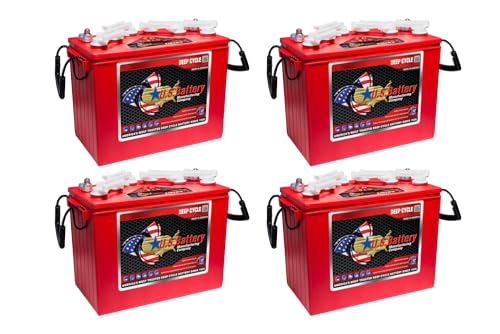
You’ll get the most out of these 12 Volt Golf Cart Batteries if you demand long-term power and durability from a proven, high-capacity flooded lead acid design. I rely on the U.S. Battery US12VXC2 for exactly that. Each 12V battery delivers 155Ah at the 20-hour rate, built with Diamond Plate Technology and an XC2 formulation for extended life. The set includes four rugged, 86-pound batteries with heat-sealed polypropylene cases. They measure 14 inches long with handles, 7 1/16 inches wide, and 11 3/8 inches tall. They’re made in America, handle heavy discharge well, and work with most standard chargers.
Best For: Those seeking durable, high-capacity 12V flooded lead acid batteries for golf carts, utility vehicles, or commercial floor maintenance equipment with long-term reliability and deep discharge performance.
Pros:
- Delivers 155Ah at the 20-hour rate with Diamond Plate Technology for extended life and faster cycling to full capacity
- Designed for broad charger compatibility and built with rugged, heat-sealed polypropylene cases for durability
- Made in America with hand-made construction and proven performance in demanding industrial and commercial applications
Cons:
- Heavy at 86 pounds for the set, making installation and handling difficult without assistance
- Flooded lead acid design requires regular maintenance including water level checks and proper ventilation
- Not sealed, which limits transport options and increases risk of leakage if improperly positioned
Battery Renew Solution for Lead Acid Batteries

Who benefits most from a 12-volt golf cart battery that consistently delivers power and resists degradation over time? I do-especially when using the Battery Renew Solution. This 64-ounce desulfator refill from Samorillo removes sulfate buildup in lead acid cells, restoring performance. I apply 3 ounces per cell for 12-volt batteries, extending service life up to three treatments. It’s safe, non-toxic, and made in the USA. I avoid using it on gel or dry-cell types. At 4.69 pounds and 9.8 x 4.7 x 4.7 inches, the container stores easily. Model B0CBGCS57D works in golf carts, boats, and trucks.
Best For: Golf cart, boat, and truck owners seeking to restore and extend the life of their 6-volt, 8-volt, or 12-volt lead acid batteries with a safe, non-toxic, USA-made desulfator solution.
Pros:
- Effectively removes sulfate buildup to restore battery capacity and performance
- Safe, non-toxic formula designed for consumer use and made in the USA
- Cost-efficient 64-ounce solution allows multiple applications across various vehicles
Cons:
- Not compatible with gel-type, dry-cell, or frozen batteries
- Requires proper dosage and maintenance for optimal results
- Limited effectiveness on severely degraded or damaged batteries
Trojan T-1275 12V Deep-Cycle Battery (2-Pack)

Trojan T-1275 12V deep-cycle batteries deliver unmatched endurance for golf carts and similar power-hungry applications. I rely on their 150Ah capacity at the 20-hour rate to sustain long drives and heavy use. Each battery offers 280 minutes of reserve capacity at 25 amps, ensuring consistent power. They’re built with rugged flooded technology and Trojan’s T2 design, featuring Alpha Plus paste for improved cycle life. The durable polypropylene case resists impacts and vibration. I use the ELPT terminals for secure, OEM-style connections. This 2-pack fits GC12 group setups perfectly, making it ideal for golf carts, floor scrubbers, and backup systems.
Best For: Golf cart owners and operators of industrial or marine equipment needing reliable, long-lasting 12V deep-cycle power with high capacity and durability.
Pros:
- High 150Ah capacity and 280-minute reserve capacity provide extended runtime for power-intensive applications
- Rugged flooded design with T2 Technology and Alpha Plus paste enhances cycle life and performance
- ELPT terminals and GC12 group compatibility ensure secure, OEM-style installation in various systems
Cons:
- Flooded design requires regular maintenance, including water level checks and proper ventilation
- Heavy weight due to deep-cycle construction may complicate handling and installation
- Not suitable for applications requiring maintenance-free or sealed battery designs
12V 100Ah LiFePO4 Lithium Battery with BMS

The 12V 100Ah LiFePO4 lithium battery with BMS is best suited for users who demand long-term reliability and high performance from their power systems. I weigh just 24 lbs-60% lighter than lead-acid-and deliver stable 12V voltage with 1280Wh capacity. My 4000–15,000 cycle life depends on depth of discharge, outlasting traditional batteries. I thrive in temperatures from -20°C to 60°C when discharging. My built-in 100A BMS prevents overcharge, overheating, and shorts. I charge fully in 5 hours with a 14.6V 20A charger. I’m ideal for golf carts, solar setups, RVs, and marine use.
Best For: Users seeking a lightweight, long-lasting, and high-performance power solution for demanding applications like RVs, solar setups, marine environments, and off-grid systems.
Pros:
- 60% lighter than lead-acid batteries at 24 lbs, offering significant weight savings
- Exceptional cycle life of up to 15,000 cycles at 60% DOD, ensuring long-term durability
- Integrated 100A BMS provides robust protection against overcharge, overheating, and short circuits
Cons:
- Higher upfront cost compared to traditional lead-acid batteries
- Requires a compatible LiFePO4 charger for optimal charging performance
- Limited charging capability below 0°C, necessitating temperature management in cold environments
Crown T-1275 12V 150Ah Golf Cart Battery

If you demand maximum power and longevity in a deep-cycle battery, the Crown T-1275 12V 150Ah is built for your toughest applications. I rely on its 150Ah capacity (20-hour rate) and 103-minute reserve at 75 amps for sustained performance. Its flooded lead acid design uses the industry’s heaviest, thickest plates with dense TBLS for durability. A one-piece solid cast core reduces internal resistance. I get 52% more current-carrying surface than competing models. It weighs 81 lbs, has SAE posts and a threaded stud, and fits GC12 trays. I use it in golf carts like Club Car X4, floor scrubbers, and marine systems. It’s a direct swap for Trojan T-1275. Crown’s 90-year reputation stands behind it.
Best For: Those seeking a durable, high-capacity deep cycle battery for demanding applications like golf carts, floor scrubbers, and marine systems who prioritize longevity and consistent power delivery.
Pros:
- Delivers 52% more current-carrying surface area than competitors for superior performance
- Built with the industry’s heaviest and thickest plates, enhancing power and service life
- Direct replacement for Trojan T-1275 and compatible with GC12 applications like Club Car X4
Cons:
- 81 lbs weight makes handling and installation challenging without assistance
- Flooded lead acid design requires periodic maintenance and water refills
- Higher initial cost compared to standard deep cycle batteries
4 Pack 12V 100Ah LiFePO4 Battery
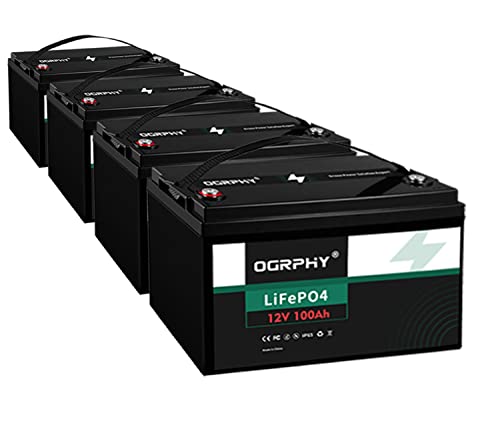
You’ll get the most out of 12 Volt Golf Cart Batteries if you choose the 4 Pack 12V 100Ah LiFePO4 Battery for high-demand applications like golf carts, RVs, or off-grid solar. I rely on Grade A cells for consistent performance and longevity. Each battery delivers 1280Wh with a 10-year lifespan and over 5000 deep cycles. They’re 1/3 the weight of lead-acid, offer 2x energy release, and last up to 10x longer. A 100A BMS guarantees protection. IP65-rated, they resist dust and water. I use them in extreme climates-charge from -20°C to 55°C, discharge up to 60°C.
Best For: Those seeking high-performance, long-lasting power for demanding applications like golf carts, RVs, trolling motors, or off-grid solar systems.
Pros:
- Exceptional 10-year lifespan with 5000+ deep cycles and Grade A cells for reliable, long-term performance
- Lightweight design (1/3 the weight of lead-acid) with 2x energy release and 10x longer life compared to traditional batteries
- Advanced 100A BMS protection, IP65 rating, and wide operating temperatures make it ideal for extreme environments
Cons:
- Higher upfront cost compared to lead-acid or lower-tier lithium batteries
- Limited discharge below 0°C, which may affect performance in freezing conditions
- Requires proper system compatibility when wiring up to 4 in series or parallel for higher voltage or capacity setups
12V 100Ah LiFePO4 Battery (3 Pack)

A rugged power solution for off-grid adventurers and marine enthusiasts, this 12V 100Ah LiFePO4 battery (3 pack) delivers reliable energy storage where performance and durability matter most. Each battery weighs 22.48 lbs-33% lighter than lead acid-and provides 1280Wh capacity. I use A+ grade LiFePO4 cells for high energy density and long life. The built-in 100A BMS protects against over-charge, over-discharge, and short circuits. It supports 30,000 deep cycles at 80% DOD and has an IP65 rating for dust and water resistance. I require a 14.6V lithium-specific charger. I’m not for starting engines or golf carts.
Best For: Off-grid adventurers, marine users, and RV owners needing lightweight, durable, and long-lasting energy storage with high cycle life and built-in safety features.
Pros:
- Delivers 15,000 deep cycles with A+ grade LiFePO4 cells for exceptional longevity
- 33% lighter than lead-acid batteries with IP65 rating for rugged, reliable performance
- Built-in 100A BMS ensures protection against over-charge, over-discharge, short circuits, and low-temperature operation
Cons:
- Requires a specific 14.6V lithium charger, incompatible with standard lead-acid chargers
- Not suitable for engine starting, golf carts, or high-surge applications beyond 300A for 3 seconds
- Individual battery shipping may lead to staggered delivery and requires careful voltage matching before series installation
Factors to Consider When Choosing 12 Volt Golf Cart Batteries
You need to pick the right 12 volt golf cart battery, and it starts with understanding key factors. Battery chemistry type-like lead-acid or LiFePO4-affects performance, maintenance, and lifespan, with LiFePO4 offering longer cycle life expectancy (2,000–5,000 cycles) versus lead-acid (300–500 cycles). Capacity and runtime, measured in amp-hours (Ah), determine how long your cart runs per charge, while charging efficiency, weight, and portability impact convenience and energy loss during recharging.
Battery Chemistry Type
Battery chemistry defines the foundation of your 12-volt golf cart’s power system. You’ll mainly choose between lead acid and lithium iron phosphate (LiFePO4). Lead acid batteries cost less upfront but demand more upkeep. Flooded types need regular watering and equalization charges, plus proper ventilation due to gas release. They last 300 to 500 deep cycles with care. Sealed versions like AGM cut maintenance and leak risks. In contrast, LiFePO4 batteries deliver over 4,000 deep cycles, need zero maintenance, and hold steady voltage from full to empty. They’re 50–70% lighter, boosting efficiency and cart handling. You can safely use 100% of their capacity without harm. These lithium units rely on built-in battery management systems (BMS) to prevent overcharge, overheating, and deep discharge. Lead acid depends more on correct charger matching and your routine checks.
Capacity And Runtime
Capacity determines how long your 12-volt golf cart can run between charges, and it’s measured in amp-hours (Ah). A higher Ah rating means longer runtime. For example, a 150Ah battery can deliver 7.5 amps for 20 hours, while a 100Ah unit provides 5 amps over the same period at the 20-hour rate. Deep-cycle batteries are rated at standard discharge times like 20 or 5 hours; actual capacity drops when you draw more current. Lithium iron phosphate (LiFePO4) batteries offer more usable capacity-they maintain steady voltage and deliver nearly full power until depleted. Lead-acid batteries lose voltage as they drain, reducing effective output. You also lose runtime in cold weather or with age. Deep discharges reduce available capacity over time. Pick a battery with enough Ah to cover your typical course length and driving habits without frequent recharging.
Cycle Life Expectancy
A single deep-cycle battery can last anywhere from 400 to 15,000 charge cycles, but how you use it makes all the difference. You’ll get fewer cycles with deeper discharges-draining a battery to 100% depth of discharge (DoD) cuts cycle life dramatically compared to stopping at 60%. Lithium iron phosphate (LiFePO4) batteries deliver 4,000 to 15,000 deep cycles, making them ideal for frequent, heavy use. In contrast, flooded lead-acid batteries typically last 300 to 1,000 cycles. Your charging habits matter-maintaining proper voltage and avoiding undercharging extends life. For lead-acid types, regular equalization prevents sulfation. Operating in extreme temperatures shortens longevity, so temperature management is key. Partial discharges can double or even quadruple cycle life over time. You’re not just buying a battery-you’re investing in long-term performance.
Charging Efficiency
Efficiency starts the moment you plug in. Charging efficiency determines how well your battery converts incoming electricity into stored energy. You lose less power with lithium iron phosphate (LiFePO4) batteries-over 95% efficient-versus flooded lead acid, which only reaches 70–80%. The rest is lost as heat and gas, especially during electrolysis. Higher efficiency means faster charging and lower electricity costs over time. It also reduces strain on your charger and electrical system. Lead acid batteries need strict voltage control to avoid overcharging and heat buildup, which wastes energy and shortens lifespan. In contrast, LiFePO4 batteries accept charge quickly and consistently, with minimal thermal loss. You get more usable energy per amp-hour delivered. When you charge efficiently, you save time, money, and wear on components-critical for frequent or seasonal use.
Weight And Portability
One major factor you can’t afford to overlook is weight-specifically, the difference between lead acid and lithium iron phosphate (LiFePO4) batteries. Flooded lead acid units weigh 80 to 87 pounds each, making them cumbersome to install and replace. In contrast, LiFePO4 batteries weigh only 22 to 24 pounds-up to 70% lighter. That dramatic reduction simplifies handling, especially when you’re swapping multiple batteries or working in tight spaces. Heavy lead acid packs also shift weight distribution in lightweight golf carts, potentially affecting handling and performance. Lithium’s lighter load improves energy efficiency by reducing total vehicle mass, which can extend range and enhance ride stability. You’ll save effort during maintenance and gain better overall vehicle dynamics. For these reasons, lighter lithium batteries aren’t just easier to move-they’re a practical upgrade that supports long-term usability and performance in demanding mobile applications.
Maintenance Requirements
While you can’t ignore the demands of upkeep when choosing 12-volt golf cart batteries, your maintenance tolerance plays a key role in selecting the right type. Flooded lead acid batteries require hands-on care. You must check electrolyte levels every 1–2 months and top off cells with distilled water. Clean terminals and prevent corrosion every 3–6 months to guarantee solid connections. You should also test specific gravity with a hydrometer every 3–6 months for accurate charge and cell health assessment. In contrast, sealed AGM and lithium iron phosphate (LiFePO4) batteries are maintenance-free. You won’t need to refill electrolytes or clean terminals. Lithium batteries only require periodic state-of-charge checks. Charge them every 2–3 months during storage to maintain longevity. Your willingness to perform routine tasks directly impacts battery life and performance. Choose based on your ability to commit to these demands.
Temperature Tolerance
You’ve already considered how much effort you’re willing to put into upkeep, but how your battery handles temperature extremes is just as impactful. Lead acid batteries lose up to 50% of their capacity below 32°F (0°C) because cold slows chemical reactions and raises internal resistance. Charging them when frozen causes permanent damage from electrolyte stratification and sulfation. In contrast, lithium iron phosphate (LiFePO4) batteries operate safely down to -4°F (-20°C), keeping over 80% capacity in freezing weather. They include built-in circuits that block charging below 32°F, protecting cell health. On the other end, temperatures above 86°F (30°C) shorten lifespan for both types by speeding up degradation and self-discharge. High heat accelerates wear, cutting cycle life markedly. Choosing a battery with strong thermal tolerance guarantees reliable performance across seasons and climates.
Warranty And Support
Since warranty terms directly reflect a manufacturer’s confidence in battery durability, choosing a 12-volt golf cart battery with strong coverage is a practical safeguard. Warranties typically span 36 months to 5 years, with longer terms signaling greater reliability. Some use a pro-rated structure, reducing compensation based on used lifespan and cycle count. Manufacturers often cover defects from materials or workmanship, but only if you register the battery and follow maintenance guidelines. Units with built-in battery management systems (BMS) usually exclude damage from incompatible or faulty charging, so use only recommended chargers. Support may include lifetime assistance, free return shipping for defects, and claims requiring proof of purchase and usage logs. Always verify warranty specifics before buying-it protects your investment just as much as the battery powers your cart.
Frequently Asked Questions
Can I Mix Old and New Golf Cart Batteries?
No, you shouldn’t mix old and new golf cart batteries. Your system’s performance drops because batteries lose capacity over time. New batteries work harder, depleting faster and shortening overall life. Mismatched internal resistance causes uneven charging, risking overloads. Think of it like pairing a sprinter with a tired runner-you’ll get inconsistent results. Always replace all batteries at once to maintain voltage balance, extend cycle life, and guarantee reliable 12-volt system performance.
How Often Should I Check Battery Water Levels?
You should check your battery water levels every 2 to 4 weeks during regular use. Low electrolyte levels expose plates, causing irreversible sulfation and reduced capacity. Fill cells with distilled water just until covering the plates-about 1/4 to 1/2 inch below the fill ring. Never overfill; it leads to acid spillage and corrosion. Check more often in hot climates or under heavy loads, as heat accelerates water loss.
Are Lithium Batteries Worth the Higher Cost?
Yes, lithium batteries are worth the higher cost. You get longer lifespan-typically 2,000 to 5,000 cycles-versus 300 to 500 for lead-acid. They’re lighter, weighing 50–70% less, and charge in half the time. No maintenance is needed, and they deliver consistent power until fully discharged. While upfront costs are higher, you save long-term on replacements and efficiency, making them a smart investment for frequent or heavy use.
What Causes Golf Cart Batteries to Overheat?
You overcharge your golf cart batteries, and that causes overheating. Exceeding 14.4 volts on a 12-volt lead-acid cell triggers thermal runaway. High ambient temperatures above 85°F accelerate heat buildup. Poor ventilation traps heat around batteries. You’re also stressing the system if you demand high current during deep discharges. Internal short circuits or sulfation increase resistance, generating excess heat. Always monitor voltage and battery temperature to prevent damage.
Can I Charge My Batteries With a Regular Charger?
No, you can’t safely charge your golf cart batteries with a regular car charger. Golf cart batteries are deep-cycle units requiring controlled, multi-stage charging. Standard chargers deliver unregulated voltage, risking overcharge, overheating, or reduced lifespan. Use a charger matching your battery’s voltage-usually 36V or 48V systems-and charge at the correct amperage, typically 15–30 amps. Always use a charger designed for deep-cycle lead-acid or lithium-phosphate batteries to guarantee proper bulk, absorption, and float stages.