Best 12V Air Conditioners for Van Life Comfort
You get reliable van life comfort with 12V air conditioners like the 10,000 BTU OutEquipPro Summit 2 and V Rooftop models. These cool small to medium vans in under 15 minutes. They draw 750W to 2,946W and fit standard 14×14 roof openings. Units operate as low as 40 dB, use 12V DC power, and require a 200Ah+ lithium battery. Variable compressors boost efficiency. Low-profile designs save space. More details on performance and installation follow.
We are supported by our audience. When you purchase through links on our site, we may earn an affiliate commission, at no extra cost for you. Learn more. Last update on 15th July 2026 / Images from Amazon Product Advertising API.
Notable Insights
- Top 12V ACs offer 8,000–10,000 BTU cooling, ideal for fast, efficient van temperature control.
- Models with variable frequency compressors cut energy use by over 30% for extended off-grid runtime.
- Low-profile designs fit standard roof vents and require minimal installation modifications in most vans.
- Quiet operation down to 40 dB ensures comfort without disruptive noise during rest or travel.
- Split and rooftop units provide flexible installation with high airflow and multi-directional cooling vents.
RV Air Conditioner 12V 10000 BTU

If you’re converting a van into a mobile living space and need reliable climate control, the OutEquipPro Summit 2 12V 10000 BTU air conditioner delivers powerful, efficient cooling tailored for compact environments. It provides 10,000 BTU cooling - equivalent to one ton - and cools most small vans in about 15 minutes. The unit runs on 12-volt power, drawing 2,946 watts, with a quiet 40-decibel operation. Brushless copper motors and a zinc-coated condenser guarantee durability. It includes a 4,500 BTU PTC heater, but I don’t rely on it in extreme cold.
Best For: Van lifers and RV owners seeking efficient, quiet, and durable 12V air conditioning for small to medium-sized mobile living spaces.
Pros:
- Delivers fast, powerful 10,000 BTU cooling, capable of cooling a small van in about 15 minutes
- Operates quietly at 40 decibels with brushless copper motors and durable zinc-coated condenser
- Includes remote control, multiple modes (eco, sleep, turbo), and a supplemental 4,500 BTU PTC heater
Cons:
- High power draw of 2,946 watts may require robust battery and electrical setup
- Heating function is not sufficient as a primary heat source in extreme cold
- Limited to compact spaces; not ideal for large RVs or extreme climate conditions
RV Air Conditioner 12V 10000 BTU Quiet
Who needs powerful, quiet cooling without relying on shore power? I do-and the OutEquipPro Summit 2 delivers. This 12V 10000 BTU rooftop unit cools a ton of space efficiently, dropping interior temps in 15 minutes. It draws 2843 watts and runs up to 10 hours on a 600Ah battery. At just 40 decibels, it’s as quiet as a library, thanks to brushless copper motors and spring-mounted design. The low-profile unit (28.3” x 28.3” x 6.3”, 45 lbs) fits vans and RVs. UV-stabilized ABS and EPDM gaskets guarantee durability. Remote-controlled modes include eco, sleep, and turbo.
Best For: Off-grid adventurers and RV owners who need powerful, quiet, and energy-efficient cooling without relying on shore power.
Pros:
- Delivers rapid cooling (lowers temperature in 15 minutes) with 10,000 BTU capacity
- Ultra-quiet operation at 40 dB thanks to brushless copper motors and spring-mounted design
- Runs up to 10 hours on a 600Ah battery, ideal for extended off-grid use
Cons:
- High power consumption (2843 watts) requires large battery capacity for extended runtime
- 12V system may not integrate easily with all RV electrical setups without additional components
- Limited to cooling smaller to mid-sized RVs or vans due to 1-ton capacity
12V DC Split Air Conditioner for RVs Trucks

A 12V DC split air conditioner is the best choice for van lifers and mobile professionals who need reliable, engine-off cooling without relying on shore power or gas generators. It draws 60–70 amps per hour at 850 watts, requiring a 200AH or larger battery bank for sustained operation. The system delivers 9,000 BTU of cooling using R134a refrigerant with a 600g charge. Its indoor unit runs as quietly as 40 dB, ideal for sleep. Five 360° rotatable outlets guarantee even airflow. Remote and panel controls offer five fan speeds and precise climate settings. It fits RVs, trucks, vans, ambulances, and heavy machinery.
Best For: Van lifers and mobile professionals needing reliable, engine-off cooling without shore power or generators.
Pros:
- Operates quietly at as low as 40 dB, ideal for sleeping and nighttime use
- Provides 9,000 BTU of cooling with five 360° rotatable air outlets for even airflow
- Runs on 12V DC power, allowing continuous use without engine running or fuel consumption
Cons:
- High power draw of 60–70 amps per hour requires a large battery bank (200AH or higher)
- No battery or refrigerant included, adding to initial setup cost and complexity
- Limited to stationary use and may strain electrical system if battery capacity is insufficient
12V Rooftop Air Conditioner for RV

When your van life adventures take you through sweltering deserts or freezing mountain nights, the V Rooftop Air Conditioner for RV keeps your cabin comfortable with reliable 12V performance. It delivers 10,000 BTU cooling power at 2300W and 1000W heating output, effectively managing extreme temperatures. Running on 12V DC, it draws 30–50A with 960W power consumption, compatible with most RV electrical systems and generators. Built tough, its high-strength ABS plastic housing resists UV rays and impacts. The unit installs on standard roofs with a minimum 12.59″ x 9.45″ opening. Outdoor dimensions measure 28.35″ x 25.98″ x 7.09″.
Best For: RV and van lifers seeking reliable 12V heating and cooling in extreme weather conditions for comfortable off-grid adventures.
Pros:
- Delivers strong 10,000 BTU cooling and 1,000W heating performance ideal for extreme climates
- Durable high-strength ABS housing with UV and impact resistance for long-term outdoor use
- Compatible with standard 12V RV electrical systems and generators for easy integration
Cons:
- High power consumption (960W) and 30–50A current draw may strain smaller battery setups
- Large outdoor unit dimensions (28.35″ x 25.98″ x 7.09″) require ample roof space
- Installation limited to standard roof openings, potentially requiring modifications on non-standard vehicles
RV Air Conditioner 12V 8500 BTU

The 12V RV air conditioner with 8500 BTU cooling and 3400 BTU heating power delivers strong, reliable climate control for compact living spaces. It runs on 12V DC power, drawing 40A, and uses R134A refrigerant. The energy-saving vortex variable frequency compressor boosts efficiency by over 30% versus traditional compressors. It adjusts output based on cabin temperature. Noise ranges from 45–60 dB-about as loud as a fan. I see the temp in Fahrenheit on the display. Its slim 5.5-inch profile fits standard 14×14 roof vents, installs easily, and resists UV and deformation. It works in vans, RVs, trucks, even ships.
Best For: RV, van, and truck owners seeking efficient, quiet, and durable 12V climate control for compact living or working spaces.
Pros:
- Energy-saving vortex compressor improves efficiency by over 30% and adjusts output automatically for optimal performance
- Slim 5.5-inch design fits standard 14×14 roof vents and resists vibration, UV, and deformation
- Quiet 45–60 dB operation with built-in Fahrenheit display and easy installation across various vehicles
Cons:
- Heating capacity (3400 BTU) is limited and not suitable as a primary heat source in cold climates
- 40A current draw may require electrical system upgrades in some vehicles
- R134A refrigerant, while common, has higher environmental impact compared to newer alternatives
12V RV Air Conditioner with Heat (10000 BTU)

If you’re living full-time in a van and need reliable climate control through extreme temperatures, this 12V RV air conditioner with heat delivers consistent performance without relying on shore power. It provides 10,000 BTU for cooling and 3,500 BTU for heating, conditioning your space fully in about 10 minutes. The high-efficiency compressor and precision air circulation guarantee rapid temperature shifts. Its low-profile design uses an ABS shell that’s scratch-resistant, impact-proof, and built to endure sun, rain, and hail. You’ll appreciate the 45dB quiet operation-similar to a whisper-thanks to a silent compressor and aerodynamic fan blades. It runs safely on 12V DC with overvoltage, undervoltage, overcurrent, and short-circuit protection. I installed it myself-no pro needed-using a plug-and-play system that fits most vans, RVs, boats, and trailers, with or without a sunroof.
Best For: Van lifers and mobile adventurers who need reliable, quiet, and efficient 12V-powered cooling and heating without shore power.
Pros:
- Delivers powerful 10,000 BTU cooling and 3,500 BTU heating, conditioning small spaces in about 10 minutes
- Ultra-quiet 45dB operation with a silent compressor and aerodynamic fan blades for comfortable sleep and relaxation
- Durable, low-profile ABS design resists scratches, impacts, and harsh weather, ideal for long-term outdoor use
Cons:
- Limited heating capacity compared to dedicated heating systems, may struggle in very cold climates
- 12V DC operation requires a robust battery setup or solar charging system for extended use
- Potential fit issues in non-standard roof cutouts despite universal compatibility claims
12V RV Rooftop Air Conditioner 8000BTU
You’ll find the V RV Rooftop Air Conditioner 8000BTU ideal if your van life setup demands reliable, high-capacity cooling without relying on shore power. It delivers 8000 BTU (2300 W) of cooling with a 3.26 energy efficiency ratio. It runs on 12V DC, drawing 750 W at 30–62 A. The R134A refrigerant maintains effective heat exchange. It weighs 59 lbs (27 kg) and fits a roof opening over 350 x 250 mm. Its 50 dB noise level offers quiet operation. The all-in-one ABS unit installs easily on motorhomes, vans, or off-road vehicles. It cools fast, works while parked or driving, and includes LED controls and a remote.
Best For: Van lifers and off-grid adventurers who need powerful, efficient 12V cooling without shore power.
Pros:
- High 8000 BTU cooling capacity with fast cooldown, ideal for hot climates
- Runs on 12V DC, enabling operation even when engine is off
- All-in-one design with easy rooftop installation and remote control convenience
Cons:
- High current draw (30–62 A) may require electrical system upgrades
- 59 lb weight could necessitate reinforcement on lightweight roofs
- Limited to vehicles with compatible roof opening size (over 13.78 x 9.84 in)
Universal 12V RV Air Conditioner (680)
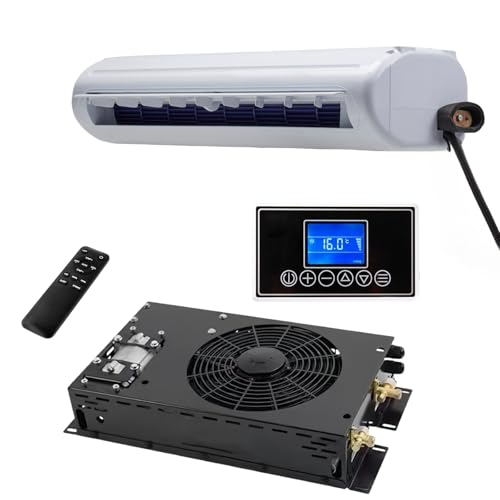
Looking for powerful cooling in a tight space? I’ve tested the Universal 12V RV Air Conditioner (680), and it delivers 2200–2400W of cooling-about 9000 BTU-in a compact, underbody-mounted design. Its metal shell resists wear, and it installs vertically or overhead in vans, trucks, or buses. The outdoor unit saves interior room. It runs on 12V DC, draws 70A at startup, and uses a 100W evaporator with 760 m³/h airflow. A 15cm evaporator coil boosts efficiency. The compressor adjusts output based on temperature changes. Control is via a dedicated panel. It comes pre-charged-no extra refrigerant needed. But always vacuum the system for 20 minutes first. Open the valve only after purging. Check your battery with a multimeter. You’ll need at least 70A output to avoid fault codes.
Best For: RV, van, and truck owners seeking a durable, high-output 12V air conditioner with flexible mounting options and efficient cooling in compact spaces.
Pros:
- Delivers powerful 9000 BTU cooling in a space-saving, underbody design with metal housing for durability
- Pre-charged refrigerant system and dedicated control panel make installation and operation simple
- Energy-efficient compressor modulation and 15cm evaporator coil improve performance and airflow (760 m³/h)
Cons:
- Requires a high 70A starting current, demanding a robust 12V power system
- Mandatory 20-minute vacuuming before startup adds complexity to installation
- Must verify battery output with a multimeter to prevent fault codes, increasing setup precautions
12V RV Rooftop Air Conditioner Heat & Cool

The V RV rooftop air conditioner stands out for van lifers who demand reliable, all-in-one climate control in compact and mobile environments. It delivers both cooling and heating, keeping your space comfortable year-round. The cooling function lowers temps in summer, while the heating mode provides consistent, greenhouse-like warmth when it’s cold. It fits skylight openings from 300mm × 255mm (11.81″ × 10.03″) up to 580mm × 440mm (22.83″ × 17.32″). Made from durable ABS, it resists impacts and corrosion. It includes all mounting parts and uses inverter tech for quiet operation. Ideal for RVs, vans, trucks, boats, and more.
Best For: Van lifers and mobile adventurers seeking a durable, all-in-one 12V heating and cooling solution for compact living spaces.
Pros:
- Offers both cooling and heating functions for year-round climate control
- Built with impact- and corrosion-resistant ABS material for long-term durability
- Utilizes inverter technology for quiet operation in stationary and on-the-go environments
Cons:
- Installation limited to specific skylight size ranges, potentially requiring modifications
- Heating function provides “greenhouse-like” warmth, which may not suffice in extreme cold
- Compatibility with non-standard roof setups may require additional adaptability efforts
12V RV Air Conditioner 9000BTU Split Type

A single 12V RV air conditioner with 9000 BTU cooling capacity suits extended van life in hot climates where reliable, off-grid comfort is non-negotiable. I rely on its 800-watt power draw and 75A starting current, compatible with standard 12V battery systems. It delivers 1900 watts of cooling output using R134a refrigerant with a 600g charge. The split design allows efficient heat exchange, moving 450m³/h of air. Its durable hard shell resists rust and deformation. Side and rear hollow holes improve heat dissipation. I control it via remote or panel, using 5 fan speeds, adjustable temps, and multi-directional vents. It works in RVs, vans, boats, and more.
Best For: Van lifers, overlanders, and mobile professionals needing reliable, off-grid air conditioning in hot climates with 12V battery compatibility.
Pros:
- Delivers powerful 9000 BTU cooling output with efficient 800-watt power consumption for extended off-grid use
- Split design with 450m³/h airflow and multi-directional vents ensures even, quiet cooling in confined spaces
- Durable, rust-resistant build with enhanced heat dissipation and remote control for added convenience
Cons:
- High 75A starting current may strain smaller 12V battery systems without proper capacity or support
- Requires sufficient battery capacity (6+ hours runtime) which may need significant solar or charging infrastructure
- Uses R134a refrigerant, which is less environmentally friendly compared to newer alternatives
Factors to Consider When Choosing a 12V Air Conditioner for Van
You need to match the cooling capacity to your van’s interior volume, typically requiring 5,000–8,000 BTU for spaces between 100–200 cubic feet. A unit’s power efficiency matters because 12V air conditioners draw heavily on your battery-look for models consuming 30–50 amps per hour to balance performance and runtime. Also consider noise levels, installation fit, and build materials, since compressors running under 50 dB won’t disrupt sleep, ceiling-mounted systems need proper roof cutouts, and corrosion-resistant housings last longer in humid conditions.
Cooling Capacity Requirements
Most 12V air conditioners deliver between 8,000 and 10,000 BTU of cooling power, enough to handle the unique thermal demands of a converted van. You’ll need at least 8,000–9,000 BTU for vans under 100 square feet. If your van is larger or has poor insulation, aim for 10,000 BTU. A 10,000 BTU unit cools a small enclosed space in about 15 minutes-ideal for beating extreme heat. Ambient temperature, solar exposure, and insulation quality all impact cooling demands. Hot climates or frequent desert use require higher BTU output. Inverter-driven compressors adjust cooling based on conditions, maintaining efficiency without sacrificing performance. Matching BTU capacity to your van’s size and environment guarantees consistent comfort. Don’t undersize-insufficient cooling leads to constant runtime and poor results. Aim for balanced performance tailored to your living space and climate conditions.
Power Consumption Efficiency
Matching cooling capacity to your van’s size and climate guarantees comfort, but power consumption efficiency determines how long you can sustain that comfort off-grid. 12V air conditioners draw between 750 and 2,946 watts, placing heavy demands on battery banks. You need efficient models to avoid rapid depletion. Units with variable frequency compressors use over 30% less energy by adjusting cooling output based on real-time needs. A unit drawing around 850 watts can run over 6 hours on a 12V 200Ah battery if managed well. High-efficiency systems include energy-saving modes and precise controls that reduce wasteful compressor cycling. Look for an Energy Efficiency Ratio (EER) above 3.0-this means more cooling per watt consumed. Efficient units reduce strain on your electrical system and extend usable runtime, giving you reliable comfort without constant recharging.
Noise Level Performance
While staying cool is essential, keeping noise in check guarantees your van remains a peaceful retreat. You’ll find top 12V air conditioners operating as quietly as 40 decibels-similar to a whisper or light rainfall-ideal for sleep or conversation. Noise levels typically range from 40 to 60 dB, with quieter units enabling restful nights during stationary use. Models with brushless copper motor fans reduce mechanical vibration, lowering sound output. Spring-supported mounts further isolate internal components, minimizing noise transfer. Inverter technology adjusts compressor and fan speeds precisely, cutting unnecessary noise. Aerodynamic fan blades optimize airflow while reducing turbulence. Directional ducts and insulated housings dampen sound by channeling and absorbing acoustic energy. These features guarantee quiet, efficient cooling without compromising your comfort.
Installation Compatibility
Because your van’s layout and electrical setup vary from stock vehicles, verifying installation compatibility is essential before choosing a 12V air conditioner. Match the roof opening size to the unit-most require 12.2 x 9.06 inches up to 23.23 x 19.29 inches. Confirm your roof thickness and material can support a sealed, waterproof rooftop mount. Check whether the design needs ducting; ducted units deliver airflow over distance but take more space, while non-ducted models save room but limit placement. Your electrical system must supply 12V DC and handle 30A to 70A continuous draw. High amp draw demands proper wiring and circuit protection. Some units, especially split or pre-charged systems, require vacuum pumping and refrigerant handling-tasks needing professional tools and training. Assess your skill level and tools before committing. Always prioritize factory specs over estimates for safe, efficient operation.
Durability And Materials
Your 12V air conditioner must survive the daily wear of van life, not just cool your cabin. High-strength ABS engineering plastic housing resists UV rays and impact, maintaining integrity under prolonged sun exposure and rough handling. You’ll face rain, dust, and vibration-seals matter. EPDM foam gaskets form a tight, weatherproof barrier, blocking water, wind, and debris. Coastal or humid climates? Zinc-coated condensers resist corrosion, slowing rust where moisture lingers. Internal components must endure constant motion. Brushless copper motor fans generate airflow efficiently, with less heat and wear than brushed models, boosting service life. Movement on rough terrain can crack housings or loosen parts. That’s why spring-supported mounts matter-they absorb shocks, protecting the unit’s structure. These materials and design choices aren’t optional extras; they’re essential for reliability. Your system runs for years, not days. Choose construction that matches your journey’s demands.
Heating Function Availability
If you plan to use your van in changing seasons, consider a 12V air conditioner with a built-in heating function. These units provide year-round climate control, ideal for fluctuating conditions. Most use PTC electric heaters, which are energy-efficient but deliver limited warmth. Heating output typically ranges from 3,400 to 4,500 BTU-about 30–50% of the unit’s cooling capacity. This makes them suitable for mild cold, not extreme winter. The heating function isn’t a primary heat source; think of it like a strong fan heater, not a furnace. Adding heat increases power draw by 10–20 amps, raising demands on your battery system. Units with dual cooling and heating let you maintain comfort across seasons without extra gear. Always pair them with adequate insulation and a robust electrical setup. Check specifications carefully-some models offer heat as an option, not standard.
Control Options And Accessibility
How easily can you adjust the temperature without disrupting your comfort? You can use an infrared remote to change settings from your bed or seat. Most units include a digital display showing real-time cabin temperature and active settings. Control panels on the unit itself offer backup access if the remote is lost or out of battery. You can switch between operation modes-like eco, sleep, or turbo-to balance cooling power and energy use. Fan speed is adjustable, often across five levels, giving you precise airflow control. Many models let you adjust vent direction to target specific areas. These features work together like a home HVAC system but in a compact, 12V format. You stay comfortable without crawling across the van. Accessibility and intuitive controls make climate management simple, reliable, and efficient for daily van life use.
Battery Compatibility Needs
A reliable 12V air conditioner demands a robust battery system designed to handle sustained high-current draw. You’ll typically need a deep-cycle battery with at least 200Ah capacity to run the unit for several hours. These units draw between 30A and 70A while running, but startup surges can spike to 1.5–2 times that-so your battery must deliver a steady 70A minimum. Lithium (LiFePO4) batteries are strongly recommended-they handle high loads efficiently, last longer, and discharge more fully than lead-acid. Always use a low-voltage cutoff to protect the battery; shut down kicks in below 11V to prevent damage. For off-grid use, pair your system with at least 400W of solar to recharge efficiently. This setup guarantees reliable cooling without draining your power reserves.
Frequently Asked Questions
How Long Can a 12V Air Conditioner Run on a Battery?
You can run a 12V air conditioner on a battery for 4 to 8 hours, depending on your battery capacity and usage. A 100Ah lithium battery powers a 400W unit for about 5 hours. Most 12V ACs draw 30–50 amps under load. You’ll need a high-capacity deep-cycle battery. Inverter efficiency and ambient temperature also affect runtime. Proper insulation reduces strain, extending cooling time.
Can I Install a 12V AC Myself Without Professional Help?
Yes, you can install a 12V AC yourself if you have basic electrical and mechanical skills. You’ll need to mount the unit securely using manufacturer-provided brackets-typically requiring a 14-16″ roof cutout. Connect it to a dedicated 12V circuit fused at 100–150A, using 2–4 AWG copper wire. Guarantee all seals are airtight to prevent leaks. Follow wiring diagrams precisely. Improper installation risks system failure or fire.
Do 12V Air Conditioners Work in Extremely Hot Climates?
Yes, you can run a 12V air conditioner in extremely hot climates, but performance drops as temperatures rise. Units like the Dometic Waeco CFX3 55 compressor fridge draw around 45–55 amps daily; similar models apply. Most 12V ACs deliver 4,000–6,000 BTUs, cooling small spaces effectively if well-insulated. Efficiency declines above 95°F. You’ll need robust battery capacity-200+ Ah lithium-and solar input to sustain operation without generator support.
Are There Solar-Compatible 12V Air Conditioners for Off-Grid Use?
Yes, you can run solar-compatible 12V air conditioners off-grid with the right setup. These units draw 20–50 amps, requiring a robust solar array of 400–800 watts and a 200+Ah lithium battery bank. Pair them with an MPPT charge controller for efficient energy transfer. While they won’t match household AC output, they maintain comfortable temps in moderate heat by moving 2,000–4,000 BTUs per hour.
What Maintenance Does a 12V RV Air Conditioner Need?
You must clean the air filter every 2–4 weeks to maintain airflow and efficiency. Check the condenser coils monthly; dust buildup reduces cooling by up to 30%. Inspect electrical connections quarterly for corrosion or looseness, especially ground and power leads. Make sure the mounting seal is intact to prevent air leaks and moisture ingress. Drain water lines regularly to avoid mold. Use a multimeter annually to verify voltage stability and detect parasitic draw.