Best Anti Seize Lubricants That Prevent Rust and Corrosion
You need an anti-seize that blocks rust and corrosion in harsh environments. Permatex 09128 works from -30°F to 1800°F, using copper to resist galling and conduct electricity. Its brush-top 8 oz can guarantees precision. Permatex 80078 and 80078-12PK add aluminum and graphite for durability up to 1600°F, ideal for exhausts and marine use. Loctite 501001 handles 1600°F with a petroleum base and metallic flakes. Copper-based options protect steel and titanium but avoid aluminum threads. More detailed comparisons reveal best uses for each formula.
We are supported by our audience. When you purchase through links on our site, we may earn an affiliate commission, at no extra cost for you. Learn more. Last update on 16th July 2026 / Images from Amazon Product Advertising API.
Notable Insights
- Permatex 09128 copper anti-seize resists rust and corrosion in extreme temperatures up to 1800°F, ideal for exhaust and sensor applications.
- Permatex 80078-12PK offers bulk protection against salt, moisture, and corrosion, perfect for marine and industrial environments.
- Loctite 501001 withstands 1600°F and resists evaporation, providing long-term rust and corrosion prevention in high-heat industrial settings.
- Copper-based anti-seizes form a protective barrier against moisture and contaminants, preventing rust on bolts, spark plugs, and brake components.
- Avoid copper anti-seize on aluminum parts to prevent galvanic corrosion; use aluminum- or nickel-based formulas for compatible, rust-resistant performance.
Permatex 09128 Copper Anti-Seize Lubricant, 8 oz.
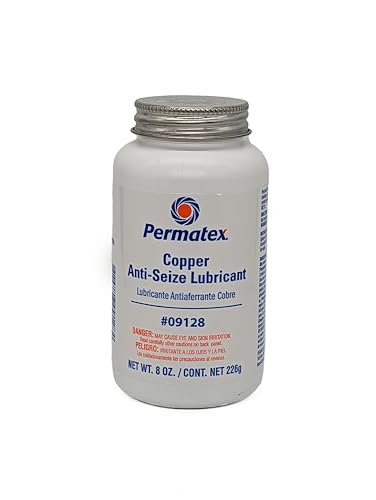
If you’re working on high-heat engine components or dealing with threaded fasteners in aluminum housings, Permatex 09128 Copper Anti-Seize Lubricant is your best defense against seized parts. I rely on it because it prevents galling, seizing, and corrosion in extreme conditions. It works continuously from -30°F to 1800°F, making it ideal for spark plug threads, exhaust manifolds, and oxygen sensors. The copper-based formula contains rust inhibitors and guarantees electrical conductivity. I use it on battery cables, fuel filter fittings, and thermostat housing bolts. It’s an 8 oz container with a brush applicator for precision. This lubricant stays stable under thermal cycling, unlike cheaper alternatives.
Best For: DIY mechanics and automotive professionals working with high-heat engine components and aluminum-threaded fasteners who need reliable anti-seize protection.
Pros:
- Withstands extreme temperatures from -30°F to 1800°F, making it ideal for exhaust systems and spark plugs
- Prevents seizing, galling, and corrosion while maintaining electrical conductivity
- Includes a brush applicator for precise, clean application on bolts and connections
Cons:
- Copper-based formula may not be suitable for use on certain alloys like aluminum-to-aluminum interfaces due to potential galvanic corrosion
- Can be overkill for low-temperature or non-critical applications compared to lighter greases
- Higher cost per ounce than standard thread lubricants
Permatex 80078 Anti-Seize Lubricant with Brush Top Bottle, 8 oz.

I rely on Permatex 80078 Anti-Seize Lubricant when working with metal assemblies exposed to extreme heat or corrosive environments. It contains a precise blend of aluminum, copper, and graphite for maximum protection. The formula resists galling, corrosion, and seizing under harsh conditions. I apply it easily using the built-in brush top. It works continuously from -80°F to 1600°F (-51°C to 871°C). That makes it ideal for exhaust systems, spark plugs, and brake components. The 8 oz bottle offers enough volume for multiple uses. It guarantees parts stay serviceable over time. I trust it for critical high-heat applications where failure isn’t an option.
Best For: Mechanics and automotive professionals working with high-heat or corrosion-prone metal components requiring reliable anti-seize protection.
Pros:
- Effective across an extreme temperature range from -80°F to 1600°F (-51°C to 871°C)
- Contains a proven blend of aluminum, copper, and graphite for superior lubrication and protection
- Integrated brush top enables precise, mess-free application
Cons:
- May be overkill for low-temperature or non-critical applications
- Copper content could pose issues in applications requiring copper-free formulations
- Graphite can be conductive, making it unsuitable for certain electrical components
Permatex 80078-12PK Anti-Seize Lubricant, 8 oz. (Pack of 12)
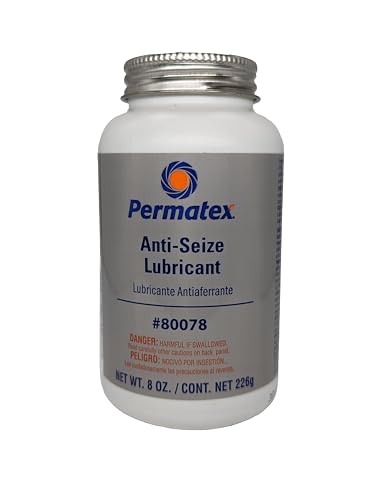
One pack handles a full shop’s worth of high-heat, corrosion-prone jobs-the Permatex 80078-12PK Anti-Seize Lubricant is best for professionals who demand reliability in extreme environments. I rely on its blend of aluminum, copper, and graphite to prevent galling, seizing, and corrosion. It resists salt, moisture, and temperatures from -60°F to 1600°F. That range makes it ideal for spark plugs, exhaust manifolds, and cylinder head bolts. Marine use? It holds up. Each 8 oz can performs like the last, and a 12-pack cuts downtime. I keep it on hand because consistent performance means fewer stuck parts and faster disassembly later. It’s not magic-just smart chemistry.
Best For: Professionals working in extreme environments who need reliable, high-temperature anti-seize performance across automotive, marine, and industrial applications.
Pros:
- Excellent resistance to salt, moisture, and corrosion, making it ideal for marine and high-humidity environments
- Wide operational temperature range (-60°F to 1600°F) ensures consistent performance in extreme heat and cold
- Prevents galling, seizing, and corrosion on critical components like spark plugs, exhaust manifolds, and cylinder head bolts
Cons:
- Contains copper, which may not be suitable for use on aluminum or other sensitive metals where galvanic corrosion could occur
- Graphite content may be undesirable in clean or precision applications due to potential for contamination
- Larger 12-pack may be excessive for DIY users or infrequent users, leading to potential shelf-life concerns
Loctite 501001 Silver-Grade Anti-Seize Lubricant, 1 lb, Brushtop

Loctite 501001 Silver-Grade Anti-Seize Lubricant is built for professionals who demand reliability in extreme conditions. I rely on this petroleum-based compound when heat and pressure push materials to their limits. It contains graphite and metallic flake for superior lubrication and corrosion resistance. The formula withstands temperatures up to 1600°F (871°C), staying stable without hardening or evaporating. I use it on high-heat assemblies like exhaust systems and industrial machinery because it prevents seizing, galling, and rust. Its 1 lb brushtop container offers precise application and long-term storage. It’s a proven solution for heavy-duty environments where failure isn’t an option-like welding or power generation.
Best For: Professionals working in high-temperature or heavy-duty industrial environments who need reliable anti-seize protection for critical mechanical assemblies.
Pros:
- Withstands extreme temperatures up to 1600°F (871°C) without evaporating or hardening
- Prevents seizing, galling, and corrosion in demanding applications like exhaust systems and industrial machinery
- Easy-to-apply brushtop design allows for precise, controlled application and convenient storage
Cons:
- Petroleum-based formula may not be suitable for applications requiring non-flammable or food-grade lubricants
- Contains metallic flakes that could pose issues in sensitive or finely machined components
- Strong odor and potential mess during application due to thick, greasy consistency
LOCTITE Automotive Silver Anti-Seize Lubricant (8 oz)

This anti-seize lubricant is ideal for automotive technicians and DIY enthusiasts who need reliable performance in high-heat and high-stress environments. I rely on LOCTITE Automotive Silver Anti-Seize Lubricant because it stays effective up to 1600°F. Its petroleum base is fortified with graphite and metallic flakes for superior protection. It resists evaporation and hardening in extreme temperatures, hot or cold. I use it on spark plug threads and electrical connections to prevent rust, corrosion, galling, and seizing. The 8 oz blow-top bottle (part number 501000) offers convenient, mess-free application.
Best For: Automotive technicians and DIY enthusiasts seeking reliable anti-seize protection in high-heat and high-stress environments.
Pros:
- Effective up to 1600°F, providing long-lasting performance in extreme temperature conditions
- Petroleum-based formula with graphite and metallic flakes offers superior resistance to rust, corrosion, galling, and seizing
- Convenient 8 oz blow-top bottle allows for mess-free, precise application
Cons:
- Petroleum-based composition may not be suitable for all environmental or material compatibility requirements
- Not recommended for use on aluminum threads due to risk of galvanic corrosion
- May attract dirt and debris over time if applied excessively
Keze Anti-Seize Lubricant Copper Grease (8 Oz)
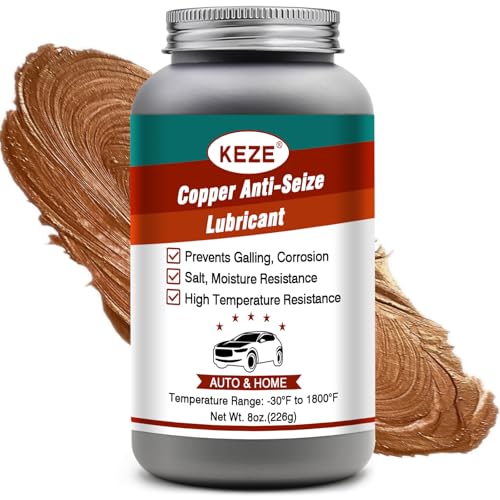
If you work with engines or machinery exposed to extreme heat, Keze Anti-Seize Lubricant Copper Grease (8 oz) is your best defense against seizing and corrosion. I rely on its copper powder and lithium composite blend for heavy-duty protection. It performs from -30°F to 1800°F, making it ideal for exhaust manifolds and spark plugs. The grease resists rust, salt, and moisture-perfect for marine or outdoor use. I’ve used it on brake caliper pins, lug nuts, and oxygen sensors with excellent results. It reduces friction, prevents galling, and extends component life. Assembly and disassembly become far easier.
Best For: Professionals and DIY enthusiasts working with automotive, marine, or industrial machinery exposed to high temperatures and corrosive environments.
Pros:
- Withstands extreme temperatures from -30°F to 1800°F, ideal for exhaust systems and engine components
- Prevents seizing, galling, and corrosion from moisture, salt, and rust
- Reduces friction and wear, enabling easier assembly and disassembly of parts
Cons:
- Contains petroleum distillates, which may not be suitable for all environmental or health preferences
- Copper-based formula may not be compatible with certain plastics or aluminum alloys
- Over-application can lead to messiness and potential interference in sensitive sensor installations
Copper Anti-Seize Compound for Spark Plugs

A copper anti-seize compound stands out for mechanics and technicians working on high-heat automotive applications, especially when securing spark plugs. I rely on its semi-synthetic grease base loaded with micro copper flakes for maximum protection. It prevents thread galling and corrosion up to 1800°F, maintaining integrity in extreme conditions. I apply a thin layer after cleaning threads to avoid excess buildup. It guarantees reliable electrical conductivity across spark plug connections. I use it on oxygen sensors, exhaust bolts, and wheel hubs too. It works down to -30°F, so it performs year-round. This compound is a trusted solution for demanding environments.
Best For: Mechanics and automotive technicians working on high-heat applications requiring reliable anti-seize protection and electrical conductivity.
Pros:
- Excellent performance in extreme temperatures ranging from -30°F to 1800°F
- Prevents thread galling, corrosion, and metal bonding in critical engine components
- Ensures strong electrical conductivity, ideal for spark plugs and sensor connections
Cons:
- Can be messy if overapplied, requiring careful cleanup of excess compound
- Copper-based formula may not be suitable for use on aluminum or dissimilar metals without risk of galvanic corrosion
- Not recommended for use where specified by manufacturer to use dry or specific torque values without anti-seize
Copper Anti-Seize Grease Lubricant 8 oz

One top-tier choice for mechanics tackling high-heat engine components is the 8 oz Copper Anti-Seize Grease Lubricant. I rely on this semi-synthetic formula because it contains a high concentration of micro copper flakes. These flakes deliver strong electrical conductivity and resist breakdown up to 1800°F. It works in extreme cold too, performing down to -30°F. I use it on spark plug threads, exhaust manifold bolts, and brake pad hardware. The grease prevents seizing, corrosion, and galling. I always clean the surface first, apply a thin, even layer, and wipe off excess. It guarantees smooth disassembly during maintenance.
Best For: Mechanics and automotive technicians working with high-temperature engine components requiring reliable anti-seize protection and electrical conductivity.
Pros:
- Excellent high-temperature resistance up to 1800°F, maintaining performance in extreme heat
- Contains micro copper flakes for superior electrical conductivity and anti-seize properties
- Versatile application on critical automotive parts like spark plugs, exhaust bolts, and brake hardware
Cons:
- Not ideal for plastic or non-metallic components due to its conductive metal content
- May require frequent reapplication in high-moisture environments despite corrosion resistance
- Over-application can lead to messy residues if excess is not wiped off after use
Park Tool ASC-1 Anti-Seize Compound

Park Tool’s ASC-1 Anti-Seize Compound is my go-to choice when I need reliable protection for high-stress bicycle components exposed to moisture, temperature swings, or road salts. It cuts friction in threaded and press-fit joints, making assembly smoother and disassembly easier. I rely on it for steel, aluminum, and titanium parts, where galvanic corrosion is a real concern. The compound seals connections, blocking moisture and contaminants. It holds up under extreme conditions, preventing rust and seizing. Packaged in a 4 oz tube, it’s compact but lasts through many applications. I find it essential for maintenance in harsh environments.
Best For: Cyclists and bike mechanics maintaining high-stress components in harsh environments where corrosion and seizing are major concerns.
Pros:
- Effectively reduces friction in threaded and press-fit connections for smoother assembly and disassembly
- Provides strong protection against corrosion and rust on steel, aluminum, and titanium parts
- Seals joints from moisture and contaminants, enhancing durability in extreme conditions
Cons:
- May be overkill for lightweight or indoor bike maintenance applications
- 4 oz tube, while long-lasting, may be excessive for casual users with infrequent needs
- Not specifically formulated for carbon fiber components, limiting versatility
Permatex 80208 Anti-Seize Lubricant with Brush Top Bottle, 16 oz., Silver

You’ll find the Permatex 80208 Anti-Seize Lubricant best suits demanding mechanical environments where high temperature and corrosion resistance are critical. I rely on its blend of aluminum, copper, and graphite to handle extreme conditions. It works continuously from -80°F to 1600°F (-51°C to 871°C). The 16 oz. bottle has a built-in brush for precise application. I use it on spark plugs, exhaust manifolds, and brake pins. It stops galling, seizing, and rust from salt or moisture. Metal parts assemble easier and disassemble later, even after long exposure. I trust it on bolts, hinges, chains, and gears.
Best For: Mechanics and automotive professionals working in high-temperature, corrosive environments requiring reliable anti-seize protection for metal components.
Pros:
- Excellent high-temperature resistance up to 1600°F (-51°C to 871°C) ensures performance in extreme conditions
- Contains a durable blend of aluminum, copper, and graphite to prevent galling, seizing, and corrosion
- Built-in brush applicator allows for precise and mess-free application on bolts, spark plugs, and joints
Cons:
- Silver color may not be ideal for applications requiring cosmetic discretion
- Contains copper, making it unsuitable for use on aluminum or magnesium components at high temperatures
- Larger 16 oz. size may be more than needed for small or occasional DIY projects
Factors to Consider When Choosing an Anti-Seize
You need to pick the right anti-seize for your job, or you could end up with seized bolts or corrosion damage. Consider temperature range first-some formulas work up to 1800°F, while others fail above 500°F-and match the lubricant to your metal types, since using copper-based anti-seize on stainless steel can cause galvanic issues. Also check corrosion resistance, electrical conductivity needs, and how easy it is to apply, whether by brush, spray, or paste.
Temperature Range
How well does your anti-seize hold up under extreme heat or cold? It must perform across a range of -80°F to 1800°F, depending on the formulation. Most standard compounds work reliably up to 1600°F, but beyond that, you need copper-based or specialty products to keep from breaking down. High-temperature stability prevents oxidation, evaporation, and carbonization over time. Under extreme heat, you can’t afford lubricity loss-it stops parts from galling during thermal cycling. In freezing environments, staying flexible below -80°F is critical. A good anti-seize won’t crack or harden when temps drop. Temperature resilience guarantees protection stays intact whether equipment heats up fast or sits in deep freeze. Your anti-seize must handle constant swings without degrading. Match your choice to your operational extremes-because when heat surges or cold bites, performance can’t afford to lag.
Material Compatibility
A compatible anti-seize compound guarantees long-term integrity of metal assemblies by preventing chemical reactions that lead to corrosion, galling, or seizing. You must match the compound to your base metals. Avoid copper-based formulas with aluminum-they can diffuse at high temperatures and cause thread seizure. Use nickel or aluminum-based alternatives instead. Never use graphite-containing anti-seizes where electrical isolation matters; their conductivity promotes galvanic corrosion, especially in wet or electrolyte-rich environments. When joining dissimilar metals exposed to moisture, pick a corrosion-inhibiting formula to block electrochemical degradation. For sensitive alloys like austenitic stainless steel, confirm the anti-seize remains chemically stable under heat, preventing oxidation or hydrogen embrittlement. Always verify compatibility with OEM specifications-some lubricants accelerate wear instead of preventing it. Choosing right guarantees reliability, not just in lab conditions, but in real-world service where failure isn’t an option.
Corrosion Resistance
Most anti-seize compounds rely on metallic fillers like copper, aluminum, or graphite to form a durable barrier against corrosive elements. These materials actively block moisture, salt, and chemicals from reaching metal surfaces. You’ll find that high-quality formulations resist rust even in damp or humid conditions, maintaining performance over months or years. The protective layer prevents oxidation and shields threads from environmental contaminants. In marine or salt-spray environments, specialized anti-seize lubricants offer enhanced resistance, drastically slowing deterioration. They also stop electrolytic reactions between dissimilar metals, reducing galvanic corrosion in fastened joints. You need this protection in critical applications where failure isn’t an option. Look for products tested under ASTM B117 salt spray standards for proven results. A reliable anti-seize keeps connections intact, prevents seizing, and guarantees easier disassembly later-no guessing, just proven defense.
Electrical Conductivity
Electrical conductivity in anti-seize lubricants depends on the compound’s metallic content. You’ll find copper- and silver-based formulas conduct electricity effectively, making them ideal for battery terminals, sensor mounts, and grounding points. These metal-rich compounds maintain continuous current flow by reducing resistance at threaded interfaces. Microscopic metallic flakes bridge gaps between surfaces, enhancing electron transfer. In critical circuits, conductive anti-seize guarantees reliable connections while preventing corrosion. But you must apply it sparingly-excess material can bridge unintended paths and cause shorts. Conversely, ceramic or graphite-free versions insulate rather than conduct, disrupting signal or power transmission. Using non-conductive anti-seize on electrical joints risks intermittent connections or complete circuit failure. Always match the lubricant’s conductivity to the application’s electrical demands. Choose metallic formulations when current transfer is essential, and avoid them near sensitive electronics unless precision-applied.
Application Ease
Don’t overlook how easily you can apply anti-seize-it directly affects performance and reliability. You need a product that spreads smoothly without dripping or clumping. Choose one with a brush-top applicator for precision in tight spaces. It lets you target threads and fasteners accurately. Apply a thin, even layer-about 0.002 to 0.005 inches thick-for best results. Too much attracts dirt and may interfere with torque specs. Before applying, clean and degrease surfaces thoroughly; oils or debris reduce adhesion. Use a solvent like isopropyl alcohol for ideal prep. Semi-synthetic base compounds spread easier and stay consistent from -40°F to 1800°F. They resist hardening or splitting under thermal stress. Squeeze tubes work well for frequent, small-scale use. Larger containers suit industrial applications. Pick the package style that matches your usage. Easy application saves time and improves protection.
Lubricant Composition
A high-performance anti-seize lubricant relies on its composition to deliver reliable protection under extreme conditions. You need metallic powders like copper, aluminum, and graphite blended into the base to prevent seizing and galling. Graphite provides dry film lubrication, reducing friction even in dynamic joints exposed to temperatures from -100°F to over 750°F. Copper conducts heat efficiently and remains stable up to 1800°F, making it ideal for exhaust systems and high-heat applications. Aluminum enhances corrosion resistance, especially in marine or chemical environments, by forming a protective oxide layer. The base often includes lithium or similar thickeners to boost adhesion and prevent slippage on vertical or threaded surfaces. You get consistent performance because the lubricant stays in place during assembly and service. Choose the right mix based on temperature, environment, and metal type to guarantee long-term protection.
Frequently Asked Questions
Can Anti-Seize Lubricants Be Used on Electrical Connections?
No, you shouldn’t use standard anti-seize lubricants on electrical connections. They’re typically non-conductive and can disrupt signal or power transmission. Instead, employ dielectric grease-specifically formulated for electrical applications. It repels moisture, prevents corrosion, and maintains conductivity without interfering with connections. Common anti-seize compounds contain metal particles like copper or nickel, which may cause short circuits or contaminate sensitive components in electrical systems.
Is Copper-Based Anti-Seize Safe for Aluminum Surfaces?
No, you shouldn’t use copper-based anti-seize on aluminum surfaces. The copper can react with aluminum through galvanic corrosion, especially in moist or high-temperature environments. This electrochemical reaction degrades the aluminum over time. Instead, you should use nickel-based or aluminum-compatible anti-seize compounds. These contain inert fillers that prevent metal-to-metal contact without risking corrosion. Always check manufacturer specs for metal compatibility.
How Long Does Anti-Seize Last Once Applied?
Anti-seize lasts indefinitely once applied, provided the joint remains undisturbed and temperatures stay within limits. You’ll get decades of protection under stable conditions. Its base-whether copper, nickel, or ceramic-doesn’t evaporate like grease. Instead, it bonds to threads and fills microscopic gaps. High-quality formulations withstand 1,800°F and resist oxidation. Reapplication is only needed during disassembly or after exposure to extreme environmental washout.
Can Anti-Seize Be Used on Oxygen Sensors?
Yes, you can use anti-seize on oxygen sensors, but only if it’s copper-based and free of metallic particles that conduct electricity. Applying it incorrectly risks contaminating the sensor’s tip. You apply a small dab to the sensor’s threads, never the probe. Most manufacturers allow this to prevent thread galling in stainless steel sensors. Over-greasing causes sensor malfunction. Always check your vehicle’s service manual-some O2 sensors require no lubrication at all.
Is Anti-Seize Flammable When Dry?
You’re right to worry-yes, anti-seize can still ignite when dry, though it’s less flammable than in liquid form. Most contain petroleum-based carriers that burn at high temps. Once cured, the metal-based paste (like copper or nickel) resists fire better. Never use near open flames. Check SDS sheets: flash points vary, but many sit around 200°F. Ventilation is key during application. Always follow safety guidelines-better safe than sorry.