Best Car Jacks Every Driver Should Own (And Trust)
You need a reliable car jack that supports your vehicle’s weight safely and efficiently. The DNA Motoring 2-Ton Hydraulic Floor Jack lifts 4,000 lbs with a 5.1″ minimum height, ideal for low-clearance cars. For heavier loads, the 3-Ton Racing Floor Jack offers dual-piston speed and 6,600-lb capacity. Electric power comes with the VEVOR 5-Ton model-11,023 lbs capacity, 12V operation, and built-in tools. Jack stands like Amazon Basics 6,000-lb pair add critical safety. Each model balances strength, lift range, and durability for trusted performance in real-world conditions-discover which ones match your driving needs and garage setup.
We are supported by our audience. When you purchase through links on our site, we may earn an affiliate commission, at no extra cost for you. Learn more. Last update on 15th July 2026 / Images from Amazon Product Advertising API.
Notable Insights
- A 2-3 ton hydraulic floor jack with low-profile design fits most vehicles and ensures reliable lifting.
- Built-in safety valves and overload protection prevent failure under heavy loads.
- Jack stands rated for 6,000 lbs are essential for secure vehicle support during maintenance.
- Scissor jacks are portable, manual options ideal for emergency roadside tire changes.
- Electric jacks offer fast, powered lifting but require a functional 12V power source.
DNA Motoring 2-Ton Hydraulic Floor Jack
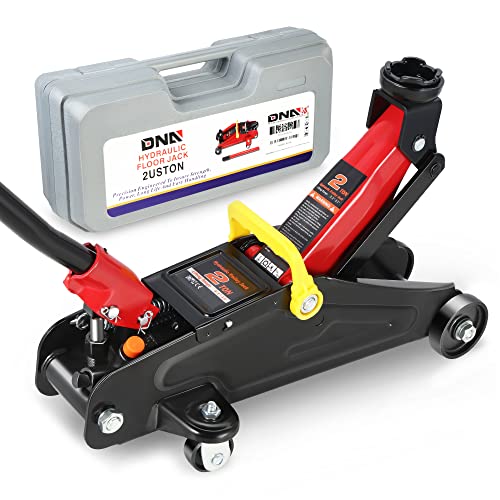
If you’re working with compact cars, sedans, or small SUVs, the DNA Motoring 2-Ton Hydraulic Floor Jack is my top pick for reliable, precision lifting under low-clearance vehicles. It lifts up to 4,000 pounds, with a minimum height of 5.1 inches and a maximum lift of 13 inches. I use it only for vertical lifting-never sideways or downward. Built-in overload protection prevents damage or injury. The heavy-duty steel frame stays rigid under load. A low-profile design slips under tight gaps. Swivel casters let me roll it smoothly into position. I always pair it with jack stands.
Best For: DIY mechanics and automotive enthusiasts working on compact cars, sedans, or small SUVs that require reliable, low-profile lifting up to 4,000 lbs.
Pros:
- 2-ton capacity with a low 5.1-inch minimum lift height for easy access under low-clearance vehicles
- Heavy-duty steel construction and built-in overload protection ensure safety and durability
- Swivel casters allow smooth mobility and precise positioning in tight garage spaces
Cons:
- Not suitable for pickup trucks, large trucks, or oversized SUVs due to capacity and height limitations
- Cannot be used for side or downward force applications, limiting versatility
- Not intended for prolonged vehicle support-requires jack stands for safety during maintenance
3 Ton Heavy-Duty Hydraulic Floor Jack

I rely on the 3 Ton Heavy-Duty Hydraulic Floor Jack when I need reliable lifting power for cars, trucks, and SUVs in my garage or workshop. It lifts up to 6,600 pounds, with a lift range from 5.5 to 18.5 inches-ideal for most vehicles. Its single piston pump delivers fast, smooth lifting with minimal effort. Built with rugged steel, it resists wear and supports heavy loads safely. Built-in overload protection stops damage from overuse. The 360° swivel saddle protects your vehicle’s frame. Dual rear wheels guarantee easy positioning. It meets ANSI/ASME PASE safety standards. Backed by a 12-month warranty and 24/7 support.
Best For: DIY mechanics, auto enthusiasts, and professional garages needing a reliable, heavy-duty hydraulic floor jack for lifting cars, trucks, and SUVs.
Pros:
- High 3-ton (6,600 lbs) capacity with a wide lift range (5.5″ to 18.5″) suitable for most vehicles
- Durable steel construction with overload protection and 360° swivel saddle for safety and vehicle protection
- Smooth mobility with dual rear wheels and quick lift operation via single piston pump
Cons:
- Lift range may be insufficient for very low or very high ground clearance vehicles
- Hydraulic jack requires periodic maintenance to prevent fluid leaks or pressure loss
- Not designed for prolonged suspension of vehicles-should always be used with jack stands
3 Ton Racing Floor Jack with Dual Pistons
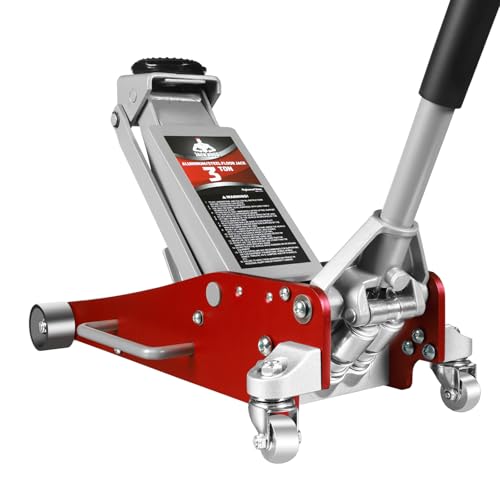
The Ton Racing Floor Jack with Dual Pistons stands as a precision tool built for car enthusiasts and DIY mechanics who demand reliability and performance when lifting lowered or ground-hugging vehicles. It supports up to 3 tons (6,600 lbs) and lifts from 3-15/16 inches to 18-5/13 inches, ideal for sedans, SUVs, and mini buses. Its low profile fits under tight clearances. The dual-piston hydraulic system reduces pump effort and speeds lift time. I find the aluminum billet and steel frame durable. Steel casters and swivel wheels aid maneuverability. It meets ANSI/ASME PASE standards. It includes a rubber saddle, two-piece handle, and carries a 1-year warranty.
Best For: Car enthusiasts and DIY mechanics working with lowered or low-clearance vehicles who need a durable, high-performance floor jack.
Pros:
- Dual-piston hydraulic system enables quick lifting with minimal effort
- Low profile design with 3-15/16 inch minimum height fits under vehicles with tight ground clearance
- Constructed with aluminum billet and welded steel for durability, featuring swivel wheels for smooth maneuverability
Cons:
- Maximum lift height of 18-5/16 inches may be limiting for taller vehicles
- 3-ton capacity may not suffice for heavier trucks or large SUVs
- Slight inaccuracy in listed max lift range (text states 18-5/13 inches, which is incorrect fraction)
Tonda 2 Ton Hydraulic Floor Jack
You’ll find the Tonda 2 Ton Hydraulic Floor Jack best suits DIYers and home mechanics who need reliable lifting for everyday repairs. It handles up to 3,800 lbs, making it ideal for most cars and light trucks. The jack lifts from 4.9 inches to 11.8 inches, fitting under low-clearance vehicles with ease. A built-in safety bypass system and overload prevention valve stop accidental overextension. Dual steel casters and two 360-degree swivel wheels let me roll it smoothly across garage floors. It’s built from heavy-duty steel with a rust-resistant coating for lasting use. A lightweight frame and integrated handle make transport and storage simple.
Best For: DIYers and home mechanics who need a reliable, portable, and durable floor jack for everyday vehicle maintenance and repairs.
Pros:
- High 3,800 lb capacity suitable for cars and light trucks
- Smooth mobility with dual steel casters and 360-degree swivel wheels
- Durable heavy-duty steel build with rust-resistant finish
Cons:
- Limited maximum lift height may not suit lifted vehicles or trucks
- Hydraulic performance may slow over time with heavy use
- No included jack stands, requiring separate safety investment
Amazon Basics Steel Jack Stands 6,000 lb

A dependable backbone for DIY mechanics and home garages, the Amazon Basics Steel Jack Stands 6,000 lb deliver reliable support during under-vehicle work. I trust these stands with their 三大职业 (2.7 metric ton) capacity, built to meet ASME PASE-2014 safety standards. Their self-locking ratchet mechanism eliminates the need for a separate locking pin, securing the stand at your chosen height without tools. Constructed from heavy-duty steel, they resist deformation under load and feature a rustproof coating for long-term durability. Clear, easy-to-read weight indicators guarantee proper usage. I rely on their stability when working beneath my vehicle. They’re backed by a 1-year Amazon Basics warranty for added confidence.
Best For: DIY mechanics and home garage enthusiasts who need reliable, high-capacity jack stands for safe vehicle maintenance.
Pros:
- Meets ASME PASE-2014 safety standards with a self-locking ratchet mechanism for secure, tool-free height adjustment
- Constructed from durable steel with a rustproof coating for long-term resilience in various environments
- Features clear, easy-to-read weight capacity indicators and comes with a 1-year Amazon Basics warranty for added assurance
Cons:
- At 33 pounds per pair, the set may be heavier to transport compared to lighter-duty alternatives
- Maximum height extension may be limiting for larger trucks or SUVs with high ground clearance
- No included carrying case, which could make storage and transport less convenient
Scissor Car Jack 3 Ton with Lug Wrench

This scissor car jack setup is perfect for drivers who need a reliable, all-in-one solution for roadside emergencies. I trust it for lifts up to 3 tons (6,610 lbs), with a range from 4.33 in (11 cm) to 15.74 in (40 cm). It fits low sedans and high SUVs. The kit includes a 3T scissor jack, ratchet wrench, 4-way lug wrench (17/19mm, 21/23mm), gloves, tire gauge, and storage bag. All parts are durable, corrosion-resistant, and built for extreme weather. Ergonomic grips guarantee better control. It’s universal for cars, SUVs, and MPVs. I keep mine in the trunk-it’s compact, ready, and always dependable.
Best For: Drivers seeking a reliable, all-in-one roadside tire change kit that handles a wide range of vehicles from low-clearance sedans to high-body SUVs.
Pros:
- Comprehensive kit includes scissor jack, lug wrench, ratchet, gloves, tire gauge, and storage bag for complete emergency readiness
- Durable, corrosion-resistant construction performs well in extreme weather and offers long-term reliability
- Universal fit and wide lift range (4.33 in to 15.74 in) accommodate cars, SUVs, and MPVs
Cons:
- Scissor jack requires manual effort, which may be strenuous for some users
- Limited to 3-ton capacity, making it unsuitable for heavy-duty trucks or vans
- Lug wrench sizes may not fit all vehicle models, especially those with non-standard lug nuts
DNA Motoring 2-Ton Hydraulic Floor Jack (TOOLS-00474)

When precision and reliability matter in a compact lifting solution, the DNA Motoring 2-Ton Hydraulic Floor Jack (TOOLS-00474) stands out for passenger cars and light-duty applications. It lifts up to 4,000 lbs, with a 5.1-inch minimum height and 13-inch maximum lift. I use it vertically only-never for side lifting. Its low profile fits tight clearances. Heavy-duty steel guarantees stability under load. Swivel casters let me position it smoothly. The built-in safety valve prevents over-pressurization. I always pair it with jack stands. The large saddle protects my car’s frame. DNA Tools engineered it with proven durability. It’s ideal for garage or industrial use.
Best For: DIY enthusiasts and professional mechanics working on passenger cars and light-duty vehicles requiring a reliable, compact, and stable 2-ton floor jack.
Pros:
- Heavy-duty steel construction ensures durability and stability under load
- Low-profile design with 5.1″ minimum height fits tight clearances under vehicles
- Swivel casters allow smooth maneuverability and precise positioning
Cons:
- Not suitable for heavy-duty trucks, SUVs, or vehicles over 2 tons
- Must be used with jack stands; not to be relied on as a standalone support
- Limited maximum lift height of 13″ restricts use on vehicles with higher ground clearance
BIG RED T820014S 1.5-Ton Hydraulic Floor Jack
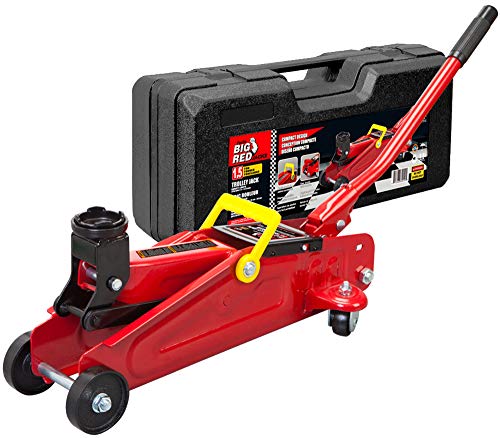
You need reliability and precision if you’re working on low-profile vehicles or tight undercarriage spaces-this jack delivers both. I’ve used the BIG RED T820014S, a 1.5-ton (3,000 lb) hydraulic floor jack, on compact sedans and sports cars where clearance is limited. Its 5-5/16-inch minimum lift height fits where larger jacks can’t. The maximum lift reaches 13 inches, enough for most service tasks. Built from heavy-duty steel with an industrial luster finish, it resists wear. A safety bypass system prevents overloading. Two large steel casters and two 360-degree swivel casters guarantee smooth movement. It includes a blow-mold plastic case for easy storage and transport.
Best For: DIY mechanics and automotive enthusiasts working on low-profile or compact vehicles requiring reliable, precision lifting in tight spaces.
Pros:
- Low 5-5/16-inch minimum lift height ideal for low-clearance vehicles
- Durable heavy-duty steel construction with an industrial luster finish for long-term use
- Smooth maneuverability with two large steel and two 360-degree swivel casters plus a safety bypass system
Cons:
- 1.5-ton (3,000 lb) capacity may be insufficient for larger trucks or SUVs
- Limited maximum lift height of 13 inches, restricting use for high-lift jobs
- Blow-mold case offers portability but may lack space for additional accessories
DNA Motoring 1.5 Ton Scissor Jack (TOOLS-00282)

A reliable lifeline for everyday drivers and DIY mechanics, the DNA Motoring 1.5 Ton Scissor Jack (TOOLS-00282) delivers consistent performance when changing tires or performing under-vehicle maintenance. It handles up to 3,306 lbs, lifting from 4 inches to 15.2 inches high. The working range sits between 10 and 15 inches, ideal for most passenger vehicles. Its lengthened screw lever and ratchet wrench cut effort and boost speed. Dual-side rotation doubles lift rate versus single-side jacks. Built with thickened steel base and solid shaft, it stays stable on pavement. The 360° swivel head fits most cars. I’ve used it on sedans, SUVs, and hatchbacks-it holds strong.
Best For: Everyday drivers and DIY mechanics needing a durable, fast-lifting scissor jack for routine tire changes and under-vehicle maintenance on passenger vehicles.
Pros:
- Dual-side rotation and lengthened lever enable faster, easier lifting with reduced effort
- Sturdy steel construction with thickened base and solid shaft ensures stability and durability
- 360° swivel head and wide 1.5-ton capacity provide universal fit for sedans, SUVs, and hatchbacks
Cons:
- Limited lifting range (4–15.2 inches) may not suit vehicles with higher ground clearance
- Working height range (10–15 inches) restricts use for low-profile or lowered vehicles
- Manual operation requires physical effort despite labor-saving design
VEVOR Electric Car Jack 5 Ton

The VEVOR Electric Car Jack 5 Ton stands out for drivers who prioritize speed and convenience in emergency tire changes, especially when manual effort is a concern. It lifts up to 11,023 lbs with a 6.1–17.7-inch range, stopping automatically at max height. I plug it into my 12V port or battery-its 13-foot cord reaches any wheel. The electric hydraulic system raises my SUV in about 2 minutes. It includes an impact wrench with 450 N·m torque and dual sleeves for 17/19 mm and 21/23 mm lug nuts. A built-in inflator checks pressure and refills tires. TUV and UL-certified fuses, LED lighting, and onboard storage complete the design.
Best For: Drivers seeking a fast, all-in-one electric solution for tire changes with minimal physical effort, especially SUV and truck owners.
Pros:
- Fully electric 5-ton jack lifts vehicles in about 2 minutes with automatic stop at max height
- Integrated impact wrench, tire inflator, and LED lighting provide comprehensive roadside assistance
- Powers via 12V outlet or battery with a 13-foot cord for flexible access to all wheels
Cons:
- Requires continuous power source, limiting use in battery-dead situations
- Heavy and bulky compared to manual jacks, reducing portability
- Impact wrench requires holding power button, which can be inconvenient during use
Factors to Consider When Choosing a Car Jack
You need a jack that matches your vehicle’s weight and design. Look at lifting capacity first-most sedans need at least 3 tons, while trucks may require 5 tons or more-and confirm compatibility with your car’s frame, especially if it has unique jack points. Portability, build materials like steel alloy, and safety features such as overload valves and non-slip pads also determine reliability and ease of use.
Lifting Capacity Needs
Every pound of your vehicle’s weight matters when selecting a jack-choose one rated at least 25% above your vehicle’s gross weight to guarantee safe, reliable lifting. That buffer prevents hydraulic failure and secures stability under load. A 3-ton (6,000 lb) jack handles most sedans and compact SUVs, but larger trucks or full-size SUVs often need a 5-ton (10,000 lb) model. Always check your vehicle’s curb weight and include passengers, cargo, and fuel in your total load estimate. Overloading a jack risks equipment damage or injury. Never assume capacity by vehicle size-verify specs precisely. Jacks with higher lift ranges work better for high-clearance vehicles, but capacity and lift height must both match your needs. Exceeding weight limits stresses internal seals and pistons, compromising performance. Choose wisely-your safety depends on accurate load matching.
Vehicle Compatibility
When your vehicle sits just inches above the pavement, even a small mismatch in jack specifications can lead to a failed lift or safety hazard. You must match the jack’s minimum lift height to your vehicle’s ground clearance-typically 6 to 8 inches for sedans, over 10 for SUVs. If the jack can’t fit, it can’t lift. Make certain the jack’s maximum lift height exceeds what you need for tire removal or suspension work-usually 18+ inches. The saddle design matters: a wide, rubber-padded contact point prevents slippage and protects your frame or pinch welds. You should verify the lifting range accommodates all vehicles you’ll service. A jack with 5-inch minimum and 20-inch maximum lift covers most cars, trucks, and SUVs. Always confirm the footprint is stable under your vehicle’s lift points. Compatibility isn’t optional-it’s critical.
Portability And Weight
A compact, lightweight jack simplifies storage and transport without sacrificing lifting performance. You’ll want models made from aluminum or reinforced steel-they cut weight while maintaining strength. Most weigh between 15 and 30 pounds, making them easy to lift and carry. Integrated handles and folding designs shrink the storage footprint, fitting neatly in tight trunk spaces. Swivel wheels-2 to 4 casters-let you move the jack smoothly across garage floors or uneven pavement. Look for a low minimum lift height of 3.5 to 5.5 inches to fit under modern, low-clearance vehicles. Electric jacks offer convenience with built-in cords and tool storage, but they’re heavier, often exceeding 40 pounds, which can limit portability. Prioritize modular components and universal wheels for quick setup and repositioning. Portability means getting where you need to be-fast, light, and ready.
Build Quality Materials
You’ve considered how easily a jack moves and fits into your vehicle, but the materials defining its strength matter just as much. High-quality jacks use heavy-duty steel or reinforced aluminum to resist deformation under load. These materials undergo tensile and fatigue testing to meet safety standards. Welded steel frames boost structural integrity, supporting higher weight capacities reliably. Look for thickened steel plates in critical areas like the saddle and lifting arms-they handle stress better and reduce failure risk. Rust-resistant coatings protect metal parts, especially in wet or humid conditions, prolonging service life. Reinforced aluminum offers a lighter alternative without sacrificing durability, ideal for frequent use. Each component’s construction is engineered for consistent performance over time. Strong materials mean less wear, even after repeated lifts. You’re not just buying a tool-you’re investing in long-term reliability under real-world conditions. Choose build quality that matches your vehicle’s demands.
Safety Mechanisms
Because safety hinges on both design and fail-safes, choosing a car jack with integrated safety mechanisms is critical. Built-in overload protection, like safety bypass valves, stops hydraulic pressure from rising if you exceed the jack’s rated capacity, preventing failure. You’ll stay safer with a self-locking ratchet mechanism-it holds the lift position without extra pins or locks, so there’s no sudden drop. A 360° rotatable saddle aligns smoothly with your vehicle’s lift points, cutting slippage risk and boosting stability. Automatic stop features halt lifting at maximum height, avoiding mechanical overextension under full load. Always pick jacks meeting ANSI/ASME PASE or TUV/UL standards-they’ve passed strict performance and safety tests. These features work together like a safety net, ensuring reliability when you’re under the vehicle. Don’t skip certified gear-it’s proven to handle real-world stress.
Ease Of Operation
Smooth operation saves time and reduces physical strain, especially during frequent or emergency use. Hydraulic jacks with dual-piston pump systems cut pumping effort by up to 50% and lift faster than single-piston models. You’ll raise heavy loads with fewer strokes, improving efficiency. Electric jacks take minimal effort-just press a button to lift your vehicle to full height in about two minutes. They’re ideal when speed and convenience matter. Scissor jacks require manual ratcheting, but deploy quickly and work reliably in roadside emergencies. Their simple mechanism rarely fails. Low-profile designs with minimum lift heights under 4 inches fit vehicles with limited ground clearance, ensuring you can position and operate the jack where others can’t. Swivel casters or 360-degree wheels let you maneuver smoothly into place, reducing drag and misalignment. You’ll position accurately with less effort.
Storage Requirements
Space is a hard currency when storing a car jack, and every inch counts. Compact models range from 12 to 20 inches in length, fitting neatly in tight trunks or small garages. Low-profile jacks with collapsed heights under 6 inches save vertical space, ideal for shallow storage areas. Scissor and some electric jacks fold or break down, reducing footprint compared to bulky hydraulic floor jacks. Weight varies from 15 to 60 pounds-lighter units are easier to lift onto shelves or stow in elevated spots. Heavier jacks may require floor storage but offer greater lift capacity. Built-in handles or integrated cases let you move and organize your jack efficiently. Choose a design that balances size, weight, and portability to match your storage environment. Smart engineering in foldable and modular units maximizes space without sacrificing performance.
Power Source Options
When you’re choosing a car jack, the power source directly shapes how fast, easy, and practical the lift will be. Hydraulic jacks use hand-powered pumps to generate lifting force, requiring physical effort but delivering reliable performance without electricity or compressed air. You’ll need to pump steadily, but they work consistently in any condition. Electric jacks connect to your vehicle’s 12V socket or battery, lifting your car automatically in under two minutes-ideal for quick roadside use. Pneumatic jacks rely on an external air compressor, making them efficient for workshops with existing air systems but impractical for most drivers. Mechanical scissor jacks use a screw or rack-and-pinion mechanism turned by a hand crank. They’re slow but dependable, requiring no fluid or power. Your choice affects speed, effort, and where you can use the jack effectively.
Frequently Asked Questions
Can I Use a Car Jack on Uneven Ground?
You shouldn’t use a car jack on uneven ground-it’s unsafe and risks vehicle collapse. The jack needs a level, solid surface to distribute load evenly. On slopes or soft terrain, pressure shifts can bend components or destabilize the car. Use wheel chocks and park on pavement whenever possible. If you must jack on a slight incline, correct the angle with a proper base pad rated for your vehicle’s weight to maintain stability and prevent tipping.
How Often Should I Maintain My Hydraulic Floor Jack?
You should inspect and maintain your hydraulic floor jack every three to six months. Check for fluid levels, leaks, and worn seals regularly. Replace hydraulic oil annually or after heavy use to prevent contamination. Clean the pump mechanism and guarantee the release valve operates smoothly. Store it indoors, dry and upright, to avoid corrosion. Lubricate moving parts quarterly. These steps preserve lift capacity, typically rated 2–3 tons, and extend service life under repeated 8,000–10,000 psi pressure cycles.
Are Electric Car Jacks Safe for Daily Use?
Yes, electric car jacks are safe for daily use if you follow manufacturer guidelines. They feature overload protection and thermal cutoffs to prevent motor damage. Most models lift 6,000–10,000 lbs at 2–3 inches per second, using 12V systems. Their precision circuits guarantee controlled operation, unlike manual jacks. Always inspect wiring and mounting before each use.
Do Scissor Jacks Work With Low-Profile Vehicles?
Yes, scissor jacks work with low-profile vehicles if ground clearance exceeds 4 inches. Most standard scissor jacks require at least 6 inches to fully extend, limiting use on extremely low cars. Low-profile versions exist-some with collapsed heights under 4 inches and lift ranges up to 16 inches. Always check your vehicle’s lift points and jack mounting clearance. Using an incompatible jack risks instability, frame damage, or failure during operation. Match jack specs precisely to your car’s clearance.
Can Jack Stands Replace a Hydraulic Floor Jack?
No, jack stands can’t replace a hydraulic floor jack-you need both. A floor jack lifts the vehicle; jack stands support it safely. Jack stands typically have 12” to 18” height ranges and hold 3 to 6 tons, but they don’t lift. Using only stands without lifting first is impossible. Always use a floor jack to raise the car, then secure it with stands. Never rely on stands alone-they’re stabilizers, not lifting tools. Safety demands both.