Best Car Multimeters Every Driver Should Trust
You need a multimeter that handles your car’s electrical system with precision and safety. Choose a model with at least 600V AC/DC voltage measurement, 10A DC current capacity, and True RMS for accurate readings on modern vehicle electronics. Look for CAT III 600V safety ratings, double ceramic fuses, and 10 MΩ input impedance to protect both you and sensitive circuits. Backlit LCDs and Data Hold simplify use in dark engine bays. Higher 6000-count resolution gives finer detail than basic 2000-count meters. Tools like the KAIWEETS TRMS HT118A or AstroAI TRMS 6000 offer advanced features such as capacitance, frequency, and temperature testing for full diagnostic capability. Top models include non-contact voltage detection and durable, insulated builds to withstand shop and roadside conditions. The best ones balance range, accuracy, and ruggedness-exactly what you’ll find in the top picks below.
We are supported by our audience. When you purchase through links on our site, we may earn an affiliate commission, at no extra cost for you. Learn more. Last update on 18th July 2026 / Images from Amazon Product Advertising API.
Notable Insights
- Choose a multimeter with at least 2000 counts and auto-ranging for accurate, easy readings.
- Ensure True RMS capability to measure non-linear signals from modern vehicle electronics reliably.
- Look for CAT III safety rating and double fuse protection for durability and electrical safety.
- Verify DC current measurement up to 10A and continuity testing for battery and starter diagnostics.
- Opt for backlit display and Data Hold to simplify use in low-light or hands-free conditions.
AstroAI Digital Multimeter 2000 Counts Blue
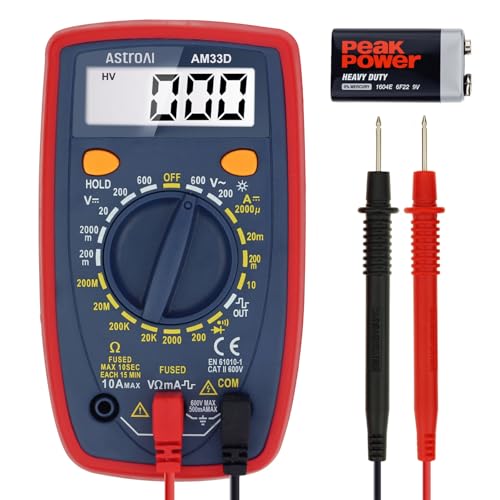
If you’re troubleshooting car electronics or testing a vehicle’s charging system, the AstroAI Digital Multimeter is one of the best choices for accurate, reliable results. I use it to measure AC/DC voltage, DC current, resistance, continuity, and diodes. It samples readings twice per second and displays up to 1999 counts on a 0.6” LCD. It can’t measure AC current or AC voltage below 100mV. The 3 ½ digit display shows positive and negative polarity clearly. A backlight helps me read results in dark engine bays. Data Hold freezes readings, and Auto Shutoff saves power. The continuity buzzer beeps when circuits are complete. Double fuses and an anti-burn design protect against surges. A silicone cover shields me from shocks and drops. It includes test leads, a battery, and a manual. I plug leads fully into correct ports and set the rotary dial precisely. Low battery indication warns me when to replace it. California-based support answers questions within 24 hours. I trust it for testing batteries, fuses, outlets, and automotive circuits.
Best For: DIYers and automotive enthusiasts who need a reliable, easy-to-use multimeter for testing car electronics, batteries, and household electrical systems.
Pros:
- Accurately measures AC/DC voltage, DC current, resistance, continuity, and diodes with a clear backlit LCD for low-light conditions
- Durable design with silicone cover, double fuses, and anti-burn protection enhances safety and longevity
- Includes useful features like Data Hold, Auto Shutoff, continuity buzzer, and responsive California-based technical support
Cons:
- Cannot measure AC current or AC voltage below 100mV, limiting low-voltage diagnostics
- Maximum display limited to 1999 counts (3 ½ digits), which may not suit advanced precision tasks
- Requires careful plug insertion and correct rotary switch settings to ensure accurate operation
Klein Tools MM325 Digital Multimeter
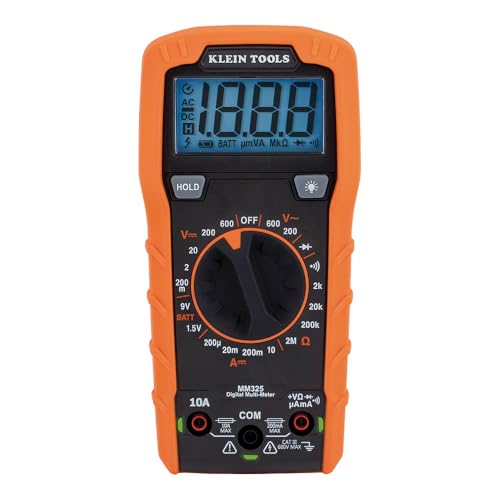
The Klein Tools MM325 Digital Multimeter is my top pick for automotive technicians and DIYers who need a rugged, accurate tool for diagnosing car electrical systems. It measures AC/DC voltage up to 600V, 10A DC current, and resistance to 2MΩ. The backlit LCD guarantees clear readings in dark engine bays. LED indicators confirm correct probe placement, reducing errors. I appreciate the built-in battery test mode for quick voltage checks. It also handles diode, continuity, and resistance tests reliably. The kickstand and rear lead holders allow hands-free use. It survives 6.6-foot drops. Includes CAT III/CAT IV-rated leads, AAA batteries, and instructions.
Best For: Automotive technicians and DIYers who need a durable, accurate multimeter for diagnosing electrical issues in vehicles and home systems.
Pros:
- Measures AC/DC voltage up to 600V, 10A DC current, and resistance up to 2MΩ with reliable diode, continuity, and battery testing
- Backlit LCD and LED probe placement indicators ensure clear, safe readings in low-light environments
- Rugged design survives 6.6-foot drops and includes test lead holders, kickstand, and CAT III/CAT IV-rated leads for convenience and safety
Cons:
- No AC current measurement capability, limiting use in some industrial applications
- AAA batteries may require frequent replacement under heavy use
- Lacks data logging or advanced features found in higher-end multimeters
AstroAI Digital Multimeter Tester (2000 Counts, Black)
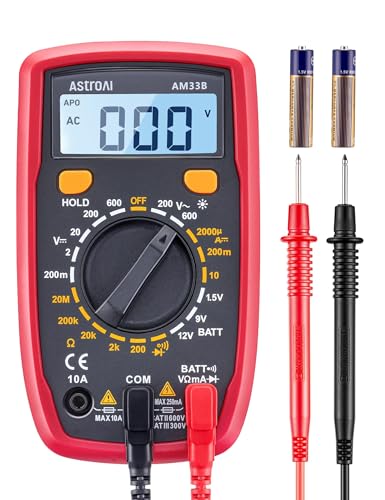
I rely on the AstroAI Digital Multimeter Tester when I need a dependable, no-frills tool for diagnosing car electrical systems and basic household circuits. It delivers accurate readings for AC/DC voltage, DC current, resistance, continuity, and diodes. The 2000-count display guarantees precise measurements across a wide range. I appreciate the auto-detect battery check for 1.5V and 9V cells-no guesswork. It includes a continuity buzzer, Data Hold, and an LCD with backlight for dark engine bays. Double fuse protection and a shock-resistant silicone cover boost safety. It lacks AC current measurement, so confirm the correct function before testing. Comes with test leads, batteries, and manual-ready to use out of the box.
Best For: DIYers, automotive enthusiasts, and hobbyists needing a reliable, easy-to-use multimeter for basic electrical troubleshooting.
Pros:
- Accurately measures AC/DC voltage, DC current, resistance, continuity, and diodes with a clear 2000-count LCD and backlight
- Features auto-detect battery testing, Data Hold, continuity buzzer, and double fuse protection for safety and convenience
- Includes test leads, batteries, and manual-ready to use right out of the box
Cons:
- Cannot measure AC current, limiting functionality for advanced electrical work
- Manual function selection required, increasing risk of user error if not careful
- No temperature measurement or advanced features found in higher-end models
KAIWEETS TRMS Digital Multimeter 6000 Counts
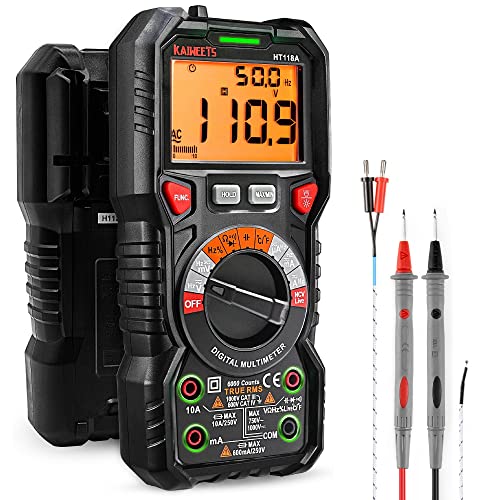
You’ll find the KAIWEETS HT118A especially useful if you need a single multimeter that handles both routine car diagnostics and advanced electrical troubleshooting. It delivers 6000-count resolution with True RMS accuracy for precise readings. I measure up to 1000V DC, 750V AC, and 10A current. It tests capacitance, frequency, duty cycle, temperature, diodes, and continuity. Non-contact voltage detection and Live mode alert me with audible and visual alarms. The 2.9-inch LCD has a backlight and auto-ranging. Min/Max/Average tracking helps spot fluctuations. Data hold and low-battery warning add convenience.
Best For: DIY enthusiasts and professionals needing a versatile, high-accuracy multimeter for automotive, household, and advanced electrical diagnostics.
Pros:
- 6000-count True RMS accuracy ensures precise measurements across a wide range of electrical parameters
- Comprehensive feature set including non-contact voltage detection, temperature measurement, and Min/Max/Average tracking
- Durable, safety-certified design with CAT III 1000V/CAT IV 600V ratings and double insulation
Cons:
- No explicit mention of ruggedized drop or water resistance beyond the silicone case
- Limited details on accuracy specifications for less common measurements like capacitance or frequency
- May overwhelm beginners due to extensive functions and auto-ranging interface
AstroAI Digital Multimeter TRMS 6000 Counts

When diagnosing complex electrical issues in automotive systems, the AstroAI Digital Multimeter TRMS 6000 Counts is ideal for technicians and DIYers who demand precision and safety. It measures AC/DC voltage up to 1000V DC and 750V AC, with True RMS ensuring accurate readings on non-linear signals. The meter handles current, resistance, capacitance, frequency, duty cycle, diode, continuity, and temperature testing. Double ceramic fuses (F500mA/600V, F10A/600V) protect against surges. It’s rated CAT III 600V and CAT II 1000V for safe use on car and home circuits. Auto-ranging, data hold, and a backlit LCD improve usability.
Best For: Technicians and DIYers who need a reliable, safe, and precise multimeter for automotive and household electrical diagnostics.
Pros:
- True RMS technology ensures accurate AC measurements on non-linear signals
- High safety ratings (CAT III 600V, CAT II 1000V) and double ceramic fuses enhance protection
- Auto-ranging, backlit display, and data hold improve usability in various environments
Cons:
- No mention of a warranty period in provided details
- Temperature measurement range and accuracy not specified
- Test lead caps must be removed before use, which could be confusing for beginners
Crenova MS8233D 6000-Count Digital Multimeter

The Crenova MS8233D stands out for DIYers and automotive enthusiasts who need a reliable, feature-rich multimeter without stepping into high-end pricing. I rely on its 6000-count LCD with backlight to read measurements clearly, even in dim engine bays. It measures DC/AC voltage, current, resistance, capacitance, frequency, duty cycle, and tests diodes and continuity. Non-contact voltage detection gives audible and visual alerts-like a warning light on a dashboard. It samples data three times per second, supports auto and manual ranging, and includes data hold and min/max recording. Built to IEC61010-1 CAT III 600V standards, it features dual internal fuses and an insulated rubber holster for safety. Weighing 1.21 pounds, it’s compact and durable, made of ABS+PVC. The package includes test leads, alligator clips, batteries, a case, and manual. I use it for car diagnostics, home electrical work, and classroom demonstrations. It’s backed by a one-year warranty and has been available since June 2014-still in production.
Best For: DIYers, automotive enthusiasts, and students who need a reliable, feature-rich multimeter for home, car, and educational use without a high-end price tag.
Pros:
- Measures a wide range of electrical parameters including voltage, current, resistance, capacitance, frequency, duty cycle, and includes non-contact voltage detection with audible and visual alerts
- Features a 6000-count LCD with backlight, data hold, min/max recording, and auto/manual range for versatile and accurate readings
- Built to CAT III 600V safety standards with dual fuses and an insulated rubber holster, ensuring durability and user protection
Cons:
- Uses AAA batteries instead of a more long-lasting rechargeable option, potentially increasing long-term operating costs
- Lacks advanced features like Bluetooth connectivity or true RMS measurement found in higher-end models
- Non-contact voltage detection is basic and may produce occasional false positives in electrically noisy environments
ANCEL BA101 Car Battery Tester (12V)

If you’re diagnosing lead-acid battery systems in vehicles daily, the ANCEL BA101 delivers lab-grade accuracy in a handheld tool. It tests 12V batteries with 99.6% precision, supporting Flooded, AGM, GEL, and EFB types. I rely on its intelligent chip and high-conductivity copper clips for consistent readings. You must input the correct CCA/AH rating and battery standard-SAE, JIS, DIN, or others-for valid results. It won’t work on lithium, 6V, or 24V systems, or batteries under 30AH. The large LCD has adjustable contrast and backlight, making diagnostics fast. It includes polarity, short-circuit, overcurrent, and overvoltage protection. I trust its reinforced ABS build in tough conditions.
Best For: Automotive professionals and DIYers who need fast, accurate 12V lead-acid battery diagnostics in cars, trucks, and marine vehicles.
Pros:
- Delivers 99.6% testing accuracy with support for multiple battery types (Flooded, AGM, GEL, EFB) and global standards (SAE, JIS, DIN, etc.)
- Features a large, backlit LCD with adjustable contrast for clear readings in any lighting and enables one-handed operation for convenience
- Includes 4-in-1 safety protection (polarity reversal, short circuit, overcurrent, overvoltage) and a durable reinforced ABS housing for rugged use
Cons:
- Not compatible with lithium, 6V, 24V, or batteries under 30AH, limiting versatility across battery technologies
- Requires manual input of CCA/AH and battery standard, which can lead to errors if information is missing or entered incorrectly
- Cannot reliably test storage or energy-storage batteries rated in Ah when using automotive testing modes
KAIWEETS Digital Multimeter with Case

This multimeter stands out for DIYers and automotive enthusiasts who demand reliability without the steep learning curve. I’ve used the KAIWEETS Digital Multimeter for testing 12V car batteries, checking fuses, and diagnosing wiring issues-it delivers accurate readings every time. It measures AC/DC voltage, DC current up to 10A, resistance, continuity, and diode function. The backlight and data hold features make work in dim engine bays easier. It meets IEC CAT III 600V safety standards, has double fuses for anti-burn protection, and is CE and RoHS certified. The included case keeps leads and probes organized.
Best For: DIYers and automotive enthusiasts seeking a reliable, easy-to-use multimeter for accurate electrical testing in vehicles, household circuits, and basic industrial applications.
Pros:
- Accurate measurements for AC/DC voltage, DC current, resistance, continuity, and diode testing
- Backlit display and data hold function enhance usability in low-light environments
- Meets IEC CAT III 600V safety standards with double fuses for overload and anti-burn protection
Cons:
- Does not measure AC current, limiting functionality for some advanced electrical tasks
- No battery included for extended use beyond the pre-installed AAA batteries
- Basic design may lack advanced features desired by professional electricians
INNOVA 3320 Auto-Ranging Digital Multimeter, Red & Black
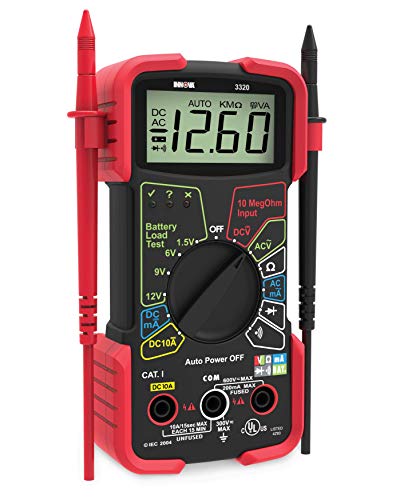
UL certification makes the INNOVA 3320 a trusted guardian for both automotive and household electrical diagnostics, ensuring safe, accurate results every time. I rely on its auto-ranging function to instantly select the correct measurement range, eliminating guesswork. The large digital display is easy to read, and color-coded LEDs clearly indicate battery charge status. It handles both AC and DC voltage with a single-setting resistance function. Its 10 MegOhm input impedance prevents loading, protecting sensitive circuits. I’ve used it on modern vehicles without harming the ECU. It’s precise, durable, and built for real-world troubleshooting.
Best For: DIY enthusiasts and automotive troubleshooters seeking a reliable, user-friendly multimeter for accurate electrical diagnostics at home or in vehicles.
Pros:
- UL certified for safety and accuracy, making it trustworthy for both household and automotive use
- Auto-ranging function simplifies measurements by automatically selecting the correct range
- High 10 MegOhm input impedance protects sensitive electronics like vehicle ECUs during testing
Cons:
- Lacks manual range selection, which may limit precision for advanced users
- No continuity beeper or backlight, reducing usability in low-light or high-noise environments
- Basic feature set compared to higher-end models, missing advanced diagnostics capabilities
Digital Multimeter with Backlight LCD (2000 Counts)

The Digital Multimeter with Backlight LCD (2000 Counts) is my go-to tool when I need reliable, precise readings in dimly lit engine bays or cluttered electrical panels. It measures AC/DC voltage, DC current, resistance, continuity, diode function, and battery voltage with 2000-count resolution. The 2.7-inch backlit LCD guarantees clarity in darkness. I use the Data Hold feature to lock readings, especially when working alone. Its double-insulated orange rubber casing resists shocks and slips. I appreciate the fold-out stand for hands-free use. It includes test leads, a 9V battery, and comes with a 2-year warranty.
Best For: DIY enthusiasts, electricians, students, and automotive technicians seeking a durable, accurate, and easy-to-read multimeter for reliable electrical measurements in low-light environments.
Pros:
- Clear 2.7-inch backlit LCD display ensures excellent visibility in dark or confined spaces
- 2000-count resolution and multiple measurement functions (AC/DC voltage, current, resistance, continuity, diode, battery) offer versatility for various applications
- Robust double-insulated orange rubber casing with fold-out stand and Data Hold feature enhances safety and usability
Cons:
- Measures DC current only, lacking AC current measurement capability
- No mention of auto-ranging, which may limit convenience for some users
- Limited accessory inclusion-no carrying case or protective holster mentioned
Factors to Consider When Choosing a Car Multimeter
You need a multimeter that matches your car’s electrical demands. Look for a voltage measurement range up to at least 1000V AC and 1500V DC, and guarantee it can test current up to 10A for accurate alternator and starter diagnostics. Safety ratings like CAT III 1000V or higher, combined with a clear, backlit LCD and rugged, drop-resistant construction, keep you protected and readings visible in tough conditions.
Voltage Measurement Range
A reliable car multimeter needs a voltage measurement range that covers both normal operating conditions and unexpected surges. You’ll want a DC range of at least 0–20V to measure your battery’s 12.6V charge and the 14.7V output when the engine runs. For safety, pick a model that reads up to 30V DC-this handles spikes from alternator issues or jump-start mistakes. You also need AC voltage capability up to 600V to check alternator ripple, which can expose failing diodes. High input impedance (10 MΩ) is critical-it prevents the meter from disrupting sensitive circuits while testing. Overvoltage protection on the voltage settings keeps your tool safe during surges from inductive loads. These specs guarantee accurate, safe testing across modern vehicle electronics. Don’t skip them-they’re essential for trustworthy diagnostics.
Current Testing Capability
While diagnosing automotive electrical issues, measuring current accurately separates a functional fix from a costly mistake. You need a multimeter that measures both AC and DC current to test alternator output and battery charging circuits effectively. Guarantee it supports at least 10A DC current measurement to handle standard automotive loads. True RMS capability gives you precise readings on non-sinusoidal waveforms common in modern vehicle electronics. Overload protection is essential-look for dual ceramic fuses rated at 10A/600V and 500mA/600V to guard against surges. Choose a model with auto-ranging or manual-ranging based on your comfort level; auto-ranging simplifies testing by selecting the correct scale automatically. These features guarantee reliable, repeatable current measurements-critical when diagnosing parasitic drains or alternator performance under real-world conditions.
Safety Ratings And Certifications
When working with automotive electrical systems, safety isn’t just a priority-it’s a requirement. You need a multimeter rated for at least CAT III 600V or CAT II 1000V to handle surges in car and household circuits. Look for models certified to IEC 61010-1 standards-they’re tested for transient overvoltage and safe operation under real-world conditions. Double fuse protection is critical: choose meters with ceramic fuses rated 500mA/600V and 10A/600V to stop overloads before they reach you. Double-insulated construction shields you from high voltage across all ranges, reducing shock risk. Don’t skip certifications-CE and RoHS mean the device meets international safety, environmental, and EMI standards. These features aren’t extras-they’re your defense against hidden electrical hazards every time you take a measurement.
Display Clarity And Backlight
You’ve guaranteed your multimeter meets the necessary safety standards-now focus on how clearly you can read it in real-world conditions. A backlit LCD is essential for visibility in dim engine compartments or dark garages. You’ll want a display of at least 2.5 inches to view multiple values-like voltage and resistance-at once. Larger digit height, ideally 0.6 inches or more, lets you read measurements quickly without straining. High-contrast screens with adjustable contrast improve legibility in direct sunlight or at night. Some models use LED indicators or color-coded readings to confirm results instantly, reducing errors. Backlighting secures you won’t miss a value when working under the hood after sunset. Don’t overlook display layout-clear symbols and spacing prevent misreading. A sharp, well-lit screen means you get accurate data fast, whether you’re checking a battery or tracing a wiring fault.
Durability And Build Quality
A reliable car multimeter must endure the daily wear and tear of automotive environments, so build quality matters just as much as accuracy. Choose models with double-insulated construction and high-impact-resistant casings to survive drops and rough handling. Rubber overmolding and reinforced housing absorb shock and resist vibration, protecting internal components during use under the hood. Look for IEC CAT III 600V or higher ratings-these guarantee safer operation during voltage spikes and transients in vehicle electrical systems. Overload protection on all ranges and thermistor circuits safeguards the meter if you accidentally misconnect probes or encounter surges. Integrated features like fold-out stands and non-slip rubber covers add stability during hands-free use on greasy shop benches. These design elements aren’t just convenient-they extend your multimeter’s lifespan in demanding conditions. A well-built meter withstands years of real-world abuse.
Auto Ranging Versus Manual
Even the most durable multimeter can’t deliver reliable results if you struggle to get accurate readings under time pressure. Auto-ranging models detect and set the correct measurement range automatically, so you get fast, error-free readings for voltage, current, or resistance without guesswork. This is ideal if you’re new to electrical testing or working quickly under the hood. Manual-ranging multimeters require you to select the range-like 20V or 200V-based on expected values, which demands experience but gives you precise control. In fluctuating or unstable circuits, locking in a fixed range avoids “range hunting” and speeds up response. Many auto-ranging multimeters include a manual override, so you’re not locked out of precision when diagnosing complex car systems. Choose auto-ranging for simplicity and speed; pick manual if you prefer full control and faster stabilization in tricky conditions.
Special Features For Vehicles
When diagnosing automotive electrical systems, having the right tools makes all the difference. Choose a multimeter with dedicated battery testing modes to measure voltage and cranking amps, so you can accurately assess your vehicle’s starting power. Always pick one that measures DC current up to at least 10A-this range covers most automotive circuits, including charging systems and fuse checks. Models with continuity testers and diode checks help you quickly find wiring faults, blown fuses, or bad semiconductors in complex vehicle electronics. For real-world use, go for a backlit display and rugged, shock-resistant build. These features guarantee reliable readings under the hood or in dim garages. Never skip safety: make sure your multimeter has overload protection and a high safety rating, like CAT III 600V, to handle voltage spikes common in car electrical systems.
Included Accessories And Support
Don’t overlook what comes in the box-accessories and support determine how quickly you can start testing and how long your multimeter lasts. You’ll need test leads, batteries, and a protective case for safe, immediate use. Models with alligator clips or thermocouples boost versatility, letting you monitor temperature or secure connections hands-free. A durable carrying case keeps components organized and protected. Look for built-in features like low battery alerts and overload protection-they preserve accuracy and prevent internal damage during high-load tests. You want a clear, detailed manual so setup is fast and error-free. Reliable technical support matters, especially when troubleshooting electrical issues mid-diagnosis-aim for brands offering help within 24 hours. A minimum one-year warranty covers defects and guarantees long-term reliability. These factors combined mean fewer delays, safer measurements, and a tool you can trust over time.
Frequently Asked Questions
Can I Use a Multimeter on Hybrid Vehicles?
Yes, you can use a multimeter on hybrid vehicles, but only if it’s rated for high-voltage systems. Always pick a multimeter with Category III or IV safety rating and a minimum 1,000V input rating. Standard multimeters risk failure or injury near hybrid components. Confirm leads are insulated and undamaged. Never probe high-voltage batteries or cables unless trained. Use the multimeter only on low-voltage circuits like 12V systems or sensors.
How Often Should I Calibrate My Car Multimeter?
You should calibrate your multimeter annually under normal use. Precision degrades over time due to component drift. For digital models, ±0.5% accuracy loss per year is common without recalibration. If you test hybrid systems regularly, calibrate every six months. Use NIST-traceable standards. Cheaper meters may need earlier calibration. Regular verification with a known voltage source helps spot drift. Skipping calibration risks false readings-like trusting a speedometer that’s off by 10 mph.
Are Car Multimeters Safe for Beginners to Use?
Yes, you can safely use car multimeters if you follow basic precautions. Always inspect probes for insulation damage-exposed wires risk shock. Set the dial correctly; measuring current in voltage mode can damage the unit. Begin in auto-ranging mode to avoid input errors. Use fused inputs rated for at least 10A on models like the Fluke 116. Keep hands behind probe barriers. Multimeters limit current flow, making them inherently safer than other tools when used properly.
Do Multimeters Work on Diesel Engine Batteries?
Yes, you can use multimeters on diesel engine batteries without issue. Diesel batteries operate at 12 volts, and your multimeter measures DC voltage up to 20V, making it fully compatible. You’ll check voltage, continuity, and resistance just like on gasoline engines. Verify your leads are in the correct ports, set to DCV, and apply proper probe pressure. Multimeters don’t differentiate fuel type-only electrical characteristics matter. You’re measuring the same battery specs.
Can a Multimeter Measure Alternator Output Accurately?
Yes, you can measure alternator output accurately with a multimeter. Set it to DC voltage, then connect the probes to the battery terminals while the engine runs. You should see 13.8–14.7 volts. Anything below 13.5 suggests undercharging; over 14.8 hints at overcharging. Use a digital multimeter with 1% accuracy, auto-ranging, and a min/max function to catch voltage fluctuations quickly and reliably.