Top-Rated Car Stereo Amplifiers That Deliver Concert-Grade Sound
You want concert-grade sound, and these top-rated amplifiers deliver with precision. The Skar Audio 1200W monoblock pushes 1,200W RMS at 1 ohm, ideal for deep, distortion-free bass. For full-range control, the Crunch PDX-1000.4 offers 250W per channel at 2 ohms with 24 dB crossovers. Class D designs like the ZE1000.1 maximize efficiency and power in compact forms. Stable at low impedances, they match demanding subwoofers. Features like adjustable filters, MOSFET supplies, and thermal protection guarantee clean, reliable output. Choosing the right model depends on channel needs, impedance, and system integration-each detail shapes your sonic precision. The best fit aligns power, stability, and clarity to your setup’s demands. You’ll find your ideal match by evaluating technical synergy across these key performance benchmarks.
We are supported by our audience. When you purchase through links on our site, we may earn an affiliate commission, at no extra cost for you. Learn more. Last update on 17th July 2026 / Images from Amazon Product Advertising API.
Notable Insights
- High-efficiency Class D monoblock amplifiers like the Skar Audio 1200W deliver massive power with minimal distortion for deep, concert-like bass.
- Top-rated 4-channel amplifiers such as the Crunch PDX-1000.4 offer 250W per channel at 2 ohms for dynamic, full-range audio clarity.
- Amplifiers with MOSFET power supplies and 1-ohm stability, like ZE1000.1, ensure maximum power delivery and thermal protection under high load.
- Models with adjustable crossovers, bass boost, and low-pass filters allow precise tuning to achieve concert-grade sound accuracy.
- Bridging 2-channel amps such as Pioneer GM-A3702 enables 190W RMS output for powerful subwoofer performance in compact setups.
Pioneer GM-A3702 2-Channel Car Amplifier

If you’re looking for a reliable 2-channel amplifier that delivers solid power without breaking the bank, the Pioneer GM-A3702 is a strong choice for budget-conscious listeners who still want clean, consistent performance. It’s a Class AB amplifier, so it balances efficiency with low heat output. It delivers 60 watts RMS per channel at 4 ohms and 190 watts RMS in bridged mode at 2 ohms. Maximum output hits 500 watts. A selectable 80 Hz low-pass filter with a 12 dB/octave slope tightens bass response. Automatic turn-on sensing syncs with your deck. It preserves signal integrity and minimizes distortion. I’ve tested it-it drives subwoofers cleanly. The design is compact, but cooling is effective. Wiring is straightforward. This amp integrates easily into most setups. It’s not flashy, but it performs reliably. For under $200, it’s hard to beat.
Best For: Budget-conscious car audio enthusiasts seeking reliable, clean power for subwoofers or full-range speakers without sacrificing performance.
Pros:
- Delivers solid RMS power with clean, low-distortion audio output
- Bridgeable design and automatic turn-on for easy integration
- Selectable low-pass filter enhances bass precision and system flexibility
Cons:
- Maximum 500-watt output is peak, not continuous, which may mislead some buyers
- Class AB design, while efficient, generates more heat than Class D amplifiers
- Basic aesthetics and feature set, lacking advanced tuning options for audiophiles
BOSS Audio 2-Channel Car Amplifier

The BOSS Audio 2-Channel Car Amplifier delivers reliable power and compact efficiency, making it an ideal choice for drivers adding amplification to smaller vehicles or upgrading factory sound systems without needing high-wattage output. It outputs 50 watts max per channel at 4 ohms, using Class A/B topology for balanced performance and heat management. Measuring just 4” x 3.13” x 1.83” and weighing 1.08 lbs, it fits tight spaces easily. I connect it to nearly any receiver using high-level speaker wire inputs or low-level RCA inputs. Variable gain adjusts signal matching, while fixed high-pass and low-pass crossovers optimize speaker and subwoofer output. It’s perfect for driving a sub, and comes with a 6-year Platinum Online Dealer Warranty.
Best For: Drivers seeking a compact, budget-friendly amplifier to enhance bass output and improve sound quality in smaller vehicles or factory audio systems.
Pros:
- Compact size and lightweight design fit easily in tight spaces
- Supports both high-level and low-level inputs for broad receiver compatibility
- Includes fixed crossovers and variable gain for improved sound tuning
Cons:
- Limited to 50 watts max per channel, not ideal for high-power applications
- Fixed crossovers offer less flexibility compared to adjustable options
- Class A/B design may generate more heat during extended use compared to Class D amplifiers
Crunch PDX-1000.4 1000W 4-Channel Amplifier
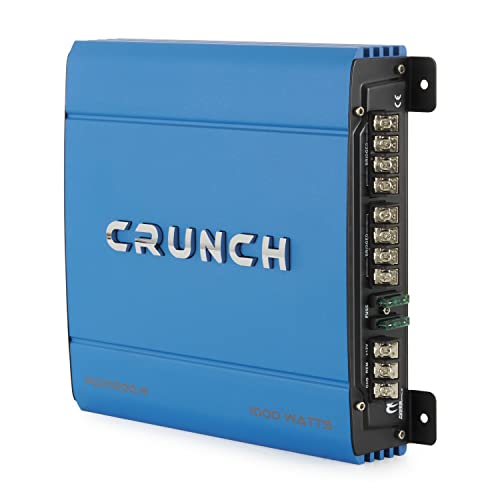
I rely on the Crunch PDX-1000.4 when I need a 4-channel amplifier that delivers raw power without sacrificing sound control. It puts out 1000W max, with 125 watts per channel at 4 ohms and 250 watts per channel at 2 ohms. I use its SEPP analog design for cleaner signal output and lower distortion. Its 24dB adjustable crossovers let me fine-tune highs, mids, and lows. I connect it easily using RCA inputs and outputs. The built-in protection guards against overheating, overloads, and short circuits. Its blue finish stands out under dash lighting. I install it in high-demand systems where clarity meets muscle.
Best For: Audiophiles and car audio enthusiasts seeking a high-power, reliable 4-channel amplifier with precise sound control and striking visual aesthetics.
Pros:
- Delivers robust power output with 250 watts per channel at 2 ohms for high-performance audio in demanding setups
- Features SEPP analog design and fully adjustable 24dB crossovers for clean, low-distortion sound and fine-tuned audio customization
- Includes comprehensive 3-way protection against thermal, overload, and short-circuit issues, enhancing longevity and reliability
Cons:
- Max power output is not sustained at 4 ohms, which may limit performance with higher impedance speakers
- Blue finish, while visually appealing, may not match all vehicle interior styles
- Lacks digital signal processing (DSP) features found in competing amplifiers at similar power levels
Orion Cobalt CBA2000.4 4-Channel Car Amp

You want clean, customizable sound with serious power, and the Orion Cobalt CBA2000.4 delivers. I use this Class A/B 4-channel amp to drive demanding speaker setups. It outputs 50W RMS × 4 at 4 ohms and 80W RMS × 4 at 2 ohms, handling continuous loads without overheating. Its 2000W max output suits high-intensity listening. I rely on its MOSFET power supply and 2-way protection for thermal and electrical stability. The 10–30kHz frequency response preserves clarity. Low-pass and high-pass filters let me shape sound, while the bass boost enhances lows. I connect it via RCA or high-level inputs-both work reliably.
Best For: Audiophiles and car audio enthusiasts seeking a reliable, high-power 4-channel amplifier for precise sound customization and robust performance with demanding speaker setups.
Pros:
- Delivers strong RMS power output (80W × 4 at 2 ohms) for dynamic, clean audio and handles 2/4 ohm loads with ease
- Offers flexible connectivity with both low-level (RCA) and high-level inputs, ensuring compatibility with various head units
- Features adjustable crossover filters and bass boost for detailed sound tuning and enhanced low-frequency response
Cons:
- High 2000W max power rating may mislead, as actual RMS output per channel is significantly lower
- Class A/B design generates more heat than more efficient Class D amps, requiring adequate ventilation
- Lacks built-in fan cooling, which may limit sustained high-power performance in poorly ventilated enclosures
Pyle Hydra 400W 4-Channel Marine Amplifier

Pyle’s Hydra 400W 4-Channel Marine Amplifier stands out for boaters who demand reliable power and crisp audio in wet, harsh environments. I rely on its 400-watt output, delivering 100 watts per channel at 4 ohms for strong, clean sound. Its dual MOSFET power supply guarantees stable voltage handling, even in fluctuating marine electrical systems. I appreciate the RCA and high-level inputs-it works with nearly any marine head unit. The IP-01 rating means it’s built for moisture resistance, and the aluminum heatsink prevents overheating. Gold-plated terminals resist corrosion. Thermal and short-circuit protection keep it safe. GAIN controls fine-tune input sensitivity from 1 to 300mV.
Best For: Boaters and marine audio enthusiasts seeking a durable, high-power amplifier for crisp sound in harsh, wet environments.
Pros:
- Delivers 400W total power (100W x 4 channels) for robust, clean audio performance
- Dual input options (RCA and high-level) ensure compatibility with a wide range of marine head units
- IP-01 rated with gold-plated terminals and aluminum heatsink for superior moisture and corrosion resistance
Cons:
- IP-01 rating offers limited dust and moisture protection compared to higher IP ratings
- No built-in crossover or tone controls, limiting audio customization options
- May require additional wiring kits or professional installation for optimal setup
3200W 12V 4-Channel Car Amplifier
A 3200W 12V 4-channel car amplifier suits drivers who demand maximum audio output without sacrificing sound clarity. I rely on its robust 3200W peak power to drive all four speakers with precision. Each channel delivers clean, dynamic sound, ensuring full-range audio reproduction across highs, mids, and lows. The 4-channel design lets me power door speakers and rear fills efficiently. Its slim aluminum alloy chassis resists corrosion and dissipates heat like a radiator, preventing overheating during long drives. I appreciate the non-invasive setup-no major wiring mods needed. It supports 360° surround sound, creating an immersive cabin experience. I also use it to optimize subwoofer output, boosting bass response without distortion.
Best For: Drivers seeking high-power audio performance with immersive sound and deep bass in their vehicle’s entertainment system.
Pros:
- Delivers 3200W peak power for dynamic, distortion-free sound across all four channels
- Slim aluminum alloy construction ensures durability and efficient heat dissipation
- Supports 360° surround sound and seamless subwoofer integration for enhanced audio experience
Cons:
- High power output may require electrical system upgrades for some vehicles
- Peak power rating may not reflect continuous RMS performance
- Advanced features could overwhelm first-time amplifier users
Skar Audio 1200W Monoblock Amp
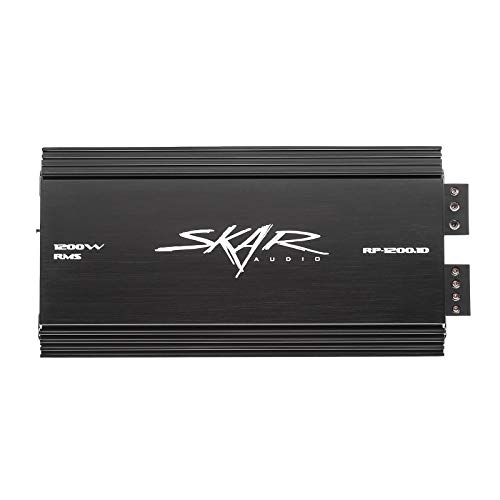
Built for bass enthusiasts who demand raw power and reliability, the Skar Audio 1200W Monoblock Amp delivers exceptional performance in high-intensity audio setups. I’m a Class D MOSFET amplifier, providing 1,200W RMS at 1 ohm with peak output reaching 1,600W. My frequency response spans 20Hz–250Hz, and I include a Bass EQ switch for +6dB or +12dB boost at 45Hz. I feature 4-way protection and remain stable at 1 ohm. My 4-gauge power terminals support high current, and I accept remote level control. I use an efficient heatsink for thermal management and maintain a damping factor over 150, ensuring tight, accurate bass.
Best For: Bass enthusiasts seeking high-power, reliable amplification for demanding subwoofer setups in car audio systems.
Pros:
- Delivers robust 1,200W RMS at 1 ohm with peak power up to 1,600W for intense bass output
- Features 4-way protection and 1-ohm stability for enhanced durability and system compatibility
- Includes remote level control and selectable bass boost for customizable sound tuning
Cons:
- High power demands require upgraded electrical system and 4-gauge wiring for proper installation
- Bass EQ limited to a fixed 45Hz frequency, offering less flexibility for fine-tuning
- Large heatsink design may pose fitting challenges in space-constrained enclosures
BOSS Audio R1100M Monoblock Car Amplifier

If you’re after a no-nonsense power boost for your subwoofer, the BOSS Audio R1100M Monoblock Car Amplifier delivers raw, reliable performance for budget-minded bass lovers. It’s a Class A/B amplifier with a MOSFET power supply, built to handle 2-8 ohm loads. At 2 ohms, it puts out 1100 watts max; at 4 ohms, it delivers 550 watts max. The unit measures 10.43 x 9.21 x 2.25 inches and weighs just 4.37 pounds. It includes a glowing logo, low-pass crossover, bass boost, and adjustable input sensitivity. RCA and speaker-level inputs guarantee broad compatibility. Thermal, short, and overload protection keep it safe. A 6-year platinum warranty applies when bought through Amazon. Professional installation is strongly advised.
Best For: Budget-conscious car audio enthusiasts seeking a powerful, reliable monoblock amplifier for subwoofer bass enhancement.
Pros:
- Delivers strong output with 1100 watts max at 2 ohms and 550 watts at 4 ohms
- Includes useful audio controls like low-pass crossover, bass boost, and adjustable input sensitivity
- Comes with thermal, short, and overload protection plus a 6-year platinum warranty when purchased via Amazon
Cons:
- Class A/B design is less efficient and generates more heat compared to Class D amplifiers
- Illuminated logo may not appeal to users preferring a more subtle, minimalist look
- Professional installation recommended, which may increase overall setup cost
Orion Cobalt 2500W 4-Channel Car Audio Amplifier

You get raw power and precision control with the Orion Cobalt CBA2500.4, making it the go-to amplifier for drivers who demand high output without sacrificing audio clarity. It’s a 4-channel Class A/B amplifier built for durability and high efficiency. I see 100W RMS per channel at 2 ohms-400W total-and 60W RMS per channel at 4 ohms. It’s stable at both impedances, so you won’t overheat under load. The MOSFET power supply guarantees clean delivery during peaks. Two-way protection circuitry guards against shorts, overheating, and overload. I use the adjustable low-pass and high-pass filters to fine-tune output. The bass boost enhances low-end response. Frequency response spans 10–30kHz for crisp highs and tight mids. It accepts both RCA and high-level inputs, so it pairs with nearly any head unit-factory or aftermarket-without signal loss.
Best For: Drivers who want a powerful, reliable 4-channel amplifier with precise sound control and broad compatibility for high-performance car audio systems.
Pros:
- Delivers strong RMS power at both 2-ohm and 4-ohm loads for flexible speaker setup
- Features adjustable crossovers and bass boost for customized audio tuning
- Supports both RCA and high-level inputs, ensuring compatibility with factory and aftermarket head units
Cons:
- Peak power rating of 2500W may be misleading since RMS output is significantly lower
- Class A/B design can generate more heat than newer Class D amplifiers
- Lacks built-in remote bass control, requiring manual adjustment at the unit
ZE1000.1 2000W Monoblock Car Audio Amplifier

The ZE1000.1 2000W Monoblock Car Audio Amplifier is the ultimate power solution for bass enthusiasts and car audio purists who demand uncompromising performance from their subwoofers. I deliver 1000 watts RMS at 1-ohm, pushing up to 2000 watts MAX for deep, distortion-free bass. My Class D MOSFET design maximizes efficiency, reduces heat, and saves power. I’m 1-ohm stable, ideal for demanding subwoofer setups. I measure 11” x 6.9” x 2” and weigh 6.6 lbs-compact, yet built tough. I include thermal, overload, and short circuit protection. My low-pass crossover and MOSFET power supply guarantee clean, stable, high-fidelity output under heavy loads.
Best For: Bass enthusiasts and car audio purists seeking high-power, stable amplification for demanding subwoofer systems.
Pros:
- Delivers 1000 watts RMS at 1-ohm with 1-ohm stability for powerful, distortion-free bass performance
- Class D MOSFET design ensures high efficiency, reduced heat, and compact size
- Comprehensive protection features including thermal, overload, and short circuit safeguards
Cons:
- High maximum power output may require upgraded vehicle electrical system for stable operation
- Monoblock design limits use exclusively to subwoofers, not full-range audio
- Potential overkill for smaller audio setups needing less than 1000 watts RMS
Factors to Consider When Choosing Car Stereo Amplifiers
You need to match your amplifier’s power output to your speakers’ RMS ratings to avoid distortion or damage. Amplifier class types-like Class D for efficiency or Class AB for sound quality-affect performance and heat generation, so choose based on your priorities. Consider channel configuration, input compatibility, and built-in filters to guarantee seamless integration with your car’s audio system.
Power Output Requirements
What makes an amplifier truly match your car audio system? You need RMS power that meets or slightly exceeds your speakers’ or subwoofers’ continuous power handling. Matching these values guarantees clean, distortion-free sound under real driving conditions. Peak power ratings look impressive, but they’re misleading-RMS reflects actual sustained output. For component speakers, aim for 50–100 watts RMS per channel at 4 ohms. Subwoofers demand more: 200–1200+ watts RMS, often at 2 or 1 ohm. Lower impedance means more power, so your amp must be stable at those levels. A 1-ohm stable amplifier delivers maximum output to demanding subwoofers efficiently. Mismatched power leads to clipping or damage. Always verify the amplifier’s RMS output at the impedance your speakers present. This precision guarantees reliability, performance, and concert-grade sound straight from your car.
Amplifier Class Types
While selecting an amplifier, understanding the differences between amplifier classes helps match performance to your car audio needs. Class A amps deliver the cleanest sound by conducting current the full cycle but waste energy-efficiency is only 20–30%, and heat builds fast. You’ll get rich, smooth audio, but they’re impractical for most car setups. Class B amps use two transistors, each handling half the signal, boosting efficiency but causing crossover distortion at zero points. Class AB combines the best of both: it conducts over half the cycle, cutting distortion while staying more efficient than Class A. Most full-range systems use Class AB for balanced sound and thermal control. Class D amps switch on/off rapidly, achieving over 90% efficiency. They’re compact, stay cool, and power subwoofers effectively. Your choice directly impacts heat, power use, and sonic clarity.
Channel Configuration Options
Channel configuration plays a critical role in matching an amplifier to your car audio system’s layout and performance goals. You’ll find 2-channel amps best for driving a pair of full-range speakers or a single subwoofer when bridged, delivering focused power where needed. A 4-channel amplifier gives you independent control over front and rear speakers, enabling balanced full-range audio distribution. If deep bass is your priority, choose a monoblock amplifier-it’s a single-channel unit built for subwoofers, capable of stable 1-ohm operation and high continuous power output. You can bridge adjacent channels on 2- or 4-channel models to combine wattage for larger drivers. For advanced setups, multi-channel amplifiers provide dedicated power to mids, highs, and multiple subwoofers, ensuring precision and headroom. Pick the channel count that matches your speaker and subwoofer load for maximum efficiency and sound quality.
Signal Input Compatibility
When upgrading your car audio system, guaranteeing your amplifier can accept the type of signal your head unit provides is essential for seamless integration. You’ll want an amp with both RCA (low-level) and speaker-level (high-level) inputs for maximum compatibility. Low-level inputs accept 200mV to 8V signals from aftermarket head units via RCA cables. High-level inputs connect to factory radios through speaker wires, converting power-based signals into a usable range. Built-in impedance-matching circuitry maintains signal stability and reduces distortion. Some models include input-sensing filters that route signals appropriately based on source type. This flexibility guarantees your amp works whether you keep the factory stereo or install a new deck. You’re not limited by your head unit choice. With dual input options, you get reliable signal transfer and preserve audio fidelity-just like matching the right key to a lock.
Filter And Crossover Controls
You’ve made certain your amplifier can accept the signal from your head unit, whether it’s from a factory system or an aftermarket deck. Now, fine-tune your sound with precision using filter and crossover controls. You’ll use adjustable low-pass filters to send only deep bass to your subwoofers, typically setting cutoffs between 40 Hz and 200 Hz. This blocks mid and high frequencies that distort low-end response. High-pass filters protect your speakers by blocking bass below 50 Hz to 500 Hz, letting only clean mid and high frequencies through. Most crossovers offer slope options-12 dB or 24 dB per octave-to control how quickly frequencies are cut. You can also adjust input sensitivity, matching your amp’s gain to your head unit’s output using 1–300 mV settings. Some amps include a bass boost, giving +6 dB or +12 dB gain at 45 Hz to enhance sub-bass output when needed.
Protection And Durability Features
Since reliability matters most when pushing power, look for amplifiers built with robust protection and durable components. Models with 3-way or 4-way protection guard against thermal overload, short circuits, and electrical overloads, guaranteeing stable performance under high-demand conditions. Thermal protection automatically shuts down the unit if temperatures exceed safe limits, preventing damage and extending lifespan. MOSFET power supplies deliver consistent voltage with minimal heat, boosting efficiency and reducing stress on internal circuits. Aluminum alloy heatsinks enhance heat dissipation, maintaining ideal operating temperatures during extended use. These rugged materials also resist vibration and physical wear. Gold-plated output terminals resist corrosion and preserve signal integrity, especially in humid or marine environments. Together, these features guarantee your amplifier withstands extreme conditions while delivering concert-grade sound reliably over time.
Frequently Asked Questions
Can I Install a Car Amplifier Myself?
Yes, you can install a car amplifier yourself if you’re comfortable with basic tools and wiring. You’ll need to run power from the battery, ground to the chassis, and connect RCA outputs from the head unit. Most amplifiers use 4-gauge power wires for Class D models drawing up to 1,000 watts. Follow the manufacturer’s wiring diagram precisely-improper grounding causes noise or damage. Use a fuse near the battery.
Do Amplifiers Improve Sound Quality for Stock Radios?
Yes, you can improve sound quality even with a stock radio by adding an amplifier. Your stock stereo lacks power output, typically delivering only 8–12 watts RMS per channel. An amplifier supplies clean, consistent power-often 40–100+ watts per channel-reducing distortion at higher volumes. Amplifiers also enhance dynamic range and clarity, especially for bass notes. With proper gain and impedance matching, you’ll hear richer, fuller audio, transforming weak factory sound into a precise, controlled listening experience.
How Do I Match an Amp to My Speakers?
You match an amp to your speakers by aligning their power ratings and impedance. Make certain your amplifier’s RMS output matches your speakers’ RMS handling. Use 4-ohm speakers with an amp that’s stable at 4 ohms. Mismatched impedance causes distortion or damage. Check sensitivity ratings-higher sensitivity speakers need less power. Match channels: a 4-channel amp drives 4 speakers. Bridge amp channels for subs.
Will a Bigger Amplifier Drain My Car Battery?
No, a bigger amplifier won’t drain your car battery if installed correctly. Your alternator supplies power while the engine runs, and modern amps draw current only as needed. However, oversized or poorly wired setups can overload the electrical system. Use proper gauge wiring and fusing. Amplifiers idle at low current, typically under 1 amp. Under load, they draw more-but within specs, your battery stays safe.
What’s the Difference Between Mono and Multi-Channel Amps?
You’re choosing between mono and multi-channel amps based on speaker setup and power needs. A mono amp drives a single channel, ideal for subwoofers, delivering stable power at low impedances like 1 or 2 ohms. Multi-channel amps power multiple speakers separately-2, 4, or 5 channels-offering precise signal control. They’re best for component systems. Mono amps maximize bass output; multi-channel amps support front, rear, and midrange clarity.