Best Dash Cams Rideshare Drivers Actually Swear By
You need a dash cam that captures every detail, front, rear, and inside your vehicle. Top rideshare drivers choose 3-channel 4K systems with 1440p–4K front cameras, 1080P rear and cabin feeds, and 170° front, 150°+ rear viewing angles. Look for STARVIS sensors, F1.5–F1.8 apertures, IR night vision, GPS, dual-band Wi-Fi, and loop recording on 512GB U3 cards. Hardwired parking mode with motion detection and supercapacitor stability guarantees 24/7 protection-even in extreme heat. Discover which models deliver the most reliable, evidence-grade performance under real-world conditions.
We are supported by our audience. When you purchase through links on our site, we may earn an affiliate commission, at no extra cost for you. Learn more. Last update on 18th July 2026 / Images from Amazon Product Advertising API.
Notable Insights
- Records front, rear, and cabin simultaneously with 4K front and 1080P+ rear cameras for complete ride documentation.
- Infrared night vision and STARVIS sensors ensure clear footage in low light and total darkness.
- Built-in GPS and dual-band WiFi enable real-time tracking, fast video transfer, and app remote access.
- Parking mode with motion detection and supercapacitor support provides 24/7 security and extreme temperature resilience.
- Easy plug-and-play installation with long rear cable, magnetic mount, and loop recording up to 512GB SD capacity.
Dash Cam Front, Rear, and Inside 1080P

If you’re a rideshare driver who needs full coverage without compromise, this 3-channel dash cam system is built for your real-world demands. I rely on its front, rear, and cabin 1080P cameras daily. The front lens captures a 170° wide view; the cabin and rear cameras offer 150° each, with the rear unit being waterproof. HDR and WDR technologies balance exposure in tough lighting, like tunnel shifts. Infrared LEDs on the interior camera deliver clear night vision. It uses loop recording, a G-sensor, and includes a 32GB card. The IPS display stays visible from any angle. Setup is plug-and-play with long cables and mounting tools included.
Best For: Rideshare drivers who need comprehensive, reliable recording of front, rear, and cabin activity in all lighting conditions.
Pros:
- 3-channel 1080P system with wide-angle coverage (170° front, 150° cabin and rear) ensures complete vehicle surveillance
- Infrared LEDs and HDR/WDR technology deliver clear night vision and balanced exposure in challenging lighting
- Plug-and-play installation with long cables, mounting tools, and loop recording simplifies setup and continuous use
Cons:
- Limited to 32GB storage which may require frequent management for heavy users
- No mention of Wi-Fi or app connectivity for easy footage access
- Requires constant power via car charger, limiting true standalone parking mode flexibility
4K Dash Cam Front/Rear with WiFi, GPS, Night Vision
The K Dash Cam Front/Rear with WiFi, GPS, and Night Vision stands out as a top choice for rideshare drivers who need undeniable evidence and full-vehicle coverage. It records 4K front and rear, plus 1080P cabin footage simultaneously. I get 170° wide front and 150° rear and cabin views-nearly 360° coverage. The F1.5 front and F1.8 rear lenses capture clear night video. Infrared LEDs record the cabin in total darkness. WDR balances harsh lighting. GPS logs speed, time, and location. Loop recording auto-overwrites old files. The G-sensor locks collision footage. Parking mode runs 24/7 with a hardwire kit. I access videos fast via WiFi 6. It includes a 128GB card and has an 18-month warranty.
Best For: Rideshare drivers and fleet operators who need comprehensive 4K front, rear, and cabin video coverage with reliable night vision, GPS tracking, and 24-hour parking surveillance.
Pros:
- Triple-channel 4K+4K+1080P recording with wide 170° front and 150° rear/cabin viewing angles for near-360° coverage
- Advanced night vision with F1.5/F1.8 apertures, WDR, and infrared cabin LEDs for clear low-light and total darkness recording
- Built-in GPS, WiFi 6 for fast transfers, loop recording, G-sensor, and 24-hour parking mode with collision detection
Cons:
- 24-hour parking mode requires a separate hardwire kit (not included) for continuous power
- Limited to 512GB microSD capacity, which may fill quickly with 4K footage
- Infrared cabin camera only records in black and white during nighttime
4K Dash Cam Front and Rear (Free 128GB Card)
I rely on the K Dash Cam Front and Rear because it delivers the kind of complete coverage I need as a rideshare driver. It supports triple-channel recording with 4K UHD front, 1080P rear, and 1080P cabin cameras. The front lens has a 170° field of view; rear and cabin cameras offer 165°, providing near 360° visibility. A built-in 128GB card stores hours of footage. Loop recording overwrites unmarked files when full. The G-sensor locks video on impact. GPS logs speed, location, and route. WiFi enables 20MB/s downloads via the TERUNSOUl app.
Best For: Rideshare drivers and fleet operators who need comprehensive, high-quality video coverage of the road, rear, and cabin with reliable storage and real-time GPS tracking.
Pros:
- Triple-channel 4K UHD and 1080P recording provides near 360° visibility with clear detail for front, rear, and interior monitoring
- Built-in 128GB card and loop recording ensure continuous operation, while the G-sensor automatically protects footage during collisions
- Wireless connectivity via dual-band WiFi enables fast 20MB/s downloads and firmware updates through the TERUNSOUl app
Cons:
- Parking mode requires a hardwire kit, which is not included and adds to installation complexity
- GPS data review requires third-party software or mobile app, limiting direct accessibility on the device
- 165° field of view on rear and cabin cameras is slightly narrower than the front, potentially missing some peripheral details
REDTIGER 4K Dash Cam Front Rear (F7NP)

You’ll want the REDTIGER 4K Dash Cam Front Rear (F7NP) if your rideshare shifts demand reliable, high-resolution documentation from both front and rear angles. I rely on its 4K front and 1080P rear cameras for sharp, detailed footage. The STARVIS 2 sensor, F1.5 aperture, and 6-layer lens capture clear images in low light. Wide 170° front and 140° rear angles cover blind spots. WDR and HDR balance lighting. Built-in 5.8GHz WiFi transfers files at 20MB/s via the Redtiger Cam app. Loop recording and event locking work seamlessly. Parking mode uses time-lapse or G-sensor triggers. A supercapacitor guarantees heat resistance. It includes a free memory card and has an 18-month warranty.
Best For: Rideshare drivers and fleet operators who need reliable, high-resolution front and rear dash cam coverage with advanced low-light performance and smart connectivity.
Pros:
- 4K front and 1080P rear recording with STARVIS 2 sensor and wide dynamic range for crisp, detailed footage in all lighting conditions
- Built-in 5.8GHz WiFi enables fast, wireless video transfers and real-time playback via the Redtiger Cam app
- Supercapacitor design ensures better heat resistance and longer lifespan compared to lithium-powered models
Cons:
- Parking mode requires a hardwire kit (not included) for 24/7 surveillance functionality
- WiFi performance and app features depend on smartphone compatibility and may vary by device
- Limited wide-angle coverage on rear camera (140°) compared to some competitors
3 Channel WiFi Dash Cam with 64GB Card
Ideal for rideshare drivers needing thorough in-cab and exterior coverage, this 3-channel WiFi dash cam captures every detail with precision. I rely on its 2.5K front camera with a Sony IMX sensor for ultra-clear road footage. The 1080P interior and rear cameras use auto IR and super night vision to deliver reliable low-light recording. Built-in WiFi pairs seamlessly with a free app, letting me stream live, adjust settings, or share clips instantly. It supports 24-hour parking mode with a hardwire kit (sold separately, ASIN: B09SPN811C). A 64GB card comes pre-installed; I can expand storage to 512GB. The low-profile design installs cleanly across sedans, SUVs, or minivans, and I appreciate lifetime tech support for any setup needs.
Best For: Rideshare drivers and fleet operators needing comprehensive in-cabin, front, and rear coverage with high-quality video and easy smartphone integration.
Pros:
- 3-channel recording with 2.5K front, 1080P interior, and 1080P rear cameras ensures complete vehicle coverage
- Built-in WiFi and free app allow live viewing, instant sharing, and wireless playback without subscription fees
- Super night vision, auto IR cabin camera, and 24-hour parking mode provide reliable protection in all conditions
Cons:
- Hardwire kit for parking mode sold separately (ASIN: B09SPN811C), adding to total cost
- 64GB included storage may fill quickly with 3-channel video; higher-capacity cards require additional purchase
- Low-profile design may limit camera adjustability for some windshield shapes or mounting preferences
1080P Dual Dash Camera for Car
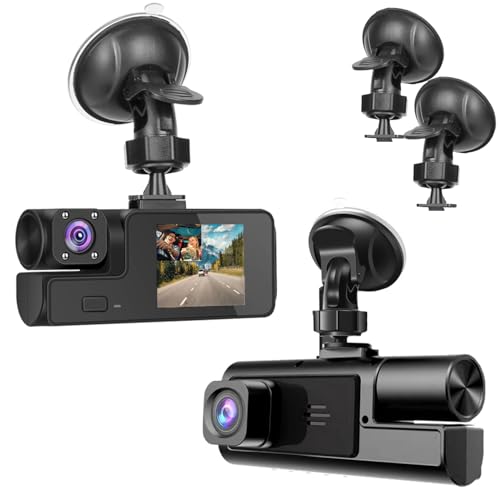
The 1080P Dual Dash Camera for Car delivers reliable, dual-position monitoring tailored for rideshare drivers who need clear evidence during passenger interactions and road incidents. I use it to record both the road ahead and my cabin in real time. It captures video at 1920×1080 resolution with a 170° wide-angle lens, ensuring maximum coverage. WDR technology balances light in high-contrast scenes. Night vision kicks in automatically in low light. Loop recording overwrites old files when the SD card fills. A built-in G-sensor locks footage during crashes. It mounts easily on my windshield and powers through the cigarette port.
Best For: Rideshare drivers seeking reliable dual-camera recording to document both road conditions and passenger interactions in clear 1080P detail.
Pros:
- Simultaneously records front and interior with 1080P resolution and a 170° wide-angle lens for comprehensive coverage
- Features WDR and automatic night vision for clear video in varying lighting, including low-light conditions
- G-sensor automatically protects crucial footage during impacts, while loop recording manages storage efficiently
Cons:
- Requires separate purchase of an SD card for operation, not included with the device
- Mount relies on suction cup, which may detach on hot or uneven windshields over time
- Limited to 2-inch screen playback; no app or Wi-Fi connectivity for easy video transfer
4K Dash Cam Front and Rear with WiFi

I rely on the K Dash Cam Front and Rear with WiFi when crystal-clear video evidence matters most-especially during night shifts or high-traffic urban runs. It records dual 4K UHD video at 3840×2160P, front and rear, ensuring every detail is captured. The front lens has a 170° wide field of view and an F1.5 aperture; the rear uses F1.8, both optimized for low light. Super Starlight Night Vision with WDR delivers full-color footage after dark. Built-in GPS logs speed, location, and route data directly in videos. Dual-band WiFi connects to the Terunsoul app for instant playback, updates, and control. Loop recording uses a 128GB card; expandable to 512GB. A G-sensor and manual lock button safeguard collision clips. Parking mode runs 24/7 at one frame per second, saving impact-triggered events. It includes a 3” IPS screen and requires a 5V/3A power supply-charger included, USB-C cable sold separately. Hardwiring enables constant power. I install mine with airbag clearance. It comes with an 18-month warranty and 24/7 support.
Best For: Night shift drivers and urban commuters who need reliable, high-resolution video evidence with advanced low-light performance and continuous parking monitoring.
Pros:
- Dual 4K UHD recording with Super Starlight Night Vision and WDR ensures crisp, colorful footage in any lighting condition
- Built-in GPS and dual-band WiFi enable precise route tracking and seamless wireless control via the Terunsoul app
- G-sensor, manual lock, and 24/7 parking mode protect critical footage, with expandable storage up to 512GB
Cons:
- Hardwire kit not included, necessary for full parking mode functionality
- USB-A to Type-C cable sold separately despite included car charger
- Installation requires careful placement to maintain airbag safety clearance
3-Channel 4K Dash Cam with WiFi & GPS

When you’re driving for a rideshare service, visibility into every part of your vehicle isn’t just helpful-it’s essential. I rely on the 3-Channel 4K Dash Cam with WiFi & GPS to cover front, interior, and rear views. Its 4K front camera, 1080P rear, and interior lenses deliver sharp detail with 170°, 160°, and 150° wide-angle coverage. I connect via 5.8GHz WiFi-transferring videos at 12MB/s, four times faster than standard 2.4GHz. Built-in GPS logs speed, route, and time directly into footage. IR night vision and WDR guarantee clear video in low light. A G-sensor locks crash clips automatically. I use 24-hour parking mode with a hardwire kit. The super capacitor handles extreme temperatures. I installed it in under 20 minutes.
Best For: Rideshare drivers, taxi operators, and families who need comprehensive 3-channel video coverage with advanced connectivity and reliable 24/7 surveillance.
Pros:
- Triple 4K and 1080P camera setup provides complete front, interior, and rear visibility with wide-angle lenses for maximum coverage
- 5.8GHz WiFi enables ultra-fast 12MB/s video transfers, and built-in GPS records accurate time, location, speed, and route data
- Enhanced night vision with IR and WDR ensures clear footage in low-light conditions, while G-sensor and 24-hour parking mode protect crucial clips
Cons:
- Requires separate hardwire kit for 24-hour parking mode, which may involve professional installation
- 64GB SD card may fill quickly with 4K recordings, limiting continuous loop recording without frequent transfers
- 5.8GHz WiFi, while fast, has shorter range and may not penetrate walls or long distances as effectively as 2.4GHz
JOMISE 4K Dash Cam Front and Rear
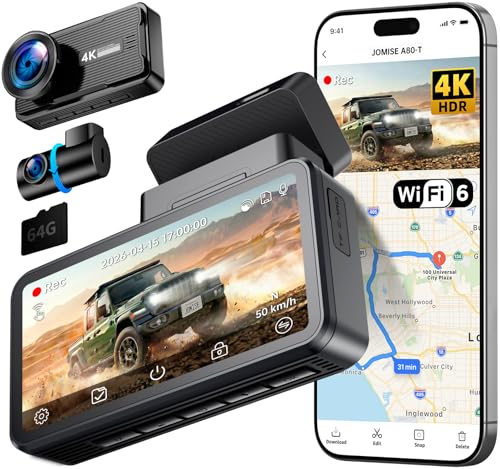
Looking for rock-solid evidence during night shifts or in heavy rain? The JOMISE 4K Dash Cam Front and Rear delivers. Its IMX678 STARVIS 2 sensor and F1.8 6-glass lens capture 4K front and 1080P rear video with 40% better low-light sensitivity. Real-time exposure control guarantees license plates stay readable in tunnels or downpours. PlatePix boosts recognition accuracy by 50%. Dual-band WiFi (5.8GHz/2.4GHz) transfers files up to 4× faster. A preloaded 64GB card enables setup in seconds. The 360° adjustable rear camera installs without drilling, using electrostatic stickers and an 18.04ft cable. Supercapacitors handle extreme temperatures reliably.
Best For: Drivers seeking reliable, high-resolution dash cam footage with superior low-light performance and easy installation for both daily commutes and overnight parking monitoring.
Pros:
- 4K front and 1080P rear video with enhanced low-light sensitivity and wide dynamic range for clear footage in challenging conditions
- Dual-band WiFi enables fast, stable file transfers and instant playback via mobile app
- Supercapacitor-powered design ensures stable operation in extreme temperatures with no risk of battery swelling
Cons:
- Limited to 64GB storage (no expandable option mentioned), which may fill quickly with 4K recording
- Rear camera cable is long (18.04ft) but not stealth-friendly, potentially requiring careful routing
- No mention of cloud connectivity or built-in screen, requiring smartphone access for viewing
Vantrue N2X 2.7K Dash Cam Dual

The Vantrue N2X 2.7K Dual Camera System stands as a top-tier choice for rideshare drivers who need reliable, high-resolution documentation of both road and cabin activity. My front camera records at 1944p, with 1440p at 60fps support, while the interior shoots 1080p. The front 158° FOV and interior 165° lens, with 45° rotation, cover wide angles. Dual STARVIS 2 sensors improve night clarity. Four IR LEDs let me see in total darkness. 5G WiFi lets me preview and edit videos fast. GPS logs speed, location, and time. A hardwired kit enables 24/7 parking mode with motion detection. Loop recording uses a 512GB card.
Best For: Rideshare, taxi, and delivery drivers who need high-resolution dual-camera recording with advanced night vision and parking surveillance.
Pros:
- High-resolution front and interior cameras with excellent low-light performance thanks to dual STARVIS 2 sensors
- 5G WiFi and GPS integration for real-time video access, route tracking, and detailed driving reports
- Comprehensive 24/7 parking mode with motion detection, pre-recording, and G-sensor protection when hardwired
Cons:
- Hardwire kit required for continuous parking surveillance, sold separately
- Interior camera’s 45° rotation may limit optimal positioning in some vehicle configurations
- Not compatible with Power Delivery fast chargers, limiting power options during use
Factors to Consider When Choosing a Dash Cam for Rideshare
You need a dash cam that captures clear evidence while you’re on the road. Look for at least 1440p resolution on the front camera to identify license plates and road signs clearly, and make sure it includes rear-view coverage with a 1080p camera and a wide 150-degree field of view. Night vision with Sony Starvis sensors and parking mode with motion detection guarantee reliable recording even when your car’s off.
Front Camera Resolution
A sharp front camera makes all the difference when documenting rideshare incidents. You need clear footage to capture license plates, road signs, and driving behavior. Opt for at least 2.5K (1440P) resolution-it’s a balanced upgrade over 1080P, offering better detail without overwhelming your storage. If possible, go for 4K (3840×2160P); it delivers superior clarity across multiple lanes. Pair high resolution with a wide 170° field of view to cover more of the road. Advanced sensors and image processing boost performance in mixed lighting, like when entering tunnels. This combo guarantees critical moments stay visible. Just remember: 4K demands more storage and faster write speeds. Always use a Class 10, U3-rated memory card to handle the data load smoothly. Don’t cut corners-your evidence is only as strong as your camera’s resolution.
Rear View Coverage
While front camera resolution captures what’s ahead, don’t overlook the importance of strong rear view coverage-your back is just as exposed during rideshare operations. You need at least a 150° wide-angle field of view to eliminate blind spots and monitor traffic directly behind you. Choose a rear camera with 1080P resolution or higher to clearly capture license plates and vehicle details in rear-end collisions. Make sure the unit is waterproof and built for external mounting so it withstands rain, snow, and extreme temperatures. Opt for systems with loop recording and a G-sensor on the rear channel to automatically save footage when impacts occur. For added protection, select models with time-lapse parking mode and rear motion detection-this helps record hit-and-runs or vandalism when your car is unattended.
Night Vision Capability
Clear visibility during nighttime rides isn’t optional-it’s a baseline requirement for rideshare safety and incident documentation. You need a dash cam with strong night vision capability to capture critical details in low-light conditions. Infrared (IR) LEDs, typically four or more, let the camera record in total darkness, especially inside your vehicle. Look for models with Wide Dynamic Range (WDR) to balance exposure when bright headlights or tunnel exits create harsh contrasts. A larger aperture lens (F1.5–F1.8) gathers more light, boosting clarity and color accuracy. Pair that with a STARVIS or STARVIS 2 sensor for up to 40% better low-light performance than standard sensors. These technologies work together to deliver sharp, detailed footage when you need it most-ensuring no detail goes unnoticed, even on pitch-black roads.
Parking Mode Features
How do you guarantee your vehicle stays protected when you’re not behind the wheel? Activate 24-hour parking mode, which keeps your dash cam recording even when the engine’s off-powered by a hardwired connection to prevent battery drain. Use time-lapse recording to capture footage at 1–5 FPS, cutting storage use while maintaining full coverage. Enable motion and G-sensor detection to auto-record and lock clips when impacts or movement occur-it’s like a security alarm for your car. Choose models with supercapacitors, not lithium batteries, for reliable function in extreme heat or cold. Rely on loop recording to keep storage free: old unmarked files get overwritten automatically, so you never run out of space. Parking mode gives you hands-free protection, day and night, ensuring every incident is documented without you lifting a finger.
Ease Of Installation
Getting your dash cam set up quickly and correctly matters most when you’re earning every minute behind the wheel. Choose plug-and-play models that power through the cigarette lighter port-no wiring or professional help needed. Pick units with adjustable suction mounts or magnetic brackets for stable, instant windshield attachment that won’t block your view. Use cable management clips and trim tools included in most kits to route wires cleanly along door seals and under dash panels. Opt for cams with pre-labeled, 18+ foot rear cables so wiring reaches the back without splicing. Look for built-in display screens with real-time setup menus-adjust settings on the spot without depending on a phone app. Fast, secure installation cuts downtime and keeps your focus where it belongs: on driving.
Wireless Connectivity Options
Why wait minutes-or even hours-to access critical footage when seconds count?
Built-in WiFi lets you connect your dash cam directly to your smartphone, so you can preview, play back, and share videos instantly-no card removal needed. Dual-band WiFi (2.4GHz and 5.8GHz) guarantees faster, more stable connections, reaching transfer speeds up to 20MB/s. You can download 4K footage seamlessly and manage large files efficiently from your phone. High-speed wireless transfers are essential when documenting rideshare incidents quickly. Wireless firmware updates keep your device current with the latest features and security patches-no cables or computers required. Fast access to video reduces downtime and strengthens your accountability. With dual-band WiFi, your connection won’t drop, even in congested areas. Think of it like upgrading from dial-up to broadband-only for your car’s security system. Choose strong wireless connectivity. It saves time, effort, and hassle every single day.
Frequently Asked Questions
Can I Use a Dash Cam Without GPS?
Yes, you can use a dash cam without GPS. It’ll still record video clearly and save footage automatically. Without GPS, though, you lose location tracking and speed data overlay-key for verifying trip details. Most mid-range and high-end models include built-in GPS, but basic models often skip it. If you need location proof for insurance or disputes, get a model with GPS. Otherwise, a non-GPS dash cam works fine for general recording.
Do Dash Cams Record While Parked?
Yes, you can use a dash cam without GPS. Dash cams record video using internal sensors and memory cards. Most operate on 12V power from your vehicle’s battery. Without GPS, you lose speed and location data overlays, but video evidence remains clear. Standard models capture 1080p at 30fps. Use Class 10 microSD cards up to 128GB. Parking mode requires hardwiring to detect motion or impact while the engine’s off.
How Long Do Dash Cam Recordings Save?
You can expect your dash cam to save recordings for 1–5 days, depending on settings. Most loop-record every 1–3 minutes. With a 32GB card, you’ll get about 2–4 hours of 1080p footage. Higher resolutions like 1440p fill storage faster. Once full, the cam overwrites the oldest files. Parking mode uses smaller clips, extending retention. G-sensor events lock files, preserving them until manually cleared or overwritten after several days.
Are Dash Cams Legal for Rideshare Drivers?
Yes, dash cams are legal for rideshare drivers in the U.S. You can legally record in your vehicle while driving for Uber or Lyft. Federal law allows one-party consent for audio recording, meaning you can record if you’re part of the conversation. Most states follow this rule. Use your dash cam only for safety and evidence. Avoid placing it in the windshield’s upper center to maintain visibility and comply with FMVSS standards.
Can Passengers See the Dash Cam?
Yes, passengers can usually see the dash cam. Most models mount on the windshield near the rearview mirror, placing them in clear view. Cameras typically measure 2–4 inches long and have a visible lens. Positioning it correctly guarantees it captures the road ahead without blocking your line of sight. Always angle it to record the front window while keeping it noticeable to passengers, promoting transparency and discouraging misconduct.