Top-Rated Diesel Filters for Maximum Engine Protection
You need a diesel filter that delivers precise protection, and top choices like the GM Genuine Parts TP3018 and Doc’s Diesel DGF429 offer 96.92% efficiency at 3 microns. These capture dirt, rust, and water before they damage injectors. The FASS Titanium Series uses a 2-micron absolute water separator to block ultrafine contaminants. Metal casings resist pressure fatigue, while high-surface-area media extends service life. Each is engineered to meet or exceed OEM standards, ensuring reliable performance. More details reveal how each model matches specific engine needs.
We are supported by our audience. When you purchase through links on our site, we may earn an affiliate commission, at no extra cost for you. Learn more. Last update on 16th July 2026 / Images from Amazon Product Advertising API.
Notable Insights
- Top-rated diesel filters offer 96.92% efficiency at 3 microns to capture dirt, rust, and water contaminants.
- Filters like Delphi G11103 and Doc’s Diesel DGF429 meet OEM standards for reliable engine protection.
- Dual-filter systems such as FASS Titanium Series provide 2-micron absolute water separation for maximum defense.
- High surface area media increases contaminant holding capacity and extends service life up to 15,000 miles.
- Effective water separation prevents injector damage and reduces wear in high-pressure fuel systems.
GM Genuine Parts TP3018 (19431541) Fuel Filter Kit
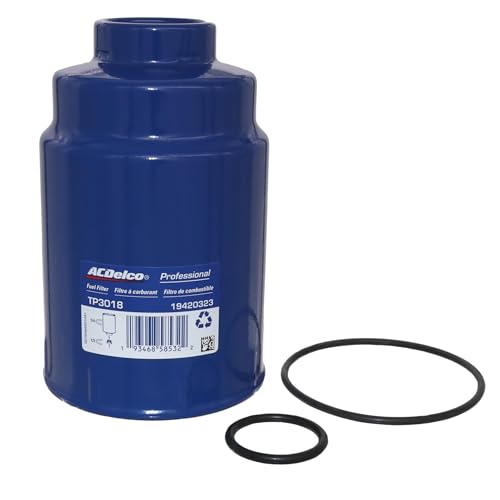
If you own a Chevrolet, Buick, GMC, or Cadillac diesel vehicle, the GM Genuine Parts TP3018 (19431541) Fuel Filter Kit is one of the best choices to guarantee long-term engine protection. I rely on this filter because GM engineers design, test, and validate it to strict OEM standards. It fits precisely, ensuring seamless integration with your vehicle’s fuel system. The filter traps dirt, rust, and contaminants before they reach sensitive components. Built as original equipment, it matches factory specs exactly. Some versions were once branded ACDelco; GM updates designs using advanced materials. This filter isn’t an upgrade-it’s the standard.
Best For: Owners of Chevrolet, Buick, GMC, or Cadillac diesel vehicles seeking reliable, OEM-spec fuel filtration for optimal engine protection.
Pros:
- Engineered and tested by GM to meet strict OEM standards for fit, performance, and durability
- Effectively filters dirt, rust, and fuel contaminants to protect sensitive fuel system components
- Direct replacement designed to integrate seamlessly with original vehicle specifications
Cons:
- Limited to GM diesel vehicle applications, reducing versatility for other makes or fuel types
- May be priced higher than aftermarket alternatives without added performance benefits
- Some users may confuse it with older ACDelco-branded versions due to rebranding history
Doc’s Diesel Fuel Filter DGF429

I rely on Doc’s Diesel Fuel Filter DGF429 when protecting high-performance diesel engines from contaminated fuel, especially in heavy-duty 2500HD and 3500HD trucks. It fits 2017–2019 6.6L Duramax and 2020–2025 3.0L Duramax models. The filter removes water, dirt, rust, and debris with 96.92% efficiency at 3 microns. High surface area media extends service life and improves fuel flow. It replaces AC/Delco TP1015, Wix WF10451, and others. I replace it every 5,000 to 10,000 miles, up to 15,000 under clean conditions. O-rings are included. Always follow factory maintenance guidelines.
Best For: Diesel truck owners with 2017–2019 6.6L or 2020–2025 3.0L Duramax engines seeking reliable fuel protection and improved performance in heavy-duty 2500HD and 3500HD models.
Pros:
- High filtration efficiency of 96.92% at 3 microns effectively removes water, dirt, rust, and debris
- Compatible with major OEM and aftermarket filters, replacing AC/Delco TP1015, Wix WF10451, and others
- Extended service life with recommended replacement every 5,000 to 15,000 miles and included o-rings for easy installation
Cons:
- Maximum 15,000-mile replacement interval may be shorter than some competitors, increasing long-term maintenance frequency
- Limited to specific Chevrolet and GMC Duramax models, reducing vehicle applicability
- Third-party tested but not OEM-branded, which may raise concerns for some warranty-conscious users
Doc’s Diesel Fuel Filter DFD4625 for Ford 6.7L

You’ll get superior fuel protection with the Doc’s Diesel Fuel Filter DFD4625 if your truck is a 2017–2025 Ford 6.7L Powerstroke. I rely on its 96.92% efficiency at 3-micron filtration to trap dirt, rust, and debris. It replaces Motorcraft FD4625, Baldwin PF46174, and others, ensuring a direct fit. The filter uses high-quality media to maximize surface area and contaminant capture. It includes o-rings and is built with a durable metal casing. I recommend replacing it every 5,000 to 10,000 miles, up to 15,000 under clean conditions. Part DF-4625 weighs 1.92 pounds and measures 12.32 x 9.84 x 6.18 inches.
Best For: Ford 6.7L Powerstroke owners from 2017–2025 seeking a high-efficiency, direct-fit replacement fuel filter that ensures clean fuel delivery and optimal engine performance.
Pros:
- 96.92% filtration efficiency at 3 microns effectively removes dirt, rust, and debris
- Direct replacement for Motorcraft FD4625 and other major brands with included o-rings for easy installation
- Durable metal casing and high-quality filtration media maximize contaminant capture and service life
Cons:
- Replacement recommended as frequently as every 5,000 to 10,000 miles, which may increase maintenance costs
- Limited to Ford 6.7L Powerstroke models, reducing versatility across other engines
- Slightly heavier and bulkier dimensions may make handling less convenient compared to smaller filters
496 Fuel Tank Filter Assembly 30 Micron

The DICMIC 496 Fuel Tank Filter Assembly 30 Micron is ideal for operators who demand reliable protection for diesel and gasoline engines in high-contamination environments. I rely on its 30-micron filter element to trap rust, sand, dirt, and water efficiently. It’s compatible with fuels containing up to 20% biodiesel and replaces B10-AL models. The 1” NPT inlet and outlet support up to 25 gpm flow at 150 psi. A hyaline bowl enables visual fuel inspection, while the integrated drain removes water. Flow drop signals when I replace the filter. It pairs with 496-5 filters and 495-4 bowls. I appreciate the included wrench and thread tape. It measures 9.84 x 4.72 x 4.53 inches and weighs 1.72 pounds.
Best For: Operators seeking a durable, high-flow fuel filter assembly for gasoline, diesel, or biodiesel blends up to 20% in demanding environments.
Pros:
- 30-micron filtration effectively removes contaminants like rust, sand, dirt, and water
- Hyaline bowl enables visual inspection of fuel condition and flow, with integrated drain for water removal
- Includes installation wrench and thread tape; compatible with common filter and bowl models (496-5, 495-4)
Cons:
- Limited to 20% biodiesel content, not suitable for higher biofuel blends
- Flow rate drops significantly under gravity feed (5 gpm vs. 25 gpm under pressure)
- Plastic or metal outer material may vary, potentially affecting long-term durability perception
Mopar OEM Diesel Filter Bundle

Since maintaining factory specifications is critical for peak performance, Mopar OEM Diesel Filter Bundle stands as the best choice for Ram 2500 and 3500 owners with 6.7L Cummins engines between 2013 and 2019. I rely on this kit because it includes three essential filters: Fuel/Water Separator (68197867AB), Fuel Filter (68157291AA), and Oil Filter (05083285AA). Each is built to original equipment standards. The bundle fits 2013–2017 Ram 4500/5500 models too. It weighs 3.56 pounds, stores in a compact 15.55 x 11.22 x 5.43-inch canister package. Plastic housing with painted finish resists corrosion. With an ASIN of B0DJPMQVK4 and a 4.2-star rating from 336 users, it ranks #4 in fuel filters.
Best For: Ram 2500, 3500, 4500, and 5500 owners with 6.7L Cummins diesel engines (2013–2019) seeking factory-spec filter replacements for optimal performance and engine protection.
Pros:
- Includes three genuine Mopar OEM filters designed specifically for 6.7L Cummins engines, ensuring perfect fit and reliability
- Helps maintain peak engine efficiency and long-term durability by filtering contaminants from fuel and oil
- Highly rated with a 4.2-star average from 336 customer reviews and ranks #4 in automotive fuel filters
Cons:
- Not compatible with 2020 and later Ram truck models, limiting use for newer vehicle owners
- Slightly heavier and bulkier packaging (3.56 lbs, 15.55 x 11.22 x 5.43 in) may be less convenient for storage
- Premium OEM pricing may be higher compared to aftermarket filter alternatives
Doc’s Diesel Fuel/Water Separator for RAM 6.7L

Anyone relying on a 2019–2024 RAM 6.7L Cummins-especially in heavy-duty 2500, 3500, 4500, or 5500 configurations-gets real protection with Doc’s Diesel Fuel/Water Separator. I trust this dual-filter kit-DGF430 and DGF401-to deliver 3-micron filtration at 96.92% efficiency. It removes water, dirt, rust, and debris before they reach sensitive components. Third-party testing confirms its high-performance standards. The increased filtration surface area supports longer service life and steady fuel flow. Each unit includes proper o-rings. DGF430 replaces Mopar 68436631AA; DGF401 replaces 68157291AA. I change them every 5,000–10,000 miles, never exceeding 15,000.
Best For: Heavy-duty RAM 6.7L Cummins owners seeking reliable fuel protection and enhanced engine performance.
Pros:
- Delivers 3-micron filtration with 96.92% efficiency to remove water, dirt, rust, and debris
- Includes both DGF430 and DGF401 filters with o-rings, designed specifically for 2019–2024 RAM 6.7L models
- Extended service life due to increased filtration surface area and optimal fuel flow
Cons:
- Requires more frequent changes (every 5,000–10,000 miles) compared to some OEM filters
- Not compatible with pre-2019 RAM 6.7L models or non-Cummins engines
- Slight premium over basic replacement filters without advanced filtration specs
FASS Titanium Series Fuel Filter Package XWS-3002 / PF-3001

Diesel engines hauling heavy loads or operating in harsh conditions demand uncompromising fuel protection-this is where the FASS Titanium Series Fuel Filter Package XWS-3002 / PF-3001 stands out. I rely on its 2-micron absolute XWS-3002 water separator on the pressure side to trap contaminants and eliminate water without manual draining. The PF-3001 particulate filter, rated at 144 microns, mounts on the suction side to prevent debris from reaching the pump. Together, they reduce cavitation, boost fuel flow, and quiet operation. Made of stainless steel, this 2.48-pound system measures 7.76 x 5.98 x 3.98 inches and fits universally, but isn’t compatible with older FASS models.
Best For: Diesel truck and bus owners who require high-efficiency fuel filtration and water separation for heavy-duty or harsh-condition operations.
Pros:
- Combines a 2-micron absolute water separator and a 144-micron suction-side particulate filter for comprehensive fuel protection
- Eliminates need for manual water draining and helps reduce cavitation, noise, and pump wear
- Durable stainless steel construction with universal fit design for broad compatibility
Cons:
- Not compatible with older FASS models (FF-3003, FF-3010, FS-1001, FS-1020), limiting upgrade paths
- Requires precise installation on pressure and suction sides, increasing complexity
- Higher cost compared to standard fuel filters due to advanced filtration technology
Doc’s Diesel CCV Filter D804418 for RAM Cummins

If you own a RAM 2500, 3500, 4500, or 5500 with a 6.7L Cummins engine built between 2007.5 and 2025, the Doc’s Diesel CCV Filter D804418 is the right choice for maintaining clean crankcase ventilation. It replaces Mopar/Fleetguard CV52001 and Dorman 904-418 directly. I rely on this filter to capture blow-by gases and oil vapors that cause sludge and engine wear. It extends oil life and reduces carbon buildup in the intake. I recommend replacing it every 50,000 to 60,000 miles, maxing out at 67,500. Built to exceed OEM standards, Doc’s Diesel-based in Northwest Ohio-designs it for durability.
Best For: RAM 2500–5500 owners with 6.7L Cummins engines (2007.5–2025) seeking reliable, long-lasting crankcase ventilation protection.
Pros:
- Effectively captures blow-by gases and oil vapors to reduce sludge and carbon buildup
- Extends engine and oil life, improving overall performance and lowering maintenance costs
- Direct replacement for Mopar/Fleetguard CV52001 and Dorman 904-418, built to exceed OEM standards
Cons:
- Replacement interval is relatively frequent at 50,000–60,000 miles
- Only compatible with specific RAM Cummins models, limiting vehicle fitment
- May require aftermarket tuning or monitoring to optimize CCV system performance
Factors to Consider When Choosing a Diesel Filter
You need to check the filtration efficiency rating, as it tells you how well the filter captures contaminants-look for filters rated at 90% or higher for particles as small as 5 microns. Make sure the micron rating matters for your engine type, since most modern diesels require a rating of 2 to 10 microns to protect tight-tolerance components. Always confirm vehicle compatibility, stick to recommended replacement intervals, and choose filters with proven contaminant removal capability to keep your engine running clean.
Filtration Efficiency Rating
Efficiency lies at the heart of diesel filter performance. You need a filter that captures nearly all harmful particles before they reach your engine. A filtration efficiency rating tells you the percentage of contaminants removed at a specific micron size. For example, a filter with 96.92% efficiency at 3 microns stops almost all particles that small. Modern diesel engines demand this level of protection due to tight fuel system tolerances. High-efficiency filters prevent abrasive wear in injectors and pumps by trapping dirt, rust, and debris. Look for filters with proven efficiency in the 2–5 micron range. Absolute ratings indicate the smallest particle completely blocked, while nominal ratings show the percentage captured. You’re better off choosing high-efficiency models designed for today’s high-pressure fuel systems. They deliver cleaner fuel and longer component life.
Micron Rating Importance
While finer filtration enhances protection, the micron rating of a diesel filter determines exactly which contaminants it can capture. You need a filter that balances precision with performance. A 2- to 3-micron rating traps dirt, rust, and debris before they harm injectors or pumps. Filters rated at 3 microns have proven 96.92% efficiency in independent tests, blocking nearly all harmful particulates. Absolute 2-micron filters go further, capturing ultrafine particles and water droplets that threaten fuel system integrity. But finer isn’t always better-you risk faster clogging, shorter service life, and restricted fuel flow if the micron rating is too low for your operating conditions. Matching micron size to your engine’s demands guarantees peak efficiency without compromising reliability. Choose wisely: too coarse, and contaminants slip through; too fine, and you’ll face unnecessary maintenance. Your engine depends on getting this balance right.
Vehicle Compatibility Check
How well does your diesel filter match your vehicle’s exact requirements? You must verify your engine type, model year, and displacement to guarantee compatibility with manufacturer specifications. Filters are engineered for specific engine platforms-using the wrong one risks poor performance or damage. Check the filter’s physical dimensions and mounting setup so it fits tightly in the engine bay and secures to fuel lines without leaks. Confirm it’s rated for your fuel type, especially if using biodiesel blends like B20, to avoid seal degradation. Guarantee the micron rating matches OEM standards-typically 2 to 10 microns-for proper filtration efficiency. The filter should meet or exceed original equipment manufacturer performance benchmarks. Always cross-reference your vehicle’s service manual to guarantee fitment, maintain warranty compliance, and support long-term engine protection.
Replacement Interval Guidelines
You’ve confirmed your diesel filter matches your vehicle’s make, model, and engine specs-now it’s time to determine how often to replace it. Most manufacturers recommend changing fuel filters every 5,000 to 10,000 miles. Some intervals extend up to 15,000 miles depending on engine design and operating conditions. CCV filters may last as long as 67,500 miles, but these are exceptions. Never exceed the maximum interval listed in your vehicle’s manual-doing so risks poor filtration and engine damage. Stick to the OEM schedule to maintain warranty coverage and guarantee peak performance. Aftermarket filters might list high efficiency ratings, but their replacement timing still depends on factory guidelines. Treat each filter as part of a precision system. Skipping timely changes is like ignoring oil changes-eventual failure isn’t a matter of if, but when.
Contaminant Removal Capability
Performance depends on what your diesel filter can stop. You need a filter that captures contaminants before they damage sensitive fuel components. Look for filtration efficiency up to 96.92% at 3-micron particles-this traps dirt, rust, and debris effectively. A 2-micron absolute rating delivers superior protection, removing fine particulates and water droplets most filters miss. High surface area media increases contaminant holding capacity, extending service life even under dirty or variable fuel conditions. Water separation is critical; even small amounts cause corrosion and injector wear. Multi-stage systems rated below 10 microns tackle sand, rust, and microbial growth with precision. Don’t rely on basic screens-they won’t stop microscopic threats. Your engine demands proven sub-micron defense. Choose filters engineered for maximum contaminant removal, not just minimum compliance. Real protection starts with what you block, not what you let through.
Material And Build Quality
While some filters cut corners on construction, premium diesel filters use robust materials designed to withstand extreme pressure and temperature fluctuations. You’ll find metal outer casings on top-tier models because they resist cracking and handle high fuel pressure better than plastic housings, which can weaken over time. The filtration media matters just as much-high-quality filters use finely layered synthetic fibers with increased surface area to trap more contaminants without restricting fuel flow. Look for 3-micron or lower efficiency ratings; they catch tiny particles like dirt and rust that destroy injectors. Seals and o-rings are made from synthetic rubber, like nitrile or Viton, so they won’t degrade when exposed to diesel or common additives. Third-party tested filters often publish dust retention and flow rate data, proving consistent build quality and reliable performance under real-world conditions.
Installation Ease And Components
A well-designed diesel filter system simplifies maintenance and guarantees reliable operation with minimal downtime. You’ll save time when the kit includes multiple filters, o-rings, and necessary hardware-everything needed for installation in one package. Universal fit filters often lack dedicated mounting solutions, forcing you to add adapters or modify brackets for a secure fit. Look for models with clearly labeled 1” NPT inlet and outlet ports; they guarantee leak-free connections to standard fuel lines without guesswork. An integrated drain valve lets you remove water quickly without disassembling the housing. Since most diesel filters require replacement every 5,000 to 15,000 miles, choose one that installs with basic hand tools and minimal fuel line disruption. Easy access to the filter element cuts service time and reduces the risk of contamination during changes.
Frequently Asked Questions
How Often Should I Replace My Diesel Fuel Filter?
You should replace your diesel fuel filter every 10,000 to 25,000 miles. This interval depends on your engine type, fuel quality, and driving conditions. Modern high-pressure common rail systems are sensitive to contamination. Most manufacturers specify a 15,000-mile service interval. Use filters meeting OEM specifications like ISO 16332 for efficiency. A clogged filter increases fuel restriction, reducing power and risking injector damage. Check your owner’s manual.
Can I Install a Diesel Filter Myself?
Yes, you can install a diesel filter yourself if you have basic mechanical skills. You’ll need a wrench, drip pan, and the correct replacement filter. Shut off the fuel supply and relieve system pressure first. Align the new filter properly-most use a gasket seal and torque to 15–25 ft-lbs. Double-check connections. A single mistake risks air in the fuel line or leaks that damage your engine.
Do Diesel Filters Improve Fuel Mileage?
Yes, diesel filters can improve fuel mileage. You remove contaminants that disrupt fuel atomization and combustion efficiency. A clean filter maintains ideal fuel pressure-typically 45–75 psi in common rail systems. When injectors receive clean, consistent fuel, engine timing and air-fuel ratios stay precise. You’ll see up to 5% better fuel economy in long-haul conditions. Flow rates of 150+ GPH in premium filters support this performance without restriction.
Are OEM Filters Better Than Aftermarket Ones?
Yes, OEM filters are generally better than aftermarket ones. You get precise engineering matched to your engine’s specs. OEM units often use higher-grade media, trapping particles as small as 5 microns. They’re tested to meet strict flow and efficiency standards, like ISO 16889. Aftermarket filters vary in quality-some match OEM performance, but many cut corners on seals or bypass valves, risking long-term engine wear.
What Happens if Water Enters My Diesel Fuel System?
Water in your diesel fuel system causes immediate damage. It corrodes injectors, disrupts combustion, and promotes microbial growth. Most diesel injectors tolerate less than 500 parts per million of water; exceeding this voids warranties. Unfiltered water leads to fuel pump failure and poor atomization, reducing efficiency. Modern filters use coalescing media to separate water from fuel, achieving 95% removal efficiency. You need a filter with hydrophobic membranes to protect your engine long-term.