Best High Build Primer: 5 Top Picks Compared (2K & Spray)
You need a high-build primer that bridges scratches and delivers a smooth, sandable surface. Rust-Oleum 2-in-1 fills and primes in one oil-based coat, covers 10 sq ft, and dries in 10 minutes. For deeper repair, Restoration Shop’s 2K urethane kit offers 1.25 gallons of shrinkage-resistant film. Sherwin-Williams 2K primer builds fast with even sanding. LiME LiNE 1K adheres to plastic and metal, stays flexible, and dries in under 30 minutes. Each guarantees durable, professional results-discover which formula matches your substrate and workflow.
We are supported by our audience. When you purchase through links on our site, we may earn an affiliate commission, at no extra cost for you. Learn more. Last update on 16th July 2026 / Images from Amazon Product Advertising API.
Notable Insights
- Rust-Oleum 2-in-1 Filler & Primer Spray offers fast drying and sandable high-build coverage for metal, wood, and fiberglass.
- Restoration Shop 1.25 Gal 2K Primer Kit delivers shrinkage-resistant, high-solids fills for deep scratches and professional finishes.
- Dupli-Color FP101 fills deep scratches and sands smoothly, ideal for precise aerosol touch-ups on minor surface flaws.
- Sherwin-Williams 2K Gray Urethane Primer provides fast film build and even sanding with minimal coats for flawless results.
- LiME LiNE 1K Flexible Primer adheres to plastic and metal, offering crack-resistant, quick-drying coverage for dynamic surfaces.
Rust-Oleum 2-in-1 Filler & Primer Spray

If you’re working on automotive panels with minor dents or surface flaws, Rust-Oleum 260510 Stops Rust 2-in-1 Filler & Sandable Primer Spray is your best choice. I rely on this oil-based formula because it combines filler and sandable primer in one application. It adheres to metal, wood, and fiberglass, making it ideal for cars, trucks, and other vehicles. It covers up to 10 sq ft per 12 oz can. The spray dries to the touch in 10 minutes and is ready for recoating quickly. It fills small imperfections and sands smoothly, ensuring a flat finish. Stops Rust technology provides a durable, rust-resistant base coat for superior top coat adhesion and long-term protection.
Best For: Automotive enthusiasts and DIYers repairing minor dents and surface flaws on cars, trucks, or metal, wood, and fiberglass surfaces requiring a fast-drying, rust-resistant filler and primer.
Pros:
- Combines filler and sandable primer in one oil-based application, saving time and effort
- Dries to the touch in 10 minutes and is ready for recoating quickly, speeding up project timelines
- Features Stops Rust technology for durable, rust-resistant protection and superior top coat adhesion
Cons:
- Limited coverage of only 10 sq ft per can, requiring multiple cans for larger projects
- Oil-based formula may require proper ventilation and longer cure times in humid conditions
- Gray color may not suit all surface types without additional topcoats for aesthetic finish
Rust-Oleum 249279 Automotive Filler Primer Spray, 11 oz, Gray
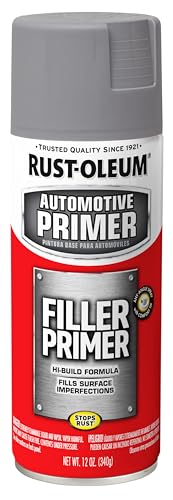
I rely on Rust-Oleum 249279 Automotive Filler Primer Spray when I need a fast-drying, high-build solution for patching and prepping automotive surfaces. It’s an oil-based formula with Stops Rust technology, so it delivers reliable corrosion resistance. I use it on metal, wood, and fiberglass with consistent results. The gray primer covers up to 12 sq ft per can and dries to the touch in 10 minutes-ready for recoating fast. It fills minor imperfections and sands easily. The flat finish guarantees superior topcoat adhesion for any paint system.
Best For: DIY auto restorers and mechanics needing a fast-drying, rust-resistant filler primer for metal, wood, and fiberglass surfaces.
Pros:
- Dries to the touch in just 10 minutes, enabling quick recoating
- Fills minor surface imperfections and sands easily for a smooth finish
- Provides excellent adhesion and compatibility with any topcoat paint system
Cons:
- Limited coverage of only 12 sq ft per can may require multiple cans for larger jobs
- Oil-based formula may require longer curing time in humid or cold conditions
- Strong odor and VOC content necessitate use in well-ventilated areas or with respiratory protection
Rust-Oleum 2-in-1 Primer Spray (6-Pack)

The Rust-Oleum 260510-6PK Automotive 2-in-1 Filler & Sandable Primer Spray is my go-to choice when I need a high-build primer that delivers a smooth, professional finish on vehicle surfaces. It’s oil-based and combines filler with sandable primer in one formula. This dual-action design fills minor imperfections and sands flat, saving time over separate applications. It works on metal, fiberglass, and wood, making it ideal for cars, trucks, and automotive repairs. Each 12 oz can covers up to 10 sq. ft. Six cans in the pack let me tackle multiple jobs. Stops Rust technology prevents corrosion. It dries to the touch in 10 minutes and allows recoating at the same time.
Best For: Automotive enthusiasts and DIYers looking for a fast-drying, rust-resistant, high-build primer that combines filler and sandable primer in one for quick repairs on cars, trucks, and other vehicles.
Pros:
- Oil-based 2-in-1 formula fills minor imperfections and sands smooth for a professional finish
- Stops Rust technology provides excellent corrosion resistance
- Dries to the touch and allows recoating in just 10 minutes, boosting efficiency
Cons:
- Limited coverage of only 10 sq. ft. per can may require multiple cans for larger projects
- Oil-based formula requires proper ventilation and protective gear during application
- Gray color may not be ideal for all paint finishes without proper top coating
Restoration Shop 1.25 Gal 2K Primer Kit

You get a professional-grade high-build primer system built for auto body shops tackling serious refinishing jobs. I use the Restoration Shop 1.25 Gal 2K Primer Kit for its 4:1 mix ratio-1 gallon of gray urethane primer surfacer and 1 quart hardener-yielding 1.25 gallons of sprayable, high-solids coating. It fills medium to deep sand scratches effectively and resists shrinkage. I apply it directly to bare metal, filler, or plastic with excellent adhesion. It sands easily, wet or dry, with no clogging. Compatible with urethane finishes and tintable for color match. Made in the USA with premium raw materials for consistent, durable results.
Best For: Professional auto body shops and restoration specialists seeking a high-build, durable 2K urethane primer for refinishing cars and trucks.
Pros:
- High-solids, 4:1 mix ratio formula provides excellent build and fills medium to deep sand scratches effectively
- Sands easily with wet or dry methods, resists clogging, and offers superior adhesion on metal, filler, and plastics
- Compatible with urethane finishes and tintable for color matching, made in the USA with premium raw materials
Cons:
- Requires proper ventilation and PPE due to being a two-component chemical coating
- Not suitable for beginners without experience in mixing and spraying automotive primers
- Limited shelf life once mixed, requiring timely application after activation
Sherwin-Williams 2K Gray Urethane Primer Quart

Perfect for small automotive shops and DIY car lovers who demand professional-grade results without complexity, Sherwin-Williams 2K Gray Urethane Primer Quart delivers high-build performance in a manageable size. I use the FP410-4 kit because it’s part of the value-driven Finish 1 line, which balances cost and quality. It’s a two-component urethane formula, so it cures hard and resists sand scratch swelling. The high-build film builds fast, minimizing coats. I mix it with the included hardener at a simple ratio-no guesswork. It sands evenly, almost like butter, saving me time. I trust this primer for a rock-solid base every time.
Best For: Small automotive shops and DIY car enthusiasts seeking a high-performance, easy-to-use urethane primer in a convenient quart size.
Pros:
- High-build formula delivers thick coverage quickly, reducing the number of coats needed
- Easy 4:1 mix ratio with included hardener ensures consistent, hassle-free preparation
- Sands smoothly and resists swelling, saving time during finishing
Cons:
- Two-component system requires careful mixing and immediate use after activation
- Limited to smaller projects due to quart kit size
- May require proper ventilation and PPE due to chemical nature of urethane products
Seymour 20-1674 PBE Professional Primer, Gray Filler

Busy body shop pros who need a reliable, fast-drying primer that handles deep surface scratches turn to Seymour 20-1674 PBE Professional Primer, Gray Filler. I rely on it because it’s built for tough prep jobs on metal. It minimizes deep scratches, creating a smooth finish. The large sprayhead delivers even, professional coverage fast. It dries quickly into a thick, sandable base coat. I can sand it smooth in under an hour. It resists heat up to 250°F-perfect for underhood work. The formula meets VOC limits, so it’s shop-legal in most states. I trust it for high-performance surface prep. It’s efficient, tough, and consistent every time.
Best For: Body shop professionals seeking a fast-drying, high-performance gray filler primer for repairing deep surface scratches on metal.
Pros:
- Fast-drying formula allows sanding in under an hour, supporting an efficient workflow
- Large sprayhead delivers even, professional coverage for consistent results
- Heat resistant up to 250°F and VOC compliant, making it suitable for underhood use and legal in most states
Cons:
- Gray color may not suit all substrates or require additional topcoats for color matching
- Aerosol application limits coverage on very large areas without frequent reapplication
- Not ideal for plastic or flexible surfaces due to rigid, sandable base formulation
Dupli-Color FP101 Scratch Filler Primer, Gray – 11 oz. Aerosol Can

One high-build primer stands out for automotive enthusiasts and detail-oriented DIYers tackling deep scratches or surface flaws: Dupli-Color FP101 Scratch Filler Primer. I rely on its fast-drying, 11 oz. aerosol formula to fill imperfections in metal, fiberglass, and wood. It dries to the touch in 30 minutes and is handleable in one hour. Its sandable finish allows smooth feather edging. The EZ Touch Fan Spray Nozzle guarantees even coverage and precise control. It promotes top coat adhesion and resists rust. Developed by Dupli-Color since 1938, it delivers professional results.
Best For: Automotive enthusiasts and detail-oriented DIYers looking to repair deep scratches and surface imperfections on metal, fiberglass, or wood with a fast-drying, sandable primer.
Pros:
- Fast-drying formula that’s touch-dry in 30 minutes and handleable in 1 hour
- High-build consistency effectively fills deep scratches and minor surface flaws
- EZ Touch Fan Spray Nozzle ensures precise, even application and optimal coverage
Cons:
- Limited color options, with gray being less ideal for lighter paint finishes
- Aerosol can may be challenging to control for beginners without practice
- May require multiple coats for deeper imperfections, increasing drying and sanding time
LiME LiNE 1K Flexible Primer (16 oz)

When you’re working on projects that demand durability and precision across diverse substrates, the LiME LiNE 1K Flexible Primer (16 oz) stands out as a top-tier choice. I rely on this aerosol spray for fast, professional results. It’s formulated for direct application on metal, aluminum, plastic, and fiberglass. The light grey, high-build formula sands easily and dries in under 30 minutes-ready for topcoating fast. Its 16 oz can delivers a wide fan pattern, ensuring even coverage. This industrial-grade primer resists cracking, offering flexibility and strength. I use it on automotive builds where lasting adhesion and smooth prep matter most.
Best For: Automotive and industrial professionals seeking a fast-drying, flexible primer for durable, high-build coverage on metal, aluminum, plastic, and fiberglass.
Pros:
- Fast-drying formula ready for topcoating in under 30 minutes
- High-build consistency provides excellent coverage and sands smoothly
- Wide fan spray pattern ensures even, professional-quality application
Cons:
- Limited to 16 oz can size, which may require multiple cans for larger projects
- Light grey color may not suit all substrate types or desired finish tones
- Aerosol format offers less control compared to spray gun applications for detailed work
Factors to Consider When Choosing a High Build Primer
You need to pick a high build primer that matches your application method, whether you’re spraying, brushing, or rolling-it affects coverage and finish quality. Check surface compatibility first; not all primers work on metal, plastic, or cured fiberglass, and using the wrong type leads to adhesion failure. Drying time, film build capacity per coat (often 6–10 mils wet to 3–5 mils dry), and topcoat adhesion are just as critical, since they determine how fast you move forward and how well the final paint job holds up.
Application Method
While application method plays a critical role in achieving a flawless finish, your choice between aerosol and bulk liquid high build primers directly impacts efficiency, coverage, and project requirements. You’ll find aerosol cans ideal for small repairs, offering portability and no need for spray equipment. They dry to the touch in 10–30 minutes, allowing quick sanding and recoating in one session. For larger jobs, you’ll apply liquid high build primers with a spray gun, ensuring even coverage and precise film thickness control. Two-component (2K) formulas require mixing with a hardener and must be sprayed for professional results. Aerosols need minimal ventilation, but liquid primers demand regulated spray booth setups. Each method suits different workspace conditions. Choose based on project scale, drying needs, and equipment access for peak performance.
Surface Compatibility
Proper surface compatibility determines the success of your high build primer application. You must match the primer to your substrate-metal, wood, fiberglass, or plastic-for strong adhesion and lasting performance. Direct-to-metal primers bond effectively with steel and aluminum, often eliminating the need for extra pretreatment. Others work best over cured body fillers or existing paint layers. Always check if the primer supports your topcoat system, as chemical mismatching can cause delamination. Some formulations adhere to both ferrous and non-ferrous metals, including galvanized surfaces, without etching primers. For plastics or flexible substrates, choose primers engineered for low surface energy and matched flexibility. Using the wrong type leads to cracking or peeling. Compatibility isn’t optional-it’s essential for a durable, flawless finish.
Drying Time
Drying time plays a critical role in selecting the right high build primer for your project. You’ll find most high build primers dry to the touch in 10 to 30 minutes, allowing quick recoating or sanding. Fast-drying versions let you handle parts within an hour, speeding up automotive refinishing jobs. Some formulations are ready for paint in under 30 minutes, cutting downtime during repairs. But remember, drying times vary with temperature, humidity, and film thickness. Higher heat speeds drying, while high humidity slows it. Thin coats dry faster and more evenly. Rapid drying reduces dust settling on wet surfaces, boosting finish quality. It also increases productivity in both professional and DIY settings. Choose a primer with drying times that match your workspace conditions and schedule. Prioritize formulations engineered for your climate to guarantee peak results.
Film Build Capacity
A high build primer’s film build capacity directly impacts how well it levels and fills surface flaws in one application. You can apply coatings 1.5 to over 3 mils thick in a single pass, letting the primer bridge deep scratches, sanding marks, and minor dents effectively. This thickness reduces the need for multiple coats, cutting labor time and material use. The primer maintains its shape on vertical surfaces without sagging, thanks to optimized rheology and fast set times. You get uniform coverage even on complex contours. High film build isn’t just about thickness-it guarantees a smooth substrate for a flawless finish. It also enhances long-term durability by forming a robust base layer on metal and composites. You’re not just filling gaps; you’re building a stable foundation that supports the entire coating system. Performance hinges on consistent, reliable film formation every time.
Topcoat Adhesion
Although appearance matters, what truly matters is how well your topcoat bonds to the surface, and that starts with the primer’s ability to create a mechanically sound foundation. A high build primer forms a uniform, porous surface that enhances mechanical adhesion. This texture provides an ideal profile for topcoats to grip, minimizing peeling or delamination. Sandable formulas cure to a matte finish, increasing surface area and removing slick, non-porous barriers. You need this roughness to guarantee strong, lasting bonding. High-build primers with dense pigment concentration improve color holdout, promoting topcoat consistency and adhesion. Always match primer chemistry-like epoxy, acrylic, or urethane-with your topcoat system. Mismatched resins can lead to poor intercoat adhesion, even if film thickness is ideal. You’re not just filling; you’re building a functional bridge between substrate and finish. Choose compatibility as rigorously as you do thickness.
Environmental Resistance
You’ve guaranteed strong topcoat adhesion with a properly prepared, porous foundation-now consider how well that system holds up when exposed to real-world conditions. You need a primer that resists moisture, UV rays, and temperature swings. High build primers with rust-inhibitive pigments block corrosion by sealing metal against moisture penetration. Urethane-based formulas deliver superior environmental resistance, standing up to UV degradation, industrial chemicals, and extreme thermal shifts. High-solids content-typically 75% or more-creates a dense, low-porosity film that minimizes water absorption and prevents blistering in high-humidity environments. A fully cured film withstands thermal cycling, avoiding cracks or delamination from repeated expansion and contraction. You also want resistance to sand scratch swelling; quality primers won’t absorb moisture or expand after sanding, even in damp conditions. This stability assures a uniform surface for finishing. Choose wisely-your primer is the first defense against environmental damage.
Frequently Asked Questions
Can High Build Primers Be Used on Plastic Bumpers?
Yes, you can use high build primers on plastic bumpers, but only if the primer is specifically formulated for flexible substrates. Most standard high build primers are too rigid and will crack. You need a urethane-based or flexible plastic primer with elongation ratings over 100%. Always abrade the surface with 320–400 grit sandpaper and apply an adhesion promoter first. Follow manufacturer guidelines for induction times and film builds to guarantee durability.
How Long Should I Wait Between Primer Coats?
You should wait 15 to 20 minutes between high build primer coats. This allows each layer to flash off properly without trapping solvents. If humidity exceeds 50%, extend drying time to 30 minutes. Apply no more than three coats in a single session to prevent sagging. Let the final coat cure for at least one hour before sanding. Always consult the manufacturer’s data sheet-drying times vary by product and environmental conditions.
Is Sanding Required After Applying High Build Primer?
Yes, you should sand after applying high build primer. Sanding levels the surface and removes imperfections. Use 320–400 grit sandpaper for best results. High build primers often exceed 6–8 mils in thickness, so block sanding with a rigid pad prevents uneven wear. You’ll achieve a smooth substrate ideal for final paint bonding. Skipping sanding risks poor topcoat adhesion and an uneven finish. Always wipe away dust before proceeding.
Can I Apply High Build Primer in High Humidity?
You shouldn’t apply high build primer in high humidity. Moisture in the air slows solvent evaporation, causing poor drying and surface defects. Humidity above 70% risks blistering and weak adhesion. Ideal application occurs between 50–70% relative humidity. Low humidity speeds drying; high humidity traps solvents. For best results, use a hygrometer to check conditions. Let ambient moisture drop before spraying-patience guarantees proper cure and smooth, durable results.
Do I Need to Use a Respirator When Spraying Primer?
Yes, you need to use a respirator when spraying primer. Airborne particles and volatile organic compounds (VOCs) can damage your lungs and nervous system. Use a NIOSH-approved respirator with organic vapor cartridges and P100 filters. Make certain it fits tightly-leaks reduce protection. Spray in well-ventilated areas, but ventilation alone isn’t enough. Your health depends on proper respiratory protection during application.