Best Hitch Balls for a Secure and Smooth Tow Every Time
Choose a hitch ball built from hot-forged alloy steel with a fine-threaded shank for maximum strength and torque retention up to 250 lb-ft. Models like the CURT 40007 support 10,000 lbs gross trailer weight, while chrome plating resists corrosion and wear. Match your trailer’s weight class-Class III and above require 2-inch or 2-5/16-inch balls with 1-inch shanks. Reversible mounts offer drop and rise options for level towing. A properly sized, high-quality ball guarantees wobble-free performance and system integrity; the safest setup aligns capacities across all components. There’s more to optimizing your hitch system for reliability and load balance.
We are supported by our audience. When you purchase through links on our site, we may earn an affiliate commission, at no extra cost for you. Learn more. Last update on 14th June 2026 / Images from Amazon Product Advertising API.
Notable Insights
- Choose hot-forged alloy steel hitch balls with chrome plating for maximum strength and corrosion resistance.
- Ensure the shank diameter and length match your mount to prevent looseness and ensure secure fastening.
- Opt for fine-threaded shanks torqued to 250 lb-ft for superior holding power and vibration resistance.
- Select trailer ball mounts with a 2-inch drop or reversible design for level towing alignment.
- Use tri-ball hitches with tool-free switching for versatility across trailers with different coupler sizes.
CURT Chrome Trailer Hitch Ball 2
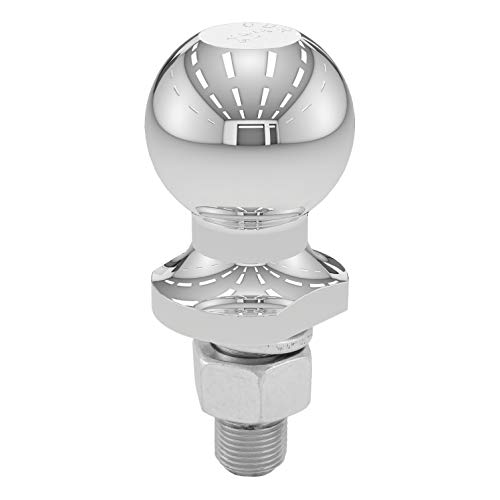
If you need a reliable hitch ball for medium-duty towing, the CURT Chrome Trailer Hitch Ball 2 is an excellent choice for everyday use with cars, trucks, SUVs, and RVs. I rely on its hot-forged alloy steel construction for strength and durability. It handles up to 3,500 pounds gross trailer weight. The 2-inch ball diameter fits standard 2-inch couplers. Its 3/4-inch shank diameter and 1-3/4-inch length suit class 3 and class 4 hitches. Fine threads guarantee secure installation. I tighten it to 160 lb-ft using a hex nut and helical lock washer. Nickel-chrome plating resists rust and wear.
Best For: Drivers of cars, trucks, SUVs, and RVs needing a durable, medium-duty trailer hitch ball for everyday towing of utility trailers, campers, boats, and recreational vehicles.
Pros:
- Constructed from strong, hot-forged alloy steel with a 3,500-pound towing capacity
- Features nickel-chrome plating for superior rust and scratch resistance
- Fine-threaded shank with included hex nut and lock washer ensures secure, stable attachment
Cons:
- Shank length may be too short for thicker receiver hitches
- Requires specific torque (160 lb-ft) for proper installation, necessitating a torque wrench
- Not suitable for heavy-duty towing exceeding 3,500 pounds
METOWARE Trailer Hitch Ball Mount 2″ Drop
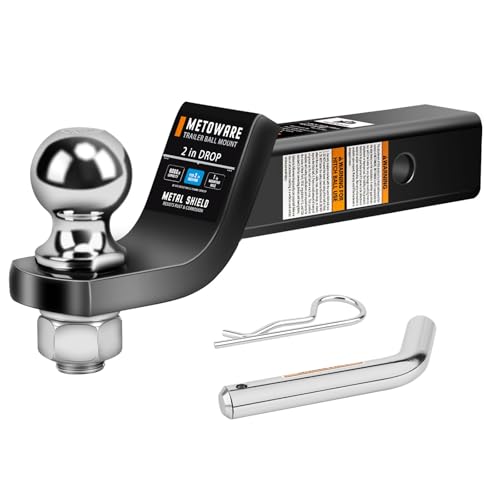
You’ll find the METOWARE Trailer Hitch Ball Mount 2″ Drop best suits mid-weight towing setups where strength and simplicity matter most. It’s rated for 6,000 lbs gross trailer weight and 600 lbs tongue weight-ideal for boats, utility trailers, and small campers. The 2″ x 2″ shank fits standard 2-inch receivers, and the 2-inch drop with 0.75-inch rise helps maintain level towing on trucks and SUVs. It’s made from solid steel and coated in durable black powder for rust resistance. The pre-attached 2″ chrome-plated ball comes with a hitch pin and clip-no assembly needed. You simply insert, secure, and tow.
Best For: Towing mid-weight trailers like boats, utility trailers, and small campers with trucks or SUVs that require a 2-inch drop for level hitch alignment.
Pros:
- Rated for 6,000 lbs towing capacity and 600 lbs tongue weight, offering reliable strength for mid-weight loads
- Includes a pre-attached 2″ chrome-plated ball, hitch pin, and clip-ready to use with no assembly required
- Durable solid steel construction with black powder-coated finish resists corrosion and withstands tough conditions
Cons:
- 2-inch drop may not suit all vehicle and trailer height combinations, limiting versatility
- Tongue weight capacity of 600 lbs may be insufficient for heavier trailers or larger RVs
- No included torque wrench or re-torquing recommendation, which could lead to maintenance oversight over time
Trailer Hitch Tri Ball Mount (2” Receiver)

The Trailer Hitch Tri Ball Mount (2” Receiver) stands out for users who need a single, reliable solution across multiple trailer types and hitch sizes. It fits any standard 2-inch receiver and includes three ball sizes: 1-7/8-inch, 2-inch, and 2-5/16-inch. Made from high-strength steel with a welded construction, it resists bending under load. The black powder-coat and electroplating prevent rust and corrosion. Each ball supports different weights: 3,500 lbs, 5,000 lbs, and 7,500 lbs GTW, respectively. The integrated hook handles up to 10,000 lbs. A self-locking latch and hitch pin keep everything secure. It works with RVs, trucks, SUVs, cargo trailers, and farm equipment. Ideal for those who tow diverse loads without switching mounts. Backed by a one-year warranty and 30-day return policy.
Best For: RV, truck, and SUV owners who frequently tow a variety of trailers and need a durable, versatile hitch solution without changing mounts.
Pros:
- Includes three ball sizes (1-7/8”, 2”, and 2-5/16”) for compatibility with different trailer couplers
- High-strength steel construction with rust-resistant coating ensures long-term durability
- Supports up to 10,000 lbs GTW with integrated hook and self-locking safety features
Cons:
- Heavier than single ball mounts, which may make handling less convenient
- Larger size may require more storage space
- Not suitable for vehicles with only a 1-1/4” hitch receiver without an adapter
CURT 40004 Chrome Trailer Hitch Ball

I rely on the CURT 40004 Chrome Trailer Hitch Ball when towing heavy loads up to 6,000 pounds, such as utility trailers, campers, and boat trailers. It’s built from hot-forged alloy steel for maximum strength. The 1-inch diameter shank is 2-1/8 inches long, with fine threads that improve torque retention. I install it with the included zinc-plated hex nut and helical lock washer, torquing to 250 lb-ft for a secure fit. Its 0 rise design keeps towing level. The polished nickel-chrome finish resists rust, corrosion, and scratches. It fits Class 3 and 4 hitches and pairs with 2-inch couplers.
Best For: Towing enthusiasts and professionals who need a durable, high-capacity hitch ball for heavy loads up to 6,000 pounds with Class 3 or 4 trailer hitches.
Pros:
- Constructed from hot-forged alloy steel for superior strength and durability
- Fine-threaded 1-inch shank with included lock washer and nut ensures secure installation at 250 lb-ft torque
- Polished nickel-chrome finish provides excellent resistance to rust, corrosion, and wear
Cons:
- 0 rise design may not suit applications requiring hitch ball height adjustment
- Requires precise torque application, which may be challenging without a torque wrench
- Chrome finish, while attractive, may show scratches over time with heavy use
Patented Forged Tri-Ball Hitch (2-Inch Receiver)

A heavy-duty towing solution like the Patented Forged Tri-Ball Hitch stands out when I need versatility without sacrificing strength. It’s built from forged alloy steel and supports up to 10,000 pounds across Class III to V receivers. I appreciate the patented, legally protected design-no knockoffs allowed. It fits any 2-inch receiver with a 7.5-inch usable shank and includes a 5/8-inch hitch pin. Three ball sizes-1-7/8, 2, and 2-5/16 inches-are secured by a tool-free, one-click snap lock. The matte black powder coat resists wear, and its 12-pound build measures 12 x 6.22 x 5.22 inches.
Best For: Towing enthusiasts and professionals needing a durable, versatile hitch for heavy-duty applications across multiple trailer types and hitch sizes.
Pros:
- Supports three hitch ball sizes (1-7/8″, 2″, and 2-5/16″) with a tool-free, one-click snap lock for quick changes
- Forged alloy steel construction with a 10,000-pound towing capacity, ideal for Class III to Class V receivers
- Patented, legally protected design with a corrosion-resistant matte black powder coat for long-lasting use
Cons:
- Weighs 12 pounds, which may be heavy for some portable towing setups
- Higher price point compared to standard single-ball hitches due to patented design and build quality
- Limited to 2-inch receivers, not compatible with 1-1/4 inch hitch systems without an adapter
DEEAGLE 2″ Ball Hitch 6000lbs
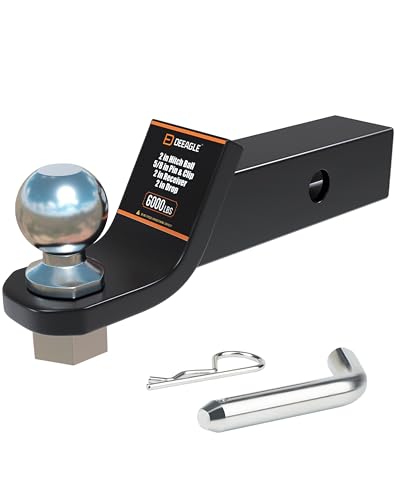
You need serious strength for heavy trailers, and the DEEAGLE 2″ Ball Hitch delivers with a 6,000-pound gross trailer weight capacity. It handles up to 600 lbs tongue weight, ideal for campers, boats, and utility trailers. The hitch fits standard 2-inch receivers with a 2-inch drop and 0.75-inch rise for level towing. Its fully welded steel construction guarantees durability. A black powder-coated mount and chrome-plated 2-inch ball resist corrosion. I assemble it myself-just the ball and hitch pin, no special tools. A slight gap may occur due to manufacturing tolerances. I recommend an anti-rattle device to reduce vibration. Customer support responds quickly if issues arise.
Best For: Towing heavy loads like campers, boats, and utility trailers with a reliable, high-capacity hitch that fits standard 2-inch receiver setups.
Pros:
- Supports up to 6,000 lbs gross trailer weight and 600 lbs tongue weight for heavy-duty towing needs
- Durable fully welded steel construction with corrosion-resistant black powder-coated mount and chrome-plated ball
- Easy self-assembly with included ball and hitch pin-no special tools required
Cons:
- Minor gap may occur between hitch and receiver due to manufacturing tolerances
- Anti-rattle device not included but recommended to reduce vibration during towing
- Limited to 2-inch drop and 0.75-inch rise, which may not suit all vehicle-trailer height combinations
CURT 40007 Chrome Trailer Hitch Ball

The CURT 40007 Chrome Trailer Hitch Ball stands out for heavy-duty towing applications, making it the ideal choice for anyone regularly hauling large trailers up to 10,000 lbs. I rely on its hot-forged steel construction for unmatched strength and long-term reliability on the road. It features a 2-5/16-inch ball diameter, which fits standard couplers perfectly. The 1-inch diameter shank is 2-1/4 inches long, ensuring a secure fit in most hitch mounts. Chrome plating resists rust, dirt, and moisture. I always torque it to 250 lb.-ft using the included zinc-plated hex nut and lock washer. It meets U.S. VESC safety standards, so I trust it every time I tow.
Best For: Heavy-duty towing enthusiasts who regularly haul trailers up to 10,000 lbs and demand reliable, durable performance.
Pros:
- Constructed from hot-forged steel for superior strength and road reliability
- 2-5/16-inch ball diameter and 1-inch shank ensure compatibility and secure fit with most hitch mounts
- Chrome-plated finish and included zinc-plated hardware resist corrosion and ensure long-term durability
Cons:
- Requires high torque (250 lb.-ft) for installation, necessitating specialized tools
- Slightly shorter shank length may not fit all hitch ball mount configurations
- Chrome finish, while durable, may show scratches over time with heavy use
ORCISH Tri-Ball Hitch Mount 10,000 LBS
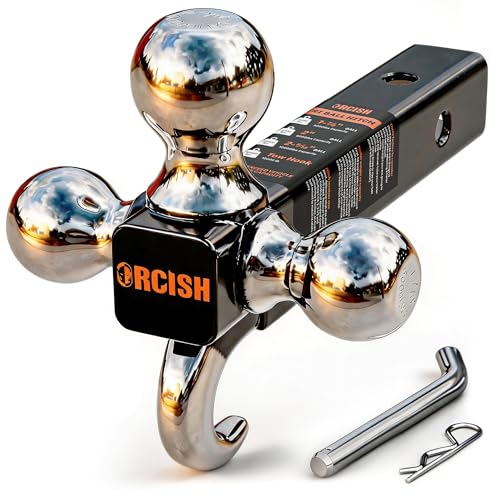
Switching between ball sizes takes seconds with the ORCISH Tri-Ball Hitch Mount-no tools, no extra mounts, just one compact unit that handles four common towing jobs. It fits Class III/IV 2-inch receiver hitches, supporting trucks, SUVs, and off-road vehicles. I use its three chrome-plated balls: 1-7/8-inch (5,000 lb), 2-inch (6,000 lb), and 2-5/16-inch (10,000 lb). Rotating the mount switches sizes instantly. An integrated 10,000 lb tow hook aids recovery. A 5/8-inch hitch pin guarantees stability. Durable plating resists scratches and wear. It’s ideal for trailers, boats, and ATVs. Not for 2.5-inch receivers or height adjustment.
Best For: Drivers of trucks, SUVs, and off-road vehicles needing a durable, multi-ball hitch mount for frequent towing of boats, trailers, RVs, or ATVs without switching between multiple single-ball mounts.
Pros:
- Switches between three ball sizes (1-7/8″, 2″, 2-5/16″) instantly with no tools-ideal for diverse towing needs
- Integrated 10,000 lb tow hook and 5/8-inch hitch pin enhance versatility and towing stability
- Chrome-plated components provide scratch resistance and durability for long-term outdoor use
Cons:
- Not compatible with 2.5-inch receiver hitches, limiting use on heavy-duty vehicles
- Not height adjustable, which may affect trailer alignment on certain vehicles
- Chrome plating may oxidize over time with prolonged exposure to moisture or harsh conditions
Orion Motor Tech Trailer Hitch Ball Mount

A top pick for serious haulers needing a durable, ready-to-use ball mount, the Orion Motor Tech Trailer Hitch Ball Mount fits precisely into any 2-inch receiver and delivers a solid connection for heavy-duty towing. It features a reversible shank for either a 2-inch drop or 3/4-inch rise, ensuring proper trailer alignment. Rated Class III, it handles up to 8,000 lbs GTW and is SAE J684 certified for safety. The 40Cr steel ball has zinc plating; the arm has a powder-coated finish, resisting corrosion from salt, snow, and rain. I get reliable performance in coastal or winter conditions. It weighs 9.22 lbs, measures 13.98 x 7.28 x 3.35 in, and includes a hitch pin, clip, and pre-assembled ball-ready in seconds.
Best For: Serious haulers looking for a durable, ready-to-use Class III ball mount with high towing capacity and corrosion resistance for heavy-duty towing in harsh environments.
Pros:
- Reversible shank provides flexibility with a 2-inch drop or 3/4-inch rise for precise trailer alignment
- Heavy-duty 40Cr steel ball with zinc plating and powder-coated arm offer excellent resistance to corrosion from salt, snow, and rain
- Pre-assembled and tool-free installation with included hitch pin and clip allows for quick, secure setup
Cons:
- Limited to 2-inch receiver size, not compatible with 1-1/4 inch receivers without an adapter
- Heavier than some comparable models at 9.22 pounds, which may matter for frequent portability
- Only includes a 2-inch ball, no option for a 1-7/8 or 2-5/16 inch ball without separate purchase
CURT Fusion Trailer Hitch Mount (45134)
Looking for a hitch ball that handles heavy loads without compromising on durability? I rely on the CURT Fusion Trailer Hitch Mount (45134) for up to 7,500 pounds gross trailer weight and 750 pounds tongue weight. It’s a one-piece, welded design, so there are no weak joints. The 2-inch x 2-inch shank fits any standard 2-inch receiver, with a 2-inch drop to keep your trailer level. It comes with a 2-inch chrome-plated tow ball-corrosion-resistant and ready to tow. A hitch pin secures it in place. The black powder coat prevents rust. Simple to install. Strong enough to trust.
Best For: Heavy-duty towing enthusiasts who need a durable, no-frills hitch mount with high weight capacity and reliable construction.
Pros:
- High towing capacity with 7,500 lbs gross trailer weight and 750 lbs tongue weight rating
- Durable one-piece welded design with corrosion-resistant black powder coat and chrome-plated tow ball
- Universal fit with a 2-inch x 2-inch shank that fits standard receivers and includes a 2-inch drop for level towing
Cons:
- Fixed 2-inch drop may not suit all vehicle and trailer height combinations
- No built-in sway or load stabilization features
- Chrome tow ball may require maintenance to prevent long-term corrosion in harsh conditions
Factors to Consider When Choosing a Hitch Ball
You need the right hitch ball to tow safely, so start by matching the ball size to your trailer coupler-common sizes are 1-7/8″, 2″, or 2-5/16″. Make sure the weight capacity meets or exceeds your trailer’s GVWR, and confirm the hitch class compatibility-Class I to V have different load limits and shank requirements. Check the shank diameter and length for a secure fit in your receiver, and go for a durable finish like chrome-plated or black oxide to resist rust and wear.
Ball Size Selection
Most hitches rely on one of three standard ball sizes: 1-7/8 inches, 2 inches, or 2-5/16 inches. You must match the ball diameter exactly to your trailer coupler’s size-mismatches risk detachment and unsafe towing. A 1-7/8-inch ball fits lightweight trailers up to 3,500 pounds, like small camping or utility models. It’s common on compact SUVs and crossover trailers. The 2-inch ball handles mid-range loads up to 6,000 pounds, ideal for boat trailers, mid-sized campers, and utility trailers. You’ll find this size on most full-size pickups and larger SUVs. For heavy-duty towing, the 2-5/16-inch ball supports up to 10,000 pounds, used for large travel trailers or equipment hauling. Each size guarantees a precise, secure fit. Always verify your coupler’s stamped size before selecting a ball-accuracy keeps your load stable and safe.
Weight Capacity Match
Every successful tow depends on matching the hitch ball’s weight capacity to your trailer’s loaded weight. You must guarantee the ball’s gross trailer weight rating (GTWR) matches or exceeds your trailer’s total loaded weight. Hitch balls are rated for specific ranges-typically 3,500 lbs, 5,000 lbs, or up to 10,000 lbs-so choose one that aligns with your trailer’s heaviest expected load. The tongue weight capacity should support 10–15% of the trailer’s total weight, maintaining proper hitch balance and vehicle control. Always base your system’s maximum towing capacity on the lowest-rated component, whether it’s the ball, shank, or receiver. Using an under-rated hitch ball risks metal fatigue, deformation, or sudden failure during transit. A failed ball can cause loss of control or serious accidents. Matching capacities isn’t optional-it’s essential for safe, reliable towing performance.
Hitch Class Compatibility
Hitch class compatibility directly determines which ball size and shank type will safely support your towing load. You must match the hitch ball to your trailer hitch’s class rating. Class I hitches handle up to 2,000 lbs GTW and often use 1-7/8-inch balls. Class II supports up to 3,500 lbs and commonly uses 1-7/8-inch or 2-inch balls. Class III handles up to 6,000 lbs and typically requires a 2-inch or 2-5/16-inch ball. Class IV supports up to 10,000 lbs and uses 2-inch or 2-5/16-inch balls. Class V exceeds 10,000 lbs and demands heavy-duty 2-5/16-inch balls. Fine-threaded shanks are standard in Classes III and above, offering stronger resistance to vibration. You’re only as strong as your weakest link-never exceed the lowest-rated component’s capacity in your towing system.
Shank Diameter Fit
A precise shank diameter match is essential for a secure connection between your hitch ball and mount. You must guarantee the shank diameter-commonly 3/4 inch or 1 inch-fits snugly into the ball mount’s hole. A shank that’s too small causes play, increasing wear and risking failure. Shank length matters just as much; it must fully extend through the mount to allow proper washer and nut installation. You’ll often encounter fine-threaded shanks, which require higher torque-typically 250 lb-ft-for maximum clamping force. Never assume compatibility; always verify measurements before purchase. An incorrect shank diameter undermines the entire towing setup, even if the ball’s capacity seems adequate. This mismatch can lead to dangerous instability. Matching diameter, length, and thread type guarantees your hitch ball stays firmly in place under load.
Finish And Durability
The finish and material construction of your hitch ball directly impact its longevity and performance under demanding towing conditions. You need a hitch ball made from hot-forged alloy steel-it delivers superior strength and resists fracturing under heavy loads and constant vibration. Chrome plating gives you a sleek look while protecting against rust, rain, dirt, and scratches, ensuring reliable function in all weather. For even tougher protection, choose a powder-coated finish; it resists chipping, UV damage, and chemicals. Fine-threaded shanks increase holding power and maintain torque, so your ball stays tight over time. Coatings like nickel-chrome plating and electroplating fight oxidation, especially when exposed to moisture and road salts. These features work together to boost durability and keep your connection secure mile after mile. Don’t overlook finish-it’s not just looks, it’s long-term reliability.
Drop And Rise Options
When matching your trailer to your tow vehicle, aligning the hitch ball’s height with the trailer’s coupler guarantees a level ride, and that’s where drop and rise measurements come into play. Drop values, like a 2-inch option, position the ball below the receiver’s centerline-ideal for trucks with higher ground clearance. Rise values, such as 0.75 inch, lift the ball above the centerline, correcting hitch height for lower-slung vehicles. Accurate measurement guarantees stable towing and prevents trailer sag or a nose-high stance, both of which compromise handling. Misalignment causes uneven weight distribution and increases sway risk. Reversible shanks give you both drop and rise in one unit, offering adaptability across trailers. Choose your measurement based on the vertical difference between your receiver and trailer coupler-precision matters here.
Installation Requirements
Every detail counts for safe towing, and proper hitch ball installation starts with correct torque application. You must tighten the shank to 160–250 lb-ft, as under-torquing risks loosening and over-torquing can damage threads or the receiver. Fine-threaded shanks offer superior holding strength and more precise torque control than coarse threads, improving reliability. Always use a helical lock washer and hex nut-they resist vibration and prevent unintended loosening during travel. Insert the hitch ball mount fully into the receiver until the hitch pin passes through both the mount and receiver tube. This guarantees maximum stability and load transfer. Some systems come pre-assembled with a mounted ball and hitch pin, allowing tool-free setup and immediate use. These integrated units simplify installation but still require full insertion and proper securing. Check all connections before each trip-one loose component compromises the entire setup.
Frequently Asked Questions
Can Hitch Balls Be Reused After Rust Removal?
Yes, you can reuse hitch balls after rust removal if they still meet OEM specifications. Inspect the shank diameter, thread pitch, and ball height-any deviation compromises safety. Remove rust with a wire brush or sandpaper, then measure wear. If the diameter drops below 1.87 inches for a 2-inch ball or shows pitting deeper than 0.01 inches, replace it. Smooth surfaces guarantee proper coupler contact and towing stability.
Are Plastic Hitch Ball Covers Necessary for Storage?
You don’t need plastic hitch ball covers for storage, but they help prevent corrosion and debris buildup. The cover shields the 1-7/8″, 2″, or 2-5/16″ ball shank from moisture and road salts. Made from UV-resistant polypropylene, most fit snugly with a snap or friction seal. While not critical, they extend service life, especially in humid or winter climates. Always clean and dry the ball first. Covers are inexpensive, lightweight, and simple-like a dust cap on a tire valve.
Do Hitch Balls Affect Fuel Efficiency During Towing?
You won’t see a direct impact on fuel efficiency from the hitch ball itself. It’s a small, fixed component that doesn’t create aerodynamic drag. However, a poorly matched or loose hitch ball increases towing instability, forcing your vehicle to work harder to maintain control. That added resistance and correction burns more fuel over time. Use the correct ball size-typically 1-7/8″, 2″, or 2-5/16″-and torque it to manufacturer specs, usually 250 ft-lbs, to guarantee efficiency.
Can a Worn Hitch Ball Damage the Receiver?
Yes, a worn hitch ball can damage the receiver. You’re transferring stress unevenly when the ball’s surface is pitted or corroded. This misalignment creates hot spots and excess friction. Over time, those forces deform the receiver’s internal cavity. You’ll see gouging, accelerated wear, or cracking around the socket edges. A standard 2-inch ball with under 1.98-inch diameter fails load ratings. Replace it before failure risks catastrophic detachment.
Is Lubrication Needed on the Hitch Ball Regularly?
Yes, you should lubricate the hitch ball regularly. Dry contact causes metal-on-metal wear, leading to pitting and corrosion. Apply a quality marine-grade grease every 3 months or after 1,000 miles. Greasing reduces friction between the ball mount and coupler, ensuring smoother towing. Use a corrosion-resistant lubricant compatible with steel or stainless hitch balls-typically 1-1/4″, 1-7/8″, 2″, or 2-5/16″ diameter. Reapply after washing your vehicle or exposure to saltwater.