Best Lug Nut Torque Wrenches Every Mechanic Trusts
You demand precision and durability, and trusted lug nut torque wrenches deliver. Models like the LEXIVON LX-183 and EPAuto 1/2-inch wrench offer ±4% accuracy, 10–150 ft-lb ranges, and Cr-V steel construction. High-end options such as the DEWALT 50–250 ft-lbs meet ASME standards with ±3% accuracy. All feature 1/2-inch drives, 72-tooth ratchets, and dual-scale markings. Reversible, click-style mechanisms guarantee reliable stops at set values. You’ll find out which models best match your workload and torque demands.
We are supported by our audience. When you purchase through links on our site, we may earn an affiliate commission, at no extra cost for you. Learn more. Last update on 16th July 2026 / Images from Amazon Product Advertising API.
Notable Insights
- Mechanics trust torque wrenches with ±3% accuracy and calibration certificates for reliable lug nut tightening.
- A 1/2-inch drive with 72-tooth ratchet allows precise, high-torque applications in tight spaces.
- Durable Cr-V or Cr-Mo steel construction ensures long-term performance under heavy use.
- Trusted models feature dual-scale readability, ergonomic grips, and secure locking mechanisms.
- Top wrenches offer 80–100 ft-lb range, meeting standard lug nut specs for most vehicles.
LEXIVON 1/2-Inch Torque Wrench (LX-183)

If you’re a DIY mechanic or professional technician who demands reliable accuracy and long-term durability, the LEXIVON 1/2-Inch Torque Wrench (LX-183) is an ideal choice for precision lug nut applications. I rely on its +/- 4% accuracy for consistent, safe tightening. It’s manufactured in Taiwan and ships pre-calibrated, complete with a certificate and trackable serial number. The reinforced ratchet head uses hardened, heat-treated Chrome Vanadium steel for strength. Its electro-black finish resists rust. I appreciate the dual-range scale-yellow on black-for easy reading in dim light. The knurled handle reduces fatigue, and the reversible ratchet saves time.
Best For: DIY mechanics and professional technicians who need reliable, precision torque control for lug nut and critical fastening applications.
Pros:
- Delivers +/- 4% accuracy with pre-calibration and includes a trackable calibration certificate for traceability
- Built with hardened, heat-treated Chrome Vanadium steel and reinforced ratchet head for long-term durability
- Features high-contrast dual-range scale and ergonomic knurled handle for easy reading and reduced hand fatigue
Cons:
- Limited to 1/2-inch drive applications, which may not suit all users’ needs
- May require recalibration over time with heavy use, adding to maintenance requirements
- Higher price point compared to non-calibrated or lower-accuracy torque wrenches
1/2 Inch Click Torque Wrench 10-170 ft.lbs

This 1/2 inch click torque wrench, with a 10–170 ft-lb range, is the go-to tool for automotive technicians and serious DIYers who demand precision on critical fasteners like lug nuts. It delivers ±3% calibration accuracy, laser-printed dual scales show 10–170 ft-lb and 13.6–230.5 Nm for clear readings. Each unit has a serial number for traceability. The 72-tooth ratchet allows 5° arc swings, perfect in tight spaces. Its chrome vanadium steel body handles stress, while the aluminum titanium alloy handle offers a durable, non-slip grip. I appreciate the tactile and audible click at torque. It works bidirectionally, has a quick-release button, and locks torque when released. Great for cars, bikes, or spark plugs. Backed by a 24-month warranty.
Best For: Automotive technicians and serious DIYers who need precise, reliable torque control for critical tasks like tightening lug nuts and spark plugs.
Pros:
- ±3% calibration accuracy with laser-printed dual scales (ft-lb and Nm) for clear, precise readings
- Durable construction with chrome vanadium steel body and aluminum titanium alloy handle for strength and grip
- 72-tooth ratchet with 5° arc swing and bidirectional drive for high precision in tight spaces
Cons:
- Click sensitivity diminishes below 5 Nm, limiting low-torque accuracy
- No included storage case mentioned, risking damage during transport
- Fixed 1/2-inch drive may not suit small fasteners requiring lower torque ranges
EPAuto 1/2-inch Drive Click Torque Wrench, 10-150 ft/lb, 13.6-203.5 N/m

The EPAuto 1/2-inch Drive Click Torque Wrench is my go-to tool for precision lug nut applications, especially when working on vehicles that demand strict adherence to torque specs. It delivers 10–150 ft/lb (13.6–203.5 N/m) of torque with ±4% accuracy. The hardened Cr-V steel ratchet head resists wear and corrosion. A satin finish enhances durability. The knurled handle guarantees a secure grip, even with oily hands. High-contrast scales make readings easy in tight spaces. The click mechanism gives clear audible and tactile feedback-stop turning the moment it engages. It comes with a storage case and a 5-inch extension bar. Made in Taiwan, it’s reliable and built for real-world use.
Best For: DIY mechanics and automotive technicians who need a reliable, accurate torque wrench for lug nuts and suspension components.
Pros:
- Delivers precise torque with ±4% accuracy for confident, repeatable results
- Durable Cr-V steel ratchet head and knurled handle provide long-lasting performance and secure grip
- Includes storage case and extension bar for added convenience and organization
Cons:
- Not suitable for very low torque applications below 10 ft/lb
- Click mechanism requires proper technique-over-torquing possible if force continues after the click
- Made in Taiwan, which may be a drawback for buyers preferring domestically manufactured tools
DEWALT Torque Wrench Set 50-250 FT-LB

A reliable go-to for automotive technicians and serious DIYers, the DEWALT Torque Wrench Set 50-250 FT-LB delivers precision and durability in demanding tire service tasks. I use it for lug nut applications where accuracy matters. Its 50–250 ft-lb range handles most trucks and SUVs. The 1/2 in. drive micrometer wrench features DirectTorqueTechnology for consistent output. It locks at set values with a secure trigger. The included breaker bar tackles stubborn fasteners. Ten SAE and metric sockets (3/4″–1″, 18–24 mm) cover common wheel sizes. Chrome vanadium steel guarantees long-term reliability. A protective bumper guards the head. The bi-material grip reduces fatigue. It meets ASME and ISO standards. The set includes a storage case.
Best For: Automotive technicians and serious DIYers who need precise, durable torque control for tire service and heavy-duty fastening tasks on trucks and SUVs.
Pros:
- Wide 50–250 ft-lb torque range ideal for automotive and truck lug nut applications
- Includes 12-piece set with breaker bar and both SAE and metric sockets for versatility
- Built with chrome vanadium steel and bi-material grip for durability and user comfort
Cons:
- Item weight listed as 0.01 ounces is likely inaccurate, raising concerns about specification reliability
- Limited socket size range may not cover all vehicle types or specialized applications
- No ratchet included in the set, reducing convenience for repetitive fastening tasks
XJX 1/2-Inch Torque Wrench Set

When precision matters most, the XJX 1/2-Inch Torque Wrench Set becomes the go-to tool for mechanics who demand accuracy and durability in critical fastening jobs. It delivers torque in a 10–160 ft-lb (13.6–217.1 Nm) range with ±4% accuracy. You get a calibration certificate, so you know it’s reliable. I use the paddle-adjustable ratchet head for quick direction changes. The dual-unit scale is easy to read. A sharp click tells me when I’ve hit the target torque. It’s built from heat-treated chrome vanadium steel, so it resists rust and lasts. I avoid using it to break loose bolts. The included 5-inch extension and adapter help me reach tight spots.
Best For: Automotive and motorcycle mechanics who need a durable, accurate torque wrench for precise fastening in demanding applications.
Pros:
- Delivers reliable ±4% accuracy with a formal calibration certificate for confidence in precision
- Durable heat-treated chrome vanadium alloy construction resists rust and withstands heavy use
- Includes useful accessories like an extension bar and drive adapter for improved reach and versatility
Cons:
- Not recommended for loosening bolts, limiting its functionality as a multi-purpose tool
- Requires regular recalibration to maintain long-term accuracy
- Heavier 1/2-inch drive may be less ideal for delicate or small-scale work
CRAFTSMAN Torque Wrench, 1/2″ Drive, 50-250 FT-LB (CMMT99434)

You need serious torque for heavy-duty lug nuts, and this CRAFTSMAN model delivers exactly that. I rely on its 50–250 ft-lbs (68–339 Nm) range for large vehicle applications. The 1/2-inch drive handles high-stress jobs without slipping. Stamped scales show both inch and metric settings, so I can read them quickly, even in poor light. Its bi-material handle fits my grip securely, reducing hand fatigue during repeated use. I appreciate the locking mechanism-it lets me adjust torque fast and keeps settings stable. It comes with a durable case, so I store and transport it without worry. This wrench meets or exceeds ASME standards, so I trust its accuracy every time.
Best For: Automotive professionals and DIY enthusiasts working on heavy-duty vehicles requiring precise torque application between 50–250 ft-lbs.
Pros:
- Delivers accurate torque in a heavy-duty range (50–250 ft-lbs), ideal for large vehicle lug nuts and high-stress applications
- Bi-material handle provides a secure, comfortable grip that reduces hand fatigue during extended use
- Includes stamped dual-scale markings (imperial and metric) and a locking mechanism for quick, stable adjustments
Cons:
- Minimum torque setting of 50 ft-lbs may be too high for lighter automotive or small engine applications
- Larger 1/2″ drive size may be cumbersome in tight or confined spaces
- No mention of calibration certification, which may be important for precision-critical professional use
1/2″ Click Torque Wrench 10-180 ft.lb ±3

This 1/2” click torque wrench with a 10–180 ft.lb range delivers the precision and durability I need for automotive work where consistent torque matters. It’s accurate to ±3%, calibrated to meet strict standards. The dual-range, laser-engraved scale shows 13.6–244.1 Nm clearly. Its 72-tooth Cr-Mo alloy ratchet head turns both clockwise and counterclockwise, locking securely in place. I adjust torque by pulling the knob down, then release to lock. It clicks audibly at the preset value-no guesswork. Made from aluminum-titanium, the handle resists slippage with a knurled grip. Weighing 1.6 kg, it’s sturdy but manageable. A powder-coated finish fights rust. It comes with a plastic case, manual, and verification certificate. I rely on it for lug nuts, suspension jobs, and wheel work. Manufacturer: Matework. Model: MT9067-MATEWORK-CA. ASIN: B0DK54ZK7Y. Backed by strong support.
Best For: Automotive enthusiasts, motorcycle owners, and professional mechanics needing a durable, precise torque wrench for tasks like tire changes, suspension work, and general repairs.
Pros:
- High precision with ±3% accuracy and a laser-engraved dual-range scale for clear, reliable readings
- Durable 72-tooth Cr-Mo alloy ratchet head with dual-direction operation and quick-release socket mechanism
- Comes with verification certificate, storage case, and manufacturer support for traceability and protection
Cons:
- At 1.6 kg, it may feel heavy for extended use in tight or overhead spaces
- Limited to 1/2-inch drive, which may not suit low-torque applications requiring smaller drives
- Powder-coated finish resists corrosion but may chip over time with heavy impact or misuse
LEXIVON 1/2-Inch Drive Torque Wrench (LX-184)
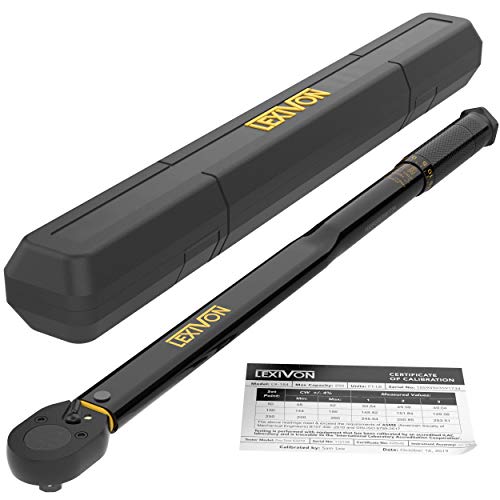
The LEXIVON 1/2-Inch Drive Torque Wrench (LX-184) is built for serious DIYers and working mechanics who demand precision without compromise. I rely on its ±4% accuracy right out of the box, backed by a calibration certificate with a traceable serial number. Its reinforced ratchet head uses hardened, heat-treated Chrome Vanadium steel for long-term durability under heavy use. The Electro-Black finish resists rust and corrosion, ideal for wet or humid environments. I appreciate the dual-range scale with yellow print-it’s easy to read, even in dim light. The reversible ratchet allows clockwise torque application and bidirectional driving, saving time during repetitive tasks.
Best For: Serious DIYers and professional mechanics who need a durable, accurate torque wrench for precision tightening in demanding environments.
Pros:
- Delivers ±4% accuracy with included calibration certificate for traceable reliability
- Constructed from hardened, heat-treated Chrome Vanadium steel for long-lasting durability
- Features an easy-to-read dual-range scale with yellow print and a reversible ratchet for versatile use
Cons:
- No mention of a protective case for storage and transport
- Limited to 1/2-inch drive, which may not suit all applications
- Higher torque precision users may require tighter calibration tolerance than ±4%
SUZUME 1/2″ Torque Wrench (10-170 Ft. Lb)

Precision matters most for mechanics who rely on consistent, repeatable torque settings-especially when over-tightening or under-tightening a lug nut can compromise wheel safety. I trust the SUZUME 1/2″ Torque Wrench for its ±3% accuracy, verified over 10,000 cycles. It holds calibration beyond 10,000 uses. The dual-scale reads 10–170 Ft. Lb (14–231 N.m), with laser-etched markings for clarity. Built from Cr-V steel, it resists wear thanks to electrophoresis treatment. The 72-tooth ratchet allows a tight 5° swing. I adjust torque easily with the pull-down locking knob. It weighs 3 lbs and comes with a certificate and manual.
Best For: Professional mechanics and serious DIYers who demand precision, durability, and reliable calibration in automotive and industrial applications.
Pros:
- ±3% accuracy verified over 10,000 cycles with long-term calibration retention
- Durable Cr-V steel construction with electrophoresis treatment and laser-etched, dual-scale readability
- 72-tooth ratchet with 5° swing angle and tool-free sleeve replacement for tight spaces and easy maintenance
Cons:
- Weighs 3 pounds, which may feel heavy during extended use
- No carry case included despite professional-grade positioning
- Limited low-torque range, making it less suitable for delicate applications below 10 Ft. Lb
1/2-Inch Drive Click Torque Wrench 40-300 FT.LB
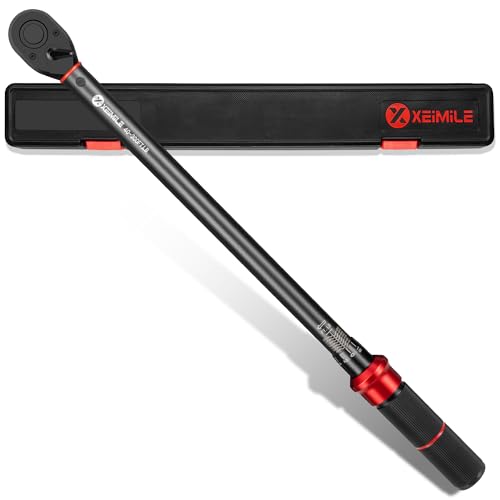
You’ll find the 1/2-inch drive click torque wrench ideal if you demand consistent accuracy and long-term reliability for heavy-duty fastening tasks. I rely on its ±3% accuracy for precision work. It includes a traceable serial certificate for calibration proof. The dual-range scale features laser-engraved markings on a black background for clear reading. Made from premium chromium vanadium steel, it resists corrosion with an electro-black finish. Its 72-tooth bidirectional ratchet allows fine adjustments. The pull-lock knob lets me set torque quickly. It clicks when reaching the preset value. I use it for lug nuts, machinery, and auto repairs. It comes with a durable storage case.
Best For: Mechanics, automotive professionals, and serious DIYers who need a durable, accurate torque wrench for heavy-duty applications.
Pros:
- ±3% accuracy with a traceable serial certificate ensures reliable, precise torque settings
- Durable chromium vanadium steel construction with electro-black finish resists corrosion and wear
- 72-tooth bidirectional ratchet and pull-lock knob allow quick, fine adjustments and easy use in tight spaces
Cons:
- Minimum torque setting of 40 ft.lbs limits use for lighter or more delicate tasks
- Click mechanism may lack feedback for users unfamiliar with tactile alerts
- Heavier than smaller torque wrenches, which may cause fatigue during extended use
Factors to Consider When Choosing a Lug Nut Torque Wrench
You need a torque wrench that matches your vehicle’s specs, so check the required torque range-most lug nuts need 80 to 100 ft-lb, but some demand up to 300 ft-lb. Accuracy matters: look for a wrench with ±3% accuracy and a clear calibration certificate, and make sure it has the right drive size-½-inch is standard for lug nuts. A solid ratchet mechanism and durable chrome-plated steel construction guarantee long-term reliability and smooth operation under daily use.
Torque Range
A torque range that covers 80–100 ft-lb is essential for properly tightening most automotive lug nuts. You’ll want a wrench that starts as low as 20–30 ft-lb to handle smaller fasteners without needing a second tool. This gives you flexibility for brake components or suspension work. Look for a maximum capacity of at least 150 ft-lb to cover trucks and SUVs, which often require higher settings. A broader range means one wrench fits more jobs. Dual-scale models display both ft-lb and Nm, so you don’t waste time converting values manually. That’s critical when switching between imported and domestic vehicles. Choose a design with consistent calibration across the full span. You need reliable performance at both ends-not just the middle. A well-built wrench delivers precision where you need it, every time.
Accuracy Level
Most torque wrenches deliver accuracy within ±4%, but top-tier models achieve ±3% tolerance for critical lug nut applications. You need that precision to prevent under-torquing, which risks wheel detachment, or over-torquing, which can damage studs and rotors. A ±3% rating means your wrench applies 97 to 103 ft-lbs when set to 100-tight enough to matter in high-stress environments. Higher accuracy tools often include calibration certificates, offering traceable proof of initial precision. This documentation matters if you work under quality compliance standards. Over time, mechanical wear degrades performance-expect accuracy drift after heavy use or drops. That’s why recalibration every 12 months or 5,000 cycles is recommended. Look for laser-engraved or high-contrast torque scales. They eliminate guesswork, let you set values clearly, and reduce user error. Readability is part of reliability.
Drive Size
Torque capacity begins with the drive. You need a 1/2-inch drive for lug nuts-it handles 50 to 250 ft-lbs, the typical range for wheel fastening. Smaller drives like 1/4-inch or 3/8-inch aren’t built for this stress. They’re meant for lighter tasks and can crack or slip under high torque. The 1/2-inch size delivers strength and resists twisting or breaking. It’s designed for heavy loads, giving you reliable performance every time. This drive size also matches standard sockets and extensions used in tire and brake work. That means you’ll have better tool compatibility and more flexibility in tight spaces. Matching drive size to the job guarantees accuracy and safety. A proper fit reduces slippage, protects your tools, and keeps torque values consistent. Don’t cut corners-use the right drive for the job.
Ratchet Quality
When working in tight wheel wells or awkward angles, a high-performance ratchet head makes all the difference. A 72-tooth ratchet mechanism gives you a 5° arc per click, delivering precise engagement even in confined spaces. You’ll appreciate minimal swing needed to tighten or loosen lug nuts efficiently. Reversible action lets you switch between clockwise and counterclockwise torque without adjusting the tool, speeding up both installation and removal. High-quality ratchets use hardened alloy steel gears that resist wear over time, maintaining smooth operation under repeated use. Precision-engineered teeth reduce internal play, ensuring accurate torque transfer with every click. Corrosion-resistant finishes protect against moisture and grime, preserving performance in harsh conditions. You’re not just buying a ratchet-you’re investing in consistent control, exactness, and reliability every time you torque a wheel.
Build Durability
A well-built torque wrench stands up to years of heavy use without losing accuracy or breaking under pressure. You need one forged from hardened, heat-treated chrome vanadium steel-it resists deformation even under high torque loads. The ratchet head should feature a 72-tooth design; this reinforces durability by spreading stress evenly across the gear during repeated swings. Look for corrosion-resistant finishes like electro-black or powder coating. They shield the tool from rust and abrasion in damp or dirty conditions. Knurled handles made of durable alloy give a secure grip, reducing slippage and protecting against impact damage from drops. Avoid models with printed markings-choose those with laser-engraved or stamped labels instead. They stay legible far longer, ensuring reliable readings over thousands of cycles. These features combined mean your wrench won’t just survive daily abuse-it’ll stay precise, cycle after cycle.
Ergonomic Design
You need a torque wrench that feels like an extension of your arm, not a burden in your hand. An ergonomic handle with knurled texturing gives you a secure, non-slip grip, even with oily hands. Bi-material grips combine soft and hard plastics to boost comfort, enhance control, and absorb vibration during use. Look for a padded or contoured grip-it molds to your hand’s shape, reducing fatigue and improving leverage. Lightweight alloy construction in the handle or body cuts overall weight, making the tool easier to maneuver during long jobs. A well-balanced head-to-handle ratio guarantees smoother operation, especially in tight wheel wells. This balance reduces wrist strain and increases precision. Ergonomic design isn’t just about comfort-it directly impacts accuracy and efficiency. Choose a wrench that supports your hand, reduces slippage, and feels natural in use. Every detail matters when you’re torquing dozens of lug nuts.
Calibration Standard
Precision begins where design meets measurement. You rely on calibration accuracy to deliver correct torque, typically within ±3% to ±4% of the set value under standard conditions. This small margin guarantees lug nuts are neither under-tightened nor over-tightened, preventing wheel damage. Most quality wrenches come pre-calibrated from the factory and include a traceable calibration certificate with a serial number for verification. Standards like ASME, ISO, and TAA certify that your tool meets strict performance criteria for repeatability and reliability. Over time, drops, heavy use, or temperature extremes can cause internal drift, making regular recalibration essential. Some models undergo rigorous testing-verified over thousands of cycles-to maintain calibration stability without adjustment. Choose a wrench built to hold its spec, not just one that starts accurate.
Measurement Visibility
How clearly can you read the torque settings in dim light or tight spaces? Choose a wrench with high-contrast scale markings-yellow-on-black scales drastically improve visibility in low-light conditions. Laser-engraved or laser-printed scales resist fading and wear, ensuring long-term legibility. Look for scales physically stamped or engraved into the tool body; they won’t scratch or peel like painted labels. Dual-range scales showing both ft-lb and Nm let you switch units instantly, cutting conversion errors. The numerals should be large, bold, and evenly spaced, with clear gradations for precise adjustments. A well-laid-out scale means you can set torque accurately, even at awkward angles. You’re not guessing-you’re measuring with confidence. These details matter when undercarriage shadows or cramped wheel wells limit your view. Visibility directly impacts accuracy. Prioritize clarity. Your wrench shouldn’t make you strain to read it.
Frequently Asked Questions
Can Torque Wrenches Be Calibrated at Home?
No, you can’t calibrate torque wrenches at home accurately. You need specialized equipment like a calibration stand and certified torque standards. Improper calibration leads to incorrect torque application, risking lug nut failure. Manufacturers recommend annual professional calibration. Some tools have ±3% accuracy, but without traceable standards, home methods won’t verify it. Always use accredited services to maintain precision, guarantee safety, and extend tool life-especially critical for automotive applications where over- or under-torquing damages components.
How Often Should I Recalibrate My Torque Wrench?
You should recalibrate your torque wrench every 5,000 cycles or annually, whichever comes first. Frequent use demands more regular checks. Each cycle includes tightening, releasing, and resetting the tool. Manufacturers like Snap-on and CDI specify this interval to maintain accuracy within ±3%. Skipping calibration risks overtightening-leading to stripped threads or rotor warping. Think of it like tuning an instrument; precise settings guarantee reliable performance. Store it properly to preserve calibration.
Are Digital Torque Wrenches More Accurate Than Click-Type?
Yes, digital torque wrenches are generally more accurate than click-type, with most offering ±1% accuracy. You’ll get precise readings thanks to internal strain gauges and digital displays. Click-types usually achieve ±3% accuracy, relying on mechanical springs and cams. Digital models let you switch units effortlessly and often include memory functions. They require batteries but offer consistent calibration over time. You gain precision, especially in critical applications where exact torque matters.
Do Torque Wrenches Expire if Not Used?
No, torque wrenches don’t expire if unused, but they can lose calibration over time. You must recalibrate every 12 to 24 months, even if stored properly. Inactive springs may weaken, affecting accuracy. Store it at 20% of max torque to reduce tension. Humidity and temperature swings cause internal corrosion or metal fatigue. Use a certified calibration service annually. Think of it like a battery-dormant doesn’t mean dead, but performance degrades without maintenance.
Should I Lubricate Lug Nuts Before Torquing?
You shouldn’t lubricate lug nuts before torquing. Lubrication reduces friction, leading to over-torquing and potential stud damage. Torque specs assume dry, clean threads-typically 80–100 ft-lbs for most passenger vehicles. Adding oil or grease can increase bolt stretch by up to 30%, risking rotor warping or broken hardware. Always follow factory specifications. Treat threads with a rust inhibitor only if needed, but never apply lubricant during installation.