Top-Rated OBD2 Scanners Every Car Owner Should Try
You need an OBD2 scanner that works reliably across 1996+ gasoline vehicles with full OBD-II compliance. The ANCEL AD310 supports all 5 protocols, clears check engine lights, and fits in your glove box. MOTOPOWER offers live data graphs and a 2.8-inch display. BlueDriver Pro delivers advanced diagnostics via Bluetooth to your phone. Top models provide lifetime updates, real-time streaming, and I/M readiness checks-keep going to see which scanner matches your vehicle and needs.
We are supported by our audience. When you purchase through links on our site, we may earn an affiliate commission, at no extra cost for you. Learn more. Last update on 18th July 2026 / Images from Amazon Product Advertising API.
Notable Insights
- ANCEL AD310 is a compact, reliable scanner for 1996+ US and 2000+ global vehicles, supporting all OBD2 protocols with easy plug-and-play use.
- MOTOPOWER offers a clear 2.8-inch display, live data graphs, and DTC library access, ideal for basic diagnostics on most 1996+ vehicles.
- BlueDriver Pro delivers advanced wireless diagnostics via Bluetooth, reading ABS, SRS, and emission codes on 1996+ gas-powered vehicles.
- FOXWELL NT604 Elite supports 5-in-1 diagnostics including ABS and SRS, works on 60+ vehicle brands, and includes a protective case.
- Autel AL319 features a color screen, one-click I/M readiness check, and full OBD2 protocol support, suitable for quick emissions testing and diagnostics.
ANCEL AD310 OBD2 Scanner (Black)

If you’re a DIY car owner who values reliability and simplicity, the ANCEL AD310 OBD2 Scanner (Black) is built for you. I rely on it to read and clear check engine codes quickly, usually within seconds. It supports all OBDII protocols-CAN, KWP2000, J1850 VPW, ISO9141, and PWM-and works with 1996+ US, 2000+ EU and Asian vehicles. The 2.5-foot thick, flexible cable connects directly to the OBDII port, drawing power without batteries. Its 8.9 x 6.9 x 1.4-inch design weighs just 12 ounces, fits easily in a glove box, and survives drops and daily wear.
Best For: DIY car owners who want a simple, reliable tool to quickly read and clear emission-related check engine codes without needing technical expertise.
Pros:
- Supports all OBDII protocols and works with most 1996+ US and 2000+ international vehicles
- Durable, compact design with a battery-free operation that powers directly from the vehicle
- Fast, user-friendly performance with clear display and easy-to-use buttons
Cons:
- Limited to emission-related codes and cannot read non-emission-related engine faults
- Not compatible with OBDI vehicles, even with an adapter
- Basic functionality may not meet the needs of users seeking advanced diagnostics
MOTOPOWER OBD2 Scanner Code Reader

The MOTOPOWER OBD2 Scanner Code Reader is built for car owners who want full access to engine diagnostics without relying on a mechanic. It reads and erases engine fault codes, displays freeze frame data, and shows I/M readiness status. I use its live data graphs to monitor engine speed, load, coolant temperature, and vehicle speed in real time. It supports all 1996+ US, 2000+ EU, and most Asian vehicles with 9 OBD2 protocols. The 2.8-inch LCD has a white backlight and adjustable contrast. Its 2.5 ft cable connects directly to the OBDII port-no battery needed. It doesn’t support ABS or airbag systems. Six buttons make navigation simple. It includes a built-in DTC library and supports six languages.
Best For: DIY car owners who want an affordable, easy-to-use OBD2 scanner to diagnose and clear engine fault codes without visiting a mechanic.
Pros:
- Reads and erases engine codes, displays live data, freeze frame, I/M readiness, and includes a built-in DTC library for quick diagnosis
- Compatible with 9 OBD2 protocols and works with most 1996+ US, 2000+ EU, and Asian vehicles; no external power required
- Simple 6-button interface, 2.8-inch backlit LCD with adjustable contrast, and supports 6 languages for broader accessibility
Cons:
- Does not support ABS, airbag, or oil service light systems, limiting diagnostic scope
- Only 2.5 ft cable length may be short for some vehicle layouts
- No advanced bi-directional controls or long-term data logging for professional diagnostics
BlueDriver Pro OBD2 Scan Tool for iPhone & Android

BlueDriver Pro stands out as the best choice for tech-savvy car owners who want professional-grade diagnostics at home. I rely on its advanced OBD2 capabilities for all gas-powered vehicles from 1996 onward. It reads and clears codes for Check Engine, ABS, SRS, Airbag, TPMS, and over 7,000 additional issues. It supports deep diagnostics on major brands, including BMW, Ford, and Toyota. The Bluetooth sensor connects wirelessly to my iPhone and Android devices, streaming live data in real time. I get unlimited repair reports, step-by-step videos, and 24/7 support-no subscriptions, no hidden fees.
Best For: Tech-savvy car owners seeking professional-grade, wireless OBD2 diagnostics with comprehensive repair guidance and no subscription fees.
Pros:
- Advanced OBD2 diagnostics for Check Engine, ABS, SRS, Airbag, TPMS, and over 7,000 issues across major vehicle brands
- Wireless Bluetooth connectivity with real-time live data streaming to iOS and Android devices
- Unlimited repair reports, step-by-step repair videos, and 24/7 technical support with no subscriptions or hidden fees
Cons:
- Limited to gas-powered vehicles from 1996 and newer, excluding older or diesel models
- No support for full system reprogramming or coding functions on高端 European vehicles like some rival tools
- Repair videos and guidance may not cover rare or highly specific mechanical issues
FOXWELL NT301 OBD2 Scanner Tool

I rely on the FOXWELL NT301 when I need a no-nonsense OBD2 scanner that delivers accurate diagnostics without unnecessary extras. It reads DTCs, resets the check engine light, and retrieves VIN and I/M readiness status. It supports all OBDII protocols-CAN, KWP2000, ISO9141, J1850 PWM/VPW-and works on 1996+ gasoline, 2000+ EU, and most Asian models. The 2.8-inch color screen displays live data and graphs sensor streams in real time. It logs engine and emissions data but doesn’t support ABS, SRS, or bi-directional controls. It’s powered via DLC, requires no updates, and includes lifetime free updates, 1-year seller assurance, and technical support.
Best For: DIYers and home mechanics who need a reliable, straightforward OBD2 scanner for basic diagnostics and check engine light resets on 1996+ US, 2000+ EU, and Asian vehicles.
Pros:
- Accurate DTC reading, live data graphing, and check engine light reset with a clear 2.8-inch color screen
- Supports all major OBDII protocols and offers lifetime free updates with no pre-update required
- Plug-and-play design powered directly from the DLC, ideal for quick diagnostics in home garages or shops
Cons:
- Does not support advanced systems like ABS, SRS, transmission, or bi-directional controls
- Limited to 12V vehicles and incompatible with heavy-duty trucks or non-OBD2 compliant models
- No internal battery or wireless functionality, requiring constant connection to the DLC during use
FOXWELL NT604 Elite OBD2 Scanner

If you’re a car owner seeking a no-fuss way to diagnose check engine lights and key system warnings without overspending, the FOXWELL NT604 Elite OBD2 Scanner delivers targeted functionality for everyday use. It supports 5-in-1 diagnostics-OBDII, ABS, SRS, transmission, and engine systems-giving me full coverage for critical error codes. Live data streaming and a built-in DTC library help me pinpoint issues fast. AUTOVIN grabs my vehicle’s info automatically, though I can enter VIN manually if needed. It works on 60+ makes and includes I/M readiness checks. I appreciate the lifetime updates and protective case-no extra costs or fragile packaging. It doesn’t perform resets or repairs, and I can only clear codes after fixing the problem.
Best For: Car owners who want an affordable, user-friendly OBD2 scanner for accurate diagnostics of engine, ABS, SRS, and transmission systems without needing advanced service functions.
Pros:
- Supports 5-in-1 diagnostics (OBDII, ABS, SRS, transmission, engine) with live data, DTC library, and I/M readiness checks
- Features AUTOVIN for automatic vehicle identification and includes free lifetime software updates
- Comes with a durable protective case and works on 60+ vehicle makes out of the box
Cons:
- Cannot perform repair or service functions like oil resets, battery registration, or ABS bleeding
- Warning lights and codes can only be cleared after physical repairs are completed
- Compatibility varies by vehicle make, model, and year-verification required before purchase
Autel OBD2 Scanner AL319 (2026 Upgraded)
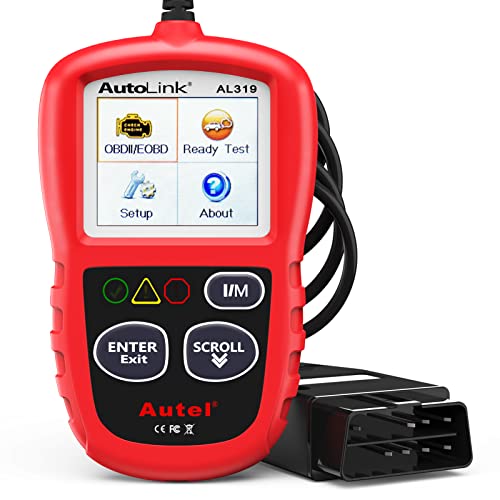
The Autel OBD2 Scanner AL319 (2026 Upgraded) is my top pick for DIY car owners who want professional-grade diagnostics without the steep learning curve. It reads and clears DTCs, displays live data, and retrieves freeze frame and I/M readiness status. It works on all OBD II vehicles after 1996, including Toyota, Honda, Ford, and Nissan. The one-click I/M function speeds up emissions testing prep. Its TFT color screen is sharp, and the built-in speaker confirms operations. The cable length fits comfortably across dashboards. No batteries are needed-it powers directly from the OBD-II port. Seven languages are supported. It includes lifetime free updates, a 12-month warranty, and direct tech support.
Best For: DIY car owners seeking an easy-to-use, reliable OBD2 scanner with professional features for diagnosing and maintaining vehicles from 1996 and newer.
Pros:
- Offers comprehensive diagnostic functions including DTC reading/clearing, live data, freeze frame, and one-click I/M readiness for quick emissions testing prep
- Features a color TFT display, built-in speaker, and plug-and-play design that makes it user-friendly for beginners
- Supports lifetime free updates, 7 languages, and comes with a 12-month warranty and responsive technical support
Cons:
- Limited to OBD-II compatible vehicles, so it won’t work on older models manufactured before 1996
- May not support advanced manufacturer-specific diagnostics beyond basic OBD2 functions
- Lacks Wi-Fi or app connectivity, limiting integration with smartphones or cloud-based data sharing
OBD2 Scanner with Reset & I/M Readiness

Who wouldn’t want a diagnostic tool that handles everything from clearing stubborn check engine lights to preparing for emissions tests with confidence? I rely on this OBD2 scanner for its built-in library of 35,901 DTCs, letting me read and clear codes fast. It turns off the MIL, checks live data, and runs I/M Readiness, Mode 6, and Mode 8 tests. Compatible with 98% of post-1996 US, 2000 European, and Asian vehicles. Ten language options guarantee broad usability. The compact device connects via Type-C for data transfer. I get lifetime free updates. It comes with a storage bag and cable.
Best For: DIY car enthusiasts and home mechanics who want a reliable, feature-rich OBD2 scanner to quickly diagnose issues, clear check engine lights, and prepare for emissions testing across a wide range of vehicles.
Pros:
- Extensive 35,901 DTC library with support for advanced diagnostics like Mode 6, Mode 8, and I/M Readiness checks
- Wide compatibility with 98% of vehicles from 1996+ (US), 2000+ (Europe), and Asian models with OBD2 ports
- Lifetime free software updates and Type-C connectivity for future-proof usability and easy data transfer
Cons:
- No mention of Wi-Fi or wireless connectivity for smartphone app integration
- Limited information on screen size, display quality, or user interface experience
- May not support certain manufacturer-specific protocols despite high compatibility claims
CGSULIT OBD2 Scanner for Cars (1996+)

You’re a DIY car owner who values precision and reliability, especially when avoiding costly trips to the mechanic. I rely on the CGSULIT SC103 because it reads and clears DTCs, turns off Check Engine Lights, and checks I/M readiness. It supports all OBD2 protocols-CAN, ISO9141, KWP2000, J1850 VPW, and PWM-on 1996+ gasoline vehicles. The 2.8-inch TFT color screen displays live data like RPM, coolant temp, and voltage clearly. Its industrial-grade chip guarantees fast, stable performance. No batteries needed-just plug and play. It’s not for electric cars. I trust it because Scotty Kilmer recommends it. It includes freeze frame analysis, a built-in DTC library, and 3-year warranty support.
Best For: DIY car owners who want a reliable, easy-to-use OBD2 scanner to diagnose and clear engine codes without visiting a mechanic.
Pros:
- Reads and clears DTCs, displays live data, and checks I/M readiness with a clear 2.8-inch TFT color screen
- Supports all OBD2 protocols and works with most 1996+ gasoline-powered vehicles; plug-and-play design requires no batteries
- Trusted by automotive expert Scotty Kilmer; includes freeze frame data, built-in DTC library, and 3-year warranty
Cons:
- Not compatible with electric or hybrid vehicles lacking internal combustion engines
- Limited to 12V gasoline vehicles, excluding some newer or non-standard models
- May require technical understanding for accurate diagnosis despite built-in guidance
Veepeak OBDCheck BLE Bluetooth Scanner

If you’re a DIY car owner who values seamless connectivity and broad Android compatibility, the Veepeak OBDCheck BLE Bluetooth Scanner stands out as a reliable entry-level choice. It works with most 1996+ OBD-II compliant vehicles for basic diagnostics. You’ll need a third-party app like Car Scanner ELM OBD2 or Torque (Android) to run it-no built-in software. Bluetooth LE connects directly through the app; don’t pair it in your phone’s settings. It reads and clears check engine codes, shows freeze frame data, I/M readiness, and live sensors. It doesn’t support advanced functions like EPB reset or injector coding. Works on Android and iOS, but not with Carly, MHD, or most BMW tuning tools before 2008.
Best For: DIY car owners seeking an affordable, easy-to-use OBD2 scanner for basic diagnostics with strong Android and iOS app compatibility.
Pros:
- Supports Bluetooth LE and connects directly through popular third-party apps without pairing
- Reads and clears check engine codes, displays freeze frame data, I/M readiness, and live sensor data
- Works with a wide range of 1996+ OBD-II compliant vehicles using apps like Car Scanner ELM OBD2 and Torque
Cons:
- Not compatible with advanced tuning apps like Carly, MHD, xHP, or ProTool
- Does not support advanced diagnostics such as EPB reset, injector coding, or service light resets
- Limited functionality for older BMW models (pre-2008) and EVs, with no support for Android head units
OBD2 Scanner Diagnostic Tool for All Vehicles
Looking for a way to handle car trouble without the mechanic’s markup? I use an OBD2 scanner that works on over 98% of vehicles-American models from 1996, Japanese from 2002, and European from 2008. It reads engine trouble codes (DTCs) to find real issues fast. One click turns off the Check Engine light. It monitors 20+ live data streams like fuel pressure and coolant temp. The 2.8-inch color display shows clear readings. A pro-grade chip delivers 50% faster analysis. It supports I/M readiness tests for emissions checks and captures freeze frame data. I rely on its CAN bus scanning for deep diagnostics. Multilingual menus include English and Spanish. Support replies within 24 hours.
Best For: DIY car owners and enthusiasts who want professional-grade diagnostics without paying for mechanic services.
Pros:
- Compatible with over 98% of vehicles from 1996+ (American), 2002+ (Japanese), and 2008+ (European) for broad usability
- One-click Check Engine Light reset and real-time monitoring of 20+ data streams for quick, accurate troubleshooting
- Features a 2.8-inch color display, fast-processing chip, and I/M readiness testing to support emissions inspections
Cons:
- Limited to OBD2-compliant vehicles, so older models outside the specified years may not be supported
- No mention of advanced bi-directional controls or coding capabilities for complex repairs
- Multilingual support appears limited to English and Spanish, which may exclude some users
Factors to Consider When Choosing an OBD2 Scanner
You need to check your vehicle’s OBD2 protocol compatibility before buying a scanner-most modern cars use CAN protocol (ISO 15765), but older models may rely on PWM or VPW. A good scanner reads both generic and manufacturer-specific codes, so look for one that supports full OBD2 PIDs and offers live data streaming at 10 frames per second or higher. Pick a device with a clear, intuitive display and Bluetooth or Wi-Fi connectivity, since wireless options let you use smartphone apps while still getting firmware updates directly from the maker.
Vehicle Compatibility
Vehicle compatibility hinges on understanding your car’s OBD2 implementation year and communication protocol. If you own a gasoline-powered vehicle made for the U.S. market after 1996, most scanners will work-federal law required OBD2 compliance starting then. European models typically adopted OBD2 by 2000, and Asian vehicles followed by 2003, so verify regional standards. Universal scanners support all five protocols: CAN, KWP2000, J1850 VPW, J1850 PWM, and ISO9141-ensuring broad connectivity. Check if your scanner lists support for these, especially CAN, which dominates post-2008 vehicles. If you drive a diesel or heavy-duty truck, confirm J1939 compatibility, as standard OBD2 alone won’t suffice. Always match scanner specs to your vehicle’s make, model, and year. Even OBD2-compliant tools can lack access to manufacturer-specific modules without additional protocol support.
Diagnostic Functions
While basic code readers only display error messages, a quality OBD2 scanner gives you full access to your vehicle’s diagnostic system, enabling precise troubleshooting. You can read and clear engine-related diagnostic trouble codes (DTCs), identifying the root cause of a check engine light. The best tools provide live data streams-engine RPM, vehicle speed, coolant temperature, and fuel pressure-for real-time performance monitoring. Freeze frame data captures sensor values at the exact moment a fault occurs, helping you diagnose intermittent issues accurately. I/M readiness checks confirm emission control systems are functioning, ensuring your car passes smog inspections. Advanced scanners support all OBD2 modes, including Mode 6 for test results from onboard monitoring and Mode 8 for direct component control-critical for deep diagnostics. These functions save time, reduce guesswork, and improve repair accuracy across modern vehicles.
User Interface
What makes an OBD2 scanner easy to use? A user-friendly interface has clearly labeled buttons and an intuitive menu layout, so you don’t need technical skills to navigate it. Look for backlit LCD or color displays with adjustable contrast-these improve visibility in low light and make data easier to read. Dedicated function buttons let you perform one-click tasks like reading codes or running I/M checks, reducing steps and saving time. You can view live data streams in real time, and on-screen graphing helps you analyze sensor performance accurately. This is especially useful when tracking oxygen sensor voltage or throttle position over time. Multi-language support guarantees you understand readings correctly, no matter your location. These features work together to give you clear, actionable diagnostics without confusion or delays.
Connectivity Options
How do you want to connect to your car’s diagnostics? Choose wired or wireless based on your needs. Wired OBD2 scanners plug directly into the 16-pin OBD2 port with a 2.5-foot cable, offering durable, reliable connections. They draw power from the vehicle, ensuring stable performance without battery drain. Wireless models use Bluetooth-either Classic or Bluetooth LE-to link to smartphones or tablets. Some skip pairing and connect automatically through a dedicated app once plugged in. This lets you monitor real-time data without cables cluttering your cabin. Wireless performance depends on app compatibility and signal stability. While convenient, they use minimal onboard power to maintain connection. Wired options guarantee consistent signal; wireless provides flexibility. Pick wired for reliability, wireless for convenience and mobile integration. Both deliver accurate diagnostics when matched with capable software.
Software Updates
Keeping your OBD2 scanner up to date guarantees it stays compatible with the latest vehicle systems and diagnostic protocols. You’ll want a model that offers lifetime free software updates-this assures long-term reliability without hidden costs. Regular updates expand diagnostic capabilities, adding support for newer car models and advanced trouble codes, including manufacturer-specific ones. Without updates, your scanner risks becoming obsolete, unable to read modern vehicles’ complex data. Updated firmware improves interface responsiveness, data accuracy, and live stream performance. Most scanners require a USB connection to a PC or sync with a mobile app for updates. Check the update frequency and ease of installation. Some brands release patches quarterly, while others only update annually. Choose a scanner with wireless update support for convenience. Always confirm compatibility with your vehicle’s year, make, and model post-update.
Frequently Asked Questions
How Often Should I Update My OBD2 Scanner Firmware?
You should update your OBD2 scanner firmware every 6 to 12 months. Outdated firmware can limit compatibility with newer vehicle models and reduce diagnostic accuracy. Manufacturers release updates to improve communication protocols like CAN, UDS, and KWP2000. Updated firmware enhances fault code detection, supports new sensors, and fixes bugs. Always back up existing settings before updating. Use only official software from the manufacturer to avoid bricking the device.
Can OBD2 Scanners Drain My Car’s Battery?
No, OBD2 scanners don’t drain your car’s battery under normal use. You plug them in only when diagnosing issues, so power draw is temporary. These devices typically pull less than 500mA-similar to a phone on standby. Leaving one connected for hours might sap charge, especially on older batteries. Always unplug after use. Modern scanners enter low-power mode when idle, but they’re not designed for continuous operation. Prevent unnecessary drain-treat it like a tool, not an accessory.
Do OBD2 Scanners Work on Diesel Engines?
Yes, OBD2 scanners work on diesel engines that comply with OBD2 standards. Most diesel vehicles made after 2007 in the U.S. support OBD2 protocols. You’ll need a scanner compatible with J1939 or manufacturer-specific diesel protocols. Standard OBD2 scanners read basic diagnostics, but advanced models access diesel-specific data like boost pressure, fuel rail pressure, and DPF status. Always verify protocol compatibility before purchasing.
Are OBD2 Scanners Legal in All States?
Yes, OBD2 scanners are legal in all states. You can use them freely on any OBD2-compliant vehicle, including diesel engines. The EPA mandates OBD2 access for emissions-related diagnostics since 1996 for gasoline vehicles and 2007 for diesel. You’re allowed to read, not modify, vehicle data. These devices connect via the standardized 16-pin DLC port. Using them doesn’t violate federal or state laws as long as you’re not tampering with emissions systems.
Can I Use an OBD2 Scanner on a Motorcycle?
Yes, you can use an OBD2 scanner on a motorcycle if it has an OBD2 port. Most motorcycles made after 2005 in the U.S. comply with EPA emissions standards and include OBD2 support. Check your bike’s emissions label first. Compatible scanners read fault codes via the 16-pin DLC. Not all bikes have it-some use proprietary connectors. Confirm protocol compatibility: CAN, ISO, or KWP2000. Use a motorcycle-rated scanner for best results.