Top Racing Spark Plugs That Boost Engine Performance Instantly
You get instant performance gains with racing spark plugs like the Autolite AR3910X, featuring a cut-back ground electrode and yttrium-enhanced core for faster ignition and reduced pre-ignition risk. The E3.102 uses DiamondFIRE technology with a dual-leg ground electrode to maximize spark exposure. Colder heat ranges in models like NGK R6252K-105 manage extreme temperatures, while precise gaps (0.020–0.035 in) guarantee reliable firing under high cylinder pressure. Each plug is engineered for specific engine demands-knowing your setup releases its full potential.
We are supported by our audience. When you purchase through links on our site, we may earn an affiliate commission, at no extra cost for you. Learn more. Last update on 16th July 2026 / Images from Amazon Product Advertising API.
Notable Insights
- High-performance racing spark plugs like Autolite AR3910X deliver maximum voltage with non-resistor design for faster ignition and improved combustion.
- E3 Racing Plugs feature DiamondFIRE technology with dual-leg ground electrodes to optimize spark efficiency and enhance fuel burn instantly.
- Colder heat range plugs such as Autolite AR3932-4PK manage extreme temperatures, preventing pre-ignition during high-RPM performance.
- Fine-wire electrodes in NGK R6252K-105 reduce firing voltage by up to 25%, ensuring reliable sparking under high cylinder pressure.
- Yttrium-enhanced alloy and copper core construction improve thermal control and conductivity, boosting engine responsiveness and durability under racing conditions.
Autolite-AR3910X Ar High Performance Racing Non-Resistor Spark Plug, 4-Pack

If you’re tuning a high-performance engine that demands reliable ignition under extreme conditions, the Autolite AR3910X AR High Performance Racing Non-Resistor Spark Plug is built for your application. I rely on its cut-back ground electrode design to minimize flame kernel quenching. This enhances ignitability, ensuring faster, more complete combustion. It’s a non-resistor type, so it delivers maximum voltage to the gap-ideal for racing ignitions. Fitment is vehicle-specific, so confirm compatibility. Each of the four plugs in this pack is manufactured in Mexico. The packaging measures 10.795 H x 2.997 L x 8.991 W centimetres and weighs 0.181 kilograms.
Best For: Enthusiasts and racers seeking high-ignitability spark plugs for high-performance engines under extreme conditions.
Pros:
- Cut-back ground electrode design improves flame kernel ignitability for faster, more complete combustion
- Non-resistor construction delivers maximum voltage to the spark gap, ideal for racing ignition systems
- Vehicle-specific fitment ensures precise compatibility and secure installation
Cons:
- Limited to specific vehicle applications; requires verification of fitment before purchase
- Non-resistor design may increase electromagnetic interference in sensitive electronics
- Packaging may be bulky relative to the product size, impacting storage efficiency
Autolite AR3910X High Performance Racing Non-Resistor Spark Plug, Pack of 1

The Autolite AR3910X High Performance Racing Non-Resistor Spark Plug is built for drivers pushing their engines to the limit-racers who demand consistent ignition and peak combustion efficiency under extreme conditions. I rely on its yttrium-enhanced alloy core to lower internal wire temps by up to 8%, cutting pre-ignition risks. Its colder heat range improves thermal control, protecting my engine during prolonged high-RPM runs. The cut-back ground electrode boosts flame kernel growth and exposes the spark for faster, more complete burns. Nickel plating resists corrosion better than black oxide, ensuring lasting conductivity. Autolite’s been perfecting spark plugs since 1936-I trust their OEM-level build and racing-specific engineering.
Best For: Professional racers and high-performance engine enthusiasts seeking reliable ignition, superior thermal management, and maximum combustion efficiency under extreme operating conditions.
Pros:
- Yttrium-enhanced alloy core reduces internal wire temperature by up to 8%, lowering pre-ignition risk
- Colder heat range and cut-back ground electrode improve thermal control and flame kernel ignitability
- Nickel plating offers superior corrosion resistance and long-term electrical conductivity
Cons:
- Non-resistor design may increase electromagnetic interference in sensitive ignition systems
- Optimized for racing; may not be ideal for daily-driven street vehicles
- Single plug per pack increases cost for full engine set installation
E3 Spark Plugs E3.102 Racing Plug
I rely on the E3.102 Racing Plug when maximum combustion efficiency is non-negotiable-this spark plug is engineered for racers and high-performance enthusiasts who demand precision ignition under extreme conditions. Its patented DiamondFIRE technology uses a dual-leg ground electrode to create an optimized edge-to-edge spark path. This design improves flame propagation, increases cylinder pressure, and enhances fuel burn. It features a 14mm thread, 0.75-inch reach, and gasket seat. The copper core guarantees superior conductivity, while the alloy steel top withstands intense heat. I’ve seen smoother idle, faster starts, and better throttle response. It’s built for UTVs, ATVs, and performance motorcycles. Weighing just 2.4 ounces, it fits tight engine bays. With a 4.6-star rating from 453 users, it’s a proven performer. It’s been available since December 17, 2008. Backed by Amazon’s 30-day return policy, it’s a low-risk upgrade.
Best For: Racers and high-performance enthusiasts seeking maximum combustion efficiency and reliable ignition in UTVs, ATVs, and performance motorcycles.
Pros:
- Patented DiamondFIRE technology with dual-leg ground electrode improves flame propagation, fuel burn, and power output
- Copper core ensures superior conductivity while alloy steel top handles extreme heat in high-performance engines
- Compact design with 2.4 oz weight fits tight engine spaces and delivers smoother idle, faster starts, and better throttle response
Cons:
- Limited to specific applications; not universally compatible with all engine types
- Higher price point compared to standard spark plugs without performance features
- Requires precise vehicle fitment knowledge to ensure correct installation
Silver Pack of 2 Racing Spark Plugs A7TC

You’re powering through rough terrain on your dirt bike or pushing the limits on a go-kart track-every spark counts when performance is on the line. I rely on the Silver Pack of 2 Racing Spark Plugs A7TC for consistent, racing-grade ignition. These plugs fit 50cc to 150cc engines in ATVs, scooters, dirt bikes, and go-karts. The A7TC model has a standard thread size and reach, ensuring proper installation. Its 3-electrode design boosts ignition efficiency. A copper core improves conductivity and heat dissipation. Nickel-plated housing resists corrosion. I’ve seen better combustion and reliability, especially under stress.
Best For: Racers and performance enthusiasts seeking reliable ignition and improved combustion in 50cc to 150cc ATVs, scooters, dirt bikes, and go-karts.
Pros:
- Features a 3-electrode design for enhanced ignition efficiency and consistent spark delivery
- Copper core provides superior conductivity and effective heat dissipation
- Nickel-plated housing increases durability and corrosion resistance for long-term reliability
Cons:
- Limited to smaller displacement engines, not suitable for larger motorcycles or vehicles
- May require more frequent replacement under extreme racing conditions
- No included gap tool, requiring separate purchase for precise electrode gap adjustment
Autolite AR3932-4PK High Performance Racing Non-Resistor Spark Plug, 4 Pack
Built for racers who demand consistency under extreme conditions, the Autolite AR3932-4PK High Performance Racing Non-Resistor Spark Plug delivers precision ignition where stock components fail. I rely on its vehicle-specific fit for secure installation and ideal performance in high-output engines. It features a colder heat range than factory plugs, effectively managing heat buildup from performance modifications. The yttrium-enhanced alloy reduces side wire temperature by up to 8%, boosting durability. A cut-back ground electrode improves flame kernel ignitability. Anti-corrosive nickel plating prevents rust, ensuring long-term reliability even in harsh environments.
Best For: Racers and high-performance engine enthusiasts seeking reliable, durable spark plugs designed to handle extreme conditions and performance modifications.
Pros:
- Features a colder heat range to effectively manage heat buildup in modified, high-output engines
- Yttrium-enhanced alloy reduces side wire temperature by up to 8%, enhancing durability and resistance to pre-ignition
- Cut-back ground electrode improves flame kernel ignitability for faster, more consistent combustion
Cons:
- Non-resistor design may increase electromagnetic interference, potentially affecting sensitive electronics
- Optimized for racing applications, making it less suitable for daily-driven or stock vehicles
- Limited compatibility outside specific vehicle models due to vehicle-specific fitment design
E3 Spark Plugs E3.101 Racing Plug

The E3 Spark Plugs E3.101 Racing Plug stands out for racers and high-performance engine builders who demand consistent ignition and peak combustion efficiency. Its patented DiamondFIRE Technology uses a dual-leg ground electrode with an edge-to-edge spark path, enhancing fuel burn. This design concentrates spark energy, igniting the air-fuel mixture faster and more reliably-especially in cold starts or extreme conditions. You get quicker flame propagation, smoother idle, and stronger acceleration. The plug delivers increased cylinder pressure, improving power output and fuel utilization. It’s a 14mm plug with a 0.75-inch reach and gasket seat, built for racing applications where performance can’t be compromised.
Best For: Racers and high-performance engine builders seeking superior ignition reliability, enhanced combustion efficiency, and maximum power output.
Pros:
- Patented DiamondFIRE Technology with dual-leg ground electrode improves fuel burn and combustion efficiency
- Edge-to-edge spark design ensures faster, more reliable ignition, especially in cold starts and extreme conditions
- Promotes smoother acceleration, stable idle, and increased cylinder pressure for greater power
Cons:
- Premium price point may be higher than standard spark plugs
- Optimized for racing applications, potentially shorter lifespan under normal daily driving conditions
- Specific 14mm size with 0.75-inch reach may not fit all engine types
NGK (2741) R6252K-105 Racing Spark Plug, Pack of 1
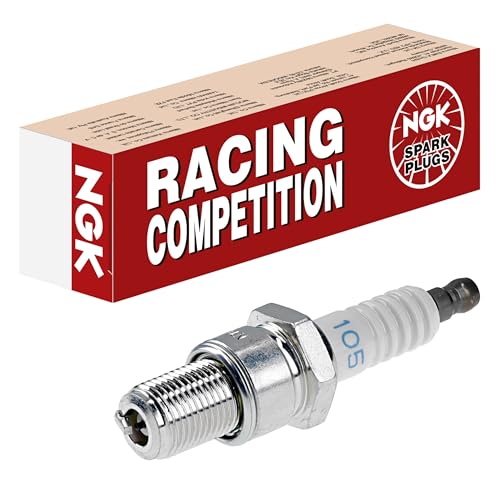
NGK delivers precision engineering for racers who demand reliability under extreme conditions, and the (2741) R6252K-105 Racing Spark Plug meets that standard. I rely on its fine-wire center and ground electrodes to deliver consistent sparking under high cylinder pressures. The design boosts ignitability, ensuring complete combustion. A zinc-dipped shell resists corrosion, even in humid or harsh environments. I’ve seen how moisture hurts performance-this plug fights back. Its triple gasket seal system locks out combustion gas leakage, maintaining compression. This isn’t guesswork-it’s engineered for exact fit in specific racing applications. You get durability, precision, and peak spark efficiency in one dependable unit.
Best For: Racers and high-performance engine enthusiasts seeking reliable, precision-engineered spark plugs built to withstand extreme conditions and deliver consistent ignition.
Pros:
- Features fine-wire center and ground electrodes for superior sparking and enhanced ignitability
- Zinc-dipped shell provides excellent corrosion resistance in harsh or humid environments
- Triple gasket seal system ensures tight combustion chamber sealing to prevent gas leakage
Cons:
- Sold individually despite “pack of 1” labeling, which may confuse buyers expecting multiple units
- High-performance design may not be optimized for everyday street-driven vehicles
- Premium pricing compared to standard spark plugs, reflecting its racing-specific engineering
TECHIE K9C Racing Spark Plugs (8-Pack)

You’ll find the TEchie K9C Racing Spark Plugs (8-Pack) deliver peak performance when your engine demands reliability under extreme conditions-especially if you’re running a high-compression or forced-induction setup. I rely on their 14mm thread diameter and 1.25mm thread pitch for secure fitment across a broad range of high-performance engines. The 5/8-inch hex and 0.031-inch (0.8mm) gap guarantee precise installation and maximum spark efficiency. They use a gasket seat design for consistent thermal sealing. These plugs replace top-tier models like NGK 5238 and Denso W27ES-U. I’ve seen them perform well in GM V8s, Hondas, and even Mercruiser marine engines.
Best For: Enthusiasts with high-compression, turbocharged, or nitrous-assisted engines seeking reliable, high-performance spark plugs for automotive, motorcycle, or marine applications.
Pros:
- Direct replacement for premium spark plug models including NGK 5238 and Denso W27ES-U
- Engineered for extreme conditions with precise 0.031″ gap and sturdy 14mm thread for reliable ignition
- Broad compatibility across performance vehicles, ATVs, and marine engines like Mercruiser GM Big Block
Cons:
- Limited modern automotive coverage despite wide vintage GM and Honda fitment
- Gasket seat design may require careful installation to avoid improper sealing
- Not optimized for daily-driven low-compression engines where standard plugs suffice
Factors to Consider When Choosing Racing Spark Plugs
You need to pick the right spark plug for your engine’s demands. Heat range affects ignition efficiency-too hot and you risk pre-ignition; too cold and fouling builds up. Electrode design, material durability, gap settings, and proper fit determine performance under high-RPM stress.
Heat Range Selection
While engine demands vary, selecting the correct heat range is critical for maintaining spark plug performance and engine reliability under extreme conditions. You need a colder plug in high-performance engines because it transfers heat faster, preventing overheating. If your plug’s heat range is too hot, it can cause pre-ignition and knocking-especially under heavy load or sustained high RPM. Colder plugs are essential for turbocharged, supercharged, or nitrous-injected setups due to higher combustion temps. The ideal electrode temperature stays between 450°C and 850°C, avoiding both fouling and melting. Running the wrong heat range risks performance loss, accelerated wear, or even catastrophic engine damage from uncontrolled combustion. Always match the heat range to your engine’s output and operating conditions. Treat it like tuning fuel maps-precision matters.
Electrode Design Matters
The right heat range keeps your plug operating in the ideal temperature window, but electrode design determines how effectively that spark ignites the air-fuel mixture. A cut-back ground electrode exposes more spark to the mixture, boosting flame kernel ignitability and combustion efficiency. You’ll see faster burn rates and improved throttle response. Dual-leg ground electrodes create an edge-to-edge spark path, promoting complete fuel burn and quicker flame spread across the chamber. Fine-wire center and ground electrodes reduce required voltage by up to 25%, ensuring reliable sparking even under high cylinder pressure. This precision enhances ignitability when you need it most. Multi-electrode setups, like 3-electrode designs, give you multiple ignition points, increasing spark consistency over time. The shape and position of the ground electrode also affect spark exposure and heat dissipation, directly influencing ignition reliability and power output. Choose wisely-your engine’s efficiency depends on it.
Material Durability Counts
A racing spark plug’s longevity hinges on its material composition, not just its design. You need high-grade alloys like yttrium-enhanced ones-they cut internal wire temps by up to 8%, slashing pre-ignition risk and boosting lifespan under stress. Copper cores deliver top-tier thermal conductivity, moving heat fast from spark tip to shell, so your plug won’t overheat during extended runs. Nickel-plated housings resist corrosion far better than standard finishes, critical in damp or salt-laden air. Fine-wire center electrodes made from tough alloys stay intact at extreme combustion temps while improving spark efficiency. Multi-layer seals, including triple gasket systems, lock in compression and block gas leaks. These materials work together like a shield, keeping performance sharp and failure rare. You’re not just buying a plug-you’re investing in endurance.
Gap Configuration Importance
Why do top racers treat spark plug gaps like precision settings on a timing map? Because the gap directly controls spark discharge efficiency and combustion quality. You need the right gap to guarantee a strong, reliable spark that ignites your air-fuel mixture completely. Too narrow, and the spark struggles to ignite lean mixtures-performance drops. Too wide, and your ignition system can’t deliver enough voltage, causing misfires. High-compression engines demand tighter tolerances, typically between 0.020 to 0.035 inches, depending on setup. Cylinder pressure and custom fuel maps mean you can’t rely on stock settings. Over time, thermal expansion and electrode wear shift the gap, hurting consistency. You must check and adjust gaps regularly-every 5 to 10 race hours-for peak output. Treat the gap like a valve timing spec: precise, critical, and non-negotiable.
Application Specific Fit
When selecting racing spark plugs, matching physical dimensions to your engine’s specs isn’t optional-it’s mandatory. You must verify thread diameter, reach, and seat type to guarantee a secure fit and proper combustion chamber positioning. A plug that’s too long can contact the piston; too short, and it disrupts flame propagation. The heat range must suit your engine’s output-too hot causes pre-ignition, too cold leads to fouling. Ground electrode design affects spark exposure and ignition efficiency, especially with high-energy ignition systems. Gap specifications must align precisely-mismatched gaps cause misfires under load. Always choose application-specific plugs to guarantee correct protrusion, maintain compression, and prevent mechanical damage. Your engine demands exact compatibility, not guesswork.
Frequently Asked Questions
Can Racing Spark Plugs Work in Daily Drivers?
Yes, you can use racing spark plugs in daily drivers, but you’ll likely face issues. Racing plugs often run hotter and have tighter tolerances designed for high-RPM engines. In a street car, this can cause pre-ignition or fouling. Their fine-wire electrodes improve spark efficiency but wear faster under stop-and-go driving. Stick with OEM specs unless you’ve modified your engine. Mismatched heat ranges reduce longevity and performance. You’re better off with a modern iridium plug tuned for daily use.
Are Expensive Spark Plugs Worth the Performance Gain?
No, expensive spark plugs usually aren’t worth the performance gain for daily driving. You get marginal improvements-maybe 1–2% in combustion efficiency. High-end plugs use fine-wire iridium or platinum electrodes, lasting 25% longer and firing more consistently. But your engine won’t make noticeably more power unless it’s modified. Stick with OEM-specified plugs. They’re optimized for your engine’s timing, compression, and fuel curve-saving you money without sacrificing reliability or performance.
Do I Need to Re-Tune After Installing Racing Spark Plugs?
yes, you should re-tune after installing racing spark plugs. they alter ignition characteristics and heat range, which affects air-fuel mixture combustion. modern engines rely on precise sensor feedback; mismatched tuning can cause lean or rich conditions. without adjustment, you risk misfires, knocking, or reduced performance. a proper dyno tune optimizes timing and fuel maps, ensuring the plugs work efficiently. it’s like upgrading brakes but skipping alignment-components improve, but the system needs recalibration.
How Often Should Racing Spark Plugs Be Replaced?
You should replace racing spark plugs every 10,000 to 20,000 miles. High-performance plugs endure extreme temperatures and pressure, degrading faster than standard units. Iridium or platinum tips last longer-up to 25,000 miles-thanks to their high melting points and resistance to erosion. Check electrode wear; gaps wider than 0.040 inches reduce ignition efficiency. Always follow your manufacturer’s interval. Regular inspection prevents misfires and maintains peak combustion.
Can Wrong Spark Plugs Damage My Engine?
Yes, wrong spark plugs can damage your engine. You risk improper ignition timing and misfires. If the heat range isn’t matched, you might cause pre-ignition or fouling. A plug that’s too long protrudes into the valve pocket, risking physical damage. Incorrect thread reach or diameter alters compression. Always verify electrode gap, heat range, and thread size. Using the wrong plug reduces efficiency and can lead to piston or cylinder harm.