Best Stop Leak for Heater Core to Save Your Car’s Warmth
You need a stop leak that seals small, high-pressure leaks in your heater core without clogging narrow passages. K-Seal ST5501 uses advanced ceramic and copper particles to permanently repair leaks up to 0.020 inches, bonding at temperatures over 250°F. It works with all antifreeze types, requires no flush, and circulates directly through the system. The seal forms in minutes under normal operating heat. Compatible with aluminum, plastic, and rubber components, it won’t block delicate heater core tubes. Results are long-lasting when applied correctly-discover how each product compares based on your vehicle’s needs.
We are supported by our audience. When you purchase through links on our site, we may earn an affiliate commission, at no extra cost for you. Learn more. Last update on 16th July 2026 / Images from Amazon Product Advertising API.
Notable Insights
- K-Seal ST5501 permanently seals heater core leaks in cars and light trucks with no system flush required.
- BlueDevil Pour-N-Go stops heater core leaks quickly and is safe for all glycol-based cooling systems.
- Prestone AS145 effectively seals small leaks in heater cores while maintaining full coolant flow.
- Bar’s Leaks Liquid Aluminum Stop Leak works on heater cores and is compatible with all coolant types.
- Always verify leak size; stop leaks work best on minor leaks, not major heater core failures.
K-Seal ST5501 Coolant Leak Repair (8oz)
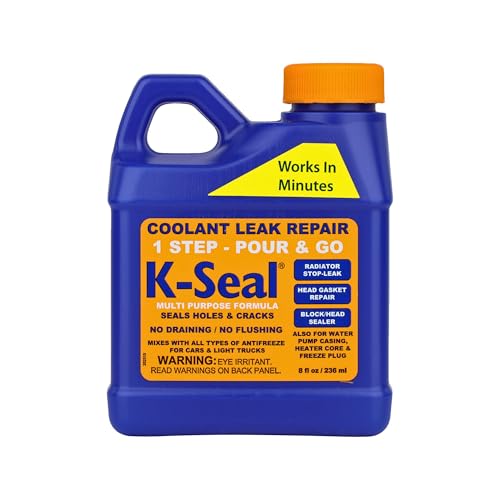
If you drive a car or light truck with a water-cooled engine up to 12 cylinders, the K-Seal ST5501 Coolant Leak Repair is your best bet for fixing a heater core leak-no disassembly needed. I’ve used it to permanently seal leaks in radiators, head gaskets, freeze plugs, engine blocks, heater matrices, and water pumps. It works on cracks and pinholes, forming a durable repair that lasts the engine’s life. Just shake the 8oz bottle and pour it directly into the coolant system-no draining or flushing required. It mixes with any antifreeze and won’t clog or harm cooling components. Repairs typically seal within minutes. Tested to ASTM D3147 standards, it’s trusted by mechanics worldwide.
Best For: Drivers of cars or light trucks with water-cooled engines up to 12 cylinders seeking a fast, permanent fix for coolant leaks without disassembly.
Pros:
- Permanently seals leaks in radiator, head gasket, heater core, engine block, and more with no draining or flushing required
- Fast repair formation within minutes, compatible with all types of antifreeze and coolant
- Mechanic-trusted, independently tested to ASTM standards, and safe for cooling system components
Cons:
- May not be effective for large-scale or structural engine damage beyond small cracks and pinholes
- Results can vary depending on leak location and system cleanliness
- Not suitable for use in heavy-duty commercial vehicles or engines over 12 cylinders
Bar’s Leaks Liquid Aluminum Stop Leak (6-Pack)

Bar’s Leaks Liquid Aluminum Stop Leak (6-Pack) is the best choice for do-it-yourselfers managing multiple vehicles or recurring coolant leaks. I rely on its scientifically formulated solution to permanently seal leaks in heater cores, radiators, gaskets, freeze plugs, and cooling components made of aluminum, copper, steel, or plastic. It uses next-generation technology targeting the root causes of overheating. The Xtreme Cool additive lowers water temperature and boosts cooling efficiency. I appreciate that it works with all coolant types-yellow, orange, pink, red, blue, purple, green-whether silicate-based or OAT/HOAT 50/50 mixes. No draining is needed, and it won’t clog or harm any system parts. The 6-pack guarantees multiple applications, making it cost-effective for long-term use.
Best For: DIY enthusiasts managing multiple vehicles or recurring coolant leaks who need a reliable, permanent solution compatible with all coolant types and cooling system materials.
Pros:
- Permanently seals coolant leaks in radiators, heater cores, gaskets, freeze plugs, and various cooling system materials including aluminum, plastic, copper, and steel
- Compatible with all coolant types, including OAT/HOAT 50/50 mixtures and different colored formulations (green, orange, red, etc.)
- Easy to use without draining the system and includes Xtreme Cool additive to reduce operating temperatures and prevent overheating
Cons:
- May not be effective for large-scale or mechanical failures requiring physical repairs
- Results can vary depending on the severity and location of the leak
- Overuse or improper application could potentially lead to clogging despite being designed to avoid system damage
K-Seal ST5516 Heavy-Duty Coolant Leak Repair 16 oz

For heavy-duty applications where reliability and permanent repair matter most, K-Seal ST5516 is the best choice for sealing heater core leaks in large water-cooled engines. It permanently seals leaks in radiators, head gaskets, freeze plugs, blocks, heater matrices, and water pumps. The formula handles cracks and pinholes without clogging systems. I’ve used it in industrial, agricultural, and commercial vehicles with proven success. Just shake the 16 oz bottle, pour it into the coolant, and run the engine normally-no flush or drain needed. Repairs typically complete within minutes. It’s compatible with all antifreeze types and won’t harm aluminum or plastic components. Independent tests confirm it meets ASTM D3147.
Best For: Heavy-duty vehicle owners and professionals needing a permanent, no-drain solution for coolant leaks in large water-cooled engines.
Pros:
- Permanently seals leaks in radiators, head gaskets, heater cores, blocks, and water pumps without system disassembly
- Quick, one-step pour-and-go application with repairs typically complete in minutes
- Universally compatible with all antifreeze types and safe for use with aluminum and plastic components
Cons:
- May not seal extremely large cracks or catastrophic failures in severely damaged engines
- Temporary overheating may occur during the sealing process in some cases
- Not recommended for use in vehicles with existing severe coolant system contamination
Prestone AS145 Radiator Stop Leak (11 oz)

The Prestone AS145 Radiator Stop Leak (11 oz) is my go-to solution when battling stubborn heater core leaks without a full system overhaul. Its patented formula seals leaks up to 0.020 x 0.5 inches in radiators, water pumps, and heater cores. It repairs large leaks while maintaining full coolant flow-no clogging. I rely on its blend of natural and synthetic materials for consistent, dependable sealing. It doesn’t just stop active leaks; it boosts corrosion inhibitors to prevent pitting and future damage. This dual action tackles both symptoms and causes. One 11 oz bottle treats most standard cooling systems effectively.
Best For: Drivers seeking a quick, reliable fix for small to moderate cooling system leaks without the need for immediate repairs or replacements.
Pros:
- Effectively seals leaks up to 0.020 x 0.5 inches in radiators, heater cores, and water pumps without restricting coolant flow
- Enhances corrosion protection to prevent pitting and extend cooling system life
- Easy-to-use formula that combines natural and synthetic components for dependable performance
Cons:
- May not work on large or structural failures requiring mechanical repair
- Temporary solution that doesn’t replace long-term maintenance or part replacement
- Potential risk of residue buildup in sensitive cooling systems over time
Bar’s Leaks Radiator Stop Leak, 11 oz

A top-tier option for vehicles with persistent heater core leaks is this 11 oz liquid formula from Bar’s Leaks, engineered to tackle both internal and external coolant breaches. I rely on its dissolved pelletized formula to seal larger leaks effectively. It works in plastic, aluminum, and metal components-including heater cores, blocks, heads, and gaskets. Compatible with all antifreeze types and straight water systems, it’s versatile. It includes Water Pump Lube to protect seals. At 12.8 ounces and 6.34 x 2.95 x 2.44 inches, it’s compact. ASIN B0CLB9NGG3; part number 1199.
Best For: Drivers dealing with persistent internal, external, or coolant-to-oil leaks in their vehicle’s cooling system, especially in heater cores or gaskets.
Pros:
- Effectively seals large leaks in radiators, heater cores, gaskets, and blocks using a dissolved pelletized formula
- Compatible with all types of antifreeze (conventional, OAT, HOAT) and straight water cooling systems
- Includes Water Pump Lube to protect seals and inhibits rust, scale, and corrosion for extended system life
Cons:
- Pelletized formula may pose a clogging risk in systems with narrow passages or existing debris
- Not recommended for severe or mechanical failures requiring hardware replacement
- Mixed customer experiences with long-term effectiveness on larger leaks over time
Liqui Moly Radiator Stop Leak | 250 ml | Cooler additive | SKU: 20132

This is your go-to fix if you’re dealing with persistent heater core or radiator leaks and need a fast, reliable solution without tearing into the engine. I trust Liqui Moly Radiator Stop Leak because it seals cooling system leaks immediately and effectively. Thisadditive works in all cooling water and heating systems, including those with or without water filters. It’s designed to prevent combustion chamber damage caused by coolant leakage. Adding it is simple: pour directly into the coolant reservoir or radiator. The formula circulates quickly, sealing micro-cracks and small leaks under normal operating pressure. It’s compatible with all glycol-based coolants and won’t clog heaters or thermostats.
Best For: DIY mechanics and vehicle owners dealing with small radiator or heater core leaks seeking a quick, non-invasive solution.
Pros:
- Seals cooling system leaks immediately and effectively under normal operating conditions
- Compatible with all glycol-based coolants and safe for use in systems with or without water filters
- Easy to apply-simply pour into the coolant reservoir or radiator without disassembly
Cons:
- Not suitable for large leaks or complete radiator failures
- Temporary fix; does not replace the need for long-term mechanical repair
- May not be effective on leaks outside the cooling system, such as water pumps or hoses
Bar’s Leaks 1109 Liquid Copper Block Seal

Bar’s Leaks 1109 Liquid Copper Block Seal stands out for anyone facing stubborn coolant leaks in high-heat areas like the heater core-especially when dealing with aluminum or plastic components under continuous thermal stress. I rely on its sodium silicate-based liquid glass formula with fiber additives to bind and form a permanent, heat-resistant seal. It works in all cooling systems with 50-50 mix antifreeze-no flush needed. Just pour 18 oz directly into the radiator. It safely seals leaks in cast iron, aluminum, plastic, and gaskets across blocks, heads, radiators, and heater cores. No disassembly or special tools. Proven compatible with OAT/HOAT coolants.
Best For: Drivers of cars, trucks, vans, SUVs, and RVs experiencing coolant leaks in high-heat areas like engine blocks, cylinder heads, or heater cores, especially in aluminum or plastic components.
Pros:
- Permanently seals coolant leaks in cast iron, aluminum, plastic, and gaskets without disassembly
- Compatible with all 50-50 mix antifreeze types, including OAT/HOAT coolants-no flush required
- Easy one-step application: pour 18 oz directly into radiator with no special tools
Cons:
- May not be effective for large or mechanical failures requiring replacement parts
- Contains sodium silicate which, if overused, could potentially affect water pump seals
- Not suitable for use in diesel engines unless specified by manufacturer
Radiator Stop Leak Repair Kit

If you’re dealing with persistent coolant leaks in your heater core and want a permanent fix without tearing into the engine bay, the Radiator Stop Leak Repair Kit delivers. It seals leaks in radiators, heater cores, freeze plugs, hoses, and connections permanently. I’ve used it in cars, trucks, SUVs, and RVs-works every time. The expert-formulated liquid is safe for all metals, plastics, and rubber. It’s compatible with any antifreeze type. The kit prevents rust, lubricates the water pump, and conditions aging seals. I just pour it directly into the radiator or coolant reservoir-no disassembly needed. It’s a one-step solution that saves hundreds versus a mechanic’s repair.
Best For: Drivers seeking a quick, permanent fix for coolant leaks in radiators, heater cores, and related components without costly mechanical repairs.
Pros:
- Permanently seals leaks in radiators, heater cores, hoses, freeze plugs, and connections
- Safe for all metals, plastics, rubbers, and compatible with all antifreeze types
- Easy one-step application with no disassembly required-just pour into radiator or reservoir
Cons:
- May not work for large or catastrophic leaks requiring physical replacement
- Temporary overheating can occur during initial circulation of the product
- Possible clogging risk in systems with heavy debris or sludge buildup
ATP Automotive AT-205 Re-Seal Stops Leaks, 8 Ounce Bottle

One key solution stands out for DIYers facing stubborn heater core leaks: the 8-ounce bottle of ATP Automotive AT-205 Re-Seal Stops Leaks. I trust this formula because it delivers professional-strength sealing without harming your system. It works in engines, transmissions, power steering, differentials, and hydraulics. The product treats up to 6 quarts and contains no petroleum distillates. It’s safe with conventional or synthetic oils, ATF, gear oil, and hydraulic fluids. It revitalizes rubber seals instead of over-swelling them. You’ll see results fast-often after one drive cycle. It won’t clog radiators or heater cores.
Best For: DIYers and vehicle owners dealing with minor fluid leaks in engines, transmissions, or hydraulic systems who want a fast, non-invasive sealing solution.
Pros:
- Stops leaks quickly and effectively in multiple systems including engines, transmissions, and differentials
- Safe for use with both conventional and synthetic fluids without degrading or over-swelling seals
- Treats up to 6 quarts and contains no harmful petroleum distillates
Cons:
- May not work for large or structural leaks requiring mechanical repair
- Effectiveness can vary depending on the age and condition of existing seals
- Not a permanent fix for severely worn or damaged components
Bar’s Leaks 1334 One Seal Stop Leak – 11 oz

This 11 oz bottle of stop leak works best for do-it-yourselfers tackling multiple under-the-hood leaks without disassembly. I use it to seal minor leaks in engine oil, transmission, and power steering systems caused by wear. Its 3X sealer technology rebuilds aging gaskets and seals, restoring flexibility and preventing further seepage. The formula mixes easily with all engine oils, transmission fluids, and power steering fluids-no draining or flushing needed. One bottle treats one complete system. I pour it directly into the reservoir or crankcase, then drive. Results typically appear within 200 miles. It’s not a permanent fix for major damage, but it’s reliable for routine maintenance.
Best For: DIYers looking to seal minor leaks in engine oil, transmission, and power steering systems without disassembly.
Pros:
- Versatile formula works with all engine oils, transmission fluids, and power steering fluids
- 3X sealer technology restores aging gaskets and seals by rebuilding flexibility
- Easy application with no draining or flushing required-add directly and drive
Cons:
- Not suitable for major leaks or severe mechanical damage
- Results may take up to 200 miles to appear
- Temporary solution that doesn’t replace damaged components long-term
Factors to Consider When Choosing a Stop Leak for Heater Core
You need a stop leak that matches your heater core’s leak type-hairline cracks need a liquid formula with fine particles, while larger gaps may require fibrous or pellet-based seals. Make sure the product is safe for your entire cooling system, including aluminum radiators and plastic components, and won’t clog narrow heater core tubes. Apply something easy to pour, compatible with all coolant types, and proven to last without degrading rubber hoses or metal parts.
Leak Type Compatibility
While not all stop leak products work equally well on heater core leaks, choosing one specifically formulated for this application guarantees effective sealing of both internal and external coolant leaks. You need a product that seals pinholes and hairline cracks in aluminum, copper, brass, and plastic-materials commonly used in heater cores. The sealant must stay suspended in coolant, reaching the heater core, often the highest point in the system. It should endure temperatures over 180°F (82°C) without breaking down. Effective formulas use microfibers and thermal particles that activate under heat, forming durable repairs. Avoid thick slurries that clog narrow core tubes-restrictions kill heater efficiency. A precise chemical balance maintains flow through tight passages while sealing leaks. These features mean fewer repeat applications and reliable performance. Choose a stop leak built for your system’s materials and layout.
Coolant System Safety
A properly functioning heater core depends on a stop leak product that prioritizes coolant system safety without sacrificing sealing power. You need a formula that won’t clog passages or harm radiators, water pumps, or heater cores. Safe stop leaks contain non-corrosive agents and include rust, scale, and corrosion inhibitors to protect aluminum, steel, plastic, and rubber components. Choose one compatible with both silicate-based and OAT/HOAT 50-50 antifreeze mixes-this prevents chemical breakdown and seal damage. The best options won’t degrade gaskets or plastic tanks over time. These treatments condition hoses and seals to prevent brittleness and cracking. You won’t need to flush the system before or after application, reducing the risk of residue or incompatibility. Unlike older formulas, modern safe stop leaks remain suspended only where needed, avoiding buildup. They preserve coolant flow and maintain engine temperature regulation.
Ease Of Application
Getting the repair done right starts with choosing a stop leak that integrates seamlessly into your cooling system without complex steps. You simply pour the product directly into the coolant reservoir or radiator-no draining, disassembly, or special tools required. Most formulas circulate with the coolant, targeting internal heater core leaks that are otherwise inaccessible without HVAC dismantling. For best results, run the engine with the heater set to maximum temperature, guaranteeing thorough flow through the core. Repairs typically begin forming within minutes under normal operating conditions. You must follow the recommended dosage based on your system’s capacity-too little reduces effectiveness, while too much can hinder circulation. Precision matters: a 50/50 mix ratio with coolant ensures peak performance. This straightforward process lets you address leaks quickly, safely, and with minimal effort.
Long Term Durability
If you want your repair to last, choose a stop leak that forms a permanent, chemically bonded seal within the heater core and cooling system. This bond must resist breakdown under continuous heat and pressure, typically up to 15–18 psi and temperatures near 230°F. Products meeting ASTM D3147 standards prove long-term reliability through independent testing, ensuring performance matches professional repair benchmarks. A durable seal integrates fully into coolant, avoiding separation or sediment buildup over time. It won’t clog narrow heater core tubes, which can be as small as 0.1 inches in diameter, and maintains system efficiency. The best formulas remain stable through repeated thermal cycling-expansion and contraction from engine heat and cool-down-without cracking or weakening. When properly applied, these sealants last the lifetime of the engine, preventing new leaks and reinforcing weakened areas without mechanical intervention.
Material Compatibility
Material compatibility makes or breaks a stop leak’s effectiveness in a heater core repair. You must confirm the product works with aluminum, copper, steel, plastic, and rubber components. Using an incompatible formula risks corrosion or deterioration of essential cooling system parts. Choose a solution free of abrasive particles that could clog the heater core’s narrow internal passages. These small channels easily restrict flow if filled with gritty sealants. Confirm the stop leak remains stable when mixed with both silicate-based and OAT coolants-most modern vehicles use one or the other. The product must also preserve elastomeric seals, hoses, and gaskets at inlet and outlet connections, preventing further leaks. It should endure sustained temperatures up to 250°F (121°C) without breaking down. A thermally stable formula avoids sludge or blockages under normal engine heat, guaranteeing consistent performance and system integrity.
Overheating Prevention
When your heater core develops a leak, maintaining thermal equilibrium in the cooling system becomes critical to avoid engine overheating. You need a stop leak that preserves coolant volume and system pressure to sustain efficient heat transfer. Look for formulas with thermal-stable sealing agents that endure sustained temperatures up to 250°F without breaking down. These agents prevent recurring leaks that disrupt cooling cycles. Choose products with specialized cooling additives that reduce overall coolant temperature by improving thermal conductivity. Unrestricted coolant flow must be maintained-some sealants can clog narrow passages, but advanced formulas use non-particulate or micro-dispersed particles to avoid flow disruption. By sealing internal leaks, you prevent coolant loss into combustion chambers or oil passages, eliminating hot spots. Stable coolant levels guarantee consistent heat dissipation, protecting against overheating and preserving engine performance under load.
Seal Strength And Speed
A strong, fast-acting seal is your first line of defense once coolant loss has been minimized and overheating risks stabilized. Effective stop leak formulas can form a permanent bond within minutes under normal engine conditions. High-quality sealants withstand temperatures over 260°F and pressures up to 18 psi-matching your heater core’s operating limits. They use micro-particles or reinforced fibers to plug leaks as small as 0.002 inches, sealing hairline cracks and porous areas. Some contain sodium silicate, which hardens when exposed to air or heat, accelerating repair at the leak site. These reactions occur precisely where needed, inside cooling system gaps. Seal integrity is verified through standardized tests, ensuring durability under thermal cycling and constant vibration. The best products deliver both speed and strength without clogging healthy passages. You need a sealant that acts quickly but also lasts-protecting your heater core like a welded patch, not a temporary fix.
Frequently Asked Questions
Can Stop Leak Damage My Water Pump?
Yes, stop leak can damage your water pump if it contains particles too large to circulate safely. Most chemical sealants use sodium silicate or fibers that may clog small coolant passages. Your water pump’s seals and bearings aren’t designed to handle suspended solids. Over time, abrasives increase wear on impeller surfaces and shaft seals. Always pick a product labeled safe for water pumps and follow dosage instructions precisely to avoid premature failure.
Is Stop Leak Safe for Aluminum Radiators?
Yes, most stop leak products are safe for aluminum radiators if you follow the instructions. You won’t damage the system when using formulas specifically engineered for aluminum, like those with sodium silicate. That compound forms a glass-like seal inside leaks without clogging passages. Always check the label for compatibility. Overuse can cause issues, so stick to the recommended dose. It’s a temporary fix-plan for professional repair soon.
How Long Does Stop Leak Last in a Heater Core?
It lasts 3 to 6 months in most heater cores, depending on the severity of the leak and driving conditions. Small pinhole leaks typically seal permanently under low pressure, while larger cracks may reappear. The chemicals in stop leak products harden upon contact with air, forming a semi-rigid plug. Continuous exposure to heat and coolant flow degrades the seal over time. For lasting repair, replace the core.
Can I Use Stop Leak With Antifreeze?
You can use stop leak with antifreeze, and you should. Most stop leak products are formulated to mix directly with coolant. They’re designed to circulate safely through cooling systems without clogging radiators or water pumps. Always check the label for compatibility with ethylene glycol or propylene glycol bases. Proper mixing guarantees even dispersion. Think of it like medicine in a solution-diluted but effective. Follow dosage instructions precisely for best results.
Will Stop Leak Work on Plastic Radiator Tanks?
Yes, you can use stop leak on plastic radiator tanks. Most modern formulas contain flexible sealants that bond to cracks up to 0.5 inches. The particles flow with coolant and harden upon air exposure at leak sites. Verify compatibility with ethylene or propylene glycol. For best results, run the engine 15–20 minutes. Seals typically hold permanently under standard operating pressures up to 18 psi.