Best Synthetic 2 Stroke Oils for Peak Engine Performance
You need a synthetic 2-stroke oil that delivers maximum protection under extreme heat and high RPM. TRIAX Power Sport 2T Full Synthetic Oil resists shear breakdown and maintains film strength up to 750°F. STA-BIL 2-Cycle Oil includes built-in stabilizer for fuel storage up to one year. Klotz R-50 and Maxima Formula K2 offer racing-grade ester chemistry for superior wear protection. All meet JASO FD or TC-W3 standards. Each excels in clean combustion, thermal stability, and engine compatibility-discover which formulation matches your performance priorities.
We are supported by our audience. When you purchase through links on our site, we may earn an affiliate commission, at no extra cost for you. Learn more. Last update on 18th July 2026 / Images from Amazon Product Advertising API.
Notable Insights
- Klotz R-50 Racing 2-Stroke Oil delivers unmatched film strength with full synthetic formula for extreme stress protection.
- Maxima Formula K2 uses ester-based synthetics and race-proven tech to reduce friction and wear in high-performance engines.
- TRIAX Full Synthetic 2T oil resists shear breakdown and maintains lubrication under extreme heat and RPM conditions.
- Husqvarna 593271901 features VEF technology and low-temperature formulation to reduce heat buildup and improve efficiency.
- STA-BIL 2-Cycle Oil includes built-in stabilizer, ensuring fuel stays fresh and engines start reliably after long storage.
TRIAX Power Sport 2T Full Synthetic Oil (1 Gal)

If you’re pushing your powersports equipment to the limit, the TRIAX Power Sport 2T Full Synthetic Oil (1 Gal) is built for you. I rely on its full synthetic formula for superior wear protection in air and liquid-cooled 2-cycle engines. It resists shear breakdown under extreme stress, maintaining high film strength. Its anti-friction chemistry safeguards piston rings and cylinder liners. Clean Burn Technology guarantees nearly smokeless combustion. The detergent system prevents carbon buildup, avoiding ring sticking. Suitable for ATVs, UTVs, snowmobiles, Jet Skis, and dirt bikes. I use it in premix or direct injection systems. It’s compatible with Arctic Cat, Polaris, Yamaha, and other major brands.
Best For: High-performance riders and racers who demand maximum protection and power from their ATVs, UTVs, snowmobiles, dirt bikes, and personal watercraft under extreme operating conditions.
Pros:
- Full synthetic formula provides superior wear protection and high film strength for extended engine life
- Clean Burn Technology delivers nearly smokeless combustion and reduces carbon buildup
- Compatible with premix and direct injection systems across major powersports brands
Cons:
- Higher price point compared to conventional or semi-synthetic 2-cycle oils
- May be over-specified for casual or low-intensity recreational use
- Not required for engines that specifically recommend lower-tier oil formulations
STA-BIL 2-Cycle Oil with Stabilizer (13 fl. oz.)

I rely on STA-BIL 2-Cycle Oil with Stabilizer when I need a full synthetic 2-stroke oil that doubles as a fuel stabilizer for long-term storage. This 13 fl. oz. bottle treats up to 5 gallons of fuel, delivering a precise 50:1 or 40:1 mix ratio. It contains multi-mix technology, making it compatible with all 2-cycle engines, including snowmobiles. The fuel stabilizer keeps gas fresh up to one year, preventing varnish and gum buildup. Its low-smoke formula reduces emissions during startup. Made in the USA, one bottle weighs 13.1 oz. It remains effective for 2 years after opening.
Best For: Snowmobile owners and small engine users seeking a full synthetic 2-cycle oil with built-in fuel stabilizer for long-term storage and ethanol protection.
Pros:
- Doubles as a 2-cycle oil and fuel stabilizer, extending fuel freshness up to 1 year
- Multi-mix technology works with all 2-cycle engines at both 50:1 and 40:1 ratios
- Low smoke formula reduces emissions and startup smoke
Cons:
- Limited to 5 gallons per bottle, requiring multiple bottles for larger fuel needs
- Only available in a single 13 fl. oz. size, less convenient for bulk users
- Effectiveness limited to 2 years after opening, requiring date tracking by user
Quicksilver 2-Stroke Marine Engine Oil (1 Gal)

Quicksilver 2-Stroke Marine Engine Oil (1 Gal) stands out for boaters who demand OEM-backed protection in harsh marine environments. I rely on this synthetic blend because it meets Mercury Marine’s strict specifications, ensuring top-tier performance in Mercury and Mariner outboards-and it works flawlessly with other brands too. Its NMMA TC-W3 certification guarantees corrosion resistance and superior lubrication. I use it in both oil injection systems and premix setups without issues. The oil shields critical components like the combustion chamber and exhaust passages from wear and rust. It’s engineered to keep 2-cycle marine engines running cleanly and efficiently, even under heavy loads or saltwater exposure-like antifreeze for your engine’s internals.
Best For: Boaters seeking OEM-recommended, high-performance 2-stroke marine engine protection in outboards, PWCs, and small engines.
Pros:
- Meets Mercury Marine OEM specifications and NMMA TC-W3 standards for reliable, corrosion-resistant operation
- Advanced synthetic blend delivers superior lubrication and engine cleanliness under demanding saltwater and heavy-load conditions
- Compatible with oil injection systems and premix applications across various 2-cycle marine engines
Cons:
- Premium pricing compared to conventional 2-stroke oils may deter budget-conscious users
- Limited to 2-stroke engines, reducing versatility for multi-engine type boaters
- May be over-specified for older or low-performance 2-stroke engines not requiring TC-W3 certification
TRIAX Power Sport 2T Synthetic Oil (1 Qt)

TRIAX Power Sport 2T Synthetic Oil (1 Qt) stands out for riders who demand peak performance from high-revving, hard-charging 2-stroke engines. I rely on its full synthetic formula for maximum wear protection under extreme heat and pressure. It resists shear breakdown, maintains film strength, and protects piston rings and cylinder liners. Its anti-friction chemistry enhances RPM response and torque recovery. Clean Burn Technology guarantees near smokeless combustion. Synergistic Detergent Chemistry prevents carbon buildup, keeping rings and ports clean. I use it in ATVs, dirt bikes, snowmobiles, and personal watercraft-premix or direct injection. It’s compatible with Arctic Cat, Can-Am, Polaris, Yamaha, and more.
Best For: Riders and racers seeking maximum performance and protection in high-revving, air- or liquid-cooled 2-stroke engines used in ATVs, dirt bikes, snowmobiles, personal watercraft, and other off-road applications.
Pros:
- Full synthetic formula provides superior wear protection and maintains film strength under extreme conditions
- Clean Burn Technology ensures nearly smokeless combustion and reduces carbon buildup for long-term engine cleanliness
- Compatible with both premix and direct injection systems, and works across a wide range of off-road brands and models
Cons:
- Premium price point compared to conventional or semi-synthetic 2-stroke oils
- May not offer noticeable benefits for casual or infrequent riders over lower-cost alternatives
- Limited to 2-stroke engines, reducing versatility for users with mixed vehicle fleets
Lucas Oil 2-Stroke Marine Oil (1 Gal)

If you’re operating a water scooter or other marine 2-stroke engine, Lucas Oil 2-Stroke Marine Oil (1 Gal) delivers reliable protection with its semi-synthetic formulation designed for demanding aquatic environments. I rely on its 20W-50 viscosity to maintain consistent lubrication under high heat and stress. The oil’s flash point is 75°C, ensuring stability during intense operation. This 1-gallon container (7.81 lbs total weight) fits standard storage, with dimensions of 8.6 x 4 x 11.95 inches. It’s a universal fit, ASIN B06XSZRH1Q, made in the USA. With a 4.7-star rating from 163 reviews, it ranks #204 in Motor Oils.
Best For: Owners of water scooters and marine 2-stroke engines seeking a high-performance, semi-synthetic oil for reliable protection in demanding aquatic conditions.
Pros:
- Semi-synthetic 20W-50 formulation provides excellent lubrication and stability under high heat and stress
- Flash point of 75°C ensures safe and consistent performance during intense engine operation
- Highly rated with a 4.7-star average from 163 customer reviews and ranks #204 in Motor Oils on Amazon
Cons:
- Product weight listed as 0.01 ounces appears inaccurate, causing potential confusion
- Limited to 2-stroke marine applications, reducing versatility for other engine types
- Higher price point compared to some conventional 2-stroke oils without clear cost-per-ounce data provided
Lucas Oil 10115 Semi-Synthetic 2-Cycle Motor Oil – 1 Gallon

The Lucas Oil 10115 Semi-Synthetic 2-Cycle Motor Oil – 1 Gallon stands out for users who demand reliable, clean-burning performance in air-cooled two-stroke engines. I rely on its balanced blend of mineral and synthetic oils for consistent lubrication under stress. It meets ISO GD and JASO FD standards, exceeds API TC requirements, and performs flawlessly in oil injection or premix systems up to 50:1. Its ashless detergent inhibitor package reduces spark plug fouling and chamber deposits. The smokeless formula burns cleanly and mixes completely with gasoline in all temperatures. I’ve found it stable across climates, ensuring long-term engine protection without residue.
Best For: Users seeking a reliable, clean-burning semi-synthetic 2-cycle oil for air-cooled engines in demanding conditions.
Pros:
- Meets ISO GD, JASO FD, and exceeds API TC standards for superior engine protection
- Advanced smokeless formula reduces emissions, spark plug fouling, and chamber deposits
- Fully compatible with oil injection systems and premix applications up to 50:1, mixing easily with gasoline in all temperatures
Cons:
- Slightly higher price point compared to conventional mineral-based 2-cycle oils
- Packaging is limited to 1-gallon size, which may not suit infrequent users
- Not recommended for water-cooled engines, limiting versatility
Premium 2-Cycle Oil 16oz Easy to Measure Bottle

When blending fuel for high-performance outdoor equipment, having precise control over oil-to-gas ratios makes all the difference in engine longevity and efficiency. I rely on the Premium 2-Cycle Oil 16oz bottle because its integrated measurement markings make mixing foolproof. You’ll find ounce and milliliter indicators for 2.6oz, 3.2oz, 80mL, and 100mL-ideal for accurate 50:1 or 40:1 ratios per gallon of gas. It meets strict JASO FD standards, ensuring clean burning and maximum protection. I use it exclusively in my trimmers and blowers. The compact 16oz size prevents waste and simplifies storage.
Best For: DIY homeowners and landscaping professionals seeking a reliable, easy-to-measure 2-cycle oil for maintaining high-performance outdoor power tools.
Pros:
- Integrated measurement markings for 2.6oz, 3.2oz, 80mL, and 100mL enable precise mixing for 50:1 and 40:1 ratios
- Meets JASO FD standards for clean burning and superior engine protection
- Compact 16oz size reduces waste and simplifies storage and handling
Cons:
- Limited to smaller fuel batches due to 16oz bottle size, less ideal for large-scale equipment users
- Measurement markings, while helpful, may be difficult to read in low-light conditions
- Formulated only for 2-cycle engines, not suitable for 4-cycle equipment or automotive use
Klotz R-50 Racing 2-Stroke Oil (1 Gal)

Klotz R-50 Racing 2-Stroke Oil is the go-to choice for hardcore racers who demand maximum engine protection under extreme stress. I rely on its 100% full synthetic formula to deliver unmatched film strength during high-RPM runs. It uses surface-active anti-wear chemistry to prevent piston and bearing damage. Advanced dispersants keep power valves clean and prevent spark plug fouling. I’ve seen it boost horsepower, improve throttle response, and eliminate smoke. It’s pre-mix only-never use it in oil injection systems. For motocross, I mix it 32:1 to 50:1; karts need richer 16:1 to 20:1. One gallon lasts through many race weekends.
Best For: Racers who demand extreme protection and performance from high-RPM, power-valve equipped two-stroke engines in motocross, karting, snowmobile, and marine racing applications.
Pros:
- Delivers unmatched film strength and wear protection under extreme racing conditions
- Keeps power valves and spark plugs clean with advanced dispersant technology
- Enhances horsepower, throttle response, and smoke-free operation
Cons:
- Pre-mix only-cannot be used in oil injection systems
- Higher cost compared to conventional or semi-synthetic 2-stroke oils
- Requires precise mixing ratios depending on engine type and application
Husqvarna 593271901 Engine Oil, Grey

Husqvarna 593271901 Engine Oil, Grey is the go-to choice for professionals who demand clean, reliable two-stroke engine performance under tough operating conditions. I rely on its high-performance synthetic formula to meet and exceed the latest JASO standards. It contains a fuel stabilizer that protects against degradation, reducing the risk of engine failure during storage or extended use. The low operating temperature formulation improves thermal efficiency, minimizing heat buildup. I trust VEF (Verified Engine Formula) technology to deliver consistent lubrication and wear protection. It mixes easily with fuel and burns cleanly, leaving minimal residue.
Best For: Professionals seeking high-performance, reliable two-stroke engine oil for demanding operating conditions.
Pros:
- Meets and exceeds latest JASO specifications for superior engine performance
- Contains fuel stabilizer to prevent degradation and reduce engine failure risk
- Low operating temperature formulation enhances thermal efficiency and reduces residue
Cons:
- Designed specifically for two-stroke engines, limiting versatility
- May be more expensive than conventional two-stroke oils
- Availability may be limited compared to more common brands
Maxima Formula K2 100% Synthetic Racing Premix
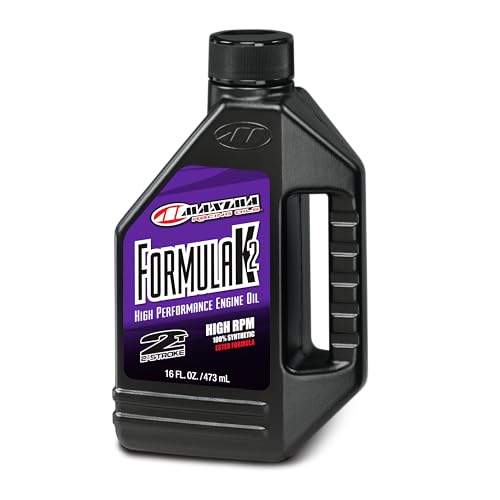
If you’re pushing the limits on a high-performance 2-stroke engine, Maxima Formula K2 100% Synthetic Racing Premix is built for your demands. I rely on its 100% synthetic racing premix technology because it’s engineered for extreme conditions. Developed with factory race teams, it uses track-proven formulations that enhance durability and power. Its ester-based compounds reduce friction and wear far better than conventional oils. Surface-active chemistry bonds to metal surfaces, providing constant protection and preventing deposit buildup. This oil maintains ideal ring seal, ensuring consistent compression and power delivery. I’ve seen measurable improvements in engine efficiency and throttle response-critical when every millisecond counts.
Best For: Racers and high-performance 2-stroke engine enthusiasts seeking maximum durability, power, and deposit control under extreme conditions.
Pros:
- Engineered with 100% synthetic racing premix technology for superior protection in high-stress environments
- Developed with factory race teams using track-proven formulations to enhance power and engine efficiency
- Features surface-active chemistry and ester-based compounds to reduce wear and prevent deposit buildup
Cons:
- Higher price point compared to conventional 2-stroke oils
- May be over-specified for casual or recreational engine use
- Limited availability outside performance racing and specialty retailers
Factors to Consider When Choosing Synthetic 2 Stroke Oil
You need to match the oil to your engine’s performance requirements and manufacturer specs. Look for synthetic 2 stroke oils with high thermal stability-rated above 400°F-to prevent breakdown under intense heat. Make sure the oil offers mix ratio flexibility, like 16:1 to 50:1, and provides strong wear protection with friction modifiers and low ash additives.
Performance Requirements
When pushing your engine to the limit, synthetic 2-stroke oil must deliver consistent lubrication under extreme conditions. You need rapid RPM acceleration and maximum power output, especially in racing or off-roading. Advanced synthetics provide high film strength, protecting piston rings and cylinder liners from wear. Anti-friction chemistry reduces drag, letting parts move smoothly under stress. The oil resists thermal degradation and shear breakdown, staying stable even at high temperatures. That means reliable lubrication when you need it most. Low smoke or smokeless combustion tech cuts visible emissions, keeping operation cleaner. Clean burn formulas prevent carbon buildup, reducing spark plug fouling and ring sticking. Deposit control guarantees long-term reliability and peak performance. You get consistent power without clogs or performance drops. These oils are built for demand-when performance can’t fail, your oil shouldn’t either.
Engine Compatibility
While engine compatibility often goes overlooked, selecting the right synthetic 2-stroke oil starts with matching the oil’s certification to your engine’s requirements. You need JASO FD, ISO GD, or API TC ratings for proper lubrication and protection. If you’re running a water-cooled engine, especially marine, use TC-W3 certified oil-it prevents corrosion and works with ethanol-blended fuels. Never assume all oils fit all systems: check if your engine uses premix or oil injection. Using the wrong type risks poor lubrication or serious damage. Also, pick a formula tailored to your cooling system-air-cooled engines need oils with strong thermal stability, while liquid-cooled units demand consistent performance under steady temps. Always confirm the oil supports your engine’s specified fuel ratio, like 40:1 or 50:1. Getting this wrong hurts combustion, increases wear, and cuts performance. Match the oil to your engine’s design, and it’ll run cleaner, cooler, and longer.
Mix Ratio Flexibility
Matching your synthetic 2-stroke oil to the correct mix ratio is just as important as confirming engine compatibility. You need the right balance to protect your engine and maintain performance. A 50:1 mix requires 2.6 ounces of oil per gallon of gas; a 40:1 needs 3.2 ounces. Some oils support wide ranges-from 16:1 for racing to 50:1 for casual use. Multi-mix technology lets one oil work reliably across different ratios, making it ideal for users with multiple machines. This flexibility simplifies storage and reduces errors. Too little oil causes overheating and wear; too much increases smoke and carbon buildup. Always follow your engine maker’s specs. Using the wrong ratio harms combustion and shortens engine life. Choose a synthetic oil designed for mix ratio flexibility-it’s a smart move for consistent, clean, and efficient operation across all your 2-stroke gear.
Thermal Stability
Because 2-stroke engines routinely run above 600°F, the oil you use must hold up under extreme heat without breaking down. Thermal stability determines how well your oil resists chemical degradation at high temperatures. High-quality synthetic oils maintain consistent viscosity and won’t form sludge or deposits, even during extended use. Their uniform molecular structure provides greater resistance to oxidation compared to mineral-based oils. When oils break down, you’ll see more emissions, fouled spark plugs, and lost power. Premium synthetics can handle continuous temps up to 750°F without shearing or thinning. This stability keeps lubrication reliable and combustion cleaner. You’re not just protecting your engine-you’re ensuring peak performance every time you throttle up. Choose a synthetic formulated for thermal endurance. It’s non-negotiable for modern high-output 2-strokes that push thermal limits. Don’t cut corners where heat rules.
Wear Protection
Reliability starts where metal meets metal. You need synthetic 2-stroke oil with anti-friction chemistry to protect high-stress areas like piston rings and cylinder liners. These oils use surface-active additives that bond to metal, slashing direct contact under extreme pressure and high RPM. The result? Less wear when you push hard. Look for high film strength-it resists shear breakdown, maintaining a solid lubricating barrier even in brutal conditions. Ester-based compounds boost lubricity, shielding parts during cold starts and rapid acceleration. Always choose oils meeting or exceeding API TC, JASO FD, or ISO GD standards. These certifications mean the oil’s built for severe-duty 2-stroke use. Don’t assume all synthetics are equal-check the specs. Real protection comes from formulations engineered to fight wear, not just burn clean. Your engine depends on it.
Clean Burn Capability
When your engine fires up, the quality of combustion starts with the oil you choose. Synthetic 2-stroke oils with clean burn capability reduce visible smoke and unburned hydrocarbon emissions by up to 70% compared to conventional oils. Advanced formulations guarantee nearly complete combustion, minimizing carbon deposits in the exhaust and combustion chamber. Low ash content-typically below 0.1%-prevents spark plug fouling and sustains reliable ignition. Efficient molecular breakdown allows fuel and oil to burn cleanly, reducing exhaust buildup and maintaining power output. Clean burn oils keep piston rings free-moving, cutting ring-sticking risks by over 50% in prolonged use. These oils also lower hydrocarbon emissions, meeting EPA and ISO standards for cleaner operation. You get longer engine life, less maintenance, and consistent performance. Choosing a low-smoke, low-residue synthetic isn’t just eco-friendly-it’s engine protection in action.
Fuel System Safety
How confident are you that your 2-stroke oil matches your engine’s fuel system? You must use oil specifically formulated for your fuel delivery-premix or oil injection-to prevent dangerous lean conditions and engine damage. If your engine uses premix, maintain exact ratios like 40:1 or 50:1 per manufacturer specs; inaccurate mixing causes poor lubrication or carbon buildup. For oil-injected systems, guarantee the oil flows cleanly without clogging pumps or lines. Choose a synthetic that’s compatible with fuels containing up to 10% ethanol-some oils degrade, leaving deposits or promoting corrosion. Opt for low-ash formulations to minimize spark plug fouling and avoid uncontrolled combustion. Never overfill or under-mix in premix applications; improper concentrations lead to piston scoring or clogged fuel pathways. Your fuel system’s reliability depends on precise oil selection and handling.
Certification Standards
Though performance claims on oil labels can sound impressive, only certification standards verify real-world effectiveness. You should look for ISO-L-EGD (ISO GD) certification, which guarantees proper lubrication, cleanliness, and efficient combustion in all 2-stroke engines. JASO FD means the oil is low-ash and high-performance, reducing deposits better than older JASO FC formulations. For marine engines, NMMA TC-W3 is essential-it guarantees water tolerance, corrosion protection, and compatibility with emission systems. API TC meets minimum North American performance standards for both air-cooled and water-cooled 2-stroke engines. Oils with multiple certifications deliver broader compatibility and better protection across different engine types. You get proven performance in extreme heat, high RPMs, and wet environments. Always check the label. Choosing multi-certified synthetic oil means you’re not guessing-you’re guaranteeing engine longevity and peak operation under real-world conditions.
Frequently Asked Questions
Can I Mix Different Synthetic 2-Stroke Oils?
Yes, you can mix different synthetic 2-stroke oils, but you shouldn’t. Combining oils may destabilize additive packages, reducing lubricity and combustion efficiency. Manufacturers formulate each oil to exact specifications-mixing alters viscosity, ash content, and detergency. Inconsistent ratios increase carbon buildup and wear. Stick to one high-quality synthetic to guarantee predictable performance. If you must switch oils, drain old mix first. Consistency protects your engine better than any workaround ever will.
Is Synthetic 2-Stroke Oil Safe for Older Engines?
Yes, synthetic 2-stroke oil is safe for older engines if it meets the manufacturer’s JASO FC or TC specifications. You won’t damage vintage engines when using synthetics labeled TC-rated-they’re formulated with proper detergent levels and low ash content. Modern synthetics flow better at cold starts and burn cleaner than older mineral oils. Just verify compatibility with your engine’s year, type, and crankcase requirements to avoid seal or ring issues.
How Long Does Synthetic 2-Stroke Oil Last in Storage?
You can store synthetic 2-stroke oil for up to five years if sealed properly. The container must stay airtight, shielded from temperature swings and moisture. Once opened, use it within two years-oxidation and contamination degrade performance. Store upright in a cool, dry place between 32°F and 85°F. Avoid concrete floors; place on a shelf to prevent condensation. Don’t mix old with new batches-chemical breakdown alters viscosity and lubricity.
Does Synthetic 2-Stroke Oil Burn Cleaner Than Conventional?
Yes, you’ll find synthetic 2-stroke oil burns cleaner than conventional. It produces fewer carbon deposits and unburned hydrocarbons. Synthetics have uniform molecular structures, improving combustion efficiency. They contain fewer impurities-typically less than 0.1% sulfur versus up to 1.5% in mineral-based oils. This means reduced smoke, lower exhaust emissions, and less fouling of spark plugs. You’ll also see improved ring and piston cleanliness, which maintains compression and power output over time.
Can I Use Marine 2-Stroke Oil in a Dirt Bike?
No, you shouldn’t use marine 2-stroke oil in a dirt bike. Marine oils are formulated for water-cooled, lower-RPM engines and contain additives for exhaust emission control, not high-temperature stability. Dirt bikes run hotter and need oils with higher JASO FD ratings, superior lubricity, and better resistance to pre-ignition. Using marine oil can cause ring stick, detonation, or piston damage. Stick with TC-W3-rated oils only if specifically designed for air-cooled, high-performance 2-strokes.