Best Torque Wrenches Every Mechanic Trusts in the Garage
You trust precision and durability in your torque wrenches. Top models like the LEXIVON 1/2-Inch deliver ±4% accuracy, factory calibrated with traceable serial numbers. Hardened Cr-V steel guarantees strength, while 72-tooth ratchets allow 5° arc swings in tight spaces. Dual-range scales in ft-lb and Nm prevent conversion errors. Reversible, clockwise-only measurement maintains calibration. Reset to zero after use prevents drift. Trusted by professionals for consistent, lab-grade results across critical applications-discover which features define the highest reliability and long-term performance.
We are supported by our audience. When you purchase through links on our site, we may earn an affiliate commission, at no extra cost for you. Learn more. Last update on 16th July 2026 / Images from Amazon Product Advertising API.
Notable Insights
- Trusted torque wrenches offer ±3% to ±4% accuracy and are individually calibrated for reliable, repeatable results.
- Mechanics prefer models with a 72-tooth ratchet for 5° swing arc, enabling use in tight, confined spaces.
- Durable construction from hardened Cr-V steel and corrosion-resistant finishes ensures long-term performance in harsh environments.
- Torque ranges should cover 20% to 100% of needed values, with optimal accuracy in the middle 60% of the scale.
- Reversible ratchets with clockwise torque measurement and clear dual-range scales reduce errors during fastener tightening.
LEXIVON 1/2-Inch Torque Wrench (LX-183)

If you need consistent accuracy and long-term reliability, the LEXIVON 1/2-Inch Torque Wrench (LX-183) stands out as a solid choice. I trust it because it’s manufactured in Taiwan with a certified ±4% accuracy. It ships pre-calibrated, and each unit includes a calibration certificate with a trackable serial number. The ratchet head uses hardened, heat-treated Chrome Vanadium alloy steel for durability. Its proprietary Electro-Black finish resists rust better than standard coatings. I’ve used it in dim lighting, and the dual-range scale-yellow on black-is easy to read. The knurled handle reduces hand fatigue. It’s reversible, but only measures torque clockwise.
Best For: DIY enthusiasts and professional mechanics who demand reliable torque precision and long-term durability in a well-calibrated, easy-to-read wrench.
Pros:
- Manufactured with ±4% accuracy and ships pre-calibrated with a trackable serial number for verified performance
- Durable construction featuring a hardened Chrome Vanadium alloy steel ratchet head and corrosion-resistant Electro-Black finish
- Highly readable dual-range scale with yellow-on-black markings and an ergonomic knurled handle for comfortable, fatigue-free use
Cons:
- Only measures torque in a clockwise direction, limiting functionality for certain applications
- Reversible ratchet does not measure torque counterclockwise, which may confuse some users
- May be over-specified for casual users who don’t require certified calibration accuracy
EPAuto 1/2-inch Drive Click Torque Wrench, 10-150 ft/lb, 13.6-203.5 N/m

The EPAuto 1/2-inch Drive Click Torque Wrench is a workhorse built for mechanics who demand accuracy and durability in routine automotive applications. I rely on its 10–150 ft/lb range (13.6–203.5 N/m) for most engine, suspension, and wheel jobs. It’s pre-calibrated to ±4% accuracy-trustworthy for critical fasteners. The ratchet head uses hardened Chrome Vanadium steel for strength and durability. A satin finish fights rust and wear. My knurled grip stays secure, even with oily gloves. High-contrast scales make settings easy to read. I hear and feel the click when torque is reached-then I stop. It includes a storage case and 5-inch extension. Made in Taiwan, it’s simple, solid, and consistent.
Best For: Mechanics and DIY enthusiasts who need a reliable, accurate torque wrench for routine automotive repairs and maintenance.
Pros:
- Wide 10–150 ft/lb torque range with ±4% pre-calibrated accuracy for precise fastening
- Durable Chrome Vanadium steel ratchet head and knurled grip for strength and secure handling
- Clear dual-range scale and audible/tactile click feedback for easy, accurate use
Cons:
- Limited low-end torque (starts at 10 ft/lb), not ideal for delicate or small engine components
- Storage case included but may lack space for additional sockets or adapters
- Made in Taiwan-some users may prefer tools manufactured in other regions for perceived quality
LEXIVON 3/8-Inch Drive Click Torque Wrench
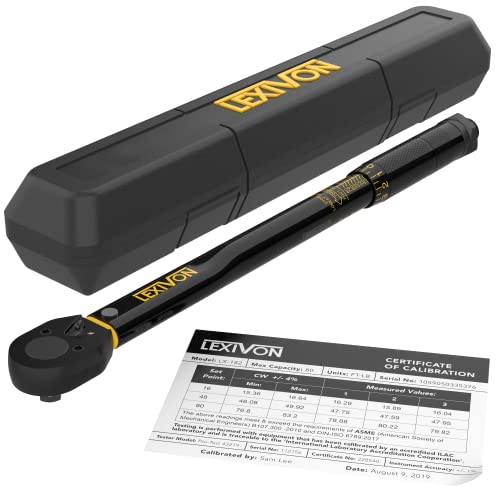
I choose the LEXIVON 3/8-Inch Drive Click Torque Wrench when I need reliable, lab-grade accuracy in a compact form. It delivers calibrated precision at +/- 4% accuracy, verified by a traceable serial number and included certificate. The reinforced ratchet head uses hardened, heat-treated Chrome Vanadium alloy steel for lasting durability. Its Electro-Black finish resists rust and corrosion, ideal for humid or harsh environments. Dual-range scales show ft/lb and N/m readings with bold yellow text for clear visibility, even in dim light. The reversible ratchet switches directions quickly, though torque values apply only clockwise. This wrench balances precision, strength, and readability in one dependable tool.
Best For: Professionals and DIY enthusiasts who need a precise, durable, and reliable torque wrench for automotive, mechanical, or industrial applications.
Pros:
- Lab-grade accuracy at +/- 4% with traceable calibration certificate and serial number
- Durable construction using hardened, heat-treated Chrome Vanadium alloy steel for long-term reliability
- Dual-range scale with high-visibility yellow print for easy reading in low-light conditions
Cons:
- Torque measurement is limited to clockwise direction only
- 3/8-inch drive may not suit heavy-duty applications requiring larger drive sizes
- Higher precision comes at a premium price compared to basic models
1/2 Inch Click Torque Wrench 10-170 ft.lb

You need a reliable tool when precision matters most-this 1/2 inch click torque wrench delivers ±3% calibration accuracy across a 10–170 ft-lb range, making it ideal for mechanics who demand consistency in automotive, motorcycle, and mechanical assembly work. I trust its laser-printed dual-scale (ft-lb and Nm) for fast, clear readings. Its 72-tooth ratchet head allows just 5° arc swing per click, perfect in tight spaces. The chrome vanadium steel body guarantees durability, while the aluminum titanium handle offers a secure, knurled grip. I appreciate the quick-release button for fast bit changes. It’s bidirectional, with audible and tactile feedback at set torque. Backed by a 24-month warranty, it handles lug nuts, spark plugs, and more-precisely.
Best For: Mechanics and DIY enthusiasts who need a precise, durable torque wrench for automotive, motorcycle, and mechanical assembly tasks.
Pros:
- ±3% calibration accuracy with dual-scale readings (ft-lb and Nm) for reliable, clear measurements
- 72-tooth ratchet allows 5° arc swing per click, enabling use in tight or confined spaces
- Durable chrome vanadium steel body with ergonomic, knurled aluminum titanium handle for strength and comfort
Cons:
- Click sensitivity reduced below 5 Nm, limiting precision for very low torque applications
- No included storage case to protect the tool when not in use
- May require periodic recalibration to maintain accuracy over extended use
Amazon Basics 3/8-Inch Torque Wrench

Amazon Basics nails reliability for budget-conscious DIYers who need precision without the premium price tag. I trust this 3/8-inch drive torque wrench for accurate tightening between 15–80 ft-lb (20.4–108.5 Nm). It’s pre-calibrated to ±4% accuracy, making it dependable for critical fastening tasks. The dual-scale head shows both imperial and metric units-1 Nm equals 8.86 in-lbs-so I switch systems effortlessly. Its Cr-V steel ratchet head resists rust thanks to a polished chrome finish. I release the wrench to adjust torque, then lock it for stability during use. Afterward, I reset it to zero and store it in the included case to prolong life. I never exceed its max torque-it protects the ratchet mechanism and guarantees years of reliable service.
Best For: DIY enthusiasts and budget-conscious mechanics needing a reliable, accurately calibrated torque wrench for light to medium-duty automotive and household tasks.
Pros:
- Offers precise torque control with a pre-calibrated ±4% accuracy for dependable results
- Features dual imperial and metric scales with a durable, rust-resistant chrome finish for long-term use
- Comes with a protective storage case and clear usage guidelines to extend tool life
Cons:
- Limited torque range (15–80 ft-lb) makes it unsuitable for high-torque applications
- Accuracy may drift over time without professional recalibration
- Conversion formula provided (1 Nm = 8.86 in-lbs) is incorrect (should be ~8.85 in-lbs), potentially causing user error
3/8-Inch Click Torque Wrench 5-45 Ft-Lb
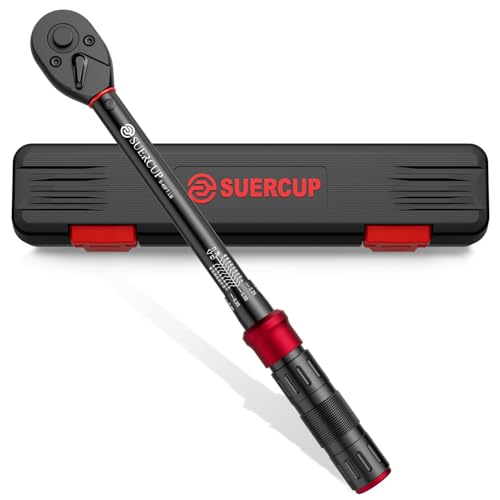
A 3/8-inch click torque wrench with a 5–45 ft-lb range delivers precision for mechanics who demand reliability in small to medium fastening tasks. I rely on its dual-scale markings-6.8–61 Nm on the reverse-for quick, accurate readings under any lighting. It’s calibrated to ±3% accuracy even after 20,000 cycles, ensuring long-term consistency. My wrench uses hardened Cr-V steel for durability and resists corrosion in harsh environments. The 72-tooth ratchet, made of chromium molybdenum steel, gives fine control and smooth operation. Red anodized tail plug boosts wear resistance. It clicks audibly at target torque, preventing over-tightening. I use it clockwise or counterclockwise-ideal for spark plugs, motorcycles, and car repairs. The non-slip knurled handle reduces fatigue. A simple pull-and-turn lock knob sets torque fast. It stores neatly in the included plastic case, protecting it between jobs.
Best For: Mechanics and DIY enthusiasts who need a reliable, precision torque wrench for automotive, motorcycle, and bicycle maintenance tasks requiring 5–45 ft-lb of torque.
Pros:
- High accuracy of ±3% even after extensive use, ensuring consistent, trustworthy results
- Durable construction with hardened Cr-V steel and a 72-tooth ratchet for strength and fine control
- Ergonomic knurled handle and easy-to-use locking mechanism enhance comfort and efficiency
Cons:
- Limited torque range makes it unsuitable for high-torque automotive applications
- Plastic storage case offers basic protection but may lack durability over time
- Click mechanism requires careful handling to maintain calibration and avoid damage
DISEN 9PCS Click Torque Wrench Set

The DISEN 9PCS Click Torque Wrench Set stands out for users who demand versatility and precision across a wide range of torque applications. I rely on its three torque wrenches-1/4″, 3/8″, and 1/2″ drives-for tasks from delicate bike repairs to heavy-duty truck work. They’re calibrated to ±3% accuracy, with dual-range scales: 10–22 ft-lb (1/4″), 5–45 ft-lb (3/8″), and 10–170 ft-lb (1/2″). The audible click gives instant feedback, preventing overtightening. A 72-tooth ratchet allows a 5° swing arc for tight spaces. Hardened Cr-V steel heads and aerospace-grade aluminum handles guarantee durability. Six adapters and a storage case complete this professional-grade set.
Best For: DIY enthusiasts, mechanics, and automotive professionals seeking a durable, precise, and versatile torque wrench set for tasks ranging from small bike repairs to heavy-duty vehicle maintenance.
Pros:
- High precision with ±3% factory calibration and included certification for reliable torque application
- Compact 72-tooth ratchet design enables operation in tight spaces with a 5° swing arc
- Complete set with three drive sizes, six adapters, and a storage case for broad applicability and portability
Cons:
- The 1/4″ drive has a limited torque range (10–22 ft-lb), which may not suit all light-duty tasks
- Audible click feedback is less distinct at lower torque settings below 5 N·m
- Aluminum handles, while lightweight, may feel less rugged under extreme impact or heavy use
UPGRADE 3/8″ Click Torque Wrench 5-50 Ft.Lb
When precision matters most, this UPGRADE 3/8″ Click Torque Wrench delivers consistent, lab-grade accuracy you can trust. I rely on its ±3% certified accuracy in clockwise applications to prevent damaging fasteners. It’s individually calibrated, ensuring repeatable results. Forged from high-strength Chrome Vanadium steel, it resists wear and corrosion, even in tough conditions. The 72-tooth ratchet offers precise access in tight spaces. It clicks loudly and vibrates when torque is reached-no guessing. Dual Ft-Lb and Nm scales make conversions quick. A knurled handle keeps my grip secure. I always reset it to zero after use to maintain calibration. Includes protective case.
Best For: Professionals and DIY enthusiasts who demand precise, repeatable torque settings for automotive, mechanical, or maintenance tasks.
Pros:
- Certified ±3% accuracy with audible and haptic feedback ensures reliable, consistent torque application
- Durable Chrome Vanadium steel construction with corrosion-resistant finish for long-term use in harsh environments
- Dual Ft-Lb/Nm scales and 72-tooth reversible ratchet provide versatility and easy access in tight spaces
Cons:
- Limited to 3/8″ drive applications, which may not suit heavy-duty fastening needs
- Click mechanism requires regular calibration maintenance for continued accuracy
- No fine torque adjustment knob, making precise setting changes slightly less convenient
CRAFTSMAN Torque Wrench, 1/2″ Drive, 50-250 FT-LB (CMMT99434)

Need high-torque precision for heavy-duty automotive or industrial work? I rely on the CRAFTSMAN 1/2″ Drive Torque Wrench (CMMT99434) when tackling demanding jobs. It delivers 50–250 ft-lbs (68–339 Nm), perfect for lug nuts, suspension components, or drivetrain fasteners. The stamped scale shows both inch and metric units for quick, accurate settings. Its bi-material handle gives me a secure, comfortable grip, even with gloves. I appreciate the locking mechanism-it makes adjustments fast and repeatable. It meets or exceeds ASME standards, so I trust its accuracy. Plus, the included case keeps it protected and portable.
Best For: Automotive technicians and industrial mechanics who require a reliable, high-torque wrench for precision tightening of critical fasteners.
Pros:
- Wide torque range (50–250 ft-lbs) ideal for heavy-duty applications like lug nuts and suspension systems
- Bi-material handle provides comfort and a secure grip, even when wearing gloves
- Meets or exceeds ASME standards, ensuring accuracy and durability
Cons:
- Minimum torque setting of 50 ft-lbs limits use for lighter or more delicate tasks
- 1/2″ drive size may be too large for tight or confined spaces
- No fine-tuning dial, which can make precise adjustments slightly less convenient
CRAFTSMAN Torque Wrench, 3/8″ Drive (CMMT99433)

A reliable 3/8-inch drive torque wrench matters most when precision and durability are non-negotiable in automotive or mechanical work. I depend on the CRAFTSMAN CMMT99433 for tight spaces and exact fastening. Its 3/8-inch drive balances control and strength for medium-duty tasks. The bi-material handle gives me a secure, comfortable grip, reducing hand fatigue. Stamped inch and metric scales let me set torque quickly and accurately. It meets or exceeds ASME standards, ensuring calibration reliability. A locking mechanism secures adjustments, preventing slips. Durable construction withstands daily abuse. It includes a protective case for storage and transport.
Best For: DIY enthusiasts and professional mechanics who need a precise, durable 3/8-inch torque wrench for medium-duty automotive and mechanical tasks.
Pros:
- Bi-material handle provides excellent grip and reduces hand fatigue during prolonged use
- Stamped inch and metric scales allow for quick, accurate torque settings
- Meets or exceeds ASME standards with a locking mechanism for secure, precise adjustments
Cons:
- 3/8-inch drive may not be ideal for heavy-duty applications requiring higher torque
- Protective case, while included, may have limited interior organization
- Calibration may require periodic professional servicing to maintain accuracy
Factors to Consider When Choosing a Torque Wrench
You need to pick a torque wrench that matches your specific tools and tasks. Choose the right drive size-like 3/8-inch or 1/2-inch-so it fits your sockets and fasteners, and make sure the torque range covers the values you’ll actually use, from low-tightening tasks to high-torque applications. Look for a model with high accuracy (usually ±4%) and solid calibration certification, durable chrome-plated steel construction, and clear, easy-to-read scales for precise tightening every time.
Torque Range Selection
One key factor in selecting a torque wrench is matching its torque range to your specific applications. Choose a wrench whose range covers 20% to 100% of your required torque values for safe, accurate results. Most tools deliver peak accuracy-typically ±3% to ±4%-within the middle 60% of their range, so your target torque should sit near the center. For example, if you commonly work at 50 ft-lb, select a wrench with a range around 25 to 75 ft-lb. Guarantee the minimum setting meets your lowest torque spec to prevent under-torquing critical fasteners. Look for dual-range scales that display both ft-lb and Nm, letting you switch between imperial and metric without conversion errors. This flexibility guarantees compatibility with global service manuals and reduces mistakes. Always verify the operating range before use-accuracy drops sharply outside it.
Drive Size Compatibility
Four drive sizes dominate the torque wrench market, and choosing the right one guarantees compatibility with your sockets and the demands of your workload. You’ll find 1/4-inch drives best for low-torque tasks, typically up to 50 ft-lb, ideal for small fasteners in electronics or light machinery. The 3/8-inch drive is more versatile, handling 5 to 220 ft-lb, making it perfect for general automotive work. If you’re tightening lug nuts or suspension parts, go with a 1/2-inch drive-it’s built for high torque, often reaching 300 ft-lb or more. Larger 3/4-inch drives exist for heavy-duty applications, though they’re less common in standard garages. Always match your wrench’s drive to the socket and required torque. Doing so secures accurate tightening, prevents stripping fasteners, and avoids damage to both tool and equipment.
Accuracy And Calibration
When tightening critical fasteners, even a small deviation in torque can lead to joint failure, making accuracy a cornerstone of any reliable torque wrench. Most models offer ±3% to ±4% calibration accuracy, ensuring consistent torque application. This precision means you’re applying the correct load within a predictable range. Factory pre-calibration guarantees your wrench meets specs right out of the box, often backed by a certification document. Accuracy is usually rated in clockwise tightening, with some tools tested across thousands of cycles to maintain repeatability. Look for laser-etched or high-contrast scales-they help you set torque precisely and reduce misreading. Keep your wrench accurate by resetting it to zero after use. That prevents spring fatigue, which can drift calibration over time. You don’t need guesswork when specs demand precision. A properly calibrated wrench delivers trustworthy results every time.
Durability Of Materials
Material toughness separates a dependable torque wrench from a disposable tool. You need hardened, heat-treated Chrome Vanadium (Cr-V) steel alloy-it delivers superior strength and resists wear over years of heavy use. A corrosion-resistant finish, like electroplating or satin coating, shields against rust, especially in damp or corrosive environments. Look for a 72-tooth ratchet made from high-strength alloy-it guarantees precise engagement under high torque without slipping. Each tooth distributes load evenly, reducing stress and extending life. Knurcold or textured handles made from impact-resistant materials enhance grip without sacrificing durability. Reinforced gear heads and aerospace-grade aluminum components resist deformation under stress, maintaining alignment and structural integrity. These materials work together to endure daily abuse in professional settings. Don’t settle for plastic housings or soft metals-they fail when you need them most.
Ease Of Readability
Ever struggled to read a torque value in a dimly lit engine bay? You need a wrench with high-contrast dual-scale markings-yellow-on-black scales offer maximum visibility. Laser-printed or stamped graduations resist fading and wear, ensuring long-term accuracy. Look for dual-range scales: models displaying both ft-lb and Nm let you switch units instantly, eliminating conversion errors. A wide, uncluttered scale with clear 1–5 ft-lb or 1–10 Nm increments improves precision. Crowded markings increase misreading risk; spacing matters. Fluorescent numerals and pointers enhance visibility, especially under shop lights or in shadows. The pointer’s tip should be sharp, aligning exactly with the scale. High-end models use etched scales with acrylic coating for scratch resistance. Readability directly impacts torque accuracy-off by 5° on the handle, and you’re out of spec. Choose clarity. It’s not just convenience-it’s calibration integrity.
Ergonomic Handle Design
A well-designed handle makes a measurable difference in torque accuracy and user endurance. You need proper hand placement and leverage to apply force consistently and safely. An ergonomic flashlight-style grip aligns your wrist naturally, reducing strain during repeated use. Look for knurled surfaces-they provide a non-slip grip even with oily hands, improving control. Handles made from aluminum titanium alloy offer high strength while staying lightweight, ideal for tight spaces. Bi-material handles combine firm inner cores with soft outer layers, delivering shock absorption and enhanced comfort over long sessions. Anti-slip texturing guarantees you maintain control under demanding conditions. These features work together to increase precision and reduce fatigue. When your tool feels like an extension of your hand, torque application becomes more accurate and consistent-critical when every inch-pound matters. Choose a handle that supports both performance and endurance.
Bidirectional Ratchet Function
Most torque wrenches with a bidirectional ratchet let you tighten and loosen fasteners without removing the tool from the bolt. You simply flip the directional switch to change between clockwise and counterclockwise operation. This reversible ratchet head improves efficiency, especially in tight spaces where swinging room is limited. A 72-tooth ratchet mechanism requires only a 5° arc per click, allowing smooth, precise adjustments. While the ratchet moves both ways, remember that torque measurement usually works in the clockwise direction only. You can loosen bolts in reverse, but don’t rely on calibrated torque then. Choose a model with a clearly marked, easy-to-reach switch for quick shifts. High-tooth counts reduce backlash and improve control, much like a fine-gear bicycle. Bidirectional function isn’t just convenient-it’s a time-saving, accuracy-boosting feature every serious mechanic should expect.
Frequently Asked Questions
Can Torque Wrenches Be Calibrated at Home?
No, you can’t reliably calibrate torque wrenches at home. Proper calibration needs certified equipment and controlled conditions. You’d need a torque analyzer, calibration stand, and traceable standards-tools costing thousands. Even slight errors affect accuracy. Manufacturers recommend professional recalibration every 12 months or after 5,000 cycles. Dropping a wrench also demands recalibration. Skipping it risks over-torquing, under-torquing, and damaged components. Stay safe-use accredited calibration services.
How Often Should I Calibrate My Torque Wrench?
You should calibrate your torque wrench every 12 months under normal use. Heavy usage demands calibration every 5,000 cycles or six months. Accuracy drifts over time due to internal spring fatigue and mechanical wear. Most wrenches have a ±4% accuracy tolerance. Skipping calibration risks over-torquing fasteners, leading to stripped threads or component failure. Think of it like tuning an engine-preventive maintenance guarantees precision. Regular calibration keeps torque values within spec and maintains reliability.
Are Click Torque Wrenches Accurate Over Time?
Yes, click torque wrenches stay accurate over time if you handle them right. They typically maintain ±4% accuracy under ISO 6789 standards. You must store them at zero torque to prevent spring fatigue. Dropping them or overloading damages calibration. Use them only for tightening, never as breakers. Regular calibration every 5,000 clicks or 12 months keeps them reliable. Treat them like precision instruments-because they are.
Do I Need Different Wrenches for Metric and Imperial Units?
No, you don’t need separate wrenches for metric and imperial units-most quality torque wrenches include dual scales. You’ll see both N⋅m and ft-lb or in-lb clearly marked on the handle or beam. Modern click wrenches, like those from Craftsman or Tekton, offer precise dual-range calibrations. Just set your value using the correct scale. It’s like having two tools in one-efficient, accurate, and ideal for mixed-unit applications in automotive or machinery work.
Can Dropping a Torque Wrench Ruin Its Accuracy?
Yes, dropping a torque wrench can ruin its accuracy. Impacts disrupt internal mechanisms, especially click-type models with calibrated springs and levers. Even a small 3-foot fall onto concrete may misalign components, causing ±5–10% variance. Manufacturers like Snap-on recommend recalibration after any drop. Over time, unnoticed damage leads to under- or over-torquing. You risk stripped threads or fastener failure. Treat it like a precision instrument-handle carefully, store properly, and check calibration regularly for reliable, repeatable results.