Toe Links & Tire Wear: 0.5° Misalignment Cuts Life 40%
Your toe links connect the steering rack to the front wheels and maintain proper alignment. Worn links let the wheels go out of parallel, causing them to scrub sideways as you drive. A 0.5° toe misalignment can reduce tire life by 40% and raise temperatures over 70°F. This misalignment creates uneven tread wear, often within 5,000 miles. It also makes your car pull to one side due to unequal drag. New toe links restore precise control, keeping toe within ±1/16 inch of spec. You’ll see how proper adjustment prevents premature wear and improves tracking.
Notable Insights
- Worn toe links cause toe misalignment, making wheels non-parallel and leading to uneven tire scrub and rapid tread wear.
- Even 0.5° of toe misalignment from faulty links can reduce tire life by nearly 40% due to increased drag and heat.
- Failed toe links allow excessive wheel movement, resulting in premature tire wear within 5,000 miles.
- Bad toe links cause the vehicle to drift or pull to one side by disrupting wheel alignment and grip balance.
- Replacing worn toe links restores precise steering response and ensures wheels track parallel, reducing tire wear.
What Do Toe Links Do: And Why They Matter
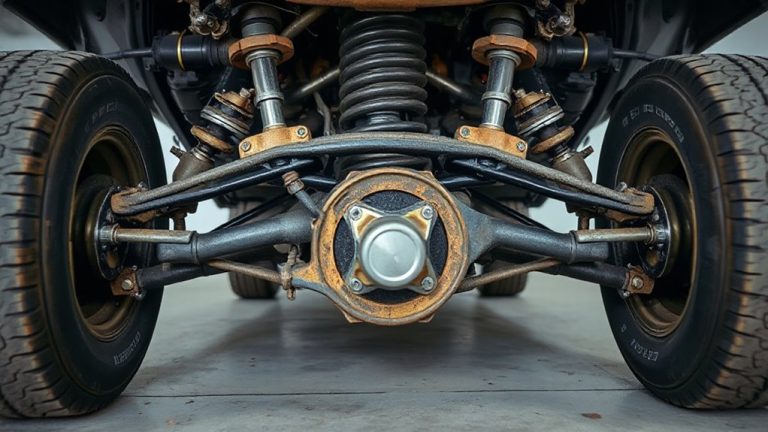
Toe links-also known as tie rod ends or steering links-play a critical role in maintaining your vehicle’s alignment and handling precision. They connect the steering rack to the front wheels, directly influencing suspension geometry and steering response. Each toe link has an inner and outer ball joint, allowing controlled movement while minimizing play. Properly functioning toe links guarantee the front wheels align parallel to each other and the vehicle’s centerline. Even 0.5 degrees of misalignment can reduce steering response and accelerate component wear. These components are typically made from forged steel or aluminum with hardened grease-filled boots for durability. Their exact length adjusts toe angle, a key setting in alignment specs usually within ±1/8 inch (3 mm) tolerance. Worn or bent toe links introduce slack, distorting suspension geometry. That compromises directional stability and reduces feedback through the steering wheel. Maintaining them guarantees precise control, especially during cornering or sudden maneuvers.
Why Bad Toe Alignment Destroys Your Tires
Ever wonder why your tires seem to wear out faster than they should? Bad toe alignment is likely the culprit. When your wheels aren’t parallel, they scrub as you drive, increasing tire temperature and accelerating tread depth loss. This uneven wear shortens tire life and hurts fuel efficiency.
| Condition | Tread Depth Loss (per 5k miles) | Avg. Tire Temp Increase |
|---|---|---|
| Proper Alignment | 1/32″ | +15°F |
| 0.5° Toe-In | 2/32″ | +30°F |
| 1.0° Toe-Out | 4/32″ | +50°F |
| Severe Misalignment | 6/32″+ | +70°F+ |
Misaligned toe forces tires to drag laterally across the road. The friction spikes tire temperature, degrading rubber and reducing tread depth prematurely. Even slight misalignment-just 0.5 degrees-can cut tire life by nearly 40%. Maintaining correct toe settings guarantees even contact with the road, preserving tread depth and preventing avoidable heat buildup that compromises performance and safety.
7 Signs Your Toe Links Are Going Bad
How can you tell when something’s off with your suspension’s precision? You’ll notice vague steering response and slight wandering at cruising speeds. These symptoms often point to failing toe links. Worn bushings in the toe link assembly allow excessive lateral movement, disrupting alignment stability. Factory toe link bushings typically allow less than 1mm of deflection-when play exceeds this, misalignment follows. Loose joints create clunking noises over bumps, especially during direction changes. Inspect the toe links by moving the tire side to side with wheels off the ground; more than 1/8 inch of movement indicates failure. Unlike control arm bushings, toe links directly control front wheel alignment angles. Even minor wear changes toe settings by 0.1 to 0.3 degrees-enough to cause rapid inside or outside tire wear. Replace both sides simultaneously to guarantee balanced geometry.
How Bad Toe Links Make Your Car Pull
When your car drifts to one side without input, a likely culprit lies in compromised toe links. These components maintain precise front wheel alignment, and when worn, they allow unwanted movement in the suspension. That causes steering wander-you feel the car tug unpredictably on uneven roads. A bad toe link can’t hold the wheel at the designed toe angle, so one tire points slightly inward or outward. This creates uneven grip between left and right tires, disrupting balance. The differing traction forces make the car pull toward the side with more forward alignment. Even a 0.5-degree toe deviation exceeds OEM specifications and generates measurable drag. You’ll notice it at highway speeds, especially on crowned roads. Over time, the constant imbalance stresses steering components and accelerates tire wear. The pull isn’t random-it’s mechanical, repeatable, and fixable only by replacing the faulty linkages.
Do New Toe Links Improve Handling?
Replacing worn toe links doesn’t just stop your car from pulling-it restores precise steering control and stability. You’ll notice immediate performance gains, especially during cornering and high-speed maneuvers. A failing link introduces play in the front suspension, reducing alignment accuracy. New OE-spec or upgraded toe links eliminate excess movement, ensuring consistent tire contact and sharper turn-in.
| Feature | Worn Toe Link | New Toe Link |
|---|---|---|
| Endplay (inches) | 0.05+ | <0.01 |
| Steering Response | Delayed | Immediate |
| Alignment Hold | Poor | Consistent |
| Stability Improvement | Low | High |
| Performance Gains | None | Noticeable |
Precision-forged joints and hardened ball sockets in replacement links maintain toe angle within ±1/16 inch of spec. This directly enhances stability improvement under braking and acceleration. You get linear steering feedback without slack, mimicking factory handling dynamics.
How to Check and Adjust Toe for Even Wear
Ever noticed your tires wearing more on one edge than the other? That’s often a sign of incorrect toe alignment. Toe refers to how much your wheels turn inward or outward when viewed from above. Proper steering geometry depends on precise toe settings-usually between 0.05 to 0.20 inches of toe-in per side for most vehicles. Misalignment causes uneven wear and reduces tire life. To check toe, use a tape measure or laser alignment tool. Measure the distance between front edges of the wheels, then the rear edges. Compare the two. If they differ beyond specs, adjust the toe links. Loosen the lock nut, rotate the tie rod end, then recheck. Accurate alignment precision guarantees straight tracking and even tire wear. Always perform this after replacing suspension parts.
On a final note
You need functional toe links to maintain proper alignment. Worn links allow unwanted movement in the suspension, changing the front toe angle beyond manufacturer specs-typically by more than ±0.25 degrees. This misalignment causes rapid, uneven tire wear, especially feathering or edge wear on front tires. It also degrades tracking, making the vehicle pull. Replacing them restores precise control and extends tire life.