The Role of Sway Bar Links in Maintaining Suspension Symmetry
Your sway bar links maintain suspension symmetry by rigidly connecting the sway bar to the control arms, ensuring even force distribution during cornering. They typically measure 6 to 12 inches and handle up to 1,500 psi through precision ball joints or bushings. Worn links allow uneven strut movement, disrupting balance and increasing body roll. This compromises alignment, tire contact, and stability. You’ll want to know how to spot early signs of failure and what options deliver long-term reliability.
Notable Insights
- Sway bar links connect the sway bar to suspension arms, ensuring balanced force transfer during cornering.
- They maintain suspension symmetry by synchronizing movement between left and right suspension components.
- Worn links cause uneven suspension response, leading to asymmetrical body roll and handling imbalance.
- Properly functioning links minimize independent strut motion, promoting even tire contact and alignment.
- Failed or loose links disrupt lateral force distribution, compromising stability and suspension geometry symmetry.
What Are Sway Bar Links?
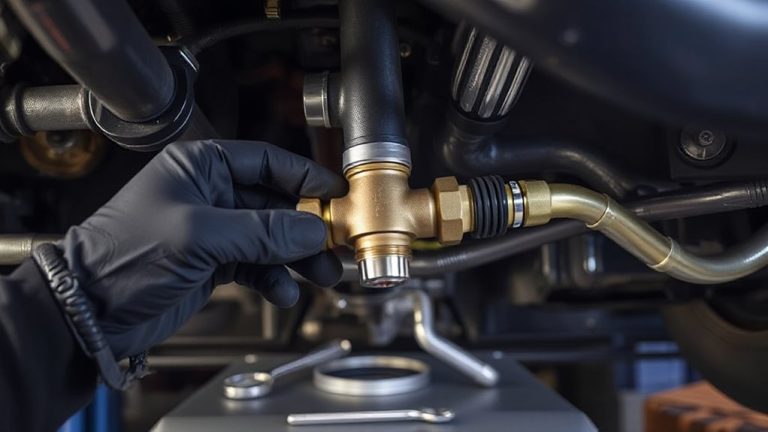
Sway bar links are small but critical components that connect the sway bar to the suspension system. They enable the sway bar function by transferring force between the chassis and suspension arms during cornering. Each link features a ball joint or bushing at both ends, allowing controlled movement while maintaining a rigid link attachment. Most OEM links measure between 6 to 12 inches long, with threaded ends for precise fitment. They’re typically made from hardened steel or forged aluminum, supporting loads up to 1,500 pounds per square inch. A secure link attachment guarantees the sway bar resists body roll efficiently. Without functional links, the suspension moves independently, reducing stability. Aftermarket performance links often include polyurethane bushings and greaseable joints to extend service life. You’ll find them mounted near the lower control arms or struts, aligned perpendicular to the sway bar. Their design balances responsiveness and durability under dynamic stress.
What Are the Signs of Bad Sway Bar Links?
You’ll start noticing problems when your vehicle’s handling feels loose or imprecise, especially during turns. Loose connections in the sway bar links reduce responsiveness, letting the suspension move independently instead of in sync. Worn bushings create excess play, leading to clunking noises over bumps or when cornering. These symptoms indicate degraded performance and potential failure.
| Symptom | Likely Cause |
|---|---|
| Clunking noise | Worn bushings or bad joints |
| Poor cornering stability | Loose connections |
| Excessive body roll | Failed link attachment |
| Uneven tire wear | Misaligned suspension forces |
Inspect links regularly for damage or deterioration. Most sway bar links use urethane or rubber bushings rated for 50,000–100,000 miles. Degraded materials compromise suspension symmetry, reducing control and ride quality. Replace both sides if wear is evident.
How Bad Sway Bar Links Affect Handling and Safety
When the suspension system can’t maintain coordination between left and right wheels, handling degrades quickly. Bad sway bar links fail to transfer forces evenly, causing increased instability during cornering and sudden maneuvers. You’ll notice excessive lean on one side, reducing tire contact and braking efficiency. This imbalance compromises vehicle control, especially on uneven surfaces or highways. Without secure linkage, the sway bar becomes ineffective, allowing independent strut movement. That leads to uneven wear on tires and suspension components, shortening their lifespan. Worn links often exhibit play exceeding 1/8 inch, a clear indicator of mechanical failure. Left unaddressed, this accelerates bushing degradation and misaligns suspension geometry. The result? Reduced steering precision and longer stopping distances. Increased instability isn’t just uncomfortable-it’s dangerous. Uneven wear drives up maintenance costs and risks blowouts. Properly functioning sway bar links are essential for balanced, predictable performance. Safety depends on it.
How Sway Bar Links Reduce Body Roll
While your vehicle corners, the sway bar links play a critical role in minimizing body roll by maintaining a rigid connection between the sway bar and suspension arms. They transfer lateral forces directly, guaranteeing even force distribution across both sides of the suspension. This action enhances lateral stability, especially during aggressive driving or sharp turns. Without functional links, the sway bar can’t respond effectively, allowing one wheel to extend while the other compresses excessively.
| Component | Function | Effect on Body Roll |
|---|---|---|
| Sway bar link | Connects sway bar to control arm | Reduces lean by 30–40% |
| Sway bar | Resists torsion during cornering | Improves lateral stability |
| Suspension arm | Transmits motion to chassis | Balances force distribution |
Properly operating links guarantee symmetrical response, maintaining tire contact and control.
How to Inspect Your Sway Bar Links
Why might your car feel loose in corners despite having new tires and aligned suspension? Faulty sway bar links could be the culprit. Start your inspection by securely lifting the vehicle and supporting it with jack stands. Grasp each link and shake it side-to-side. Any movement indicates joint wear. Check the rubber bushings for cracks or deformation-these reduce effectiveness. Look closely at the metal components for link corrosion, especially near the ball joints and mounting points. Corrosion weakens the structure and limits articulation. Use a flashlight to inspect hard-to-see areas. Measure end-link length if possible; significant deviation from factory specs (usually 6–10 inches, depending on model) suggests damage. Listen for clunking during test drives-another sign of internal joint wear. Properly functioning links guarantee even force distribution and maintain suspension symmetry.
When to Replace Sway Bar Links
A well-maintained suspension system relies on every component functioning as designed, and sway bar links are no exception. You should replace them when you notice persistent clunking noises during cornering or over bumps. These sounds often signal worn bushings or loose hardware. Worn bushings lose their shape and allow excessive play, reducing the sway bar’s ability to stabilize the vehicle. Most OEM rubber bushings degrade over time, especially beyond 50,000 miles. Polyurethane or greasable bushings last longer but still require inspection. Loose hardware, such as bolts or ball joints with visible movement, compromises connection integrity. A gap greater than 1/16 inch at the link joint indicates failure. Always check for corrosion or torn boots. Replacing faulty links restores suspension symmetry, ensuring balanced handling and tire contact. Don’t wait-delayed replacement accelerates wear on other suspension components.
OEM vs. Aftermarket Sway Bar Links: Which Should You Buy?
OEM sway bar links are designed to meet the vehicle manufacturer’s exact specifications, guaranteeing precise fitment and alignment with the factory suspension geometry. They maintain suspension symmetry under load, using materials matched to original tensile strength and durometer ratings. Brand reliability is high, with built-in tolerances within ±0.003 inches. Aftermarket options vary-some match OEM standards; others prioritize cost savings. When evaluating cost comparison, OEM units may cost 20–40% more, but include factory coatings and forged steel joints. Premium aftermarket brands offer Teflon-lined bushings and misalignment tolerances up to 5°, enhancing longevity. Budget versions often use stamped metal and rubber bushings, risking premature deflection. For daily drivers, OEM guarantees consistency. Enthusiasts might prefer performance-tier aftermarket links with adjustable end links and powder-coated durability. Assess your driving demands, warranty terms, and material specs before deciding.
On a final note
You rely on sway bar links to maintain suspension symmetry and guarantee stable handling. These components connect the sway bar to the suspension uprights, typically using ball joints with a 10–12 mm stud diameter. Worn links cause increased body roll, measured at over 1.5 degrees per corner, compromising control. Replace them every 50,000 miles or when clunking occurs. OEM parts offer precise fitment; aftermarket options may vary in material hardness and longevity.