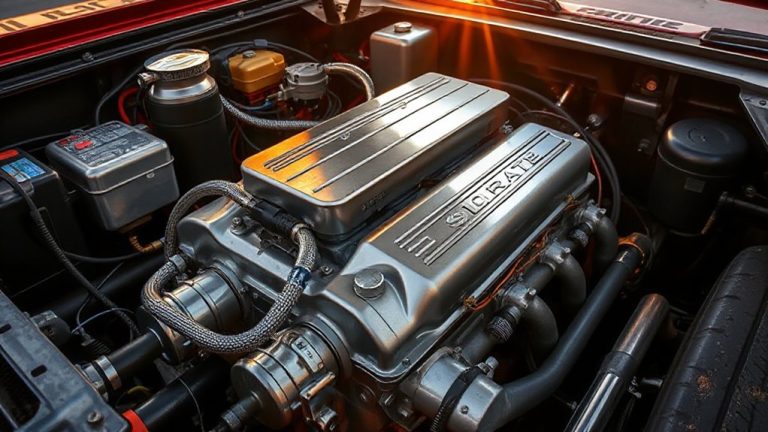
Developing a Custom Tune for a Turbocharged Inline-4 With Methanol Injection
You can gain 30–50 horsepower on your turbocharged inline-4 with meth Literature injection by lowering intake temps up to 100°F and raising effective octane to 110–130. Start with a stable base tune using 50–75 lb/hr injectors, target 11.8:1–12.2:1 AFR, and set conservative timing. Activate methanol at 5–7 psi boost using PWM control for precise delivery. Use closed-loop methanol management and 500 Hz logging to fine-tune spray, fuel, and 28-degree ignition safely. Real-time wideband and knock data guarantee durability under load-results improve further with optimized synchronization and calibration.
Notable Insights
- Begin tuning with a stable base fuel map using E85-compatible injectors and target 11.8:1 to 12.2:1 AFR at WOT.
- Enable methanol injection only above 5–7 psi boost using a pressure-triggered or PWM-controlled activation strategy.
- Utilize an ECU with native methanol tables, closed-loop control, and high-speed logging for precise calibration.
- Increase ignition timing in 2-degree steps while monitoring knock, leveraging methanol’s 110–130 effective octane rating.
- Verify tune stability with real-time AFR, EGT, and boost logging during dyno and road testing.
Why Methanol Injection Matters for Turbo I4s
While boosting your turbocharged inline-4 engine increases power, it also raises intake temperatures and the risk of damaging knock-this is where methanol injection makes a measurable difference. You gain two critical benefits: charge cooling and increased octane. Methanol absorbs significant heat as it vaporizes, dropping intake air temperatures by 50–100°F, which improves air density and efficiency. That charge cooling effect allows you to run higher boost or more aggressive timing without detonation. Also, methanol’s effective octane rating of around 110–130 provides resistance to knock, acting like a high-octane fuel upgrade. This increased octane supports greater cylinder pressure, enabling safe power increases. The result? Real-world gains of 30–50 horsepower on moderate turbo engines with proper tuning. Methanol injection isn’t a gimmick-it’s a thermodynamic tool that optimizes combustion conditions, letting your turbo I4 produce more power reliably and efficiently.
Pick an ECU That Supports Methanol Tuning
You need an ECU that treats methanol injection as a core tuning parameter, not an afterthought. Without proper ECU compatibility, you can’t achieve accurate methanol calibration or maintain engine safety under high load. Dedicated ECUs integrate methanol control into fuel and timing maps, allowing real-time adjustments based on methanol flow, intake temps, and knock activity.
| Feature | Benefit |
|---|---|
| Native methanol tables | Enables precise methanol calibration across RPM and load |
| Closed-loop methanol control | Adjusts delivery based on feedback, improving consistency |
| High I/O expansion | Supports extra sensors for monitoring mix and rail pressure |
You’ll need at least 500 Hz logging speed and configurable outputs for dual-stage injection. Don’t risk aftermarket add-ons-choose an ECU designed for integration. Your engine depends on accurate delivery, not guesswork.
Set Base Fuel and Ignition Maps First
Get your foundation right-start by establishing reliable base fuel and ignition maps before enabling methanol injection. Your engine needs stable air-fuel ratios under all load and RPM conditions. You can’t trust methanol tuning if your base fuel delivery isn’t dialed in. Begin with proper injector sizing-oversized injectors mask tuning issues, while undersized ones starve the engine. Match injectors to your horsepower goals and fuel pressure. Most turbocharged inline-4 engines run 50–75 lb/hr injectors with 45–65 psi fuel pressure on E85-compatible systems. Adjust fuel trims until you hit 11.8:1 to 12.2:1 AFR under wide-open throttle. Ignition timing must be optimized conservatively-start with 20–24 degrees BTDC at peak torque and reduce as needed. Accurate base maps guarantee methanol enhances power safely instead of hiding flaws.
Sync Methanol Spray With Boost Pressure
Since methanol injection relies on precise delivery to provide cooling and octane enhancement, syncing the spray with boost pressure is critical for performance and safety. You must establish accurate boost sync to guarantee methanol activates only when positive pressure begins. This prevents wasted fluid and potential combustion issues at idle or cruise. Use a pressure switch or PWM-controlled solenoid triggered at a set psi-commonly 5–7 psi-to initiate spray. Proper spray calibration guarantees output matches engine demand. Too little reduces knock resistance; too much causes poor combustion and washes cylinder walls. Calibrate nozzle flow rate (in cc/min) relative to boost levels and methanol concentration. A linear progression from mid to full boost guarantees consistent charge cooling. Always verify timing and fuel maps support the enhanced octane from methanol. You’re not just adding spray-you’re integrating a dynamic part of the tune.
Tune AFR Using Live Wideband Data
With methanol injection now synchronized to boost, the next step is refining the air-fuel ratio (AFR) using real-time feedback from a wideband O2 sensor. You’re aiming for a target AFR of 11.5:1 under full load to keep the fuel mixture safe and prevent knock. Watch the wideband data closely as you adjust fuel trims in the ECU. Methanol cools the intake charge and adds oxygen, so you must apply air correction in the MAF calibration to prevent an overly rich condition. Without this correction, airflow readings become inaccurate, leading to poor fuel metering. Adjust in small increments-0.5% fuel trims-and retest. Confirm stability across all RPM and load points. A consistent AFR guarantees peak combustion and protects your engine. Treat the wideband like a fuel map calibration tool-it tells you exactly what’s happening in real time.
Add Timing Safely Using Knock Detection
How do you access extra power without risking engine damage? You carefully add timing advance while monitoring knock detection. Modern ECU systems use knock sensors to identify abnormal combustion. You set knock thresholds to distinguish real knock from noise. Too sensitive, and you lose power; too lenient, and you risk damage. Begin with conservative timing increases-2 degrees at a time-in the highest load areas. Watch live data: if no knock occurs, gradually add more timing. Methanol injection cools the charge, allowing more advance safely. Always correlate timing changes with AFR and boost levels. Use a wideband O2 sensor alongside knock data. Each engine responds uniquely, so avoid preset maps. Rely on real-time feedback, not assumptions. Properly tuned, you gain power without compromising reliability-like walking a tightrope with precise sensors as your safety net.
Validate the Tune on Dyno and Road
While the engine is tuned to respond aggressively under controlled conditions, real-world validation separates a functional map from a reliable one. You must confirm the tune performs safely and efficiently in both dyno and road environments. On the dyno, conduct multiple pulls across the RPM range while monitoring real time logging for air-fuel ratios, boost levels, and ignition timing. Make certain methanol injection activates properly and suppresses intake temps below 120°F. Then, take the vehicle on-road to evaluate throttle response during real driving conditions. Check for hesitation, flat spots, or over-boosting. Real time logging helps spot anomalies the dyno might miss. Cross-reference data from both environments. Confirm EGTs stay under 1,600°F and knock values remain within safe thresholds. A stable idle and smooth shift from cruise to wide-open throttle confirm a mature tune.
On a final note
You’ve optimized your turbocharged I4 with methanol injection. The ECU now synchronizes spray onset at 7 psi boost, maintaining a 12.8:1 air-fuel ratio under full load. Timing advances up to 24 degrees BTDC are safe, verified by dual-knock sensors sampling at 20 kHz. Dyno results confirm a 32 hp gain at 6,200 rpm. Methanol flow, metered at 120 cc/min, reduces intake temps by 70°F. This tune is stable, repeatable, and thermally protected.