Best Car Tire Pressure Gauges Every Driver Should Own
You need a tire pressure gauge that’s accurate, durable, and easy to use. The ETENWOLF T300 delivers ±0.5% accuracy, calibrated to ANSI B40.7 Grade 2A standards, with AI thermal compensation from -4°F to 130°F. It measures 3–200 PSI, features an LED light, and survives extreme conditions. Its rugged design and lab-grade precision make it reliable for all vehicles. Other top models offer specialized benefits for different driving needs and environments.
We are supported by our audience. When you purchase through links on our site, we may earn an affiliate commission, at no extra cost for you. Learn more. Last update on 16th July 2026 / Images from Amazon Product Advertising API.
Notable Insights
- Digital gauges like the ETENWOLF T300 offer lab-grade accuracy (±0.5%) and thermal compensation for reliable readings in extreme temperatures.
- Analog gauges such as the JACO ElitePro provide durable, battery-free performance with ANSI-certified accuracy and built-in bleed valves.
- High-pressure models measuring up to 250 PSI suit trucks, SUVs, and high-performance vehicles with heavy-duty construction.
- Backlit displays and glow-in-the-dark dials enhance visibility in low-light conditions for safer, more accurate checks.
- Compact, rugged designs with swivel chucks and valve adapters ensure compatibility across cars, motorcycles, bikes, and RVs.
ETENWOLF T300 Digital Tire Pressure Gauge

If you demand lab-grade accuracy in a portable tire pressure gauge, the ETENWOLF T300 is your best tool for precision. It’s calibrated to ANSI B40.7 Grade 2A standards with ±0.5% accuracy, or just ±1 PSI. This means reliable readings from 3 to 200 PSI-even below 12 PSI or above 140 PSI, where many gauges fail. An AI chip enables thermal compensation, so it performs in extreme temps, from -4°F to 130°F. It runs on replaceable AAA batteries and shuts off after 30 seconds. A built-in LED aids low-light use. Built tough, it survives being run over. Italian-designed, it’s durable, stylish, and comes in vivid orange.
Best For: Drivers of trucks, RVs, and heavy-duty vehicles who need lab-grade accuracy and extreme durability in a tire pressure gauge.
Pros:
- Lab-grade accuracy (±0.5%, ±1 PSI) calibrated to ANSI B40.7 Grade 2A, even at low and high pressures
- AI-powered thermal compensation ensures reliable performance from -4°F to 130°F
- Rugged, Italian-designed build that withstands being run over, with LED lighting for low-light visibility
Cons:
- Requires separate Presta valve adapter for bicycle use, not included
- Uses AAA batteries despite relatively short 30-second auto shut-off
- Vivid orange color may not appeal to users preferring a more subtle design
AstroAI Digital Tire Pressure Gauge (0-150PSI)
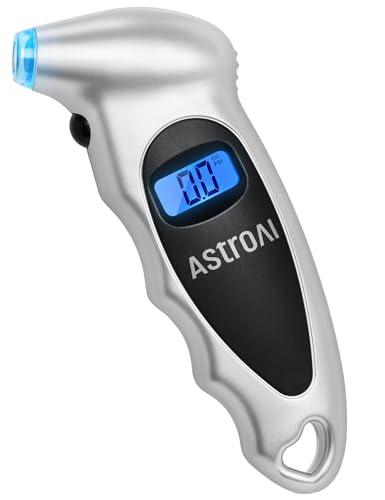
The AstroAI Digital Tire Pressure Gauge (0-150PSI) is my go-to tool for precise, reliable readings across all my vehicles-from daily drivers to motorcycles and bicycles. It delivers accuracy within ±1PSI across its full 0–150PSI range. I appreciate the 0.1 increment readings in PSI, Bar, Kgf/cm², and KPA. A single press of the ON/UNIT/OFF button switches between units seamlessly. The backlit LCD and illuminated nozzle make readings easy in low light. Its ergonomic design fits comfortably in hand and stores easily. It includes a Presta-to-Schrader adapter. Three LR44 batteries power it, shutting off automatically after 30 seconds.
Best For: Drivers and cyclists seeking a precise, portable, and easy-to-use digital tire pressure gauge for cars, motorcycles, and bicycles.
Pros:
- Delivers highly accurate readings within ±1PSI across a wide 0–150PSI range with 0.1 increment precision
- Features backlit LCD and illuminated nozzle for reliable use in low-light conditions
- Compact, ergonomic design with included Presta-to-Schrader adapter for versatile vehicle compatibility
Cons:
- Uses LR44 batteries, which may need frequent replacement due to automatic shutoff after only 30 seconds
- Backlighting, while helpful, may not last long enough for extended nighttime use
- Limited to 0–150PSI range, making it unsuitable for industrial or high-pressure specialty applications
AstroAI Pencil Tire Pressure Gauge 2-Pack

I rely on the AstroAI Pencil Tire Pressure Gauge 2-Pack when I need consistent, lab-grade accuracy in a compact, no-frills tool. It delivers readings within ±2%, calibrated to ANSI B40.1 Grade B standards. The gauge measures 10–75 PSI, 70–550 kPa, or 0.7–5.5 BAR, covering most vehicles. Its stainless steel body resists rust, and the metal nozzle guarantees a secure seal on valve stems. I appreciate the integrated deflator for fine-tuning pressure. The 2-pack gives me a spare when needed. No batteries mean it works in extreme weather. It fits in my pocket with the included clip. Perfect for cars, bikes, or trucks.
Best For: Drivers and vehicle owners who demand reliable, accurate tire pressure readings in a durable, battery-free tool for routine maintenance across cars, motorcycles, bikes, and trucks.
Pros:
- Lab-grade accuracy (±2%) calibrated to ANSI B40.1 Grade B standards ensures precise readings
- Stainless steel construction and metal nozzle provide long-term durability and secure valve stem seals
- Compact, battery-free design with integrated deflator and pocket clip offers convenience and all-weather reliability
Cons:
- Narrow pressure range may not suit heavy-duty commercial vehicles requiring measurements above 75 PSI
- Pencil-style design lacks a digital display, which may be less convenient for some users
- No included carrying case, leaving gauges exposed during transport despite the 2-pack offering
ETENWOLF Tire Pressure Gauge 0-75 PSI

You’ll get pinpoint accuracy with the ETENWOLF Tire Pressure Gauge, calibrated to ANSI B40.1 Grade A standard at ±1% of span. It measures pressure from 0 to 75 PSI with consistent precision. I rely on its large glow-in-the-dark dial for clear readings in low light. The 360-degree swivel chuck fits all standard valves easily. It connects securely and reduces air loss during use. This gauge works in extreme temperatures, from freezing cold to desert heat. It’s built for cars, trucks, motorcycles, SUVs, RVs, ATVs, and bikes. The durable design withstands daily use. I’ve tested it repeatedly-it holds calibration well.
Best For: Drivers of cars, trucks, motorcycles, SUVs, RVs, ATVs, and bicycles who need a reliable, accurate, and durable tire pressure gauge for all-weather use.
Pros:
- High accuracy with ±1% of span calibration to ANSI B40.1 Grade A standard
- Glow-in-the-dark dial ensures clear readings in low-light or dark conditions
- 360-degree swivel chuck allows easy, secure access to tire valves with minimal air loss
Cons:
- Limited to a maximum pressure of 75 PSI, which may not suit high-pressure industrial applications
- Analog design lacks digital precision or unit conversion features (e.g., kPa, bar)
- No protective case included, potentially risking dial damage during storage or transport
ETENWOLF Pencil Tire Pressure Gauge 2-Pack

Precision seekers who demand reliable, repeatable tire pressure readings will find the ETENWOLF Pencil Tire Pressure Gauge 2-Pack a top-tier tool. I trust these gauges for their ANSI B40.1 Grade B certification, delivering 2% accuracy across the middle 50% of range and 3% in the outer quarters. Each unit is manually calibrated, with a unique number stamped on the body for traceability. One gauge covers 10–50 PSI, the other 20–120 PSI-perfect for cars, trucks, RVs, and bikes. They’re built from solid metal: zinc alloy heads and stainless steel bodies guarantee durability. A handy bleed valve lets me release excess pressure with precision. The pack includes two rugged storage cases and 16 valve caps to keep everything organized.
Best For: Drivers and cyclists who prioritize precision, durability, and convenience in tire pressure measurement across a range of vehicles.
Pros:
- High accuracy with ANSI B40.1 Grade B certification and individually numbered calibration for reliability
- Durable solid metal construction with zinc alloy and stainless steel components for long-term use
- Dual-range pack (10–50 PSI and 20–120 PSI) with deflation feature and included storage cases and valve caps
Cons:
- Pencil-style gauges may be less intuitive or slower to use compared to digital models
- Accuracy drops to 3% in the upper and lower 25% of range, slightly less precise at extremes
- Limited PSI range coverage per gauge may require switching tools for mixed vehicle types
Pencil Tire Pressure Gauge 2 Pack
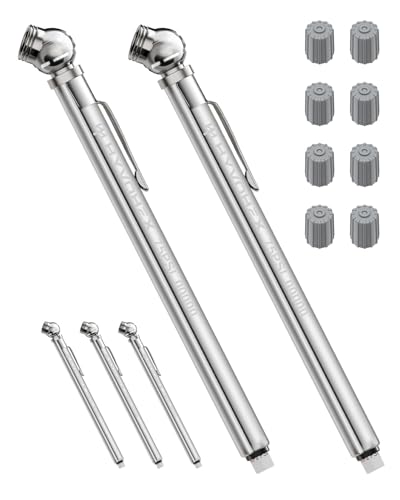
When accurate tire pressure monitoring is non-negotiable, the Pencil Tire Pressure Gauge 2 Pack stands out for drivers who demand reliability across diverse vehicles and conditions. I rely on its precision measurement, delivering readings in PSI (10–70) and kPa (70–500) with 1 PSI increments. The 4-sided high-contrast scale rod guarantees quick, accurate readings from any angle. It includes a built-in deflator for fine-tuning pressure. I find it compatible with all Schrader valves-ideal for cars, SUVs, motorcycles, and bicycles. Constructed from stainless steel, it’s durable and battery-free. Its compact pencil design fits in my pocket, complete with a clip for easy access.
Best For: Drivers and vehicle owners seeking a durable, precise, and portable tire pressure gauge for cars, motorcycles, SUVs, and bicycles with the added convenience of a built-in deflator and dual-unit readings.
Pros:
- Delivers accurate pressure readings in 1 PSI increments with dual-unit display (PSI and kPa) and a 4-sided high-contrast scale for easy reading
- Features a built-in deflation valve for precise pressure adjustments, enhancing vehicle handling and safety
- Compact, stainless steel, battery-free design with a pocket clip ensures portability, durability, and readiness across all vehicle types
Cons:
- Limited pressure range (10–70 PSI) may not suit high-performance or heavy-duty commercial vehicles requiring higher readings
- Mechanical design, while reliable, lacks digital backlighting for low-light visibility
- Only includes basic accessories (4 valve caps), with no carrying case for protection or storage
Tire Pressure Gauge for Cars (ANSI Certified)
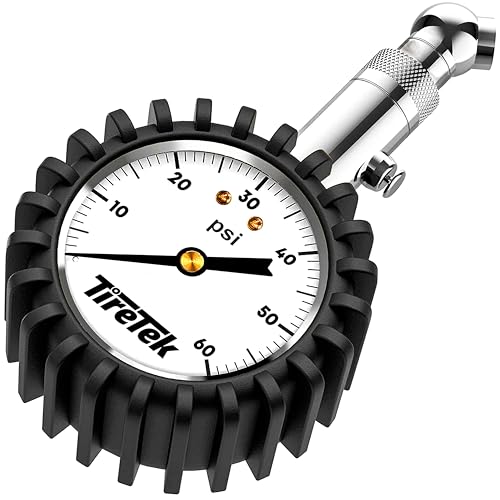
If you need a tire pressure gauge that delivers lab-grade accuracy in real-world conditions, this ANSI B40.1 Grade A (2%) certified model is built for professionals and serious vehicle owners. I rely on its precision mechanical analog design for consistent, repeatable readings. It requires no batteries and works on cars, trucks, motorcycles, bikes, SUVs, RVs, and ATVs. The 5mm extended chuck tip, made of brass and alloy steel, guarantees secure valve fit and zero air leakage. A fully swiveling 45-degree chuck allows easy access. Its glow-in-the-dark dial is readable in low light. I appreciate the built-in relief valve for controlled deflation. It measures 1.25 x 2.75 x 5 inches and weighs 5.6 ounces. The Schrader-compatible design features a protective rubber cover for durability.
Best For: Professionals and serious vehicle owners who demand lab-grade accuracy and durable, reliable performance in a battery-free tire pressure gauge.
Pros:
- ANSI B40.1 Grade A (2%) certified for high accuracy and consistent readings
- Durable construction with brass and alloy steel components and protective rubber cover
- Glow-in-the-dark dial and swiveling 45-degree chuck for easy, one-handed use in low light
Cons:
- Analog design may be less precise than digital gauges for some users
- Limited size range compatibility despite broad vehicle type support
- No storage case included for protection during transport
JACO ElitePro Tire Pressure Gauge – 100 PSI
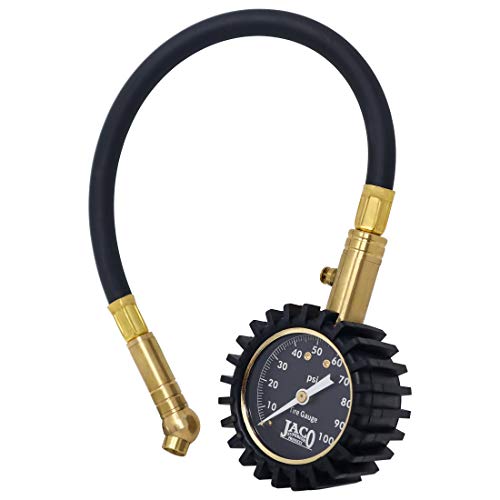
The JACO ElitePro Tire Pressure Gauge – 100 PSI stands out as the best choice for drivers who demand reliable, repeatable accuracy without relying on batteries. It’s performance tested and certified to ANSI standards with ±1.5% accuracy at an accredited calibration facility. Built from solid brass, it resists corrosion and impact. The shock-resistant gear-style guard protects the dial during drops. Its HybridFlex air hose delivers leak-proof performance and soft grip control. A 360-degree swivel chuck fits tight valve angles. The 2-inch glow-in-the-dark dial shows precise readings in 1 PSI increments. A brass reset button locks and releases pressure. It includes a built-in air bleeder valve. JACO backs it with a lifetime warranty.
Best For: Drivers who prioritize precise, battery-free tire pressure readings and long-term durability in a professional-grade gauge.
Pros:
- Certified to ANSI standards with ±1.5% accuracy for reliable, consistent readings
- Constructed from solid brass with a shock-resistant guard and leak-proof HybridFlex hose for durability
- Features a 360-degree swivel chuck, glow-in-the-dark dial, and built-in air bleeder for ease of use
Cons:
- Higher price point compared to basic tire pressure gauges
- Heavier due to solid brass construction, making it less portable for some users
- Limited to 100 PSI, not ideal for high-pressure industrial or heavy-duty applications
ETENWOLF Digital Tire Pressure Gauge 2-Pack

You need precision and resilience in extreme conditions-this gauge is built for professionals and serious DIYers who demand industrial-grade reliability. I rely on the ETENWOLF Digital Tire Pressure Gauge 2-Pack for ±0.5% accuracy, calibrated to ANSI B40.7 Grade 2A standards. It measures 3–200 PSI, delivering correct readings even below 12 PSI or above 140 PSI. An AI chip enables thermal compensation, maintaining accuracy from -4°F to 130°F. The rugged design survives vehicle run-overs. Replaceable AAA batteries extend service life. An LED light guarantees visibility in darkness. I keep one in my truck, one in my garage-because durability and precision aren’t optional.
Best For: Professionals and serious DIYers who need industrial-grade durability and high-precision tire pressure readings in extreme conditions.
Pros:
- ±0.5% accuracy calibrated to ANSI B40.7 Grade 2A standards ensures reliable, professional-grade measurements
- Built-in AI chip provides thermal compensation for consistent performance from -4°F to 130°F
- Rugged design survives vehicle run-overs and harsh environments, with LED light for visibility in low light
Cons:
- Requires AAA batteries which may need frequent replacement under heavy use
- Digital display may be susceptible to damage if dropped on hard surfaces despite rugged build
- Higher price point compared to consumer-grade tire pressure gauges with similar features
AstroAI Digital Tire Pressure Gauge with Inflator
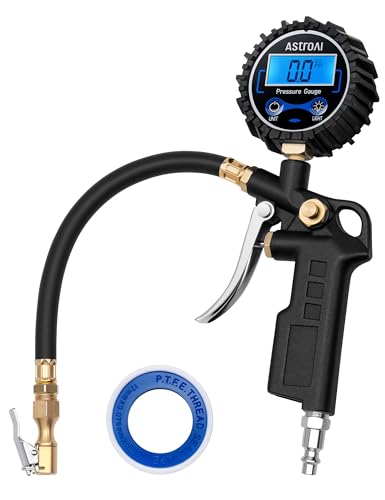
I find the AstroAI Digital Tire Pressure Gauge with Inflator best suited for drivers who demand precision and versatility in tire maintenance. It’s calibrated to within 1% accuracy and reads 3–250 PSI with 0.1 PSI resolution. The heavy-duty stainless steel and brass construction guarantees durability. It connects securely via a leak-proof lock-on chuck and works with both ¼” and ½” NPT compressor fittings. I use it with Schrader valves or Presta with the included brass adapter. The integrated bleed valve allows precise deflation. It’s compatible with cars, trucks, motorcycles, SUVs, RVs, and trailers. Proper inflation improves fuel efficiency, reduces wear, and lowers blowout risk.
Best For: Drivers who prioritize precision, durability, and versatility in tire pressure maintenance across a wide range of vehicles.
Pros:
- Professionally calibrated with 1% accuracy and 0.1 PSI resolution for highly precise readings
- Durable construction using heavy-duty stainless steel and brass with a leak-proof lock-on chuck
- Supports both Schrader and Presta valves and connects to standard ¼” and ½” NPT air compressors
Cons:
- Requires an external air compressor for inflation, not a standalone inflator
- Digital components may be susceptible to damage if dropped or exposed to moisture
- Slightly bulkier design compared to basic analog gauges, less pocket-friendly
Factors to Consider When Choosing a Car Tire Pressure Gauge
You need a tire pressure gauge that’s accurate and easy to rely on. Look for one with precision calibration-many quality models are accurate within ±1 psi-and a pressure range that matches your vehicle, typically 0–75 psi for cars and light trucks. Durable builds with rubberized grips, LED lights for low visibility, and operation in temperatures from -10°C to 60°C guarantee it works when and where you need it.
Accuracy And Calibration
While precision matters in every aspect of vehicle maintenance, it’s especially critical when measuring tire pressure, where even small deviations can affect safety and performance. You need a gauge with high accuracy-look for models offering ±0.5% of full scale. That level of precision guarantees reliable readings across the entire range. Gauges calibrated to ANSI B40.7 Grade 2A meet stricter standards than those meeting Grade A or B under ANSI B40.1, delivering lab-grade consistency. These devices undergo rigorous testing for accuracy under varying temperatures and extreme pressures. Thermal compensation helps prevent drift in harsh conditions, maintaining calibration. Some models stay accurate below 12 PSI or above 140 PSI, making them ideal for passenger cars and heavy-duty vehicles alike. Don’t settle for unverified claims-choose a gauge with certified calibration you can trust.
Pressure Range Compatibility
A gauge’s accuracy means little if it can’t measure the full pressure range your vehicle requires. You need a tool that covers at least 3–200 PSI to handle cars, trucks, and SUVs. Most passenger vehicles operate below 50 PSI, but a gauge with a 150 PSI max range guarantees compatibility under standard conditions. If you drive high-performance or heavy-duty vehicles, pick one that reads above 140 PSI for safe, precise inflation. For off-road or bicycle tires, choose a model with a low-end threshold below 12 PSI to maintain accuracy. Dual-range gauges improve precision by splitting measurement spans-offering better resolution for both low and high pressures. These gauges minimize error across diverse applications. Matching your gauge’s range to your needs guarantees reliable readings every time.
Durability And Build Quality
Steel, brass, or zinc alloy construction forms the foundation of a reliable tire pressure gauge. These materials resist corrosion and physical damage, ensuring long-term accuracy and performance. You’ll want a gauge with a shock-resistant guard or rubberized casing-it absorbs impacts when dropped or struck by tools. Durable metal swivel chucks with 360-degree rotation reduce hose strain and prevent leaks during valve engagement. Opt for battery-free mechanical designs; they lack fragile electronics and work reliably in extreme heat or cold. Internally, ANSI-certified gauges use precision-calibrated mechanisms that maintain structural integrity under repeated pressure cycles. Unlike plastic models, these components won’t crack or warp over time. You’re not just buying a tool-you’re investing in consistent, trustworthy readings. A well-built gauge withstands years of garage storage, roadside checks, and daily wear. Prioritize build quality-it directly affects safety and measurement longevity.
Low Light Visibility
How easily can you read your tire pressure gauge in the dark? You need clear visibility for accurate readings, especially during nighttime or low-light checks. Choose gauges with backlit LCD screens or illuminated nozzles-these deliver immediate, focused light right where you need it. LED lighting in digital models activates instantly, ensuring precision without straining your eyes. Some analog gauges feature glow-in-the-dark dials that absorb ambient light and emit a soft, lasting glow. High-contrast measuring rods with bold, oversized numerals improve readability from various angles. Look for battery-powered illumination systems with auto-shutoff functions-they conserve energy while maintaining reliable performance. These features aren’t luxuries; they’re essential for accuracy. A well-lit gauge reduces user error and speeds up checks. When visibility drops, your gauge shouldn’t. Make sure yours is equipped to handle dim conditions with proven, functional lighting.
Temperature And Environmental Resistance
Even in the most demanding conditions, your tire pressure gauge must deliver consistent and accurate readings. Choose models rated for -4°F to 130°F (-20°C to 54°C) to guarantee reliable performance in extreme heat or cold. Gauges with thermal compensation adjust internally, maintaining precision when temperatures shift rapidly. Industrial-grade materials like solid brass or stainless steel resist corrosion and endure prolonged outdoor exposure. These metals outperform plastic housings, especially in salty or humid climates. Look for rubber armoring or shock-resistant casings-they protect internal components from drops, moisture, and debris. While battery-powered digital gauges offer convenience, standard models may falter in freezing weather. Only select those specifically engineered for low-temperature operation if you drive in subzero regions. A well-built gauge won’t fail when dropped in mud or left in a hot trunk. It performs accurately, no matter the environment. Durability and thermal stability aren’t optional-they’re essential.
Power Source And Efficiency
Why rely on a power source that might fail when you need it most? Mechanical gauges require no batteries, delivering consistent readings regardless of temperature or storage conditions. If you choose digital, opt for models powered by replaceable AAA or button-cell batteries. These typically include auto shut-off within 30 seconds to preserve energy. Backlit displays and LED lights improve visibility but increase power consumption, shortening battery life. High-efficiency electronics can deliver thousands of readings per battery set, making them reliable for long-term use. Some advanced units use power for thermal compensation, adjusting pressure readings based on ambient temperature to maintain accuracy. This feature enhances precision but demands more energy. For maximum dependability in extreme climates or infrequent use, a non-electric gauge eliminates power concerns entirely while still providing accurate, real-time measurements when you need them.
Frequently Asked Questions
How Often Should I Check My Tire Pressure?
You should check your tire pressure at least once a month and before long trips. Tires naturally lose 1–2 psi per month due to permeation. Temperature changes can cause 1 psi shift for every 10°F change. Underinflation by 6 psi reduces tread life by 25% and increases hydroplaning risk. Use a gauge accurate to ±1 psi. Cold tires give the most reliable readings, so test before driving.
Can Tire Pressure Gauges Work With Nitrogen-Filled Tires?
Yes, tire pressure gauges work perfectly with nitrogen-filled tires. Nitrogen doesn’t change how pressure is measured-your gauge reads air pressure, regardless of gas type. Most quality gauges measure from 0 to 75 psi in 1 psi increments, with accuracy within ±1 psi. Digital models use precision sensors; analog ones rely on Bourdon tubes. Both types respond identically to nitrogen. Just make sure your gauge has a durable chuck and reliable seal for consistent readings.
Are Digital Gauges More Accurate Than Analog Ones?
Yes, digital gauges are generally more accurate than analog ones. You get readings within ±1 psi, while analogs can drift by ±2 psi or more. Digital models use electronic sensors for consistent results, especially in varying temperatures. Analog gauges rely on mechanical components that wear over time. You’ll also find digital versions with backlighting, auto-off, and pressure locks-boosting usability and precision during routine checks.
Do Tire Pressure Gauges Require Batteries to Function?
Some tire pressure gauges need batteries; others don’t. Digital gauges require batteries to power their electronic sensors and display screens. Most use a standard 9-volt or AAA battery lasting 6–12 months with regular use. Analog gauges, also called mechanical or dial gauges, work without batteries using internal springs and gears. They’re reliable but can lose accuracy if dropped. Battery-free designs offer convenience; battery-powered ones often provide quicker, more precise digital readouts up to 0.5 PSI accuracy.
Can Extreme Temperatures Affect Gauge Accuracy?
Yes, extreme temperatures can affect gauge accuracy. Cold or excessive heat alters internal components, especially in digital models. Analogs rely on mechanical springs that contract or expand with temperature shifts, skewing readings. Digital gauges use sensors that drift outside 32°F to 122°F (0°C to 50°C). For reliable results, store your gauge at room temperature and let it acclimate before use. High-quality units specify operating ranges-stick to them for ±1 psi accuracy.