Exploring the World of Turbocharging: Understanding How This Technology Enhances Performance by Forcing More Air Into the Engine Cylinder
You get more power because a turbocharger forces extra air into the engine’s cylinders, letting it burn more fuel with each stroke. Exhaust gases spin a turbine at up to 150,000 rpm, driving a compressor that delivers 6–15 psi of boost. This pressurized air increases oxygen density, enabling a 30%–50% horsepower gain over naturally aspirated engines. High-strength alloys handle temperatures over 1,700°F, while intercoolers lower intake temps by up to 100°F. Next, see how internal components work together for sustained performance.
Notable Insights
- Turbochargers use exhaust gases to spin a turbine, which drives a compressor to force more air into engine cylinders.
- Increased intake air pressure raises oxygen levels, enabling more fuel combustion and significantly boosting engine power output.
- Compressors typically generate 6–15 psi of boost, increasing horsepower by 30%–50% without requiring a larger engine.
- Intercoolers cool the compressed air, increasing its density and further enhancing combustion efficiency and performance.
- Modern advancements like variable geometry turbines and twin-scroll designs reduce turbo lag and improve throttle response.
What Is Turbocharging and How Does It Work?
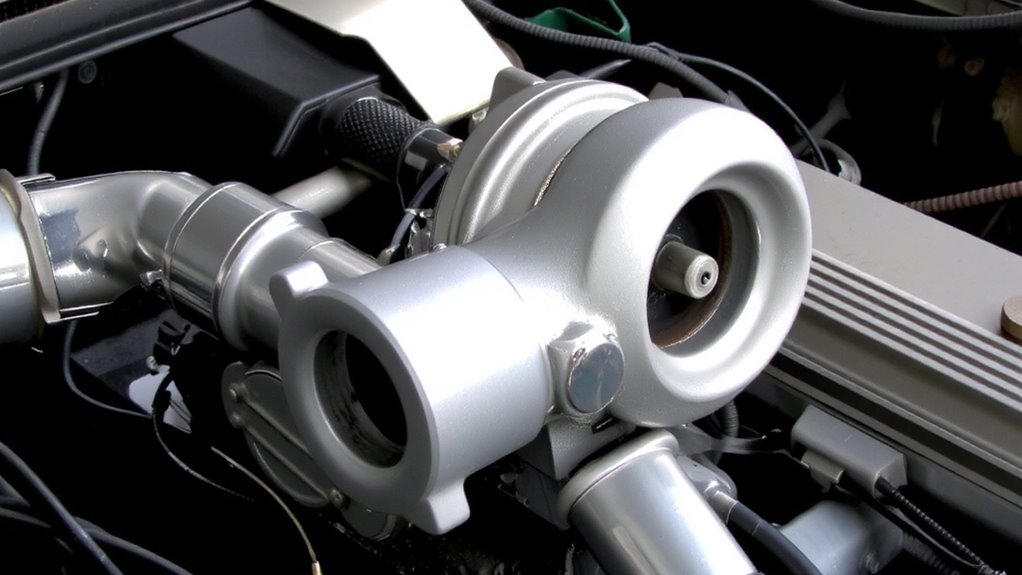
Think of air as the lifeblood of an engine-without enough, power suffers. Turbocharging forces more air into the cylinder, increasing combustion efficiency. You get more power from the same engine size. A turbocharger uses exhaust gases, routed from the exhaust manifold, to spin a turbine. That turbine rotates a compressor on the other end of a shared shaft. The compressor pressurizes the incoming air through the air intake. Boost pressure typically ranges from 6 to 15 psi, depending on setup. This compressed air contains more oxygen, enabling more fuel to burn per cycle. The result? Horsepower increases of 30% to 50% are common. Turbo lag, a brief delay in power delivery, occurs due to exhaust gas buildup time. Properly tuned systems minimize this. Turbocharging improves thermal efficiency, making engines both stronger and more fuel-efficient.
What’s Inside a Turbocharger?
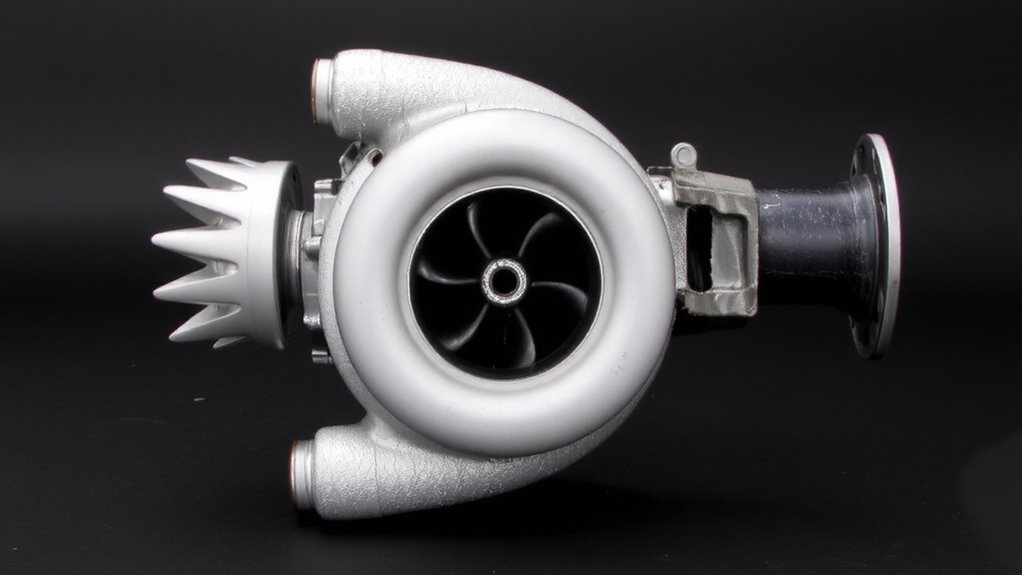
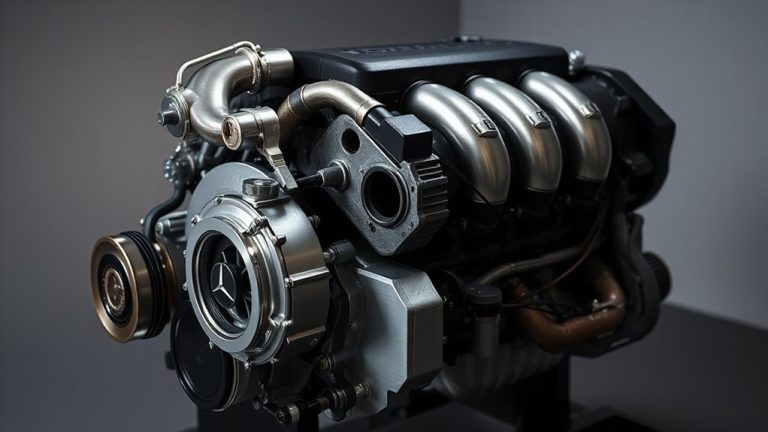
While it might seem like magic under the hood, a turbocharger’s power boost comes from precision-engineered components working in sync. You’ll find two main wheels connected by a shaft: the turbine and compressor. Hot exhaust gases spin the turbine, which drives the compressor to force more air into the engine. Turbo materials matter-most use nickel-alloy steel for the turbine due to extreme heat, while aluminum or titanium alloys coat the compressor for lightness and durability. The center housing holds critical bearing types: traditional journal bearings use oil lubrication and suit most daily drivers; ball bearing systems reduce friction and spool faster, ideal for performance setups. These bearings keep the shaft stable at speeds over 100,000 RPM. Seals at each end prevent oil leaks and gas mixing. All parts must endure high pressure and temperature swings, ensuring reliability and performance longevity.
How Turbocharged Engines Make More Power
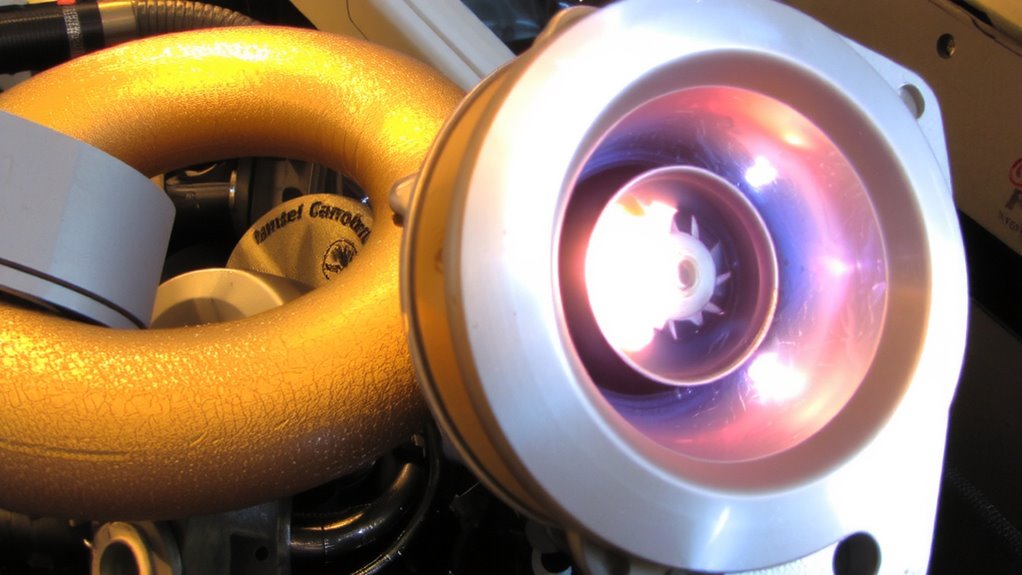
Since your engine can only burn as much fuel as air allows, forcing more air into the cylinders is the key to accessing extra power. A turbocharger compresses intake air, enabling increased compression and greater air density. This high-density air supports more fuel enrichment, ensuring efficient combustion. More controlled fuel and air mean a stronger explosion per stroke. That directly translates to higher horsepower and torque output without increasing engine size.
| Feeling | Without Turbo | With Turbo |
|---|---|---|
| Acceleration | Sluggish | Electrifying |
| Power Delivery | Gradual | Immediate |
| Engine Response | Delayed | Razor-sharp |
Increased compression ratios, typically ranging from 9:1 to 11:1 in turbo engines, maximize efficiency. Fuel enrichment is carefully managed by the ECU to match airflow, preventing knock while optimizing performance. You get more power from the same displacement-clean, linear, and potent.
Turbocharging vs. Naturally Aspirated: Key Differences
A turbocharged engine operates on a fundamentally different principle than a naturally aspirated one, and that difference starts with how air enters the combustion chamber. You get more air forced in under pressure, thanks to exhaust-driven turbines spinning up to 150,000 rpm. Naturally aspirated engines rely solely on atmospheric pressure, limiting airflow and peak efficiency. Turbo efficiency comes from scavenging wasted exhaust energy, converting it into usable boost-often 15 to 25 psi-increasing power without enlarging displacement. This allows smaller engines to match larger NA engines in output while using less fuel under load. Engine tuning plays a critical role, as turbos require precise management of airflow, fuel delivery, and ignition timing. Boost thresholds, wastegate control, and intercooling all depend on finely calibrated tuning to prevent knock and maintain reliability. You’re trading mechanical simplicity for thermal and pressure complexity.
More Power, Better Efficiency: Real-World Turbo Advantages
Many modern vehicles use turbocharging to deliver a noticeable jump in performance without sacrificing fuel economy. You get more power from smaller engines because turbos force more air into the cylinder, enabling more complete combustion. Automakers achieve up to 20% better fuel economy with turbocharged four-cylinder engines versus larger naturally aspirated ones producing similar horsepower. Turbocharging also supports emissions reduction by improving combustion efficiency, lowering CO2 output by approximately 15% under real-world driving conditions. Advanced engine management systems maintain ideal air-fuel ratios, reducing unburned hydrocarbons. You’ll find these benefits in everyday driving-responsive acceleration and fewer trips to the pump. Turbocharged 2.0L engines now match the output of older 3.0L V6s while consuming less fuel. This efficiency gain isn’t theoretical-it’s verified through EPA testing and onboard diagnostics.
Turbo Lag, Heat, and Reliability: Modern Fixes
Though turbocharged engines deliver strong performance and efficiency, they once struggled with turbo lag-the delay between pressing the accelerator and feeling the power surge. Modern turbos use variable geometry turbines (VGT) to minimize this lag. These systems adjust vane angles in real time, optimizing boost across rpm ranges. Exhaust tuning plays a critical role, with equal-length headers reducing pulse interference and increasing scavenging. This improves spool-up time by up to 18%. Twin-scroll turbos further enhance response by separating exhaust pulses. Heat remains a challenge, but improved intercooler efficiency reduces charge air temps by as much as 100°F, boosting density and power. High-strength alloys in turbine wheels withstand temperatures over 1,700°F. Direct-fluid cooling extends turbo life. Together, advanced materials, precise exhaust tuning, and superior intercooler efficiency make today’s turbo systems both reliable and responsive.
On a final note
You gain more power efficiently with turbocharging. A turbo forces extra air into cylinders using exhaust-driven compression. This increases oxygen density, enabling more fuel burn per cycle. Modern turbos spin over 150,000 rpm, boosting performance without raising engine displacement. Turbo lag is minimized with ball-bearing systems and variable geometry. Intercoolers reduce intake temps by up to 150°F. You achieve better fuel economy and lower emissions versus naturally aspirated engines of similar power.