Optimizing Exhaust Flow With Long-Tube Headers on Naturally Aspirated V8S
You gain 15–25 horsepower by replacing restrictive stock manifolds with long-tube headers. Tuned primary tubes enhance scavenging through low-pressure wave dynamics. Mandrel-bent 1-5/8″ to 1-7/8″ tubes reduce backpressure and improve exhaust flow. Proper sizing matches engine displacement-1-5/8″ for 350–400 ci, larger for 454+ ci or high-RPM use. 32–36 inch tube lengths target power between 5,000–6,500 rpm. Exact fitment guarantees sealing and clearance. Future sections reveal more on pairing headers with cam profiles.
Notable Insights
- Long-tube headers improve exhaust scavenging by using tuned primary tubes to create low-pressure waves that pull out exhaust gases efficiently.
- Select primary tube diameter based on engine size and RPM range: 1-5/8″ for 350–400ci street V8s, 1-3/4″ or larger for high-RPM or big-block applications.
- Equal-length primary tubes (typically 30–36 inches) optimize exhaust pulse timing and enhance volumetric efficiency across the power curve.
- Longer tubes shift peak torque to lower RPMs, while shorter tubes tune scavenging for higher RPM power (5,500–6,500 rpm).
- Ensure proper fitment by matching bolt patterns, using correct gaskets, and torquing gradually to prevent leaks and damage during installation.
Why Upgrade to Long-Tube Headers on a V8?
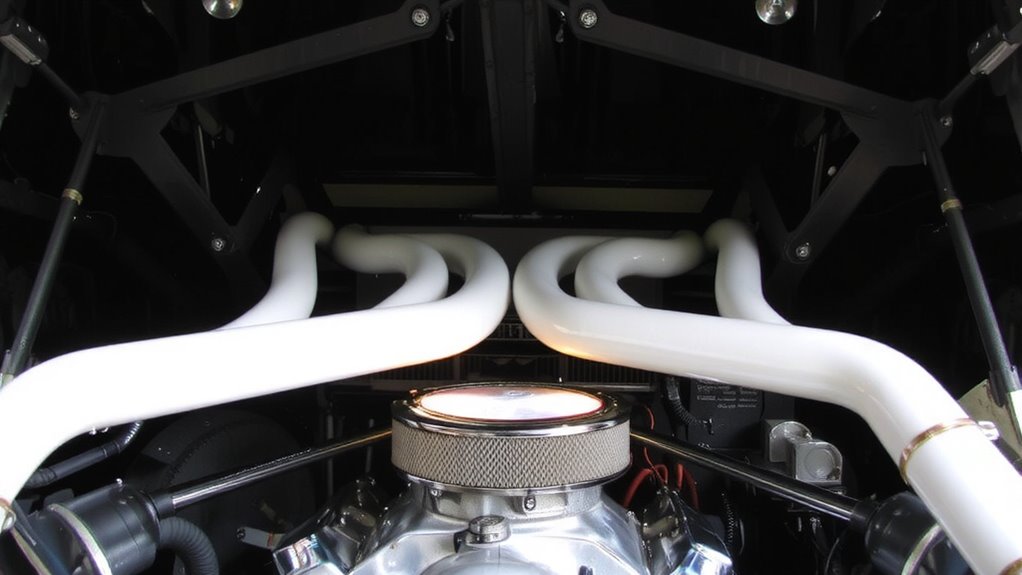
Performance. You upgrade to long-tube headers to maximize your V8’s efficiency and power output. Increased scavenging occurs as exhaust pulses travel through longer, tuned primary tubes, creating low-pressure waves that pull subsequent exhaust gases from the cylinder. This process improves cylinder evacuation, especially at higher RPMs. Reduced backpressure results from smoother, mandrel-bent tubing and optimized collector designs, replacing restrictive stock manifolds. Headers typically use 1.75- to 2.0-inch primary tubes, depending on displacement and cam profile, allowing faster exhaust velocity without flow choking. You gain 15–25 horsepower on average, with improved throttle response. The headers bolt directly to the cylinder head, maintaining precise exhaust timing critical for NA engine tuning. Unlike shorty headers, long-tubes exploit pressure differentials more effectively. Upgrading supports future modifications while delivering immediate gains in engine breathing and thermal efficiency.
How Long-Tube Headers Improve V8 Exhaust Flow
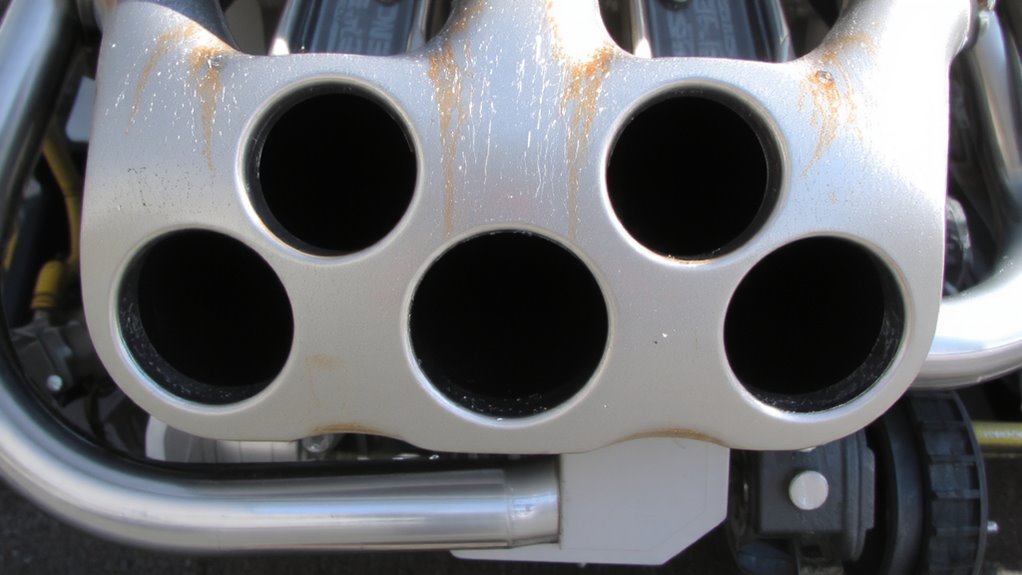
You already know these headers boost power, but how they do it comes down to exhaust pulse management and tuned airflow dynamics. Long-tube headers use precise pipe length and diameter to optimize pulse tuning, helping each cylinder’s exhaust pulse exit efficiently. When one cylinder fires, it creates a high-pressure wave that travels down the primary tube. That pulse generates a low-pressure area behind it, pulling exhaust gases from the next cylinder in the firing order-this is exhaust scavenging. Properly tuned headers synchronize these pulses so they don’t interfere, improving cylinder evacuation. The result is increased volumetric efficiency and more complete combustion. These headers typically use 1.75- to 2.0-inch primary tubes, with lengths around 30 to 36 inches, ideal for mid-to-high RPM performance.
Header Size: Matching Long-Tube Headers to V8 Displacement and RPM
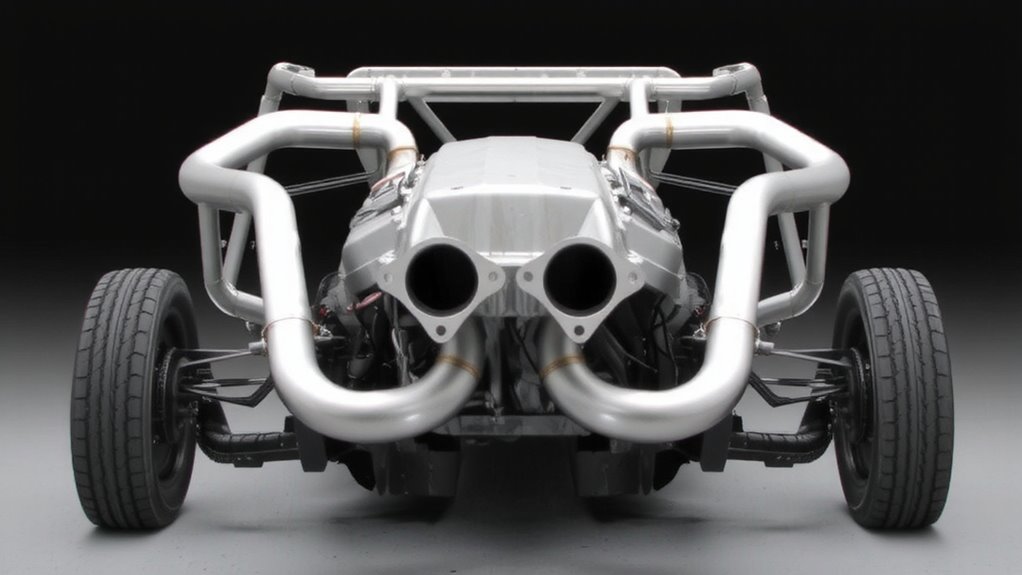
Choosing the right header size isn’t just about fit-it’s about matching your engine’s displacement and operating RPM range to maximize scavenging and power delivery. For most street-driven V8s (350–400 cubic inches), 1-5/8-inch primary tubes offer a balanced blend of exhaust scavenging and low-end torque. Larger engines (454+ cubic inches) or those revving past 6,500 RPM benefit from 1-3/4 to 1-7/8-inch primaries, enhancing high-RPM flow and backpressure reduction. Proper sizing promotes pulse separation, improving exhaust scavenging by pulling fresh intake charge into the cylinder. Undersized headers increase backpressure, restricting power. Oversized tubes reduce velocity, weakening scavenging below 4,000 RPM. Headers with equal-length primaries around 30–36 inches tune flow for specific RPM bands. Matching diameter to your engine’s output range guarantees peak efficiency without sacrificing drivability.
How Long-Tube Header Tube Length Tunes V8 Power
Tube length in long-tube headers plays a direct role in shaping a V8’s power curve by controlling exhaust pulse timing and scavenging efficiency. You use pulse tuning to position arriving exhaust pulses so they create low-pressure waves that help pull the next charge out of the cylinder. Longer tubes delay pulse arrival, enhancing exhaust scavenging at lower RPMs, boosting torque below 5,000 rpm. Shorter tubes move the scavenging effect higher, typically peaking between 5,500 and 6,500 rpm. Most factory long-tube headers use 32 to 36-inch primary tubes, tuned for mid-range balance. A 34-inch tube, for instance, generally optimizes power near 5,800 rpm. Custom systems can fine-tune length in 2-inch increments to match your cam profile and target RPM. Precision in tube length guarantees efficient exhaust scavenging and maximizes volumetric efficiency where you need it most.
Avoid Fitment Problems When Installing Long-Tube Headers
While long-tube headers deliver significant performance gains, getting them to fit properly requires careful attention to clearance and engine bay geometry. Clearance issues commonly arise near steering linkages, motor mounts, and exhaust routing. Always verify exact dimensions before purchasing. Mismatched bolt patterns cause installation failure-double-check your engine’s pattern (e.g., small-block vs. big-block Chevy). Many headers use either 5/16″ or 3/8″ bolt spacing; even a 1/16″ error prevents sealing.
| Header Brand | Bolt Pattern | Overall Width (in) |
|---|---|---|
| Hooker BlackHeart | Small-block Ford | 32.1 |
| Kooks 1-7/8” | LS Gen III/IV | 33.4 |
| Doug’s 1-3/4” | Small-block Chevy | 31.8 |
| Patriot 1-7/8” | Big-block Chevy | 35.2 |
Measure critical zones and test-fit when possible. Precision matters-don’t assume universal compatibility.
Common Long-Tube Header Mistakes for V8 Engines
If you’re upgrading your V8 for maximum exhaust efficiency, skipping proper gasket selection can undermine even the best long-tube header setup. A gasket mismatch leads to exhaust leaks, which rob power and increase underhood temperatures. You must match gasket thickness and material-typically stainless steel shim with graphite coating-to header flange and cylinder head specs. Even a 0.002-inch variance can cause leaks. Use manufacturer-recommended gaskets; don’t assume OEM-style gaskets work. Misalignment from incorrect gaskets stresses header tubes, risking cracks. Torque header bolts gradually in a star pattern to 25–30 ft-lbs, ensuring even clamping. Re-torque after first heat cycle. Steel headers expand ~0.007 inch per foot per 100°F-account for this. Avoid silicone sealants; they degrade under sustained heat. Proper fit prevents exhaust leaks, maintaining scavenging efficiency and maximizing horsepower gains up to 15–20 hp.
On a final note
You gain measurable power by optimizing exhaust scavenging with long-tube headers. Tubes typically 32–38 inches long tune peak torque to specific RPM ranges using resonant timing. For most naturally aspirated V8s, 1⅝- to 2-inch primary tubes balance low-end response and high-RPM flow. Proper collector sizing-usually 3–4 inches-preserves exhaust velocity. Fitment demands checking clearance for steering, suspension, and chassis rails. Mismatched header specs or poor installation robs performance.