Testing Fuel Pump Operation After Three Months of Static Vehicle Storage
Turn the key to ON and listen for a 70–85 dB hum from the fuel pump-it should last 2–3 seconds. No sound? Check the relay, fuse, and wiring for power and ground issues. Use a gauge to verify fuel pressure: 60–66 psi at startup, holding at least 50 psi after 5 minutes. Weak pressure or flow below 0.5 gallons per minute suggests varnish or debris from degraded ethanol fuel. A whining noise or stutter under load means wear or contamination. What comes next could save you from a no-start scenario.
Notable Insights
- Check for fuel contamination or degradation after static storage, especially with ethanol-blended fuels that attract moisture and form varnish.
- Listen for a consistent 70–85 dB hum during ignition prime; absence or abnormal noise suggests pump or electrical issues.
- Test fuel pressure at the rail: 60–66 psi with key on, engine off, and maintain at least 50 psi after 5 minutes.
- Inspect relay, fuses, wiring, and connections for damage, corrosion, or voltage drops; verify 12.6V ±0.5V at the pump connector.
- Replace the fuel pump if pressure, flow rate (<0.5 gpm), or resistance (outside 2–5 ohms) indicates mechanical or electrical failure.
Test the Fuel Pump After Long-Term Storage
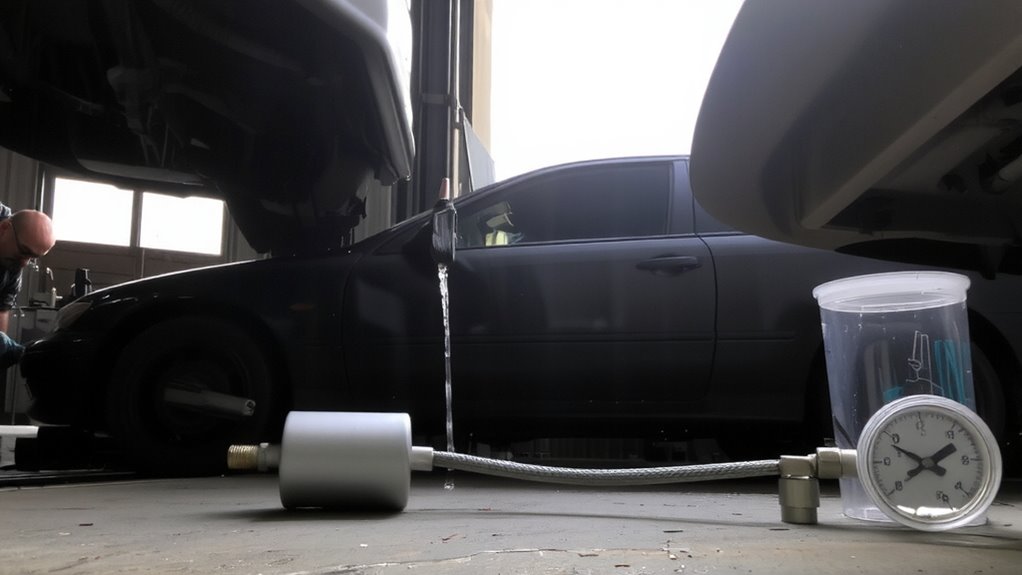
How do you know if your fuel pump still works after months of sitting idle? Start by inspecting for fuel contamination and evaporation effects. Ethanol-blended fuels attract moisture, promoting microbial growth that clogs pumps. Old gasoline degrades, forming varnish that impairs moving parts. Fuel evaporation leaves behind residue, reducing lubrication and increasing wear. Most modern electric fuel pumps operate at 55–60 psi; a drop below 50 psi indicates potential failure. Test pressure using a gauge on the fuel rail. If pressure builds slowly or fluctuates, the pump may struggle. Voltage at the pump should be 12.6 volts when priming. Low voltage worsens performance. Contaminated or degraded fuel reduces flow rate-specifications usually require 0.5 to 1.0 gallons per minute. Always replace the fuel filter to rule out blockages. Immediate testing prevents engine damage.
Listen for the Prime Sound When Turning the Key
Can you hear that subtle buzz when you turn the key to the “run” position? That’s the fuel pump hum-a critical sign of proper operation after static storage. During the ignition cycle check, the vehicle’s ECU activates the fuel pump for 2–3 seconds to prime the system. A healthy pump emits a consistent, medium-pitched hum from the rear or underbody, typically around 70–85 decibels. No sound could mean a failed relay, blown fuse, or degraded pump motor. Listen closely; intermittent or rattling noises suggest debris or wear. This quick auditory test confirms electrical continuity and mechanical readiness before startup. If you don’t hear the expected fuel pump hum, inspect the relay, fuse, and wiring harness. Conduct the ignition cycle check repeatedly to verify consistency. This simple step saves time and prevents engine damage during restart.
Check Fuel Pressure With a Gauge
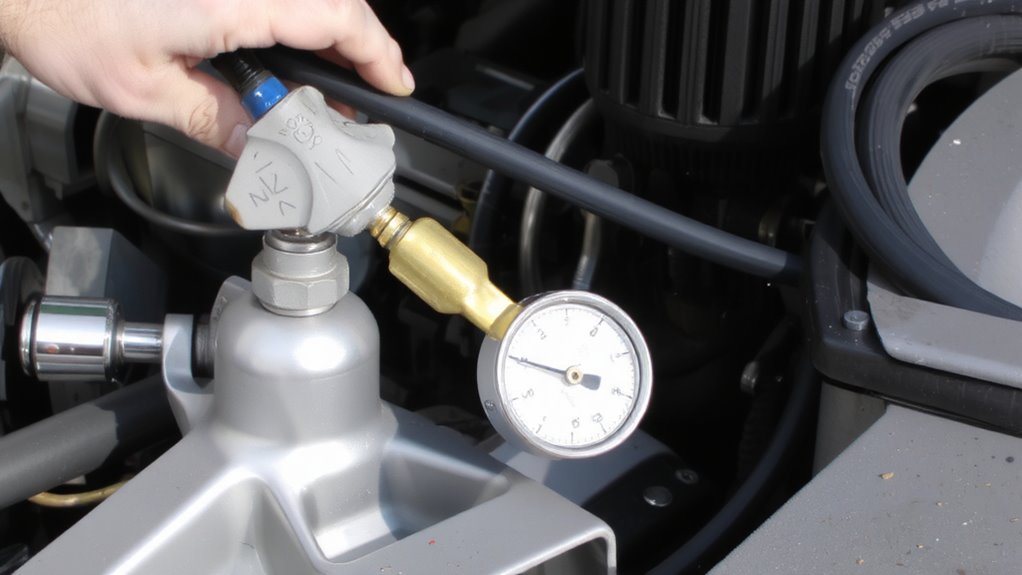
Fuel pressure tells the real story of your pump’s performance. Without accurate readings, you can’t confirm if the system delivers fuel under proper force. Always verify gauge calibration before connecting-uncalibrated tools give false assurance. Attach the pressure gauge to the service port and compare readings to specs. Low pressure may point to worn components or changes in fuel viscosity, especially after static storage.
| Condition | Pressure (PSI) |
|---|---|
| Idle | 55–62 |
| Key On, Engine Off | 60–66 |
| Vacuum Hose Removed | 60–66 |
| After 5 Min | Min 50 |
Hold pressure for at least five minutes. A steady drop suggests leaks or weak pumps. High fuel viscosity from old gasoline increases pump load. Always test with fresh fuel and a calibrated gauge-accuracy matters.
Inspect the Relay and Wiring for Power
Why might your fuel pump fail to engage even when the gauge shows proper pressure? The issue could lie in the relay or wiring. First, check the fuel pump relay-swap it with a known-good one to test function. A faulty relay interrupts power delivery. Next, inspect wiring connections at the pump, relay, and fuse box for corrosion, looseness, or damage. Use a multimeter to verify voltage at the pump’s connector; you should read within 0.5 volts of battery voltage (typically 12.6V). Any significant voltage drop indicates excessive circuit resistance. High circuit resistance reduces power to the pump, impairing performance or preventing startup. Measure resistance across wiring runs-values above 0.3 ohms suggest a problem. Confirm ground connections are clean and tight. Poor grounding increases resistance and causes voltage drop, starving the pump of needed power. Address these issues before proceeding. For accurate diagnostics, use a reliable car multimeter that can precisely measure voltage and resistance.
Identify Common Failure Signs (Noise, Stutter, No Start)
While you’re checking electrical components, don’t overlook the symptoms your vehicle displays during startup and operation-these clues often point directly to fuel pump health. A loud whining noise from the tank signals internal wear or fuel contamination disrupting flow. You may hear a buzzing or humming if the pump motor struggles due to voltage drop below 9.6V during cranking. Engine stuttering under acceleration suggests inconsistent fuel delivery, often caused by a failing pump or blocked filter. If the engine cranks but won’t start, verify fuel pressure; most systems require 40–60 psi. No pressure often means pump corrosion has damaged internal brushes or commutators. Fuel contamination accelerates corrosion and clogs strainers, reducing efficiency. A weak pump may still operate but fail to maintain pressure past 50 psi, leading to lean misfires. These signs-noise, hesitation, no-start-warn of degradation you can’t afford to ignore. Upgrading to a reliable electric fuel pump can prevent many of these issues, especially when selecting a model designed specifically for carbureted systems.
Stop Fuel Pump Problems Before Long Storage
Before storing your vehicle for months at a time, take steps to protect the fuel pump from avoidable damage-ethanol in modern gasoline attracts moisture, and stagnant fuel can lead to internal corrosion. Fill the tank to reduce air space, minimizing condensation and fuel contamination. Ethanol-blended fuels can absorb up to 0.5% water by volume, increasing corrosion risk. Use a fuel stabilizer designed for ethanol fuels; it preserves octane levels and maintains pump lubrication. Without proper lubrication, the pump’s armature and commutator wear prematurely. Run the engine for 10 minutes after adding stabilizer to circulate the treated fuel. Store in a dry, temperature-stable environment to prevent phase separation. A full tank with treated fuel can remain stable for up to 12 months. This simple prep prevents gum and varnish buildup, ensuring consistent fuel flow and protecting sensitive pump components from degradation during static storage.
Decide If You Need to Clean or Replace the System
How do you know when it’s time to clean versus replace your fuel system after long-term storage? If you detect fuel contamination or suspect pump corrosion, act immediately. Fuel contamination often introduces water, debris, or microbial growth into the tank, degrading fuel quality and clogging filters. Inspect the fuel for cloudiness or sediment-these are clear indicators. If contamination is mild, a complete flush and fuel system cleaning with a high-quality solvent may restore function. However, if pump corrosion is evident-such as pitting on the pump’s armature or electrical resistance outside the 2–5 ohm range-replacement is necessary. A corroded pump won’t deliver consistent pressure, typically dropping below the required 45–60 psi. Cleaning won’t fix internal damage. When in doubt, test flow rate: less than 0.5 gallons per minute means replacement. Prioritize reliability-replace compromised components outright.
On a final note
You should test the fuel pump after three months of inactivity. Turn the key to “on” without starting; you should hear a 2–3 second hum from the tank. That’s the pump priming at 45–60 psi. No sound? Check the relay, fuse, and power at the harness-typically 12V. Stuttering or no-start issues may indicate clogged filters or weak pressure. Address problems early. Prevent future failures with fuel stabilizer and a full tank before storage.