DCT Maintenance Guide: Fluid Change Intervals & Warning Signs
Your dual-clutch transmission isn’t maintenance-free. It needs clean fluid and proper hydraulic pressure-typically 60–80 psi-to function. Fluid breaks down from heat, especially under performance or towing conditions. Change it every 40,000–60,000 miles, or as early as 30,000 with aggressive use. Use only OEM-spec fluid to maintain viscosity and clutch performance. Clutch plates wear over time-replace them when thickness drops below 4 mm. Watch for shudder, slippage, or warning codes like P0847. Ignoring these risks catastrophic failure. There’s more you should know about protecting your investment.
Notable Insights
- Dual-clutch transmissions require regular maintenance, including fluid changes every 40,000 to 60,000 miles depending on driving conditions.
- Use only OEM-spec fluid to ensure proper viscosity and friction performance for reliable DCT operation.
- Clutch shudder at low speeds, gear slippage, and warning lights like P0847 signal potential DCT problems.
- Avoid aggressive launches and hard takeoffs to prevent excessive heat and premature clutch wear.
- Perform professional inspections at 40,000 miles to check clutch thickness and catch issues early.
Why Your DCT Needs Regular Maintenance
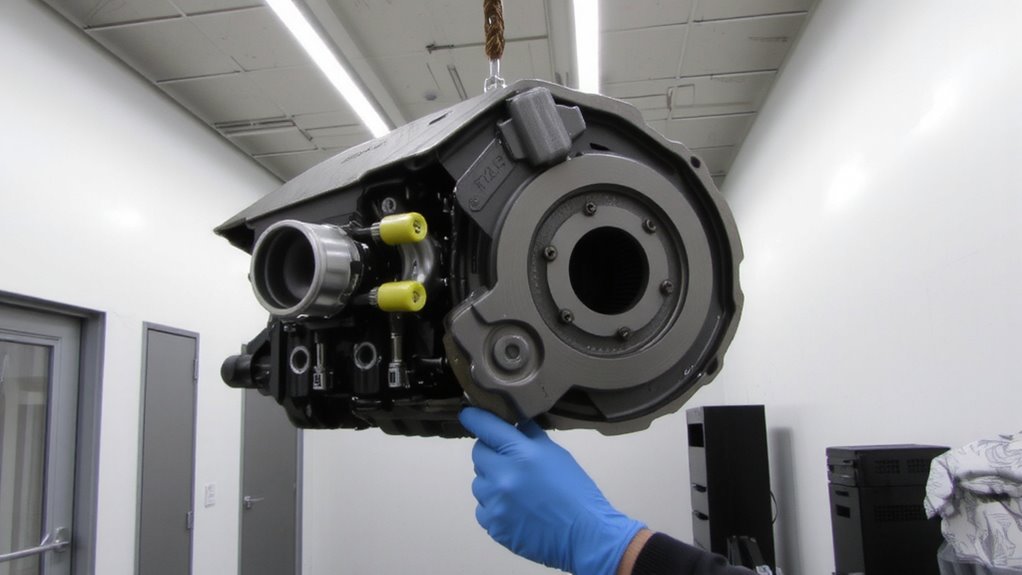
While many drivers assume their dual-clutch transmission (DCT) is maintenance-free, neglecting it can lead to costly repairs down the road. Your DCT relies on precise hydraulic pressure and clean fluid to operate efficiently. Over time, heat and friction degrade the fluid, reducing its ability to lubricate and cool internal components. This directly impacts transmission longevity. Most manufacturers recommend servicing every 40,000 to 60,000 miles, though some high-performance models require attention as early as 30,000 miles. This maintenance frequency guarantees peak clutch response and shift timing. Without it, you risk delayed shifts, shuddering, or complete failure. The mechatronic unit, which controls gear changes, is sensitive to contamination. Regular maintenance prevents debris buildup and preserves valve body performance. Think of it like oil changes for your engine-skipping them accelerates wear. Following factory-specified service intervals protects reliability, efficiency, and overall drivetrain performance.
When (And Why) to Change DCT Fluid
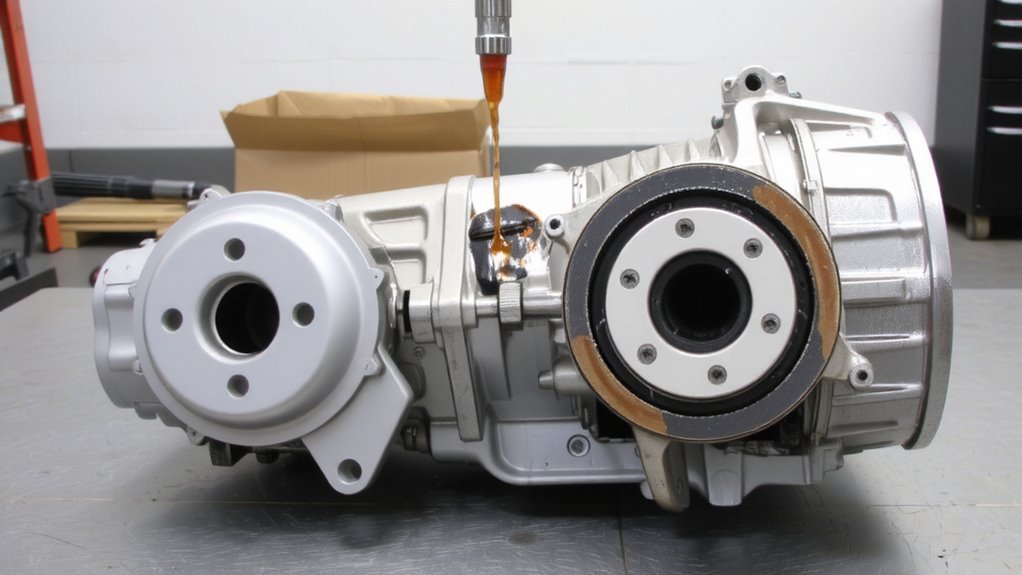
How often should you change your DCT fluid? Most manufacturers recommend every 40,000 to 60,000 miles, but severe driving-like frequent stop-and-go traffic or towing-means you should do it sooner. Fluid degradation over time reduces lubrication efficiency and heat dissipation, increasing wear on clutches and gears. Contamination risks from metal particles and clutch dust also build up, impairing valve operation and hydraulic pressure. Fresh fluid maintains ideal viscosity and friction characteristics critical for smooth shifts.
| Interval (Miles) | Condition |
|---|---|
| 40,000 | Severe driving |
| 60,000 | Normal driving |
| 30,000 | Performance use |
| 50,000 | Towing loads |
Changing fluid on schedule minimizes contamination risks and combats fluid degradation, protecting complex internal components. Always use fluid meeting OEM specs-incorrect types impair performance.
Signs Your Transmission Is Failing
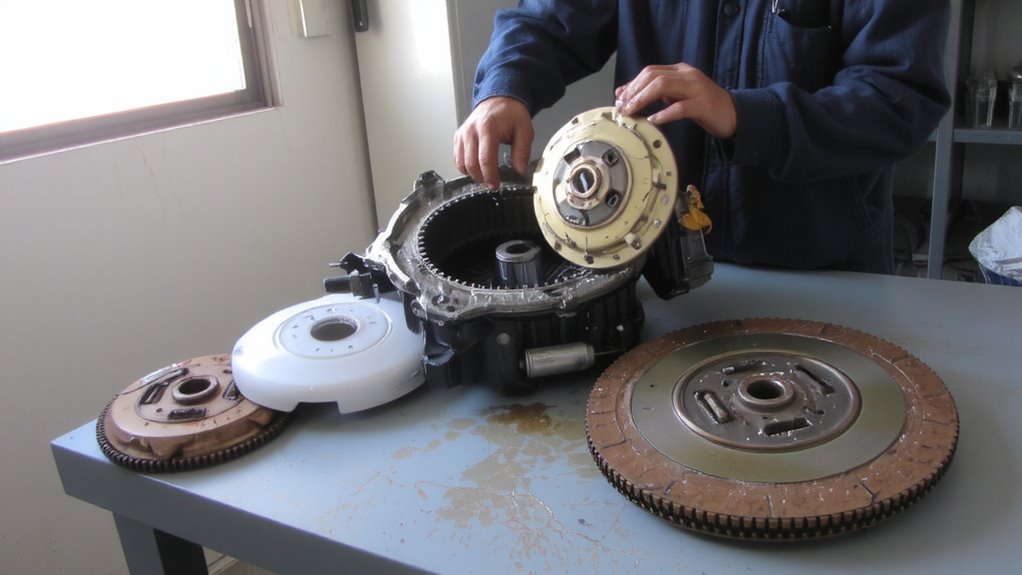
Ignoring fluid maintenance can lead to serious transmission trouble, and recognizing early warning signs helps prevent costly damage. You may notice clutch shudder, a vibration felt during low-speed acceleration, typically between 10–25 mph, caused by worn clutch packs or contaminated fluid. It often occurs in forward or reverse engagement. Gear slipp- age is another red flag-your DCT unexpectedly shifts out of gear or RPMs spike without acceleration. This usually stems from hydraulic pressure loss, faulty solenoids, or degraded friction materials. Warning lights, like the gearbox icon, may illuminate with error codes such as P0847 or P0805. Shift delays exceeding 0.5 seconds indicate actuator or sensor issues. Unusual noises-grinding or clunking-suggest mechanical wear. Fluid darkening or burning smells confirm thermal breakdown. Address these symptoms immediately. Letting them persist risks complete transmission failure, often requiring replacement over repair. Early diagnosis improves outcomes and reduces repair costs markedly.
Driving Habits That Protect Your DCT
When you let the vehicle come to a complete stop before shifting between drive and reverse, you reduce strain on the dual-clutch module’s synchronizers and engagement mechanisms. This simple habit prevents abrupt torque transfer that can degrade clutch pack longevity over time. Practice smooth shifting by allowing slight pauses during gear changes, especially in manual mode. Smooth shifting reduces wear on the electro-hydraulic actuators and minimizes heat buildup in the clutch baskets. Avoid riding the brake or creeping forward while partially applying the accelerator-this causes excessive clutch slippage and promotes gear hunting. Gear hunting occurs when sensors detect conflicting inputs, forcing frequent upshifts and downshifts. It stresses the transmission control unit and accelerates fluid degradation. Maintain consistent throttle inputs in stop-and-go traffic. Use neutral when stopped for more than a few seconds to relieve clutch pressure. These behaviors extend DCT lifespan and sustain peak shift response.
Biggest Mistakes That Kill DCTs
You might think driving gently protects your dual-clutch transmission, but everyday habits can do more harm than you realize. An aggressive launch, especially from a stop, overworks the clutch packs and accelerates wear. These transmissions rely on precise hydraulic pressure-typically 60–80 psi-to engage gears smoothly. Repeated hard takeoffs generate excessive heat, increasing overheating risks beyond the safe threshold of 250°F. Prolonged exposure above this limit degrades transmission fluid, reducing lubrication efficiency and raising the chance of solenoid failure. Stop-and-go driving in hot climates worsens this effect, particularly in models without auxiliary coolers. Fluid breakdown leads to delayed shifts or complete clutch slippage. Unlike traditional automatics, DCTs have limited heat dissipation due to compact design. Avoid riding the clutch or “launch control” techniques unless your vehicle is built for repeated high-torque scenarios. Preserve your DCT by moderating throttle input and monitoring operating temperatures.
When to Get a Pro DCT Inspection
How can you tell when your dual-clutch transmission needs a professional eye? Watch for transmission slippage, where engine RPM spikes without corresponding acceleration. This indicates degraded clutch packs or low hydraulic pressure, often at 80,000 miles or more. Clutch shudder-a vibration during takeoff-means worn dual-mass flywheels or uneven clutch engagement. It commonly occurs below 20 mph under light load. Unexplained gear hunting, delayed shifts, or warning lights like “Check DCT” demand immediate evaluation. Technicians use OEM-level scanners to read fault codes and check solenoid response times, typically under 50 milliseconds. Ignoring these signs risks complete failure, costing $3,000+ to repair. Pro inspections every 40,000 miles catch issues early. They measure clutch plate thickness, usually 6–7 mm new, and inspect for wear below 4 mm. Preventative checks preserve performance, efficiency, and component lifespan. Don’t wait-act when symptoms emerge.
On a final note
You must maintain your DCT to guarantee long-term reliability. Transmission fluid degrades over time, losing its ability to lubricate and cool internal components. Most manufacturers recommend fluid changes every 40,000 to 60,000 miles. Neglecting this leads to increased friction, shuttering, and potential failure. Proper maintenance preserves shift speed, which can be as fast as 8 milliseconds in high-performance models. Regular inspections prevent costly repairs.