The Role of the Intake Manifold Plenum in Modern Engines: How Its Design Affects Airflow Distribution and Combustion Efficiency Within Each Cylinder
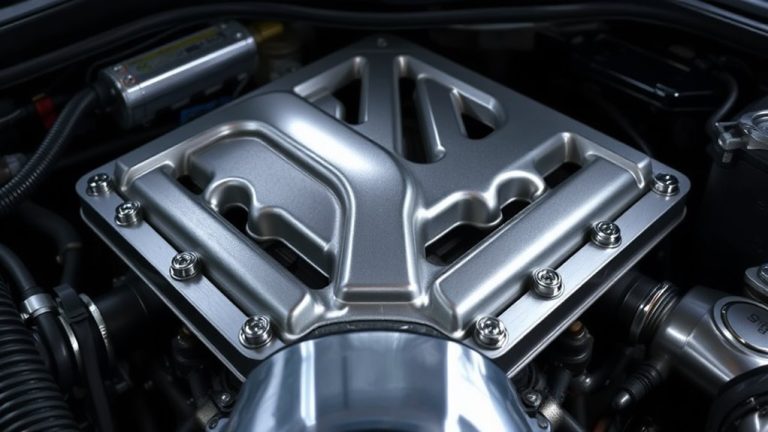
You rely on the intake plenum to evenly distribute air to each cylinder, ensuring balanced combustion. Its volume-typically 3 to 6 liters-impacts performance: larger plenums enhance high-RPM power, while smaller ones boost low-end torque. A symmetrical shape with smooth contours minimizes turbulence, improving airflow. Runner length, often 30–35 cm for 3,000 RPM tuning, affects wave dynamics. CFD simulations and lightweight composites refine efficiency. There’s more to how these elements work together.
Notable Insights
- The intake plenum evenly distributes air to all cylinders, ensuring consistent airflow for balanced combustion efficiency.
- Plenum volume impacts engine performance, with larger volumes favoring high-RPM power and smaller ones enhancing low-end torque.
- Symmetrical design and internal baffles minimize turbulence, promoting uniform air distribution and stable pressure across cylinders.
- Runner length connected to the plenum tunes pressure wave timing, optimizing torque at specific engine speeds.
- Modern plenums use CFD and lightweight composites to refine airflow precision and improve thermal and structural performance.
What Is an Intake Plenum and How Does It Work?
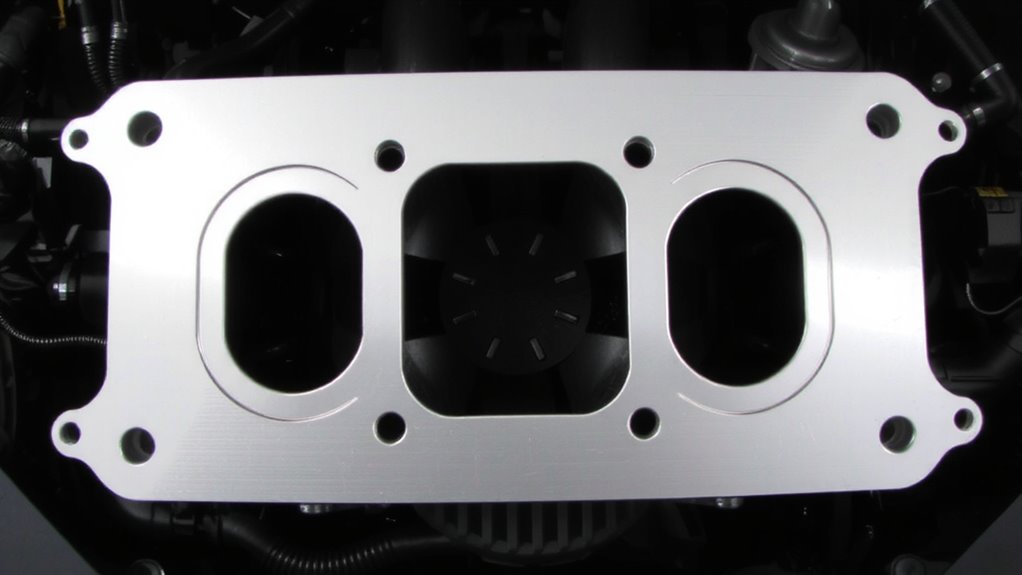
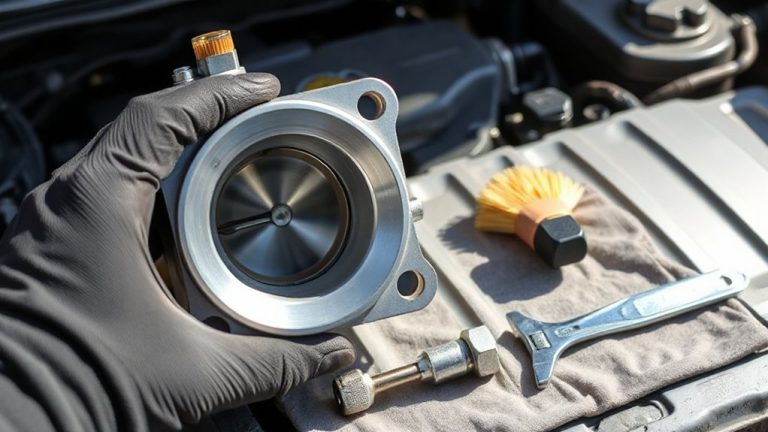
Think of the intake plenum as the heart of your engine’s air intake system. It stores and distributes incoming air to each cylinder evenly. Without it, airflow would rush directly into individual runners, causing intake turbulence and erratic cylinder filling. The plenum dampens pressure pulses from the opening and closing of intake valves, enabling pressure stabilization for smoother delivery. Most modern plenums have a volume between 3 to 6 liters, depending on engine size and application. Internal dividers and tuned baffle walls reduce resonance, while a smooth internal finish minimizes flow disruption. You’ll often see a throttle body mounted at the plenum’s inlet, regulating total airflow. Its design guarantees each runner receives nearly equal air mass, critical for consistent combustion. Pressure stabilization within the plenum reduces cycle-to-cycle variation, improving efficiency and emissions. It doesn’t generate power-it optimizes what the engine already has.
Why Plenum Volume Affects Torque and Power?
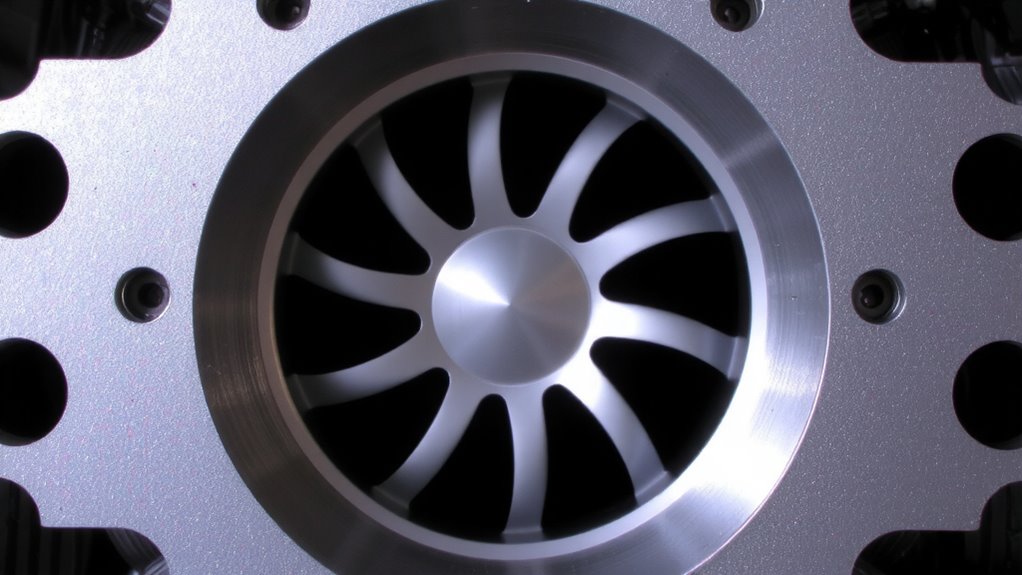
Plenum volume plays a direct role in shaping an engine’s torque and power characteristics across the RPM range. A larger plenum provides more air storage, improving high-RPM power by reducing flow restrictions. It enhances air inertia, helping maintain airflow momentum into the cylinders during valve overlap. However, it can reduce low-end torque due to lower air velocity at slower speeds. A smaller plenum increases air velocity, boosting low-RPM torque through stronger pressure pulses. It promotes plenum resonance tuned to lower frequencies, enhancing cylinder filling at idle and mid-range. The ideal volume balances these effects, typically between 50–70% of engine displacement for performance applications. You’ll see peak torque shift lower with smaller volumes and higher with larger ones. Matching plenum volume to RPM targets guarantees efficient breathing, directly influencing combustion efficiency and power delivery.
How Plenum Shape Balances Airflow to Cylinders?
Air distribution inside the intake manifold hinges on the plenum’s shape, not just its volume. Your engine relies on consistent flow dynamics to deliver equal air to each cylinder. An asymmetric plenum disrupts this balance, causing uneven fuel mixing and reduced efficiency. A well-designed, symmetrical plenum promotes even pressure stabilization, minimizing turbulence at high airflow rates. Think of it like water spreading evenly in a circular basin versus pooling in one corner. Shorter paths to certain runners create pressure differentials unless the plenum’s internal geometry compensates. Modern plenums use tuned internal dividers and rounded contours to smooth airflow. These features maintain laminar flow and reduce pressure spikes during rapid throttle changes. You’ll see peak performance when flow dynamics remain predictable across all operating conditions. Proper pressure stabilization guarantees each cylinder breathes equally-critical for maximizing combustion efficiency and minimizing emissions in performance and economy-focused engines alike.
How Runner Length Tunes Plenum Performance?
Runner length plays a direct role in how effectively the plenum delivers air to each cylinder, building on the balanced airflow established by the plenum’s shape. You use specific runner lengths to optimize engine performance through wave tuning. Pressure waves generated during intake valve closure travel back through the runner, reflecting off the plenum. When timed right, these waves return as positive pressure just as the next intake valve opens, boosting cylinder filling. This effect peaks at certain RPMs, depending on runner length-longer runners promote low-end torque by tuning for lower RPM pressure wave return, while short runners favor high-RPM power. You’ll often see variable-length intake systems that switch runner paths to broaden torque curves. At 3,000 RPM, a typical tuned runner might be around 30–35 cm long. Proper wave tuning enhances volumetric efficiency by up to 12%, directly improving combustion efficiency and power output.
How CFD Optimizes Modern Plenum Design?
Ever wonder how engineers consistently achieve maximum airflow with minimal losses in today’s engine intakes? They rely on computational fluid dynamics (CFD) to fine-tune plenum design. You use CFD simulations to visualize airflow behavior before any physical prototype exists. The software models turbulent flow, helping identify dead zones or separation areas that disrupt air delivery. Pressure pulsation is also analyzed-critical for maintaining consistent cylinder filling. By adjusting plenum volume, inlet position, and divider geometry in virtual environments, you balance pressure waves across all runners. Modern plenums often feature asymmetrical chambers or tuned baffles, optimized through thousands of CFD iterations. These changes reduce flow deviation between cylinders to under 2%, boosting combustion efficiency. With grid resolutions reaching 50 million cells and transient simulations over 50 engine cycles, CFD delivers precision you can’t get with testing alone.
How New Materials Improve Plenum Efficiency?
The latest generation of intake plenum designs leverages advanced composite materials to reduce weight and enhance airflow stability under high-temperature conditions. You’ll find these composites offer lower material density than traditional aluminum, cutting plenum mass by up to 30%. That reduced weight improves overall engine efficiency and responsiveness. These materials also exhibit low thermal conductivity, minimizing heat transfer from the engine block into the intake air. Cooler air means higher charge density and better combustion efficiency. Unlike metal counterparts, composites resist under-hood heat soak, maintaining consistent air temperature. Some high-performance plenums use carbon-fiber-reinforced polymers, combining strength with minimal thermal expansion. This dimensional stability guarantees precise internal geometries remain intact. You get uniform airflow distribution across all cylinders, cylinder-to-cylinder variation drops below 2%. Advanced materials aren’t just lighter-they’re smarter, delivering measurable gains in power and throttle response without adding complexity.
On a final note
You rely on the intake manifold plenum to deliver balanced airflow to each cylinder. Its volume, typically 2 to 4 liters in performance engines, directly impacts torque curves. A well-designed plenum guarantees uniform air distribution, minimizing cylinder-to-cylinder variation. Computational fluid dynamics (CFD) optimizes internal contours, reducing turbulence by up to 18%. Runner lengths, often 150–300 mm, tune pressure waves for peak efficiency at specific RPMs, enhancing volumetric efficiency.