Custom Fabrication of Supercharger Snout Adapters for Non-Factory Configurations
You need custom snout adapters when off-the-shelf kits won’t fit your non-factory setup. They’re machined to ±0.001 inch for perfect pulley alignment, eliminating belt slip. Made from 6061-T6 or 7075-T6 aluminum, they handle high torque and boost. Vintage blowers on modern blocks require precise drive synchronization-custom adapters guarantee it. Misalignment as small as 0.030 inch causes premature wear. Strong materials and precision prevent failure under 1.5x operating loads. Discover how fitment issues are solved next.
Notable Insights
- Custom snout adapters enable precise alignment between modern engines and vintage superchargers lacking factory mounting options.
- CNC machining to ±0.001-inch tolerance ensures perfect pulley alignment, eliminating belt slip and premature wear.
- 6061-T6 aluminum or 4340 chromoly steel provide lightweight strength and durability under high boost and torque loads.
- Adapters correct dimensional mismatches in bolt patterns, pilot diameters, and drive ratios for non-factory supercharger installations.
- FEA and load testing validate structural integrity, ensuring safety and reliability in custom supercharged configurations.
Why Snout Adapters Beat Off-the-Shelf Kits
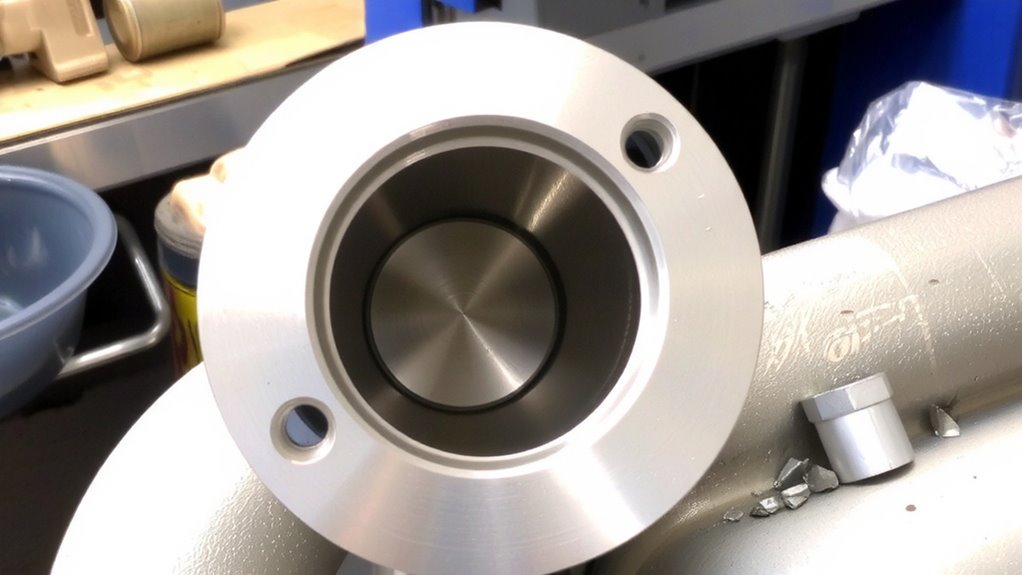
A custom snout adapter isn’t just a bolt-on part-it’s a precision-engineered solution built to eliminate the compromises of off-the-shelf kits. You get exact alignment between your supercharger and crank pulley, preventing belt slip and premature wear. Off-the-shelf kits use generic tolerances, often leading to misalignment up to 0.060 inches-enough to degrade performance. With custom engineering, adapters are CNC-machined to within ±0.001-inch accuracy for perfect drive alignment. They’re made from 6061-T6 aluminum, ensuring strength without added weight. This precision directly supports performance tuning, allowing higher boost levels safely. Misaligned kits create parasitic loss; your engine loses 5–10 hp easily. A custom adapter maintains belt tension under load, improving drive efficiency by up to 18%. You’re not adapting to the kit-you’re building it for your exact configuration. That’s ideal integration.
Adapting Vintage Blowers to Modern Engines
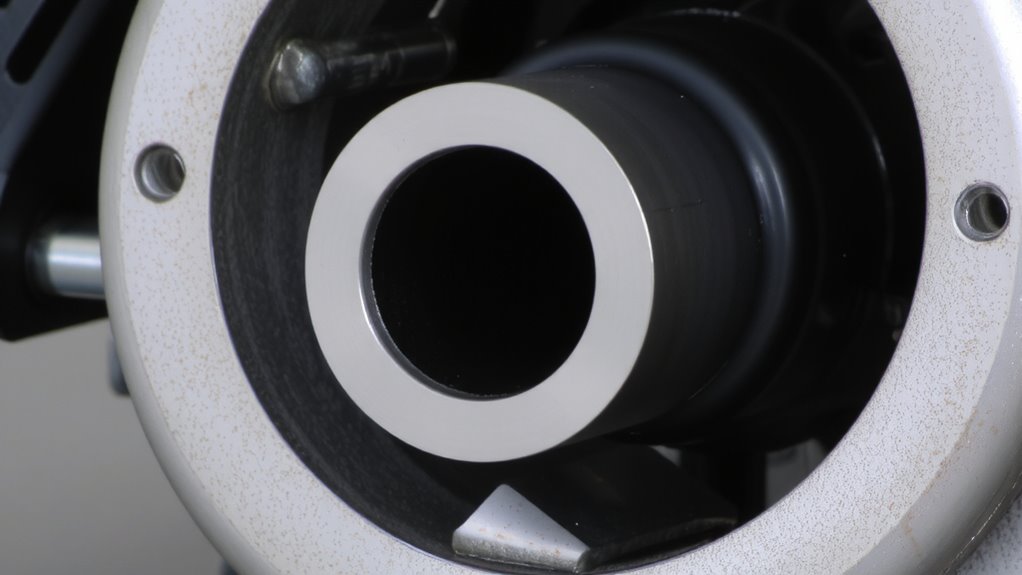
Every vintage Roots or centrifugal supercharger brings character, but bolting one to a modern engine block isn’t plug-and-play. You need precise vintage integration to match outdated mounting patterns with current engine architecture. Modern blocks lack the original bolt holes and drive configurations, requiring custom snout adapters that bridge dimensional gaps. These adapters must maintain timing synchronization between the crankshaft and supercharger rotor or impeller. A 2° variance in drive alignment can disrupt pressure delivery and cause backflow. You’ll typically work with 7:1 or 8:1 crank-to-blower drive ratios, depending on the blower model. Materials matter-use 6061-T6 aluminum for strength and thermal resistance. Wall thickness should be at least 0.25 inches to prevent flex. Proper clearance for harmonic balancer movement is 0.125 inches minimum. Your success hinges on matching drive diameters and maintaining phase accuracy across temperature cycles.
Achieving Perfect Pulley Alignment
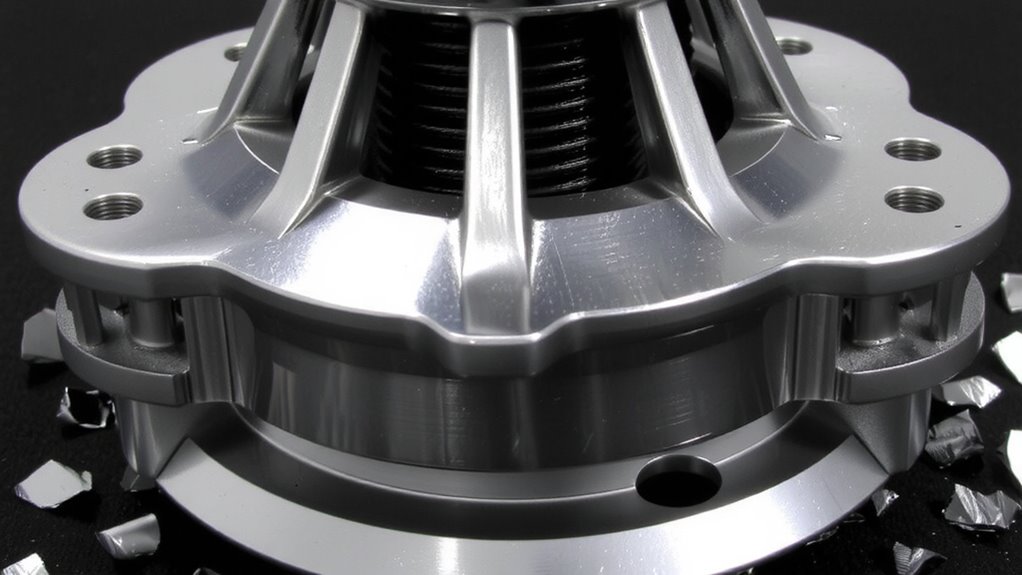
Misaligned pulleys will kill efficiency, no matter how well you’ve matched the snout adapter to your vintage blower and modern engine. You must guarantee perfect pulley alignment to maintain belt life and power transfer. Even 0.030 inches of offset across a 6-inch pulley face can cause premature belt wear. Use a straightedge or laser alignment tool across both pulley faces to check side-to-side alignment. Pulley spacing affects belt angle and wrap; incorrect spacing leads to slippage or binding. Maintain manufacturer-recommended belt tension-typically 180–220 pounds deflection force on a 1/2-inch span-to prevent flutter or excessive load on bearings. Too much tension damages shafts; too little reduces drive efficiency. Alignment isn’t just front-to-back-it’s axial, angular, and radial. Your setup must account for thermal expansion and engine movement under load. Perfect alignment means zero wobble and consistent belt tracking.
Best Materials for Strong Snout Adapters
Strength begins with material choice-your snout adapter must handle extreme torque, heat, and mechanical stress without flex policter or failing. For high-performance builds, 4340 chromoly steel is the top choice due to its exceptional tensile strength of 160,000 psi and fatigue resistance. Material selection directly impacts reliability under load, especially with oversized pulleys or high-boost setups. You’ll also see 7075-T6 aluminum used for lightweight applications, offering 83,000 psi tensile strength but less durability under constant stress. Every custom adapter undergoes rigorous strength testing, simulating 1.5x normal operating loads to verify integrity. Finite element analysis (FEA) helps predict stress points before physical testing. Proper heat treating and stress-relieving processes eliminate internal warping. Your adapter isn’t just a spacer-it’s a load-bearing component. Choose wisely.
LS Swap With 1940s Roots Blower: A Fitment Case Study
You’re bolting together an LS engine with a vintage 1940s Roots blower, and that snout adapter you chose better handle the twist. Misalignment risks throwing off blower timing, causing pressure loss and potential backflow. Precision machining within ±0.002” guarantees drivetrain harmony. Fuel compatibility is critical-older blowers weren’t designed for ethanol-laced fuels, risking seal degradation over time.
| Factor | Specification |
|---|---|
| Adapter Material | 6061-T6 Aluminum |
| Max Torque Load | 75 ft-lbs |
| Fuel Resistance | Compatible with E10, not E85 |
Custom fitment preserves original gear positioning while adapting to modern LS front housings. You maintain classic looks without sacrificing reliability. The adapter acts as a mechanical bridge-its role extends beyond connection to guaranteeing long-term synchronization between crankshaft and blower input shaft.
Fixing Common Snout Adapter Fitment Problems
How do you guarantee perfect alignment when your vintage blower snout doesn’t sit flush with the LS engine front cover? Start by verifying pilot diameter and bolt circle specs-most fitment issues stem from a thread mismatch or incorrect register depth. Use precision-ground spacers to correct axial positioning. If bolts won’t seat fully, check thread pitch; common swaps mix SAE and metric, causing thread mismatch that stresses adapter plates. Address gasket leakage by selecting fluoroelastomer O-rings rated for 300°F+ and pressures up to 15 psi. Machine a 0.030” compression groove for positive seal retention. Misaligned dowel pins cause runout-use hardened alignment sleeves with ±0.002” tolerance. Confirm flatness with a surface gauge; any warpage over 0.003” invites gasket leakage. Always dry-fit before final assembly. Proper prep guarantees leak-free, vibration-free operation even at 8,000-rpm drive speed.
On a final note
You need custom snout adapters when off-the-shelf kits don’t fit. Precision machining guarantees alignment within ±0.005 inches. Aluminum 6061-T6 provides strength at 35,000 psi tensile rating. Proper fit prevents belt slip and bearing wear. Misalignment over 1° causes premature failure. Custom adapters support exact pulley spacing. They enable vintage blowers on modern LS engines. Fitment is repeatable across builds. This guarantees reliable supercharger operation.