How to Install Speakers in Vehicles With Factory JBL Systems
Replace your factory JBL speakers with 4-ohm models rated at 87–92 dB sensitivity to maintain amplifier compatibility. Match power handling to 50–100 watts RMS per channel. Keep factory wiring intact using a harness adapter to preserve signal integrity. Guarantee correct polarity by connecting positive leads to striped wires. Use DSP-safe speakers to retain factory EQ and time alignment. Avoid impedance mismatches or parallel wiring that can damage the amplifier. Peak performance hinges on phase accuracy and frequency response replicating stock 50 Hz–20 kHz output. Further refinements guarantee lasting audio precision.
Notable Insights
- Match aftermarket speakers to the factory 4-ohm impedance to prevent amplifier damage and ensure optimal performance.
- Choose speakers with 87–92 dB sensitivity and 50 Hz–20 kHz frequency response to maintain sound quality and balance.
- Use factory wiring with a harness adapter to preserve signal integrity and avoid electrical issues during installation.
- Retain JBL DSP tuning by selecting DSP-safe or factory-tuned speakers that align with original phase and sensitivity curves.
- Safely remove door panels using a plastic trim tool, disconnecting the battery first, and handle shielded JBL wiring with care.
Match Your Aftermarket Speakers to JBL’s Impedance
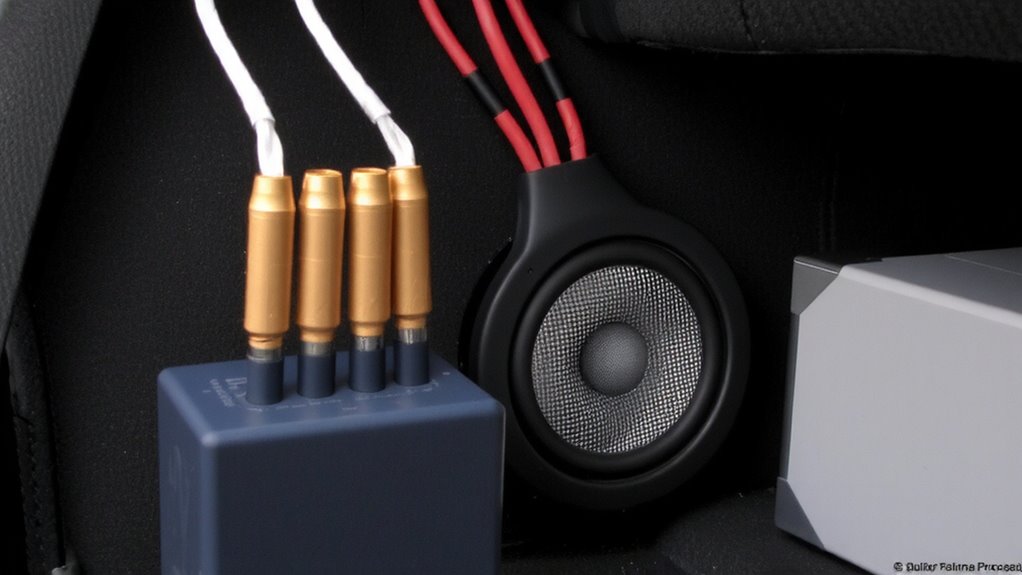
Most factory JBL audio systems in vehicles use 4-ohm impedance speakers, so you’ll want to match that spec exactly when picking aftermarket replacements. Using mismatched impedance can overload your amplifier or reduce sound quality. Aftermarket speakers must also closely align with the factory system’s speaker efficiency, typically ranging from 87 to 92 dB, to guarantee consistent volume output. A lower-efficiency speaker will seem quieter, even with the same power input. Frequency response should mirror original specs-usually 50 Hz to 20 kHz-to maintain balanced audio across all ranges. If you choose drivers with narrower response, you’ll lose clarity in highs or bass. Don’t assume higher numbers mean better performance; focus instead on matching OEM behavior. Proper impedance, speaker efficiency, and frequency response prevent distortion and preserve system integrity.
Preserve JBL’s DSP Tuning With Compatible Speakers
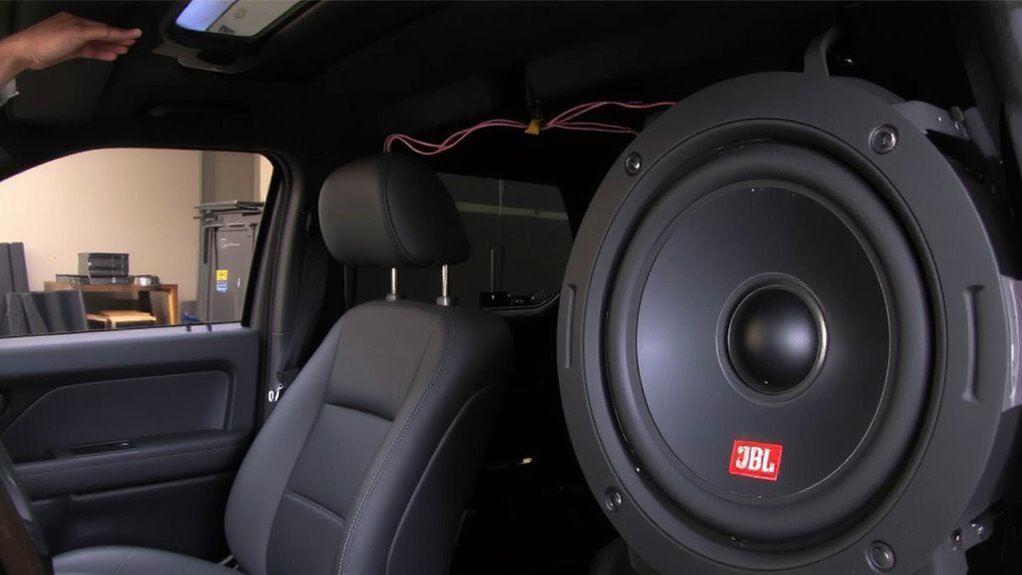
You’ve matched your aftermarket speakers’ impedance, efficiency, and frequency response to the factory JBL specs-now it’s time to protect the system’s built-in digital signal processing, or DSP. Preserving signal integrity is critical; the factory DSP applies precise equalization, time alignment, and crossover settings calibrated for stock components. If your new speakers don’t respond to these signals as expected, audio fidelity suffers drastically. Choose speakers explicitly designed to maintain compatibility with JBL’s DSP tuning, such as those with matching phase response and sensitivity curves. Even minor deviations in driver behavior can distort timing and frequency outputs. Think of it like swapping one instrument in an orchestra-the sound only blends if the tone and timing stay true. Aftermarket models labeled “DSP-safe” or “factory-tuned” typically retain OEM performance standards. This guarantees the processed signal delivers accurate imaging, balanced staging, and uncompromised audio fidelity-just as JBL engineered it.
Use Factory Wiring to Connect New Speakers
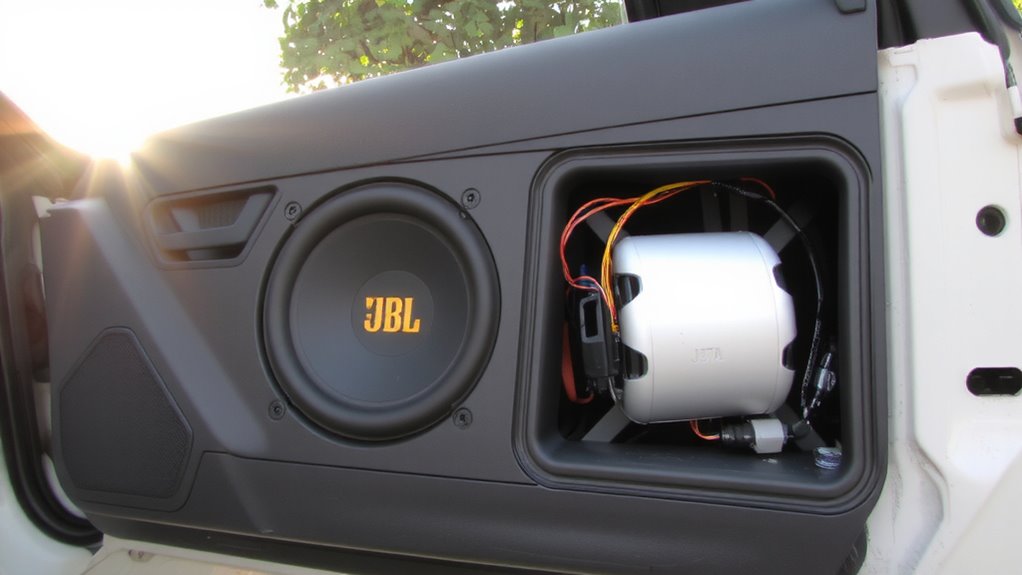
Since the factory wiring harness is already calibrated to deliver the correct voltage and signal integrity to each speaker location, you’ll want to retain it instead of splicing directly into the wires. Use a harness adapter to bridge the factory connector to your new speakers without cutting or modifying the original harness. This maintains factory signal quality and simplifies reversibility. Match speaker polarity carefully-connect positive (+) terminals to the harness’s positive wire (usually marked with a stripe or symbol) and negative (–) to negative. Reversing polarity reduces bass response and creates phase issues that degrade sound staging. Factory wiring harness color codes vary by model, so consult your vehicle’s service manual. Most JBL systems run 50–100 watts RMS per channel, so verify your new speakers can handle the output. Proper polarity and harness use guarantee maximum performance and protect amplifier circuitry.
Remove Door Panels on JBL-Equipped Vehicles Safely
Begin by powering down the vehicle and disconnecting the negative terminal of the battery to prevent electrical shorts, especially since JBL systems operate with amplified signals that can surge during panel removal. Door removal requires care to avoid damaging integrated wiring harnesses or the amplifier module. Start at the door’s lower edge, using a plastic trim tool to gently release panel clips spaced every 4–6 inches. These plastic fasteners snap into metal retainers and can break if pried too aggressively. Most JBL-equipped doors use a combination of push-pin clips and screw fasteners near the handle and armrest. Remove visible screws first. Lift the panel upward once all clips are released, angling it slightly to disengage the window channel. Always support the panel’s weight to prevent wire strain. Handle wiring connectors with care, noting JBL’s shielding and twisted-pair signal lines.
Install Speakers Without Damaging JBL Amplifier Signal
When replacing speakers in a vehicle with a factory JBL system, protecting the amplifier’s sensitive output signals is critical to maintaining sound quality and preventing damage. Factory JBL amplifiers deliver precise power-usually 35–55 watts RMS per channel-and are tuned to specific speaker impedances. Using mismatched speakers can cause amplifier overload or signal interference. Always select 4-ohm speakers with a power handling range of 40–60 watts RMS to stay within factory specs. Guarantee wiring is gauge-appropriate (16–18 AWG) and avoid coiling excess leads, which can create electromagnetic loops and induce signal interference.
| Factor | Risk | Prevention |
|---|---|---|
| Impedance mismatch | Amplifier overload | Use 4-ohm speakers |
| Poor grounding | Signal interference | Secure ground to clean metal |
| Parallel wiring | Over-current | Avoid combining speaker wires |
Test and Balance Sound Through the Factory Head Unit
How do you guarantee your new speakers deliver peak performance without compromising the factory JBL system’s tuning? Use the factory head unit to test and balance sound precisely. Start by playing tracks with wide frequency response, like classical or jazz, to evaluate clarity across highs, mids, and lows. Adjust fade and balance controls to fine-tune sound staging, making sure audio appears to come from in front of you, not inside your head. A well-centered image improves realism and driver focus. Use built-in EQ settings conservatively-small changes let you match new speakers to the JBL system’s calibrated output. Avoid boosting frequencies beyond +3 dB to prevent distortion. Confirm consistent output levels across channels using an SPL meter at ear level. The factory system expects specific signal ranges; staying within them preserves audio integrity. Proper testing makes certain seamless integration, best sound staging, and accurate frequency response.
Avoid Common JBL System Mistakes When Upgrading
More than half of all upgrades to factory JBL audio systems fail to deliver expected performance due to avoidable technical errors. You must address ground loop issues, which cause humming noises by creating multiple grounding paths. Always use a single, clean chassis ground point near the amplifier or head unit. Isolate power and signal grounds to prevent interference. Signal phase alignment is equally critical-misaligned speakers cancel bass and distort imaging. Verify that all speakers move in and out together by checking polarity with a 1.5V battery test. Factory crossovers expect specific impedance; replace speakers only with 4-ohm models to maintain compatibility. Never bypass JBL’s active equalization without re-tuning. Use multimeters and oscilloscopes to validate connections. Avoid daisy-chaining grounds. These precise steps guarantee system coherence and prevent damage.
On a final note
You must match aftermarket speakers to the factory JBL system’s 4-ohm impedance to prevent amplifier strain. Keep DSP tuning intact by selecting speakers with similar frequency response-typically 50 Hz to 20 kHz. Use factory wiring harnesses for seamless integration; they deliver 45 watts RMS per channel. Avoid cutting wires or bypassing the OEM amp. Test all channels through the head unit, balancing front-to-rear output. Proper installation preserves sound staging and system integrity.